
That shift solves real headaches: unstructured parts arriving in random orientations, quality inspection that varies shift to shift, and expensive changeovers on mixed production lines. A robot that can "see" doesn't need every part fed the exact same way, every time.
This guide covers what robot vision actually is, how the technology works, the different system types available, real manufacturing applications, what these systems cost, and what's changing heading into 2026.
Key Takeaways
- Robot vision lets robots identify and adapt to parts instead of relying on fixed coordinates
- 2D vision handles flat, well-lit inspection tasks; 3D vision manages depth, bin picking, and palletizing
- AI-assisted vision shortens programming and deployment from weeks toward days
- Budget around camera type, integration complexity, and application scope—not hardware alone
What Is a Robot Vision System?
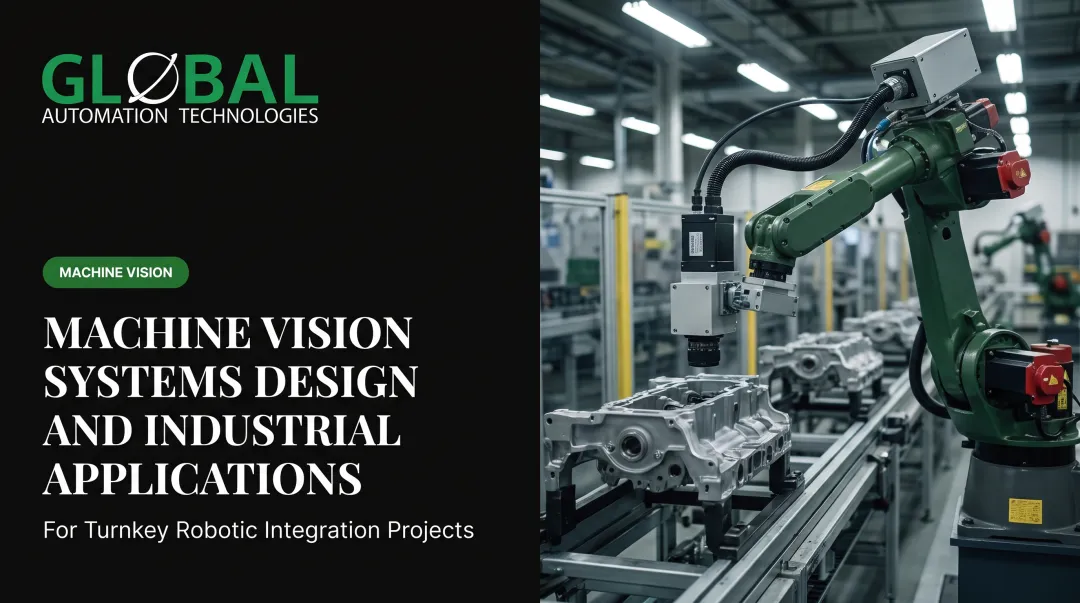
A robot vision system is an imaging-based sensing setup, mounted on or near a robot, that lets the machine recognize shapes, positions, and defects in real time. FANUC describes its own iRVision platform as a fully integrated visual-detection system that runs through the robot controller itself, with no separate PC or side cabinet required.
Before vision existed, robots operated purely on pre-taught coordinates. Every part had to arrive in a precise, fixed position. That meant custom fixturing, tight tolerances on incoming parts, and zero tolerance for variation. Miss the alignment by a few millimeters, and the robot missed the pick.
Do robots have vision? Not inherently. A robot arm has no built-in sense of sight. Vision is a layer added on top:
- Cameras and optics to capture the scene
- Lighting so part features stay readable
- Processing software that feeds position and defect data into the controller
ABB's integrated vision approach connects cameras, image capture, and robot programming through one system, giving the arm "eyes" it didn't come with.
The camera captures an image. Software processes it. The robot moves based on what it finds. That's the entire premise.
How Robot Vision Systems Work
Every vision-guided robot cell relies on the same core stack:
- Camera/sensor — captures 2D images or 3D depth maps
- Lighting — controls shadows, glare, and contrast
- Optics — lenses that determine field of view and resolution
- Image processing software — analyzes what the camera sees
- Robot controller integration — translates image data into movement
The Capture-to-Action Workflow
The process runs in a consistent sequence:
- Capture — camera records the scene
- Analyze — software detects edges, features, or defects
- Compare — the image is matched against a trained model
- Translate — pixel coordinates convert to robot coordinates
- Act — the robot picks, places, tends, or verifies

Calibration is what keeps that sequence accurate. It maps image pixels to real-world robot coordinates and corrects lens distortion.
According to Keyence, calibration drift from camera movement or lighting changes can shift pick points and force rework. That risk is why auto-calibration tools now matter as much as the camera hardware itself.
Where AI Fits In
Once the hardware stack is calibrated, the system still needs a model of what “good” looks like. Traditional vision required extensive teaching: scanning a part from every angle and storing that model for comparison.
AI-based deep learning changes the load. Systems can recognize irregular or varied parts without retraining the full model from scratch, which is critical on high-mix production lines.
GLOBAL, a top-tier Level 5 FANUC Authorized System Integrator, uses AI-assisted simulation to model, test, and optimize robot programs before a single line of code runs on the plant floor. That approach has cut vision-guided programming timelines from weeks to days for some projects, reducing commissioning surprises before launch.
Types of Robot Vision Systems: 2D vs 3D vs AI-Enabled
Vision Sensor vs. Vision System
A vision sensor is a simpler device that captures one type of data—such as presence, position, or a barcode—for a pass/fail decision. A full vision system goes further: it actively guides robot motion based on what it sees.
2D Vision Systems
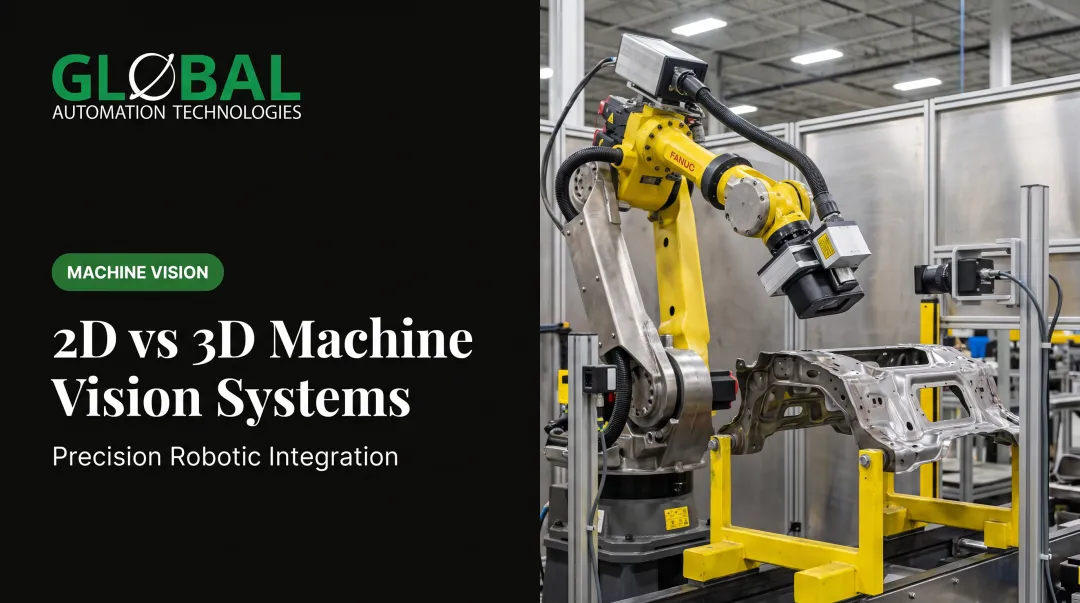
2D vision captures x-y information for flat, well-lit surfaces. Common uses:
- Barcode and QR code scanning
- Flat-part inspection
- Presence/absence checks
It's generally lower-cost and easier to configure than 3D, according to Keyence, making it the default choice when depth isn't a factor.
3D Vision Systems
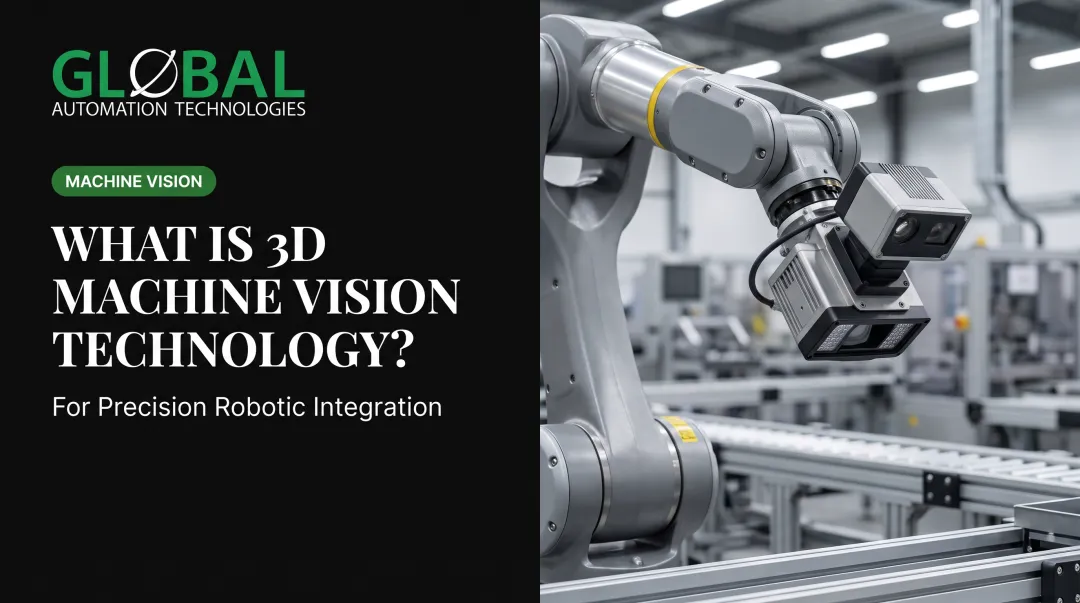
3D vision adds depth data, producing a point cloud instead of a flat image. That's essential for:
- Bin picking (random part orientation)
- Palletizing (variable box heights)
- Height-variable or stacked parts
The tradeoff is cost. 3D systems need more sensors, more processing power, and more setup complexity than 2D, but they unlock use cases 2D can't handle.

AI-Enabled Vision: The 2026 Outlook
AI isn't a replacement for 2D or 3D imaging. It's a software layer on top of either. Its value shows up most in cluttered scenes, inconsistent lighting, or parts with high visual variation, where rule-based vision alone starts to struggle. Industry reporting from A3's 2025 conference coverage confirms AI perception is now active in robot-guided material handling, assembly, and machine tending. Representative adoption percentages are not yet available.
| Type | Best for | Main tradeoff |
|---|---|---|
| 2D | Flat parts, codes, presence checks | No depth data |
| 3D | Bin picking, palletizing, stacked parts | Higher cost and setup |
| AI-enabled | High variation, clutter, uneven lighting | Needs training data and tuning |
How Robot Vision Systems Are Used in Manufacturing
Vision-guided robots are used across five core application areas: bin picking, quality inspection, machine tending, painting/coating, and sorting/traceability.
Bin Picking and Material Handling
3D vision lets robots grab randomly oriented parts directly from bins, no custom feeders or precise part alignment required. This cuts tooling costs and gives lines flexibility to handle multiple part numbers without hardware changes.
Quality Inspection and Defect Detection
Vision systems catch defects in real time, before parts move downstream. GLOBAL's dispensing applications use real-time bead validation that checks:
- Bead width — flags thin or off-spec application
- Bead placement — confirms material lands on the programmed path
- Bead continuity — catches missed sections before they reach the next station
Vision also handles orientation and count checks before parts leave the cell. FANUC's 2026 BelleFlex case study reports a 10x increase in production volume on a cell using vision for those verification steps.

Machine Tending
Vision helps robots locate and load parts into CNC machines without fixed positioning. That supports faster changeovers between part numbers and unattended overnight runs. GLOBAL's machine-tending cells typically pay for themselves in 12 to 18 months, driven by higher spindle utilization and extended unattended operation.
Robotic Painting and Coating
Vision guides spray robots to each part's actual position and orientation so film build stays consistent even when fixtures vary. GLOBAL's robotic paint systems hold film build within specification, cutting overspray and material waste across Class A automotive parts, industrial coatings, and composites.
Sorting, Palletizing, and Traceability
Barcode and QR-based vision supports real-time sorting and pallet-building decisions. FANUC's RIG palletizing system, for example, uses integrated vision to identify box sizes and correct misalignment on the fly, supporting throughput of 6+ picks per minute.
Example of a Robot Vision System in Action
Bin picking: A robot arm with a mounted 3D camera scans a bin of randomly placed components. The system generates a point cloud, calculates grip coordinates for the topmost accessible part, and places it onto a conveyor or fixture. No structured feeding, no manual sorting.
Machine tending: In automotive manufacturing, a vision-guided robot tends a machining cell. When part dimensions shift slightly from batch to batch, the camera detects the variation. The robot adjusts its grip and placement without an operator stepping in.
The same approach scales across real production lines. GLOBAL's vision-guided handling systems use FANUC iRVision and 3D area sensors for these applications, locating parts that arrive in random positions from bins, racks, or conveyors.
Cost of Robot Vision Systems in 2026
How much does a robot vision camera cost? Price depends on system type and integration scope—there is no single number. Cost drivers break down like this:
- 2D systems cost less upfront and are simpler to configure
- 3D and AI-guided systems need a larger upfront investment for sensors, compute, and algorithms
- Integration, lighting, and software licensing often add more to total project cost than the camera itself
ROI depends on application complexity rather than camera price alone. GLOBAL's benchmark: machine tending cells typically pay for themselves in 12 to 18 months, driven largely by labor redeployment and higher uptime.
Costs are still trending down as AI shortens model training time and hardware standardizes across vendors—a shift expected to hold through 2026.
Choosing the Right Robot Vision Partner for 2026
Not every integrator can carry a project from concept to production floor. Prioritize partners who bring:
- Turnkey capability spanning layout, design, programming, validation, and ongoing support under one roof
- Cross-industry experience, with automotive-proven solutions that transfer to aerospace, heavy industry, and data center manufacturing
- Fluency with ISO 10218 and ANSI/A3 R15.06 safety standards, not just a sales pitch
GLOBAL pairs automation solutions, services and technical staffing. That means a manufacturer scaling vision-guided automation gets both the cell itself and the engineers who can run it, rather than needing to source talent separately after commissioning.
Frequently Asked Questions
How much does a robot vision camera cost?
Costs vary by system type: 2D sensors are generally cheaper and simpler, while 3D and AI-guided systems cost more due to added hardware and processing needs. Integration, lighting, and software licensing all add to total project cost.
How are robot vision systems used?
Common uses include quality inspection, bin picking, machine tending, robotic painting, and sorting or palletizing. Each application uses vision differently, from defect detection to guiding random-part pickup.
What does a vision sensor do?
A vision sensor captures one type of data—presence, position, or a barcode—for simple pass/fail decisions. A full vision system goes further, actively guiding robot motion based on what it sees.
What is a robot vision system?
It's an imaging-based sensing system mounted on or near a robot. It recognizes shapes, positions, and defects in real time and feeds that data to the robot controller to guide movement.
Do robots have vision?
Not inherently. Robots have no built-in sense of sight. Vision is an added layer of cameras, sensors, and software connected to the robot controller.
Can you give an example of a robot vision system?
A common example: a robot with a mounted 3D camera identifies randomly placed parts in a bin, calculates grip coordinates, and places them onto a conveyor—no manual sorting needed.