
Introduction
Robotic welding isn't a novelty anymore. It's the backbone of automotive body shops, heavy equipment frame lines, and metal fabrication plants running millions of welds every day across the globe.
The numbers back this up. The global robotic welding market hit $8.10 billion in 2025 and is projected to reach $27.90 billion by 2034, growing at a 15.20% CAGR.
But here's where buyers get tripped up: they picture a robot arm and assume that's the whole system. It's not. A welding robot is one component inside a much larger "cell", and confusing the two leads to blown budgets, missed lead times, and ROI math that never adds up.
This guide breaks down exactly how robotic welding works, stage by stage, and what actually makes up a robot welding cell.
TL;DR
- Robotic welding automates arc, spot, TIG, MIG, laser, and plasma processes using a programmable robotic arm
- A "welding cell" is the full system (robot, power source, fixturing, safety guarding, and controls), not just the arm
- The process runs through four stages: initiation, core operation, quality regulation, and output
- Best fit for high-volume, repetitive joins in automotive, heavy equipment, and general fabrication
- Turnkey integrators combine design, programming, and validation to cut startup time and commissioning risk
What Is Robotic Welding?
Robotic welding is an automated process where a programmable industrial robot performs both the weld and the part handling, guided by pre-programmed paths, machine vision, or a mix of both.
That second part matters. A fixed automated welding gun that still requires a human to load and position parts isn't true robotic welding. It's a semi-automated station. Real robotic welding removes the manual handling step entirely.
Why It Exists
Manual welding has three built-in problems: inconsistency, fatigue, and safety risk. A welder's hand tires after hours on the line, quality drifts, and prolonged exposure to fumes and arc flash adds real risk. Robots don't get tired.
The technology traces back to automotive spot welding from the late 1960s through the 1980s, when manufacturers first needed a way to produce identical welds at volume without relying on human endurance.
Manual welding hasn't disappeared, though. Skilled welders still handle:
- One-off fabrication jobs
- Complex geometries robots can't easily adapt to
- Field repairs where a cell simply can't be deployed
Main Robotic Welding Processes
Different jobs call for different heat sources and precision levels:
- MIG/GMAW: Consumable wire electrode feeds continuously through a shielding gas; fast, versatile, common on production lines
- TIG/GTAW: Non-consumable tungsten electrode; slower but far more precise, suited to detailed or delicate work
- Resistance/spot: Two electrodes clamp sheets and pass current through them, melting metal locally — the classic automotive body-weld method
- Laser: A focused beam fuses seams with high precision and can produce deep, narrow welds on thicker stock
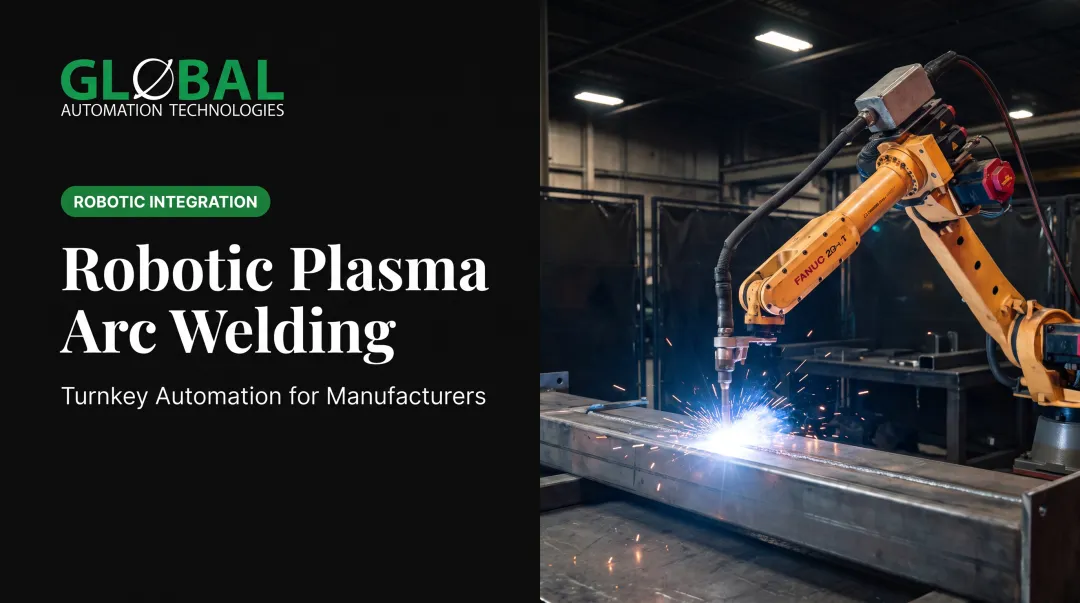
- Plasma: A constricted arc delivers higher speed and deeper penetration than TIG, often applied to sheet and components up to roughly 8 mm
What Is a Robot Welding Cell?
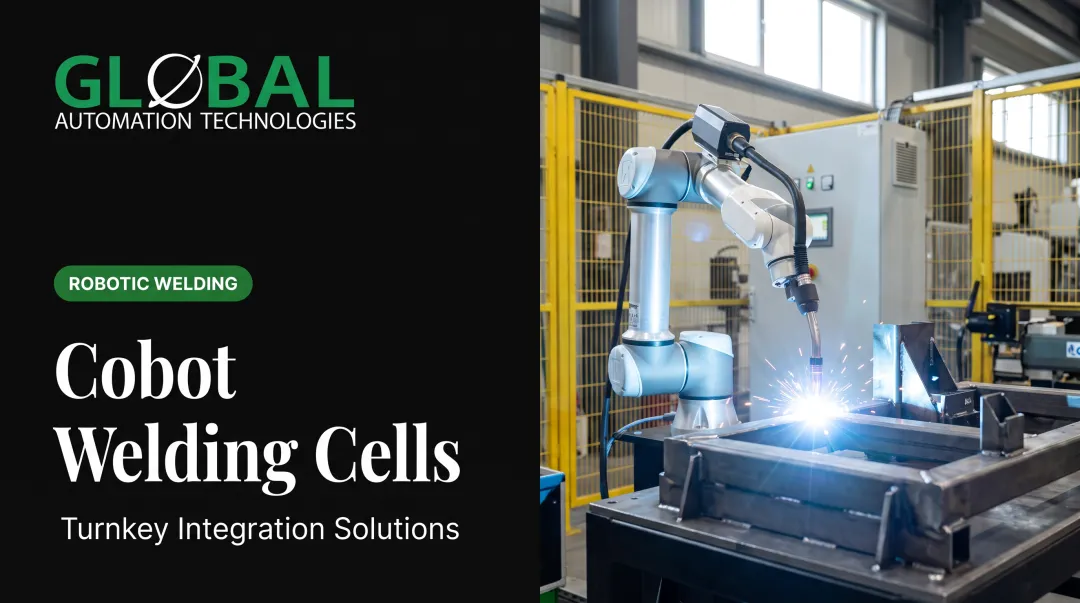
Here's the distinction that trips up most first-time buyers: the robot is not the cell. A robot welding cell is the complete, self-contained work environment built around that arm, engineered to produce welds safely, repeatably, and at production speed.
Core Components
A functioning cell typically includes:
- Robotic manipulator and controller: the arm and its brain
- Welding power source and wire feeder: delivers and regulates current and wire for the chosen process
- Torch or end-of-arm tooling: the business end that strikes the arc
- Part-specific fixturing or positioners: holds and rotates the workpiece for consistent access

The Safety Layer
Because these cells run at production speed, often beyond a single shift between scheduled maintenance windows, they need containment:
- Perimeter fencing
- Light curtains
- Arc shields
- Interlocks that stop the system the instant a barrier is breached
This layer is what allows a cell to run multi-shift without a human standing next to it the entire time.
Parts reach the weld position one of three ways: manual load/unload, conveyor feed, or a dedicated tending robot. Each choice directly affects cycle time and how much throughput the cell can sustain.
Cell Design Determines Outcomes, Not Robot Brand Alone
Procurement talks often fixate on the robot brand. In practice, layout, reach, fixturing accuracy, and programming quality drive weld quality and uptime more than the logo on the arm.
Configurations vary widely, too. A single-robot arc welding cell for a fabrication shop looks nothing like a multi-robot spot welding line with dedicated positioners handling a full automotive body assembly.
That is why turnkey integrators like GLOBAL Automation Technologies design, build, program, validate, and commission complete welding cells as one deliverable. Many of those cells are built around FANUC platforms, so the customer is not left integrating a bare arm alone.
How Does Robotic Welding Work?
Regardless of process — MIG, TIG, spot, laser, or plasma — every robotic weld runs through the same four-stage sequence: initiation, core operation, quality regulation, and output.
Initiation
The sequence begins the moment a part is loaded, whether by hand, conveyor, or a tending robot. Once positioning is confirmed, the controller triggers the pre-programmed weld path.
Most industrial cells are programmed via teach pendant or offline simulation, not fully autonomous decision-making — though sensor-guided initiation is growing more common as vision systems get cheaper and more reliable.
The most common bottleneck at this stage? Fixture misalignment. If a part isn't presented in exactly the position the robot expects, weld quality suffers immediately. This is exactly why fixturing accuracy sits at the center of good cell design, not as an afterthought bolted on later.
Core Operation
This is where the actual joining happens. The robotic arm moves the torch or electrode along its programmed path while the power source delivers controlled heat or current to melt and fuse the base metals.
What's happening under the hood depends on the process:
- Continuous wire feeding for MIG/GMAW
- Arc formation and maintenance for TIG or plasma
- Resistance current flow for spot welding
Three variables govern weld performance here: travel speed, arc-on time, and torch angle.
Arc-on time is where robots pull dramatically ahead of manual welders. Human welders typically hold an arc-on percentage of just 5% to 20%, with most shops averaging 10% to 15% due to repositioning, fatigue, and setup breaks between welds. A robot doesn't need to stop and stretch.

Regulation and Control
Modern cells don't just execute a fixed path blindly. Seam tracking sensors, vision systems, and closed-loop feedback monitor the weld in progress and correct for part variation mid-weld — catching gaps or misalignment a rigid program would miss.
Two maintenance routines keep this running smoothly:
- Calibration cycles that confirm the torch is still tracking accurately
- Torch cleaning cycles that clear spatter buildup before it disrupts wire feed
AI-assisted simulation and offline programming tools are increasingly used to validate weld paths before a robot ever touches steel. That shrinks the trial-and-error loop that used to eat up floor time. GLOBAL Automation Technologies, a top-tier Level 5 FANUC Authorized System Integrator, applies AI-assisted simulation in the programming phase to compress that timeline, modeling and testing the weld path digitally before commissioning begins.
Output and Result
The end goal: a dimensionally consistent weld meeting defined strength and appearance standards, every time, without a human double-checking each one.
That consistency has a direct downstream effect. Parts move straight to inspection, coating, or final assembly instead of looping back for rework.
The scale of that impact shows up in real installations. FANUC reports that when Trantech Radiator Products switched from brazing to robotic MIG welding, the company saw 50% to 80% fewer repairs and roughly 30% higher throughput. That's what consistent output actually buys a manufacturer — not just cleaner welds, but fewer bottlenecks everywhere downstream.
Where Are Robotic Welding Systems Used?
Robotic welding tends to concentrate at three points in a production line:
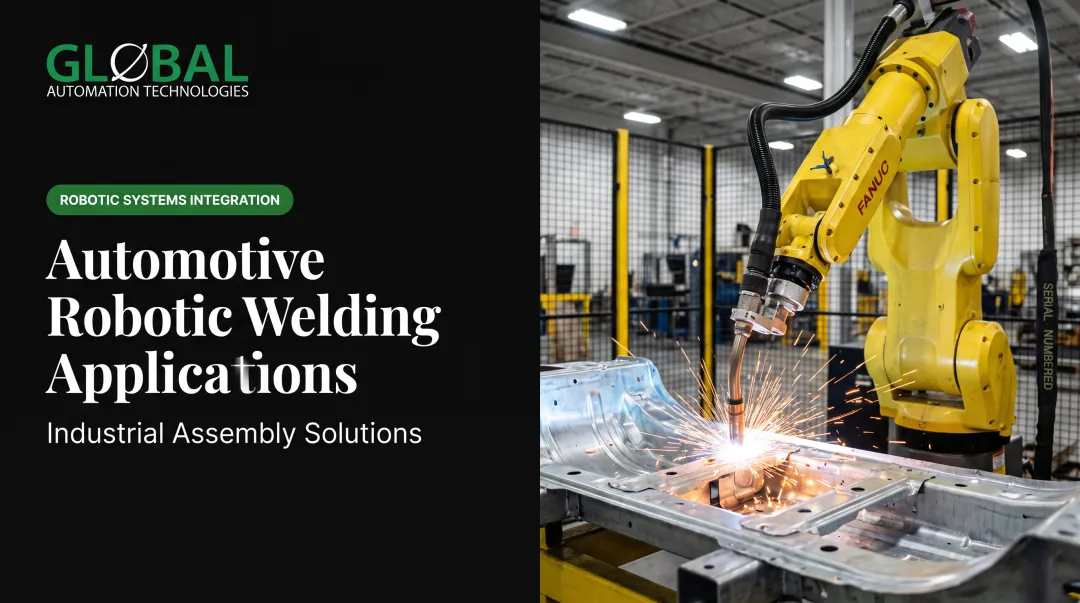
- Body-in-white assembly: spot and arc welding the vehicle shell before paint
- Chassis and frame fabrication: joining structural rails and cross members
- Sub-component joining: brackets, suspension parts, and smaller assemblies before final assembly
Where It Performs Best
Robotic welding isn't the right fit for every job. It excels under specific conditions:
- High part volume that justifies programming and fixturing investment
- Repeatable geometry, part after part
- Multi-shift operation where consistency over hours (not just minutes) matters
Industry Variations
How cells are built depends on the product and the plant.
Automotive OEMs and Tier 1 suppliers lean heavily on spot and arc welding cells for body assembly. FANUC's R-2000 robots, for instance, spot weld Cadillac CT6 bodies on high-volume lines.
Heavy equipment and commercial vehicle manufacturers take a different approach. They use larger-format arc welding cells with external axes to handle oversized frames and structural components that dwarf a typical car chassis.
Conclusion
The value in robotic welding comes from pairing a capable robot with a well-engineered cell. Fixturing, controls, and safety systems carry just as much weight as the manipulator itself.
A smart buying decision reflects that reality. Evaluate the full cell and the integrator behind it, not just robot spec sheets side by side.
Frequently Asked Questions
What is the difference between a robot and a robotic welding cell?
The robot is the manipulator arm. The cell is the full production system — power source, fixturing, safety guarding, and controls — required to deliver production-ready welds.
How much does a robotic welding cell cost?
Cost depends on robot count, welding process, fixturing complexity, and automation level, so ranges span widely from simpler single-robot cells to multi-robot turnkey lines. An integrator quote is the reliable way to price a complete system for your parts and volume.
Is robotic welding better than manual welding?
Robotic welding wins on speed, consistency, and safety for repetitive, high-volume work. Manual welding remains better suited to one-off, complex, or field-repair jobs.
What types of robots are used for welding?
Most welding cells use six-axis articulated industrial robots, commonly from brands like FANUC, ABB, and Yaskawa, chosen for their reach and precision.
How long does it take to install and commission a robotic welding cell?
Timelines depend on part complexity, fixturing, and production volume. AI-assisted simulation and offline programming can cut startup from weeks to days versus teach-pendant-only methods.
Can robotic welding cells handle small batch or custom production?
Yes. Flexible cells with vision-guided programming and quick-change fixturing can support smaller batches, though ROI is strongest at higher production volumes.