
That's the job of material handling equipment. Get it wrong, and takt time slips, labor costs balloon, and safety incidents climb. Get it right, and it becomes one of the quietest competitive advantages on the plant floor.
This article breaks down the equipment types automotive plants rely on, the biggest operational challenges, how automation and AI are changing deployment timelines, and what to look for in an automation partner.
Key Takeaways
- Automotive plants need four material handling system types working together: transport, positioning, storage, and unit-load
- Collaborative robot installations typically pay back in 12-24 months
- Legacy infrastructure integration and safety compliance rank among the top challenges automakers face
- AI-assisted simulation and predictive maintenance cut deployment timelines and unplanned downtime
What Is Automotive Material Handling Equipment?
Automotive material handling equipment is the machinery that moves, positions, stores, and protects parts, tools, and vehicle bodies as they travel through assembly. That covers everything from a simple push cart to a fully automated, vision-guided robotic cell.
Automotive plants demand more from this equipment than a typical warehouse does. Just-in-time delivery and build-order sequencing mean parts must arrive at the exact station, in the exact order, at the exact second the line needs them. A late tote or misplaced bin can stall an entire line, not just one station.
Equipment falls into three tiers:
- Manual: carts, hand trucks, and gravity-fed racks for short moves
- Semi-automated: forklifts, hoists, and powered conveyors for repetitive transfer
- Fully automated: AGVs, AMRs, and vision-guided robotic cells for high-volume flow
Most plants run all three simultaneously, matched to the risk and repetition level of each task.

Core Types of Automotive Material Handling Equipment
The Material Handling Industry's CICMHE taxonomy groups equipment into five categories, though four matter most on the automotive plant floor.
Transport Equipment
Conveyors, cranes, industrial trucks, and increasingly AGVs and AMRs handle dock-to-line and station-to-station moves. In one documented automotive AGV deployment, 36 AGVs across two flagship sites achieved a 98% mission success rate running 24/7 across more than 200 routes.
Positioning Equipment
Hoists, manipulators, and industrial robots place parts precisely, tend machines, and remove operators from repetitive lifting. This is where ergonomic risk drops fastest.
Storage Equipment
Racks, bins, and automated storage/retrieval systems (AS/RS) buffer inventory and feed production cells with real-time visibility into what's on hand and what's running low.
Unit Load and Engineered Systems
Pallets, tote systems, and fully engineered robotic cells combine multiple functions (pick, transfer, palletize) into one automated workflow.

Robotic machine tending is a prime example. Loading and unloading CNC machines, presses, and injection-molding equipment automatically pushes spindle utilization toward round-the-clock operation. GLOBAL Automation Technologies, a FANUC-based systems integrator, notes that machine-tending cells typically pay for themselves in 12-18 months through reduced labor hours and higher parts-per-shift output.
Robotic Systems vs. Traditional Equipment
Traditional forklifts and manual carts still have a place, particularly for low-frequency or highly variable moves. But for repetitive, high-volume transfers, robotic and AGV-based systems generally outperform on three fronts:
| Factor | Manual/Forklift | Robotic/AGV |
|---|---|---|
| Speed consistency | Varies by operator | Fixed cycle time |
| Labor dependency | High | Low, redeployable |
| Safety exposure | Operator-dependent | Reduced hazardous contact |
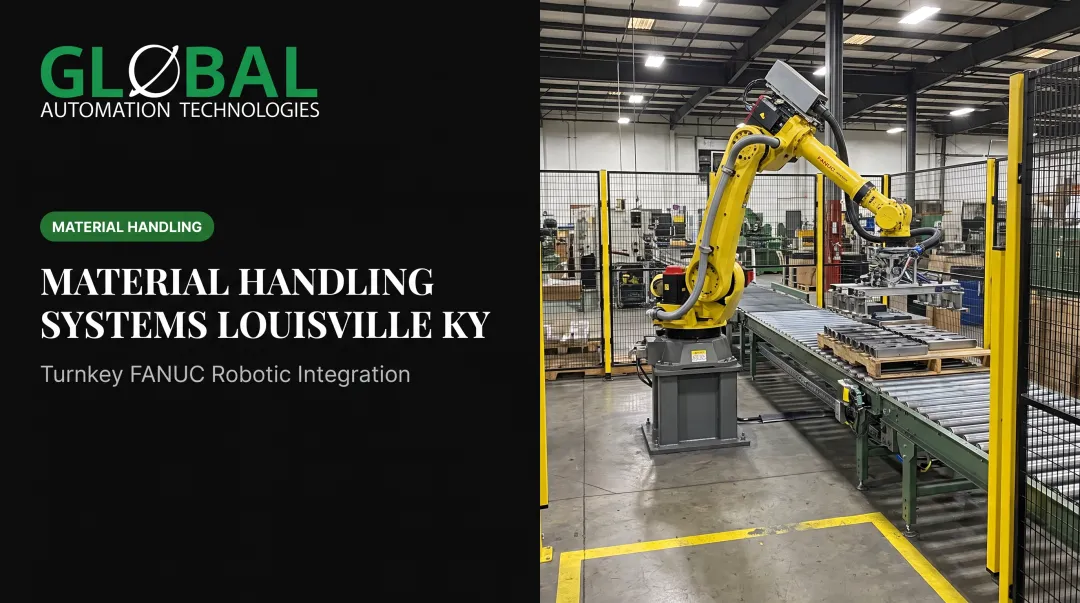
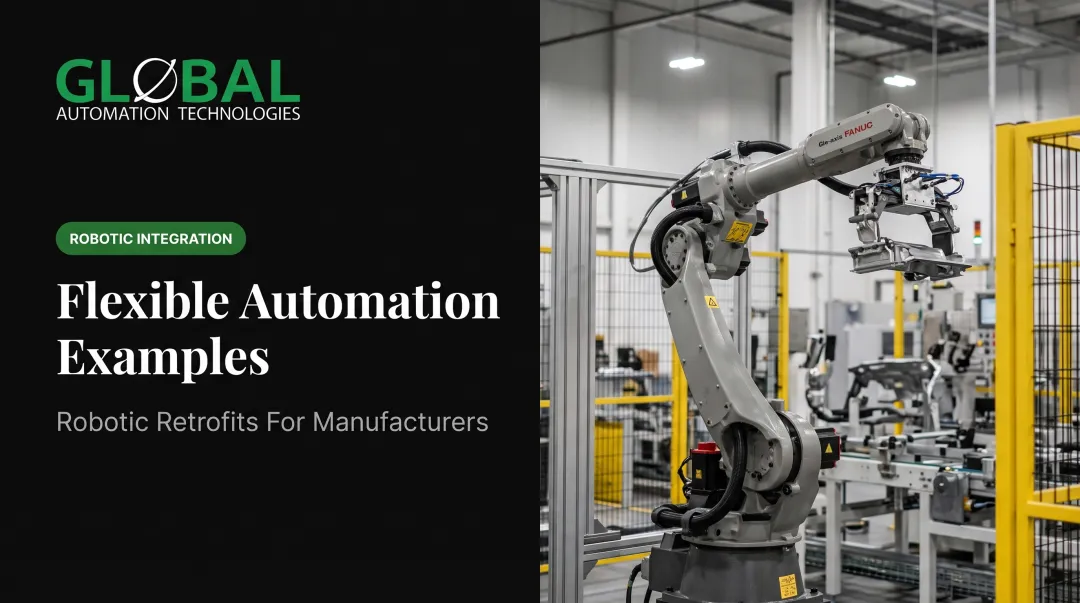
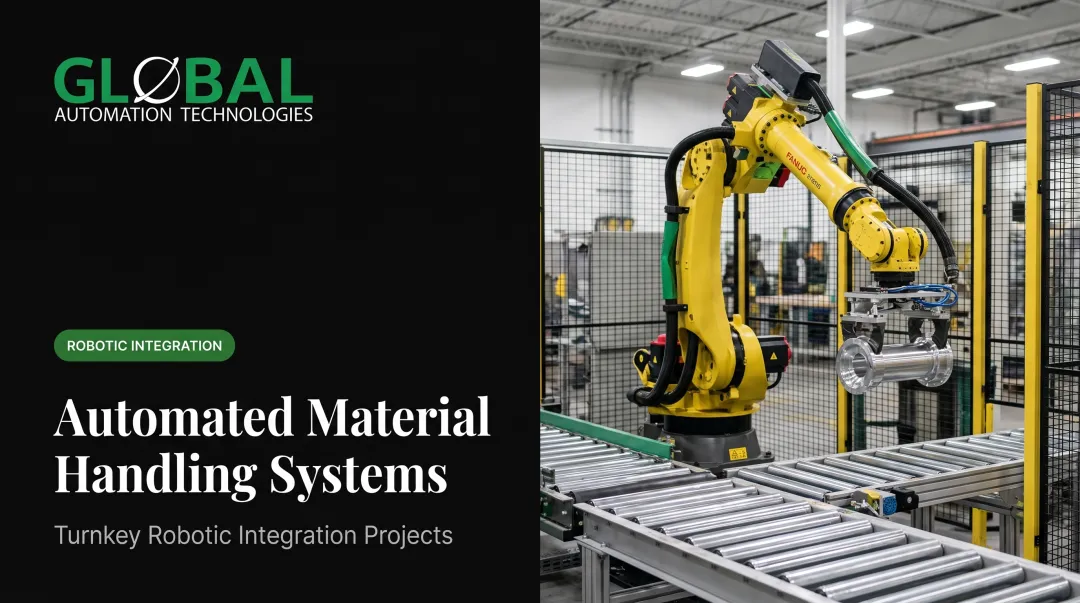
FANUC-based robotic systems are built for the precision and hazardous-environment demands of automotive plants. They handle bin picking, conveyor-synchronized part transfer, and similar work without the fatigue or variability of a human operator.
Biggest Challenges in Automotive Material Handling
Automotive plants face a specific set of pressures that generic manufacturing doesn't.
Part-volume complexity. Gas, hybrid, and EV variants running down the same line multiply the SKUs a handling system must track. Just-in-time sequencing has to stay accurate even as build orders shift daily.
Legacy infrastructure. Aging PLCs and MES systems weren't designed for modern robotic cells. Retrofits require careful assessment of existing controls before new equipment goes in—rushing this step is where most integration headaches start.
Safety and compliance. Automotive material handling operates under several overlapping frameworks:
- OSHA 29 CFR 1910.178 — powered industrial truck operation and training rules
- ANSI/ITSDF B56.1-2020 — design and operation standard for lift trucks
- ISO 45001:2018 — organization-wide occupational health and safety management
Meeting all three while holding takt time is a constant balancing act.

Clear those constraints and the returns show up fast. A peer-reviewed 2024 automotive logistics study found 72% modeled productivity potential from automated material handling adoption, with one AGV deployment calculating an eight-month payback against manual staffing costs, according to research published in the journal Sensors.
How Automation and AI Are Transforming Material Handling
On the plant floor, AI compresses the time between concept and commissioning. Engineers still own the work; the tools just get them there faster.
Faster Programming Through Simulation
AI-assisted simulation lets engineers model, test, and optimize robot programs before a single line of code runs on the actual floor. GLOBAL reports this approach has cut robot programming time from weeks to days, reducing surprises during startup and shortening the path from design to production.
Predictive Maintenance
Instead of waiting for a conveyor motor or robot joint to fail mid-shift, AI-driven health assessments flag equipment issues early. Those early flags protect uptime and the maintenance budget by catching small problems before they turn into expensive failures.
Connectivity and Digital Twins
Modern plants are layering in:
- SCADA/MES integration for real-time diagnostics
- Digital twins that simulate material flow before physical installation
- 360-degree visibility across the equipment fleet
BMW's Virtual Factory now spans more than 30 production sites. The company projects up to 30% lower production-planning costs, and virtual collision checks take three days versus nearly four weeks of physical testing, according to BMW Group's 2025 announcement.
Gains like these are showing up more broadly. Deloitte's 2025 survey of 600 executives links smart-manufacturing adoption to 10-20% higher production output and 7-20% higher employee productivity across surveyed manufacturers.

Choosing the Right Material Handling Automation Partner
Not every integrator offers the same depth of support. A few things separate a reliable long-term partner from a one-time equipment vendor.
Look for turnkey capability, not piecemeal equipment sales:
- Layout and design — built around part flow, floor space, and cycle-time requirements
- Build and programming — robot selection, tooling, fixtures, controls, PLC integration
- Validation and installation — simulation, testing, commissioning
- Ongoing support — training, documentation, and continued optimization
Automation solutions plus skilled talent. A robotic cell is only as good as the engineers who keep it running. This is where GLOBAL stands out. GLOBAL designs and builds the FANUC-based material handling system, and separately supplies controls engineers, robotics technicians, and project managers on a contract, contract-to-hire, or direct-placement basis.
For an OEM or Tier 1 supplier, one phone call gets both the system and the people to run it, rather than juggling a vendor and a separate staffing agency.
Check the track record. Years in operation, robots deployed, and countries served all signal reliability. GLOBAL, for instance, has operated for 17+ years, installed 700+ FANUC robots, and worked across 22 countries as a Level 5 FANUC Authorized System Integrator. Weigh those numbers against any partner's claims before you commit.
Frequently Asked Questions
What are the three types of material handling?
The three major categories are transport equipment, positioning equipment, and storage equipment. Some frameworks also add unit-load formation and identification/control systems.
What is the difference between an AGV and a forklift in automotive plants?
AGVs operate autonomously along programmed routes without a human operator, while forklifts require a licensed driver for every move. AGVs fit best on repetitive, high-frequency transfers where consistency matters most.
How long does it take to see ROI on robotic material handling equipment?
Most collaborative robot installations pay back within 12-24 months, depending on labor savings and application complexity. Some automotive AGV cases have shown payback in as little as eight months.
What safety standards apply to automotive material handling equipment?
Key frameworks include OSHA's 29 CFR 1910.178 for powered industrial trucks, ANSI/ITSDF B56.1-2020 for lift truck design and operation, and ISO 45001:2018 for occupational health and safety management systems.
Can robotic material handling be integrated with existing plant infrastructure?
Yes, but it requires a careful assessment of legacy PLCs and MES systems first. Most integrations work best as phased rollouts rather than a single plant-wide switchover.
What industries besides automotive use similar material handling automation?
Heavy equipment manufacturers, aerospace producers, and data center infrastructure builders all rely on comparable robotic handling solutions for machine tending, part transfer, and precision positioning.