
Introduction
Ecommerce orders keep climbing, warehouse labor keeps getting harder to find, and customers now expect same-day delivery as a baseline, not a bonus. Many operations struggle to keep pace with these three pressures at once.
That's why material handling systems now serve as mission-critical infrastructure. The right mix of conveyors, robotics, and software decides whether a warehouse hits throughput targets or misses fulfillment promises.
Warehouse automation spending reflects the shift. McKinsey projects the warehouse-automation market will reach $51 billion by 2030, growing at a 23% compound annual rate.
This article ranks the 10 material handling systems driving that growth today.
TL;DR
- Material handling spans manual, motorized, and automated systems—match the category to warehouse size and volume
- Prioritize SKU count, order volume, labor availability, and layout over budget alone
- Top options range from AS/RS and robotic picking to conveyors and WMS software
- Choose systems on reliability, scalability, integration capability, and proven ROI
Overview of Material Handling Systems in Modern Warehouses
Material handling systems are the equipment and technology used to move, store, protect, and control goods through receiving, storage, picking, and shipping. That spans everything from a basic pallet jack to a fully automated storage and retrieval system.
Modern warehouses rarely pick one extreme. Instead, they blend automation with human labor based on what each task requires. Roughly 20% of North American warehouses used some form of automation in 2024, with adoption projected to climb toward 25% by 2027 as facilities respond to labor shortages and rising volume expectations.
Choosing the right systems comes down to four factors:
- Reliability — can the system run consistently across shifts without excessive downtime?
- Throughput impact — does it measurably speed up receiving, picking, or shipping?
- Safety — does it reduce injury risk for workers operating near heavy equipment?
- Adaptability — can it scale as SKU count or order volume changes?

With those criteria in mind, here's how the top 10 systems stack up.
Top 10 Material Handling Systems for Modern Warehouses
This ranking reflects adoption rate, operational impact, scalability, and relevance across warehouse sizes and industries, not just novelty or hype.
1. Automated Storage and Retrieval Systems (AS/RS)
AS/RS uses stacker cranes, mini-load cranes, or pallet shuttles to automatically store and retrieve inventory within dense racking structures. It's the go-to solution when floor space runs out but volume keeps growing.
Vendor benchmarks show storage-density gains of 40% to 85% with inventory accuracy above 99.9%, and throughput exceeding 1,000 transactions per hour. Payback timelines vary by configuration. One 2025 Kardex customer survey found 80% of buyers hit ROI within 12 months, and a third within just three.
| Attribute | Detail |
|---|---|
| Best For | High SKU-count facilities needing vertical space optimization |
| Key Benefit | Maximizes storage density while cutting retrieval time |
| Typical Use Case | Cold storage, distribution centers, e-commerce fulfillment |
2. Conveyor Systems (Roller, Belt, Chain)
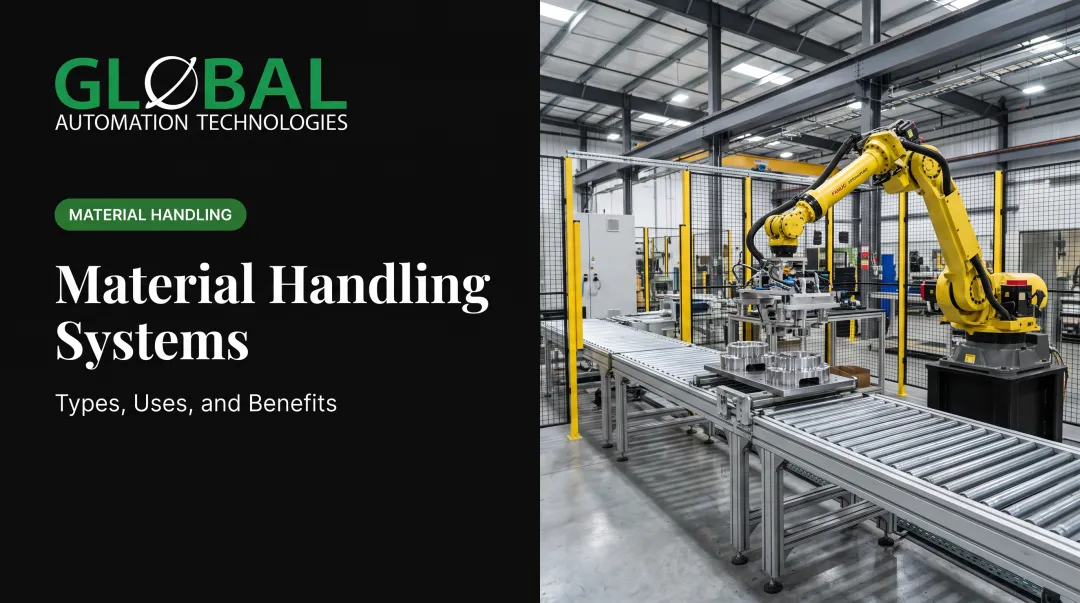
Conveyors physically connect receiving, storage, and shipping zones, keeping goods moving without manual carts or forklift trips. They're the connective tissue of most high-volume facilities.
What sets conveyors apart is low disruption to existing footprints combined with easy integration into sortation and WMS/WCS software. Oriental Trading's distribution center paired conveyors with sortation and voice picking to handle up to 400,000 items per day, cutting picker travel from 7-10 miles down to under one mile daily while raising accuracy to 99.9%.
| Attribute | Detail |
|---|---|
| Best For | High-volume facilities with repetitive, linear flows |
| Key Benefit | Reduces manual transport and speeds internal movement |
| Typical Use Case | Distribution centers, order consolidation lines |
3. Automated Guided Vehicles (AGVs)
AGVs follow fixed, sensor-guided paths to move pallets and carts between set points. They suit repetitive transport where routes stay consistent and on-the-fly rerouting isn't required.
Because they run prescribed routes, AGVs deliver predictable, safe performance in structured environments with little reprogramming after install. Manufacturers use them for repeatable point-to-point transfers.
| Attribute | Detail |
|---|---|
| Best For | Facilities with fixed, repeatable transport routes |
| Key Benefit | Reduces labor costs on repetitive point-to-point moves |
| Typical Use Case | Manufacturing-to-warehouse transfers, pallet transport |
4. Autonomous Mobile Robots (AMRs)
Unlike AGVs, AMRs navigate using onboard sensors and mapping software, adjusting routes dynamically as obstacles or layouts change. They work alongside human pickers rather than requiring dedicated lanes.
This flexibility translates into faster deployment and easier scaling. Real-world results back it up: GEODIS improved picking rates from roughly 100 to 175-200 units per hour using mobile robots, while the mobile robot market itself is forecast to grow from under $5 billion in 2024 to $14 billion by 2030.
| Attribute | Detail |
|---|---|
| Best For | Dynamic, high-mix warehouses with changing layouts |
| Key Benefit | Cuts picker travel time via goods-to-person delivery |
| Typical Use Case | E-commerce fulfillment, retail distribution |
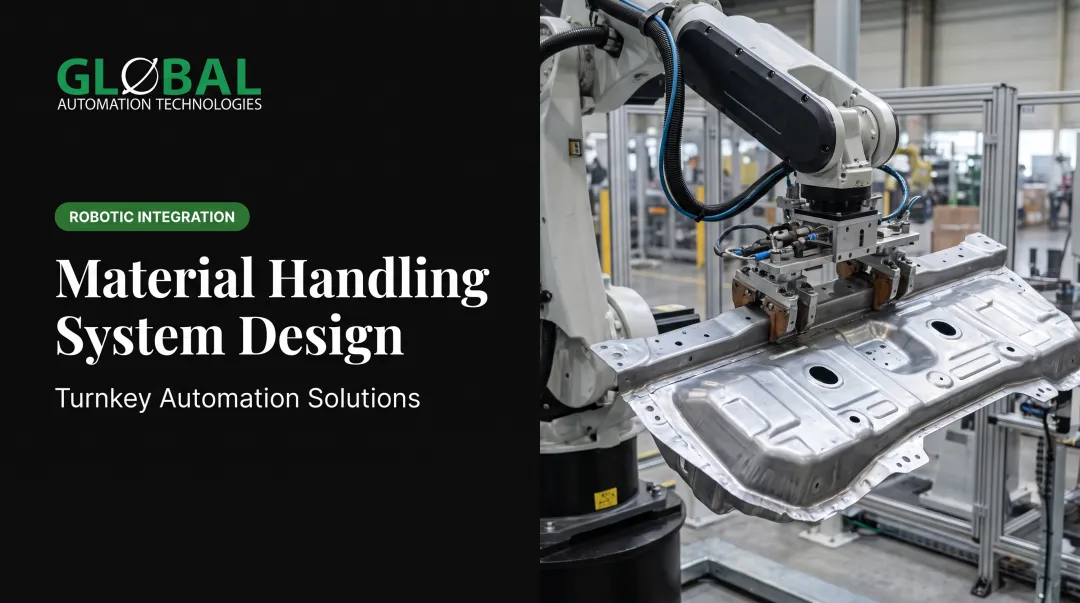
5. Robotic Material Handling & Picking Systems
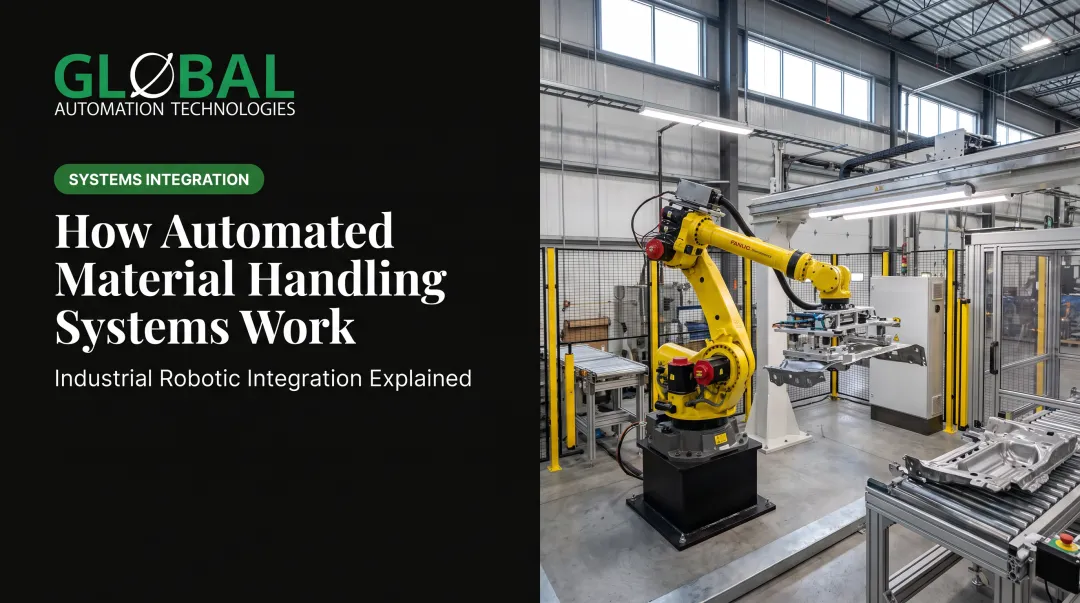
Robotic arms and palletizers handle case picking, palletizing, and machine tending tasks that used to require constant manual labor. Their role is expanding fast in warehouses tied directly to manufacturing operations, where product flows straight from production line to distribution.
GLOBAL Automation Technologies has spent 17+ years building these cells for automotive, general industry, and heavy equipment manufacturers. The work covers pick-and-place, palletizing, depalletizing, and vision-guided bin picking, primarily on FANUC platforms.
As a Level 5 FANUC Authorized System Integrator and #1 purchaser of FANUC robots among North American integrators in 2025, GLOBAL uses AI-assisted simulation to test robot programs digitally before deployment. That approach compresses robot programming timelines and catches reach or collision issues before equipment reaches the floor.
| Attribute | Detail |
|---|---|
| Best For | High-volume, repetitive palletizing or tending tasks |
| Key Benefit | Extends production beyond a single shift and improves throughput consistency |
| Typical Use Case | Manufacturing-linked warehouses, production-to-distribution handoffs |
6. Vertical Lift Modules (VLM) & Vertical Carousels
VLMs store small parts in trays within a compact vertical footprint, then present them to operators at ergonomic access points. One VLM can replace roughly 120 bays of static shelving, saving up to 85% of floor space.
The staffing efficiency can be striking. At Van Meter, four employees ran 18 VLMs across four zones — doubling picking throughput, cutting labor requirements 21%, and hitting 99.95% accuracy at an average of 65 lines per hour.
| Attribute | Detail |
|---|---|
| Best For | Small parts, high SKU density, limited floor space |
| Key Benefit | Increases storage density while improving pick ergonomics |
| Typical Use Case | Spare parts, electronics, pharma distribution |
7. Pallet Shuttle Systems
Motorized shuttles travel on rails inside racking channels, storing and retrieving pallets without requiring forklift access to every slot. Lanes can run up to 50 pallet positions deep.
The tradeoff between density and speed is what makes these systems attractive. One staging example cut loading time from 60 minutes down to 30, while overall storage capacity exceeded selective racking by more than 50%.
| Attribute | Detail |
|---|---|
| Best For | Deep-lane pallet storage with high SKU turnover |
| Key Benefit | Improves space utilization over drive-in racking |
| Typical Use Case | Cold chain, FMCG, bulk pallet storage |
8. Forklifts & Motorized Handling Equipment
From counterbalanced forklifts to reach trucks, turret trucks, and order pickers, motorized equipment remains the backbone of most warehouse operations. A 2024 survey of roughly 200 equipment buyers found fleet sizes across the board, with 32% operating 3-9 trucks.
Versatility is the draw. Forklifts handle receiving, storage, and shipping tasks without the capital investment full automation requires. That said, they demand trained operators and carry real safety stakes: OSHA estimates roughly 85 forklift-related fatalities and nearly 35,000 serious injuries occur annually in the U.S.
| Attribute | Detail |
|---|---|
| Best For | General pallet handling and mixed-height storage |
| Key Benefit | High versatility across receiving, storage, and shipping tasks |
| Typical Use Case | Nearly all warehouse types, especially mid-size operations |
9. Automated Sortation Systems
Sortation systems use sensors, barcodes, RFID, and diverters to route parcels or cases to the correct destination without manual intervention. Dematic recommends considering automated sortation once throughput exceeds 3,600 items per hour.
The differentiator is accuracy at scale. Modern sortation platforms achieve up to 99%+ accuracy while processing thousands of parcels hourly — a level of consistency manual sorting simply can't match during peak volume.
| Attribute | Detail |
|---|---|
| Best For | High-volume parcel and e-commerce distribution |
| Key Benefit | Cuts manual sorting labor and mis-ship rates |
| Typical Use Case | Last-mile hubs, multi-carrier fulfillment centers |
10. Warehouse Management & Control Software (WMS/WCS)
Software is what turns individual pieces of equipment into a coordinated system. WMS platforms track inventory and orders; WCS platforms direct real-time equipment behavior across conveyors, AS/RS units, and robotic pickers.
Without this layer, automated equipment operates in silos instead of working together. West Coast Distribution's Manhattan SCALE implementation reached nearly 99.9% inventory accuracy, alongside lower labor costs and continuous visibility into operations.
| Attribute | Detail |
|---|---|
| Best For | Any warehouse running multiple equipment types |
| Key Benefit | Provides real-time visibility and orchestrates automation |
| Typical Use Case | Multi-equipment facilities, omnichannel fulfillment centers |
How We Chose the Best Material Handling Systems
Ranking these systems meant looking past sticker price toward what actually moves the needle operationally.
Our evaluation weighed:
- Throughput impact — Does the system measurably speed up core warehouse processes?
- Integration capability — Can it connect with existing WMS/WCS software and equipment?
- Scalability — Will it still fit the operation at double or triple current volume?
- Total cost of ownership — What's the real cost across installation, maintenance, and labor over five-plus years?

A common mistake: picking equipment because a competitor runs it, or because it's trending, instead of matching the system to your SKU profile, order volume, and labor constraints. A pallet shuttle that's ideal for cold storage can be entirely wrong for a high-mix parts distributor.
We also weighed factors that rarely show up on a spec sheet:
- Safety compliance and operator risk reduction
- Vendor support responsiveness after install
- Documented client outcomes in similar operations
Gear that looks strong on paper but lacks reliable support becomes a liability on the floor.
Conclusion
No single system fits every warehouse. The right combination depends on order volume, facility layout, and growth trajectory — not brand reputation or what a competitor down the road installed last year.
Before committing capital, rank options by scalability and integration potential—not sticker price alone. As automation becomes standard on the warehouse floor, operations that plan for flexibility now will adapt faster later.
If you're evaluating robotic material handling for your warehouse or plant, GLOBAL Automation Technologies offers feasibility studies that cover process analysis, cycle-time evaluation, and ROI assessment before you commit to a full system.
Contact GLOBAL's team to talk through your operation's specific requirements.
Frequently Asked Questions
What are the main warehouse processes?
Core warehouse processes include receiving, putaway/storage, replenishment, picking, packing, and shipping. Material handling systems exist specifically to support and speed up each of these stages.
What is the most popular warehouse management system?
Widely adopted enterprise WMS platforms include SAP Extended Warehouse Management, Blue Yonder, and Manhattan Associates, all recognized as Leaders in Gartner's 2025 Magic Quadrant for WMS. Popularity varies by warehouse size and industry.
What are the main types of warehouse handling systems?
Warehouse handling systems fall into three categories: manual (forklifts, pallet jacks), motorized/semi-automated (conveyors, pallet shuttles), and fully automated (AS/RS, AMRs, robotic picking). Most modern warehouses use a blend of all three.
How do I choose the right material handling system for my warehouse?
Start with your SKU profile, order volume, labor availability, and facility layout. These factors matter more than budget alone in determining which systems will actually deliver ROI.
What is the difference between AGVs and AMRs?
AGVs follow fixed, predetermined paths using sensors or magnetic strips, making them ideal for repeatable routes. AMRs use onboard sensors and AI-based mapping to navigate dynamically, adjusting in real time as layouts or obstacles change.
How much does warehouse automation typically cost to implement?
Costs vary widely by system type: vertical carousels start around $70,000, while unit-load AS/RS systems can exceed $1 million. For context, robotic material handling cells typically pay for themselves within 12 to 18 months through labor savings and increased throughput.