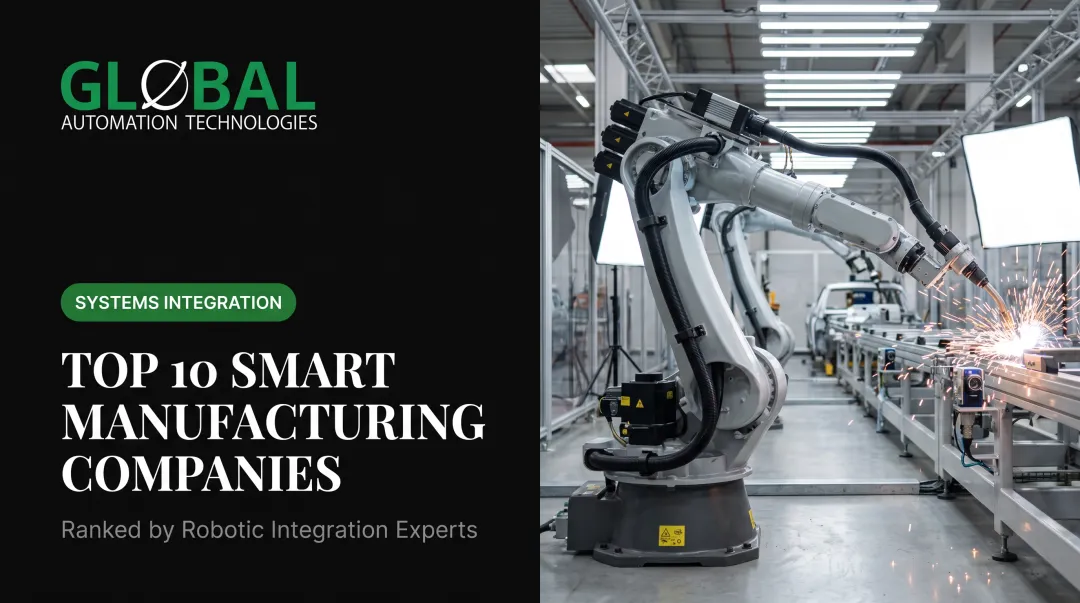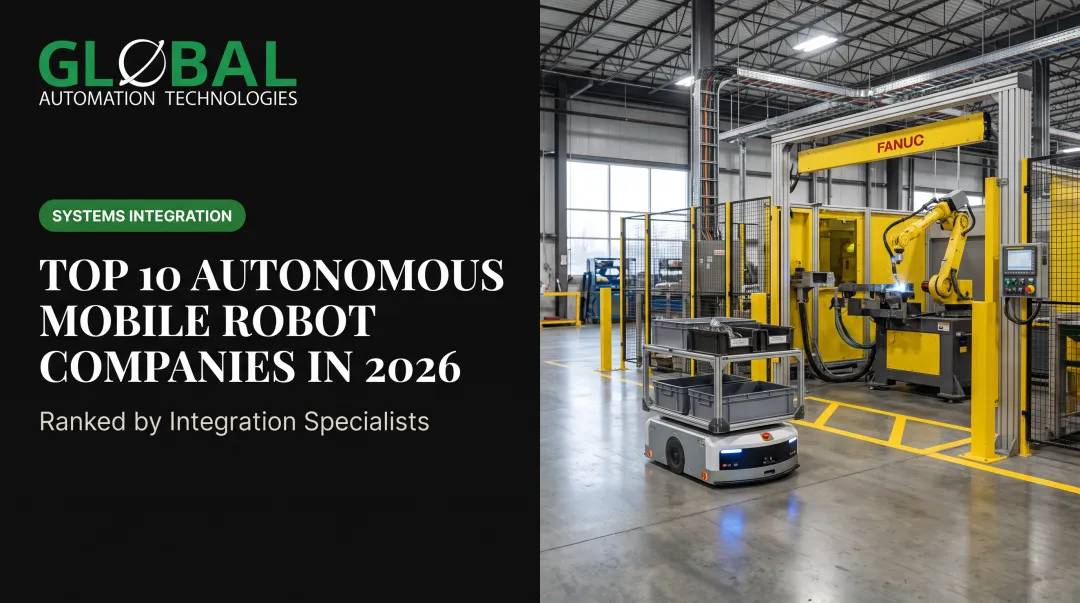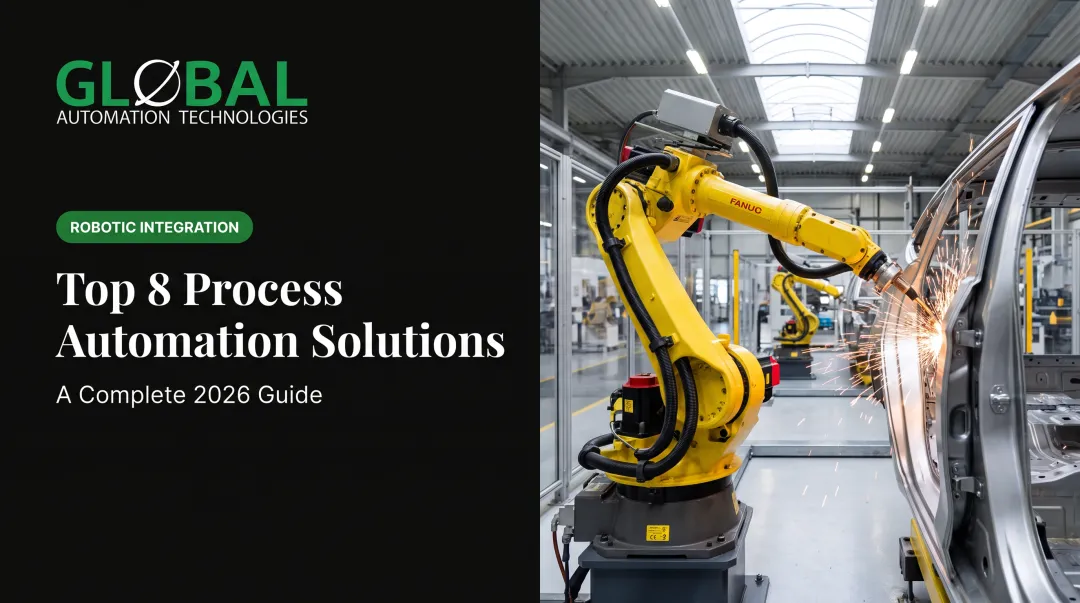

Intelligent automation now covers both ends of the plant — robots welding, painting, and tending machines on the floor, plus AI and RPA software handling purchase orders, quality documentation, and scheduling in the office. Done right, it lifts throughput, tightens quality control, and cuts labor costs simultaneously.
The market reflects that urgency. Intelligent process automation is projected to grow from $14.6 billion in 2024 to $44.7 billion by 2030, a 22.6% CAGR, according to Grand View Research's 2025 market analysis. This article ranks the 10 companies best positioned to help manufacturers capture that growth.
TL;DR
- Intelligent automation blends AI, robotics, and RPA/BPM to automate physical and digital manufacturing work
- The market splits into plant-floor robotics integrators and back-office automation software vendors
- Ten leading companies for 2026 span robotics integration, industrial OEMs, and enterprise automation software
- GLOBAL Automation Technologies delivers both the robotic systems and the engineers who run them
- Rankings weigh technology capability, industry track record, certifications, and client trust
Overview of Intelligent Automation in the Manufacturing Industry
Intelligent automation is the combination of AI, robotics, and process software that lets manufacturers run production and business operations with minimal manual intervention. In practice, that means welding robots on an automotive body line working alongside AI tools that flag a maintenance issue before it causes downtime.
North America's industrial control and factory automation market was valued at $80.19 billion in 2025 and is projected to reach $125.55 billion by 2030, per MarketsandMarkets. Automotive, heavy equipment, electronics, and data center infrastructure manufacturers are driving much of that spend.
The list below covers companies on both sides of that market:
- Robotic systems integrators that build physical automation cells
- AI and software vendors that automate enterprise workflows
Some companies do both.
Top 10 Intelligent Automation Companies in 2026
Rankings below reflect technology depth, industry certifications, global project reach, client base diversity, and the ability to deliver turnkey outcomes — not just brand recognition.
1. GLOBAL Automation Technologies
GLOBAL is a 17+ year automation integrator that pairs turnkey automation solutions with engineering services and technical staffing. Founded in 2009, the company runs projects from a proven global base of robotic deployments, serving automotive OEMs, Tier 1 suppliers, and heavy industry manufacturers.
What sets GLOBAL apart is how its three offerings reinforce each other. Its automation solutions team designs, builds, and commissions robotic cells — primarily on FANUC platforms, where GLOBAL is a Level 5 Authorized System Integrator and #1 purchaser of FANUC robots among North American integrators in 2025. Alongside that, GLOBAL's engineering services place its own engineers on customer contracts, and its technical staffing recruits controls, mechanical, and project management engineers into client roles.
That structure closes a gap most competitors leave open: the team that builds the system knows what the people running it need, and the staffing side knows what the system requires.
AI-assisted simulation compresses robot programming from weeks to days, and AI-driven predictive maintenance flags equipment health issues before they cause downtime. The result is faster startups with fewer surprises.
| Attribute | Details |
|---|---|
| Core Specialization | Turnkey robotic integration, engineering services, and technical staffing from one partner |
| Key Technology | FANUC robotics, AI-assisted simulation, and AI-driven predictive maintenance health assessments |
| Best For | Automotive OEMs, Tier 1 suppliers, and heavy industry manufacturers needing turnkey automation plus engineering talent |
2. FANUC America
FANUC has spent decades as one of the most recognized names in industrial robotics, with a footprint across automotive, aerospace, and heavy manufacturing. Its robots handle welding, material handling, machine tending, palletizing, and inspection at scale.
The company's strength lies in reliability and reach: a global service network, a broad application range, and controllers refined over generations of deployment. FANUC's newest R-50iA robot controller, released in 2024, extends that performance further.
| Attribute | Details |
|---|---|
| Core Specialization | Industrial robot manufacturing and controls |
| Key Technology | Proprietary robot controllers and CNC integration |
| Best For | Manufacturers standardizing on a single robot platform at scale |
3. ABB Robotics
ABB brings a global footprint spanning industrial robots, collaborative robots, and autonomous mobile robots. Its portfolio is one of the broadest in the industry, covering automotive, electronics, and logistics applications.
The company's RobotStudio Suite gives engineers offline programming and digital twin simulation powered by ABB's virtual controller — letting teams test and refine programs before touching a physical robot.
| Attribute | Details |
|---|---|
| Core Specialization | Industrial and collaborative robotics |
| Key Technology | RobotStudio simulation and digital twin software |
| Best For | Manufacturers seeking flexible robot platforms across multiple applications |
4. KUKA Robotics
KUKA built its reputation on German-engineered precision, with deep roots in automotive body-in-white and assembly work. The company's modular robot arms and systems integration subsidiaries give it flexibility across production layouts.
KUKA's current iiQWorks Engineering Suite, including iiQWorks.Sim, handles offline programming, testing, optimization, and digital twin modeling — a modern evolution of the simulation tools engineers rely on for precision assembly.
| Attribute | Details |
|---|---|
| Core Specialization | Precision robotic arms and automated production systems |
| Key Technology | iiQWorks engineering suite with simulation and digital twin capability |
| Best For | High-precision automotive body and assembly lines |
5. Rockwell Automation
Rockwell leads on the controls and software side of the plant floor, with FactoryTalk and PlantPAx forming the backbone of its offering. Its strength is plant-wide connectivity — tying machines, data, and decision-making together.
FactoryTalk Analytics LogixAI adds no-code machine learning for production quality, while FactoryTalk DataMosaix layers in AI-assisted DataOps. For process manufacturers, PlantPAx provides a distributed control system built for scale.
| Attribute | Details |
|---|---|
| Core Specialization | Industrial control systems and plant-wide automation software |
| Key Technology | FactoryTalk suite with AI-driven analytics |
| Best For | Manufacturers modernizing controls and plant connectivity |
6. Siemens Digital Industries
Siemens operates at massive scale across industrial automation hardware, PLCs, and manufacturing operations software. Its Xcelerator platform and Opcenter X offering push toward a fully digital-twin approach to production.
The comprehensive digital twin model lets manufacturers plan, simulate, and optimize everything from individual machines to entire plants before committing capital.
| Attribute | Details |
|---|---|
| Core Specialization | Industrial automation hardware and digital twin software |
| Key Technology | Siemens Xcelerator and Opcenter X manufacturing operations platform |
| Best For | Large enterprises pursuing full digital-twin manufacturing transformation |
7. Yaskawa Motoman
Yaskawa built its name on motion control and welding automation, with a product line that scales from heavy industrial arms down to compact cobots for smaller shops.
The HC-Series collaborative robots and AR-Series arc-welding systems, run on YRC1000 and YRC1000micro controllers, give manufacturers flexibility whether they're running a full welding cell or a single compact automation station.
| Attribute | Details |
|---|---|
| Core Specialization | Robotic motion control and welding automation |
| Key Technology | Motoman robot controllers and HC-Series cobot lines |
| Best For | Manufacturers needing welding-focused or compact automation cells |
8. UiPath
UiPath sits firmly on the software side, leading in enterprise RPA and intelligent document processing. It's built for back-office automation, not plant-floor robotics. Think invoice processing, not welding cells.
Its Document Understanding tool combines RPA with AI to extract and interpret data from varied document formats, while Process Mining analyzes business-application data to surface where workflows break down.
| Attribute | Details |
|---|---|
| Core Specialization | Enterprise RPA and process orchestration |
| Key Technology | AI-powered document understanding and process mining |
| Best For | Enterprises automating back-office and administrative workflows |
9. IBM (watsonx Orchestrate)
IBM brings decades of AI research pedigree and global consulting scale to enterprise automation. Its watsonx Orchestrate platform governs AI agents and workflow orchestration across enterprise applications.
Paired with Cloud Pak for Business Automation, IBM's offering targets structured workflows, decisions, and content management. That mix suits enterprises already running hybrid cloud infrastructure and looking to layer AI strategy on top.
| Attribute | Details |
|---|---|
| Core Specialization | Enterprise AI orchestration and automation consulting |
| Key Technology | watsonx Orchestrate and IBM Cloud Pak for Business Automation |
| Best For | Large enterprises needing AI strategy plus hybrid cloud automation |
10. Automation Anywhere
Automation Anywhere built its Automation 360 platform for cloud-native deployment, targeting organizations moving off legacy on-premises RPA systems. Its AI Agent Studio connects to generative AI models, including custom-built ones.
The Control Room component enables generative AI and external connections, positioning the platform toward agentic process automation rather than the older rules-only RPA model.
| Attribute | Details |
|---|---|
| Core Specialization | Cloud-native RPA with generative AI workflows |
| Key Technology | Automation 360 platform with GenAI connectors |
| Best For | Organizations migrating from legacy on-prem automation to cloud-first platforms |
How We Chose the Best Intelligent Automation Companies
Buyers frequently make one of two mistakes: picking a vendor on brand recognition alone, or ignoring what happens after commissioning (support, spare parts, and program updates). Both lead to costly regret.
Global robot installations reached 542,000 units in 2024, pushing the operational stock to 4.66 million machines worldwide, according to the International Federation of Robotics. That scale means more vendors competing for your business. It also means more reason to evaluate carefully.
We weighed each company against five factors:
- Technology depth — Does the AI or robotics capability solve a real production problem, not just check a marketing box?
- Industry certifications — Does the vendor hold recognized credentials, like a FANUC Authorized System Integrator designation?
- Global project track record — Has the company delivered projects across multiple countries and industries?
- Client base diversity — Does the vendor serve automotive, heavy equipment, and adjacent sectors, or just one niche?
- Turnkey support — Does support run from design through commissioning and beyond, tied to outcomes like uptime, ROI, or defect reduction?

Conclusion
Pick an intelligent automation partner based on fit, not brand size. Match technology, certifications, and support model to your production volume, compliance requirements, and talent gaps.
Before signing anything, evaluate scalability and cost-effectiveness — including payback period — as rigorously as you evaluate the technology itself. A robot that pays for itself in 14 months beats one with flashier specs and a 4-year break-even.
GLOBAL Automation Technologies builds that alignment into its model: the robotic systems and the engineers who run them, delivered together. If you're weighing automation options for 2026, reach out to GLOBAL for a consultation at info@globalat.com or +1 (810) 877-0329.
Frequently Asked Questions
What does intelligent automation do?
Intelligent automation combines AI, robotic process automation (RPA), and robotics to automate both physical manufacturing tasks and digital business processes. It reduces errors, cuts manual labor, and increases throughput across the plant and back office.
What is the difference between intelligent automation and robotic process automation?
RPA automates rule-based digital tasks like data entry. Intelligent automation adds AI/ML on top, letting systems handle unstructured data, complex decisions, and physical robotics that RPA alone can't manage.
How do manufacturers choose the right intelligent automation partner?
Prioritize technology fit, industry experience, turnkey support from design through commissioning, and access to engineering talent for ongoing operation.
How much does it cost to implement intelligent automation on a factory floor?
Costs vary widely by application and scale. Machine tending and dispensing cells often pay back within 12 to 18 months through labor savings and higher throughput.
Which industries benefit most from intelligent automation?
Automotive, heavy equipment, electronics, and data center infrastructure manufacturing lead adoption. Gains show up in higher productivity and less worker exposure to hazardous tasks like spray painting.
Can intelligent automation companies provide both systems and skilled engineers?
Most vendors specialize in either integration or staffing, not both. A few, like GLOBAL, offer both under one roof, which speeds up deployment and simplifies ongoing support.