
Introduction
Walk any warehouse floor or plant aisle and you'll see it: workers lifting totes, sorting parts, and hauling containers between stations. It's repetitive, physically demanding, and still one of the biggest labor drains in modern facilities.
Case picking is the least automated warehouse process today, and it consumes nearly half of all labor hours in a typical distribution operation. Up to 55% of that time is spent simply walking between picks, according to MHL News's 2025 analysis of case-picking inefficiency.
This guide covers what bin handling robots are, the main types and technology behind them, the business case for deployment, and how to choose the right solution for your facility.
Key Takeaways
- Case picking eats up to 50% of warehouse labor hours, with over half of that lost to travel time
- Bin handling robots fall into three types: structured tending, AI random picking, and AMR transport
- Machine tending cells often pay for themselves in 12 to 18 months through labor savings alone
- Open protocols like OPC-UA and REST APIs make WMS/ERP integration far less risky than it used to be
What Is a Bin Handling Robot and Why It Matters for Warehouse Transport
A bin handling robot is an automated system, either a fixed robotic arm or a mobile platform, built to load, unload, sort, and move bins, totes, and containers throughout a facility. That's a broad definition on purpose, because the category covers two very different jobs.
The two core functions:
- Bin picking/tending — extracting or placing individual parts within a bin, typically at a machine or workstation
- Bin transport — physically moving filled or empty bins between stations, racks, or production lines
This is where bin handling robots differ from general-purpose AMRs and AGVs. A standard mobile robot just needs to get from Point A to Point B. A bin handling system needs container-level logistics: knowing what's inside the bin, how full it is, whether it's the right SKU, and where it needs to go next.
Why the Combined Loop Matters
More facilities now pair stationary bin-tending cells with mobile transport robots. The result is a continuous loop: a bin arrives, a robot picks or places parts, and an AMR carries the bin to its next destination. The cycle repeats without a forklift or a person in the middle.
Why now? Labor shortages are forcing the issue. The National Association of Manufacturers projects that up to 1.9 million of the 3.8 million manufacturing jobs needed by 2033 could go unfilled, according to NAM's 2024 workforce study. The same research finds 65% of manufacturers cite talent attraction as their top business challenge.
That pressure is pushing even mid-sized operations to automate work that used to be exclusively manual.
Types of Bin Handling Robots Used in Warehouses and Plants
Bin handling robots fall into three categories, split by function and how they're deployed on the floor.
Structured Bin Tending & Picking Cells
These are fixed robotic arm cells that load and unload parts from bins arranged in a known, predictable layout. They're built for high-volume, low-mix production — the backbone of most machine tending operations today.
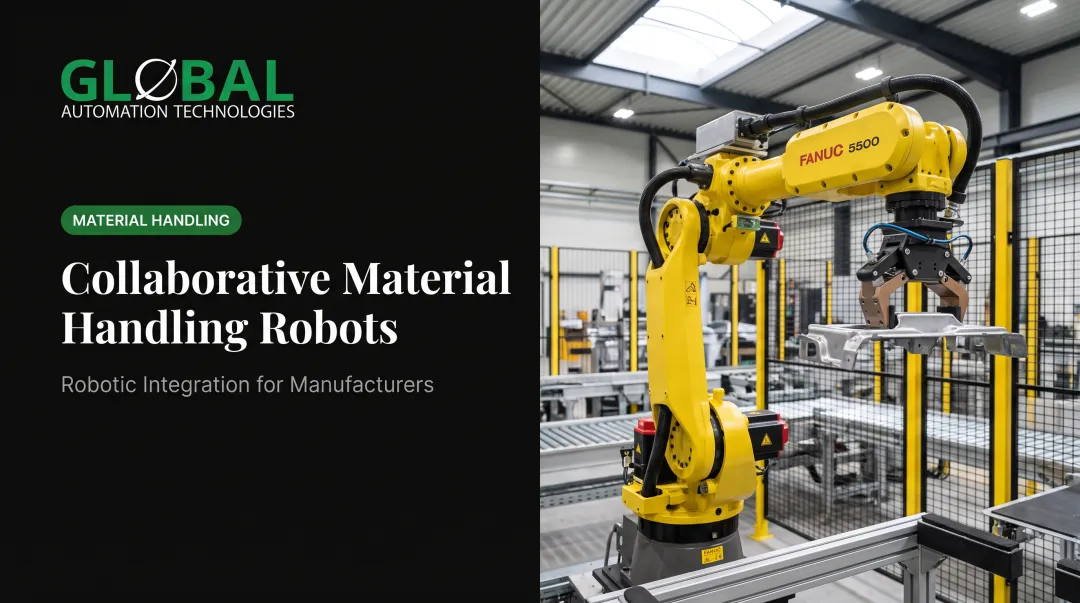
At GLOBAL Automation Technologies, structured bin tending cells typically run on FANUC industrial robots configured for automotive OEMs, Tier 1 suppliers, and heavy industry manufacturers.
These cells often pair with collaborative tending setups when a line needs quick changeover between part numbers — a better fit for high-mix, lower-volume production than a single repeated part.
Random/AI-Powered Bin Picking Robots
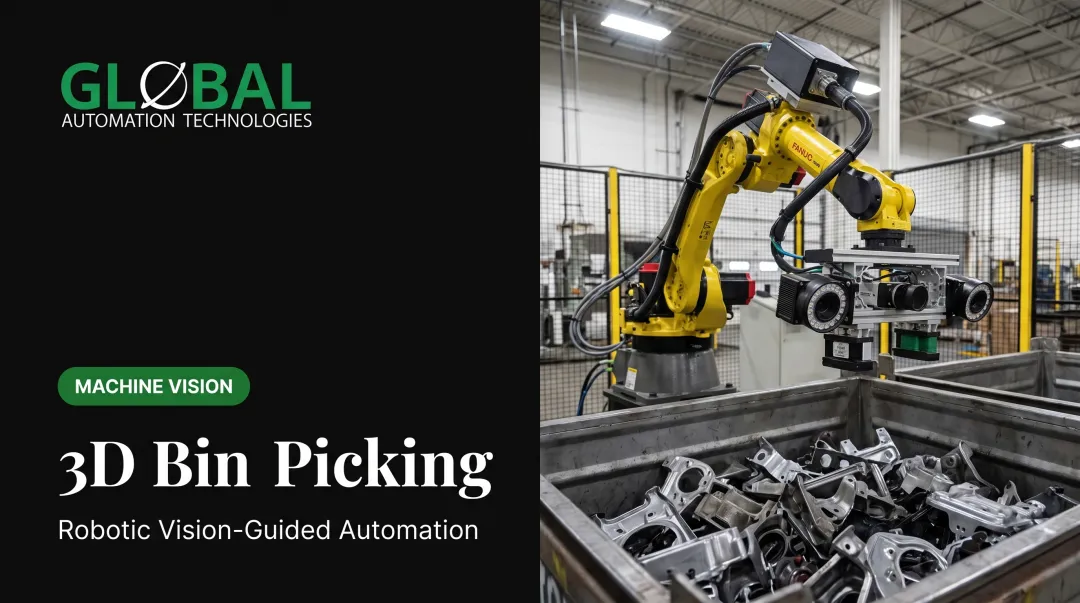
When parts arrive bulk-loaded, overlapping, and randomly oriented, structured tending doesn't work. That's where 3D vision paired with AI grasp planning comes in. The robot scans the bin, identifies individual parts regardless of orientation, and calculates a collision-free pick path in real time.
This approach fits:
- High-mix manufacturing with frequent part changeovers
- Fulfillment operations handling varied SKUs
- Any line where pre-arranging parts costs more labor than the automation itself
Autonomous Mobile Robots (AMRs) for Bin Transport
AMRs and AGVs shuttle bins, totes, and pallets between picking stations, storage racks, and production lines. Unlike a fixed conveyor, an AMR can reroute around obstacles and adapt to a changing floor plan, reducing dependence on forklifts and tow tuggers.
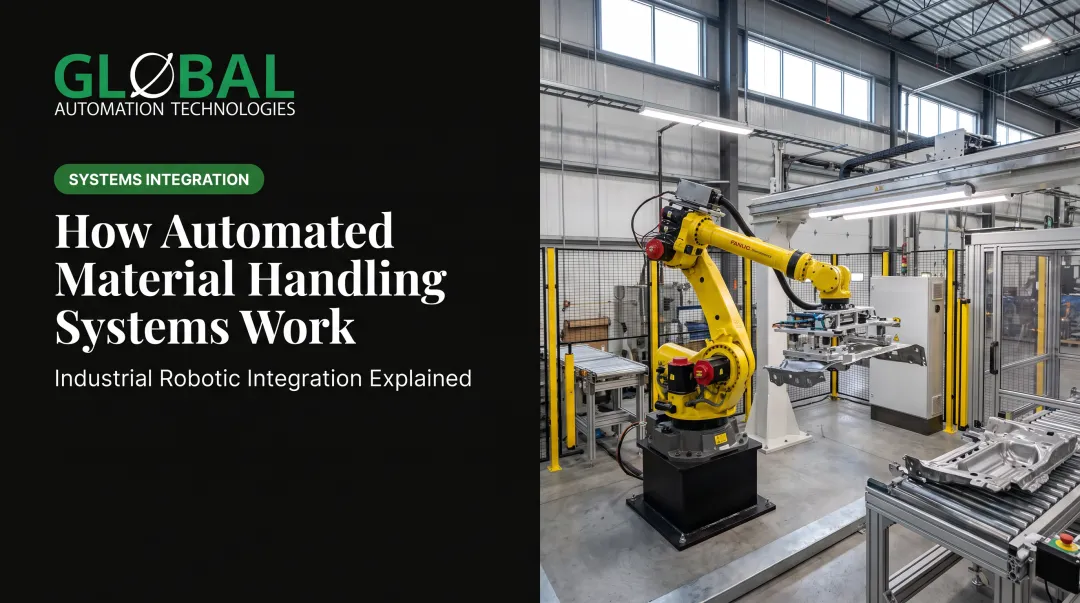
Pairing these mobile fleets with fixed bin-handling cells creates a continuous pick-to-transport loop without manual handoffs. Interact Analysis forecasted several mobile robot categories, including tote-to-person systems, to grow by more than 30% in 2024 — a clear sign facilities are investing heavily in this pairing.

Core Technologies That Power Efficient Bin Handling
Underneath every functional bin handling robot is a stack of technologies working together. Four layers do most of the work on the floor.
3D machine vision and point cloud generation. Structured light or laser-based sensors give a robot spatial awareness, letting it locate parts and bin edges accurately even under inconsistent warehouse lighting.
GLOBAL's material handling cells commonly pair FANUC iRVision with 3D area sensors to give robots real-time depth perception across stacked, overlapping bin contents.
AI-driven grasp planning. Once a robot "sees" the bin, software has to decide how to pick. That decision covers:
- Identifying the optimal grasp point on an irregular or overlapping item
- Generating a collision-free motion path through cluttered contents
- Adjusting in real time as the bin empties and part positions shift
Adaptive end-of-arm tooling. Vacuum cups, magnetic grippers, and compliant tooling let a single robot handle varied bin contents without a hardware changeover between runs. Tooling design is engineered around exact part geometry and cycle time targets rather than a one-size-fits-all gripper.
Picking is only half the job when bins also have to move. Navigation for mobile transport relies on SLAM (simultaneous localization and mapping) and laser guidance so AMRs can travel safely through congested, dynamic warehouse floors without fixed guide paths, fusing camera data with odometry to stay oriented.
Simulation Is Compressing Deployment Time
AI-assisted simulation software now lets engineers model, test, and optimize a robot program before it ever touches the production floor. That shortens the gap between project kickoff and live production.
GLOBAL, a top-tier Level 5 FANUC Authorized System Integrator, applies this approach across its engineering workflow, and the effect is measurable: robot programming time that once took weeks now often takes days.
Business Benefits of Deploying Bin Handling Robots
The case for bin handling automation comes down to three things: throughput, cost, and safety.
Extended operation beyond a single shift. A robotic cell doesn't clock out. It can run through breaks, shift changes, and overnight hours between scheduled maintenance windows, pushing throughput well beyond what shift-limited manual labor can sustain.
Labor cost reduction and reallocation. Automating repetitive lifting and sorting cuts labor cost and frees employees for higher-value work like quality inspection, process improvement, or equipment oversight. For machine tending cells specifically, the math is straightforward: more parts per shift, fewer direct labor hours, and payback within 12 to 18 months in many deployments.
Improved workplace safety. Manual bin handling means constant lifting, awkward reaching, and repetitive strain, exactly the ergonomic hazards OSHA flags as leading contributors to warehouse injury.
Warehousing recorded 4.8 total injury/illness cases per 100 full-time workers in 2024, with 4.1 involving days away, restriction, or transfer, according to BLS warehousing injury data. Removing workers from that physical burden cuts injury exposure at the source.

How to Choose the Right Bin Handling Robot Solution for Your Facility
Picking the right system starts with an honest look at your production profile, not a vendor's feature list.
- Assess product variety and volume first. Low-mix, high-volume lines fit structured bin handling well. High-mix operations with frequent SKU changes need AI-powered random picking that adapts without reprogramming.
- Evaluate integration requirements early. Confirm the system supports your existing WMS/ERP setup and plant communication standards, whether that's OPC-UA, ROS, or REST APIs, before you commit to a vendor.
- Model total cost of ownership, not just sticker price. Factor in installation, tooling, training, and ongoing support. Payback timelines vary by application complexity.
Once you know what the cell must do and what it should cost, the partner you choose matters as much as the hardware. A turnkey provider that supplies both the robotic system and the engineers to run it changes the risk equation.
GLOBAL's combined automation solutions, services and technical staffing model means the same team that designed the cell can support it after launch. That continuity cuts the troubleshooting delays that come with handing a finished system to an unfamiliar maintenance team.
Common Implementation Challenges and Best Practices
Even well-designed bin handling systems run into predictable friction points. Knowing them ahead of time saves budget and downtime later.
Difficult-to-handle items. Reflective and glossy parts create distorted point clouds and noise, which can throw off CAD matching or produce bad pick positions. Hybrid sensing—structured light paired with compliant gripper design—gives the vision system cleaner data and more reliable pick positions.
Integration complexity. Connecting picking cells, AMR fleets, and warehouse software involves multiple systems that weren't necessarily built to talk to each other. Look for partners who support open communication standards rather than proprietary lock-in.
Unplanned downtime. AI-driven predictive maintenance catches problems early:
- Learns a normal operating baseline for servo and motion data
- Flags anomalies before they become failures
- Protects maintenance budgets from reactive emergency repair costs
Facilities that build these checks into their bin handling rollout from day one avoid most of the surprises that derail less-planned deployments.

Frequently Asked Questions
What is a bin handling robot?
A bin handling robot is an automated system, fixed or mobile, that picks, sorts, loads, unloads, or transports bins and containers within a warehouse or plant. It replaces manual lifting and container movement with programmable, repeatable automation.
What's the difference between bin picking robots and bin transport robots?
Bin picking robots are fixed arms that manipulate individual parts inside a bin, often at a machine or workstation. Bin transport robots, typically AMRs, physically carry bins between locations across the facility floor.
How much do bin handling robots cost, and what is a typical payback period?
Costs vary widely based on complexity, part geometry, and integration scope. Well-designed bin handling systems often pay for themselves within 12 to 18 months through labor savings and throughput gains.
Can bin handling robots integrate with our existing warehouse management or ERP systems?
Yes. Most modern systems support open protocols like OPC-UA and REST APIs, which allow fleet controllers and robotic cells to exchange data with existing WMS and ERP platforms without custom middleware.
Which industries benefit most from bin handling robots?
Automotive OEMs and Tier 1 suppliers, e-commerce fulfillment, heavy equipment manufacturing, and general industrial manufacturing are the leading adopters, driven by labor availability pressure and high-volume throughput needs.
How long does it take to implement a bin handling robot system?
Timelines depend on part complexity and integration scope. AI-assisted simulation and turnkey integration partners often cut programming time from weeks to days, shortening overall deployment.