
Introduction
Walk onto almost any modern production floor and you'll see it: robots welding chassis, sensors tracking every degree of temperature, systems adjusting themselves before a human ever notices a problem.
That's industrial automation and control at work—the systems that keep modern plants precise, repeatable, and running.
The global manufacturing automation market was valued at $12.3 billion in 2023 and is on track to hit $24 billion by 2030, according to Grand View Research.
Yet many manufacturing leaders still treat "automation" and "control systems" as interchangeable buzzwords. They aren't.
Understanding how PLCs, DCS, SCADA, sensors, and robotics work as one system is the difference between a smart factory and an expensive collection of disconnected machines.
This guide breaks down what industrial automation and control actually means, its core components, the different types you'll encounter, and why it matters when you're choosing an automation partner.
Key Takeaways
- Industrial automation executes the physical work (robots, actuators); control systems make the decisions (PLCs, SCADA)
- Reliability rests on four hardware pillars: sensors/actuators, controllers, HMIs, and communication networks
- Control choice comes down to three system types: open-loop, closed-loop, and supervisory
- Plants match production needs to four automation categories: fixed, programmable, flexible, and hierarchical/CIM
- Modern architecture is moving from centralized control toward edge computing and IIoT connectivity
What Is Industrial Automation and Control?
Industrial automation and control systems, often shortened to IACS, are the combined hardware and software networks that monitor and manage industrial processes with minimal human intervention. The National Institute of Standards and Technology (NIST) defines an industrial control system as an information system used to control manufacturing, product handling, production, and distribution processes.
Here's where the confusion usually starts. Automation refers to the mechanized execution of tasks: robots welding, conveyors moving parts, machine tending replacing manual loading. Control refers to the logic and systems that direct those tasks in real time, including PLCs, sensors, and feedback loops.
Automation is the muscle; control is the nervous system. Neither works well without the other.
Five Core Functions IACS Perform
Every IACS, regardless of size, performs these functions:
- Process control – regulating variables like temperature, pressure, and flow
- Machine automation – executing repetitive physical tasks without manual input
- Motion control – coordinating precise movement in robotics and servo systems
- Safety and compliance monitoring – enforcing safety interlocks and regulatory standards
- Real-time data acquisition – collecting operational data for analysis and decision-making

The scale of this market reflects how central these systems have become. MarketsandMarkets estimates the industrial control and factory automation market will grow from $274.99 billion in 2025 to $435.24 billion by 2030.
The two layers are complementary, not identical. IACS spans everything from a single PLC controlling one machine to enterprise-wide SCADA networks overseeing an entire plant.
Key Components and Technologies of Industrial Automation and Control Systems
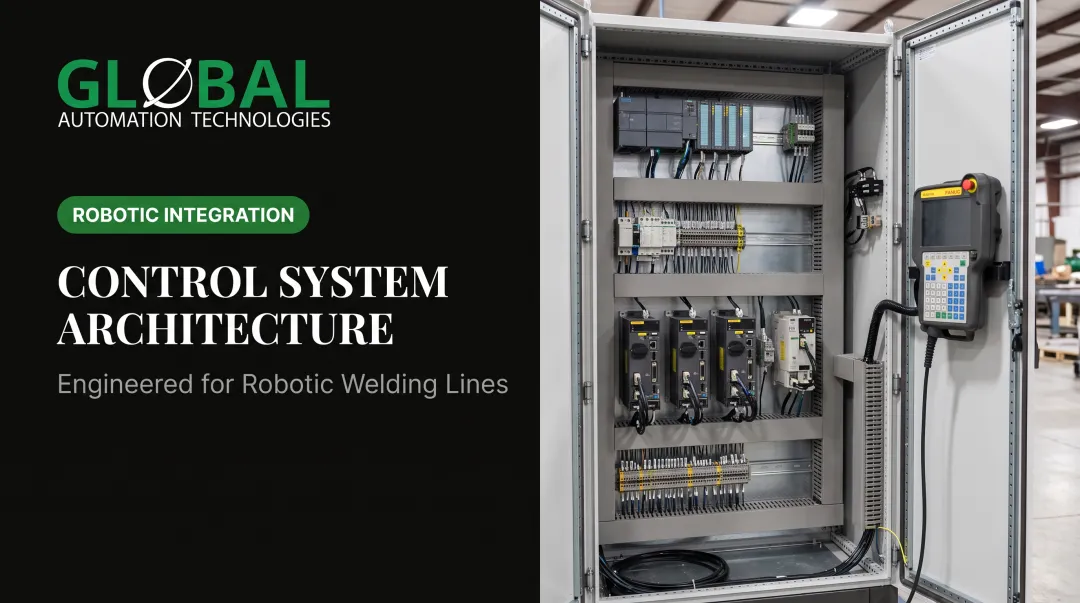
IACS reliability comes down to four hardware pillars working in sync: sensors and actuators, controllers, human-machine interfaces (HMIs), and communication networks. Remove one, and the whole system loses precision or visibility.
Controllers: PLCs, DCS, and SCADA
Programmable Logic Controllers (PLCs) function as the brain of most automation cells. Rockwell Automation describes a PLC as an industrial computer that automates machinery and continuously monitors sensor inputs. PLCs excel at sequential, discrete control tasks, meaning start-stop machine logic, part counting, and safety interlocks.
Distributed Control Systems (DCS) take over when the process is large and continuous. Emerson notes that a DCS is built for real-time process control with the scalability to handle both batch and continuous operations, like chemical processing or oil refining.
SCADA sits above both. It aggregates data across wide or geographically dispersed operations, letting engineers monitor and control remote functions from a central location. That wide-area view is why SCADA is common for pipelines, utilities, and multi-site plants.
Field Devices and Interfaces
Sensors and transducers gather the raw data that feeds every controller decision:
- Temperature and pressure sensors
- Flow meters
- Proximity switches
- Vision sensors for part detection and quality checks
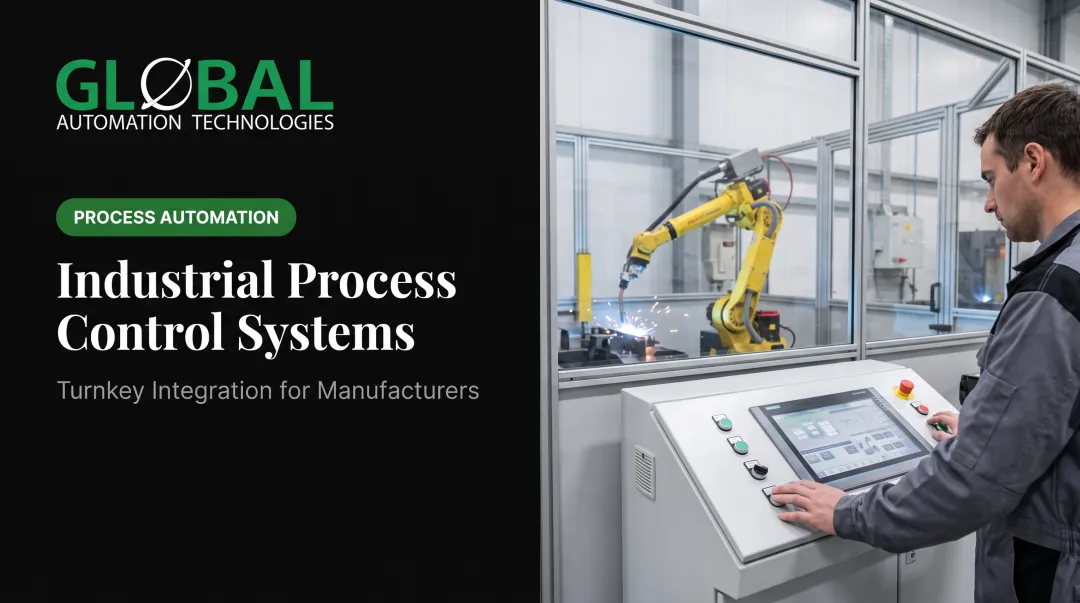
Actuators and motor drives (VFDs, servo drives) turn control logic into physical motion on the floor. HMIs sit between operators and the system, showing real-time status and accepting manual commands when needed.
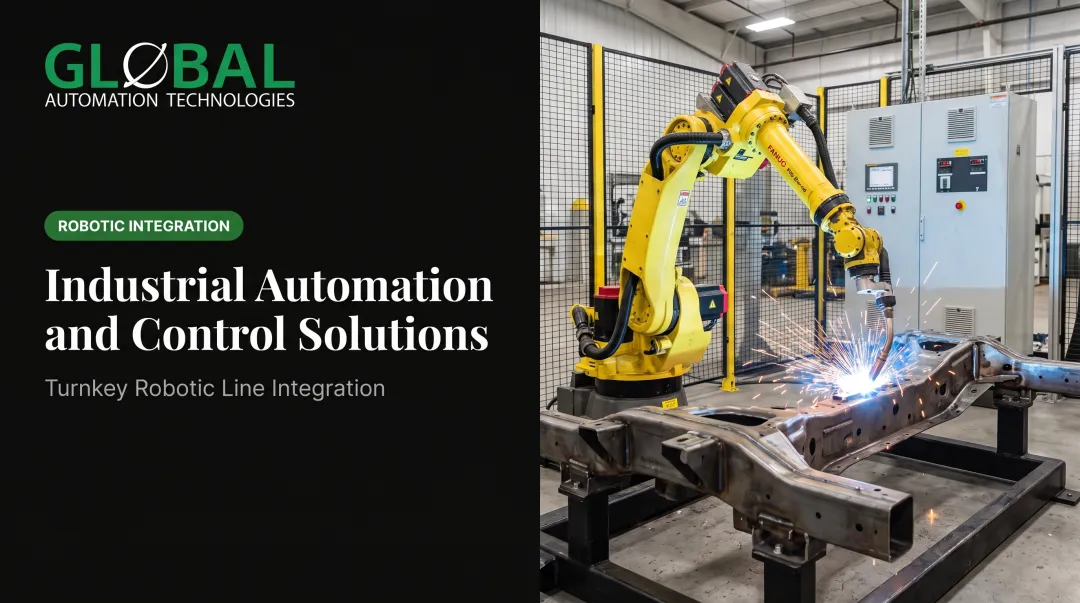
Industrial robots are a specialized class of high-precision actuators. They now anchor many automation cells in welding, machine tending, dispensing, and painting.
Communication Networks
Networks bind the other three pillars together. Industrial Ethernet and fieldbuses such as EtherNet/IP, PROFINET, and Modbus move sensor data to controllers and push commands back out with the speed and determinism a plant floor requires.

The Three Main Types of Control Systems Used in Industrial Automation
Not every process needs the same level of feedback. The publication Control Engineering groups industrial control into three approaches, each matched to a different level of precision.
| Control Type | How It Works | Best For |
|---|---|---|
| Open-loop | Executes a predetermined action with no feedback verification | Simple, predictable tasks (such as starting an agitator) |
| Closed-loop (feedback) | Continuously measures output, checks against a target, and adjusts | Tasks requiring precision, like temperature or pressure regulation |
| Supervisory | PLC/DCS/SCADA combinations overseeing multiple loops | Plant-wide coordination across many processes |
Open-loop control works fine when the outcome doesn't require verification, like flipping on a conveyor motor.
Closed-loop control, according to Control Engineering, repeats a measure-decide-actuate cycle. A paint booth or curing oven temperature, for instance, has to be measured continuously rather than assumed after a burner switches on.
Supervisory control ties both of the above together at scale. This is where SCADA earns its keep, coordinating dozens or hundreds of individual control loops across an entire facility.
The Four Main Types of Industrial Automation
Automation isn't a one-size-fits-all category. The right type depends entirely on production volume and how often your product changes.
| Automation Type | Description | Common Use Case |
|---|---|---|
| Fixed (hard) automation | Purpose-built equipment for a single, unchanging task | Traditional automotive assembly lines |
| Programmable automation | Reconfigurable systems for batch production | Periodic, structured product changeovers |
| Flexible (soft) automation | Highly adaptable systems built for frequent changeovers | EV and mixed-model manufacturing |
| Hierarchical/CIM automation | Multiple automated processes under one centralized computing system | Enterprise-wide integrated production |
Fixed automation runs dedicated machinery that performs a single function at high speed. Per IEEE, it delivers low cost per unit at volume—but the equipment is inflexible once installed.
Programmable automation changes operation sequences through electronic controls. It suits batch production where you reprogram between scheduled runs, then produce a set quantity before the next changeover.
Flexible automation matters most for manufacturers running EV transitions and mixed-model lines. ABB's 2025 survey found that fully flexible, connected smart factories are essential for producing ICE, hybrid, and electric vehicles on the same line.
Computer-integrated manufacturing (CIM), the most advanced tier, ties production data and controls together across lines, plants, and networks under one computing system. It coordinates multiple automated processes so the operation runs as one connected system.
How Industrial Automation and Control Architecture Works
Most IACS architecture still follows the layered Purdue Model, and understanding it helps explain how data and commands move through a facility.
- Level 0-1: Field devices — sensors and actuators that sense or affect production
- Level 2: Control systems — PLCs and DCS running supervisory logic
- Level 3: Manufacturing operations — MES and SCADA
- Level 4: Enterprise systems — ERP and related business applications

Data flows upward through these layers while commands flow downward. It's a clean model, but modern plants no longer stop at a single central stack.
The Shift Toward Edge and IIoT
Manufacturers are pushing more computing power to the plant floor with distributed, edge-based architectures. Siemens describes Industrial Edge as supporting faster, localized decision-making rather than routing every data point back to a central server.
Industrial Internet of Things (IIoT) connectivity closes the gap further. NIST notes that IIoT applies connected sensors to machinery, allowing real-time data transmission that bridges IT and OT systems that historically never talked to each other.
None of this works without standardized communication protocols. The most common include:
- EtherNet/IP – uses the Common Industrial Protocol across the OSI model
- PROFINET – an Industrial Ethernet standard optimized for real-time communication
- Modbus – a widely adopted application protocol for simpler device communication
- OPC UA – a secure, manufacturer-independent standard for industrial data exchange
Most plants run multi-vendor equipment, so shared protocols are what make those systems interoperable.
That same connectivity raises the stakes on security. CISA notes that many ICS environments still run legacy technologies and proprietary protocols built for reliability, not security. For connected production lines, OT cybersecurity is now a baseline design requirement—not an add-on.
Why Industrial Automation and Control Matters for Manufacturers
The business case for IACS comes down to four outcomes:
- Higher throughput
- Tighter quality control
- Reduced downtime through predictive maintenance
- Improved worker safety
The numbers back this up. McKinsey reports that across Industry 4.0 use cases, reductions of 30% to 50% in machine downtime and increases of 10% to 30% in throughput are common among manufacturers who've implemented these systems well.
That's the theory. Execution is where most manufacturers get stuck, and where GLOBAL Automation Technologies comes in. GLOBAL delivers turnkey robotic systems covering layout, design, build, programming, validation, and commissioning, plus the engineering talent to run and maintain them after launch.
Here's what that looks like in practice:
- Process study and engineering design — define feasibility and layout before anything gets built
- AI-assisted robot simulation — model and optimize programs before code hits the floor, compressing programming time
- Controls engineering and machine vision — handle PLC logic, safety systems, and adaptive part inspection
- Build, installation, and commissioning — bring the system online on-site
- Training and ongoing support — keep the system running well past launch

Backed by 17+ years of experience and a proven global base of robotic deployments, GLOBAL has built this process around FANUC's platform as a Level 5 Authorized System Integrator, the highest tier in FANUC's certification program.
GLOBAL's AI-assisted simulation and predictive maintenance tools reflect where IACS is heading: away from static control logic and toward smarter, self-optimizing systems. Predictive maintenance flags equipment issues early, protecting maintenance budgets before small problems become costly downtime.
GLOBAL makes that practical by pairing engineering with talent. The engineering team builds the system, while GLOBAL's engineering services and technical staffing place controls engineers, technicians, and project managers who already understand that system's architecture. One call gets a manufacturer both the equipment and the people to run it.
Frequently Asked Questions
What are industrial automation and control systems?
IACS are the combined network of hardware (PLCs, sensors, actuators) and software that monitors and controls industrial processes. They keep production safe, efficient, and consistent with minimal manual intervention.
What are the four main types of industrial automation?
Fixed (hard) automation runs single, high-volume tasks. Programmable automation handles batch changeovers. Flexible automation adapts quickly to mixed production. Hierarchical (CIM) automation integrates everything under one centralized system.
What are the three main types of control systems used in industrial automation?
Open-loop systems execute actions without feedback verification. Closed-loop systems continuously measure and adjust output to hit a setpoint. Supervisory systems (PLC/DCS/SCADA) coordinate multiple loops plant-wide.
Which protocol is commonly used for industrial automation and control systems?
EtherNet/IP, PROFINET, Modbus, and OPC UA are the most widely used protocols. Choice depends on your equipment vendor and network requirements.
What is the difference between a PLC and a DCS?
PLCs typically handle discrete, machine-level logic, like sequencing and part counting. DCS manages large, continuous processes across an entire plant, common in chemical and process manufacturing.
How is AI changing industrial automation and control systems?
AI is expanding into predictive maintenance, simulation-based robot programming, and real-time defect detection. GLOBAL Automation Technologies, for example, uses AI-assisted simulation to compress robot programming time.