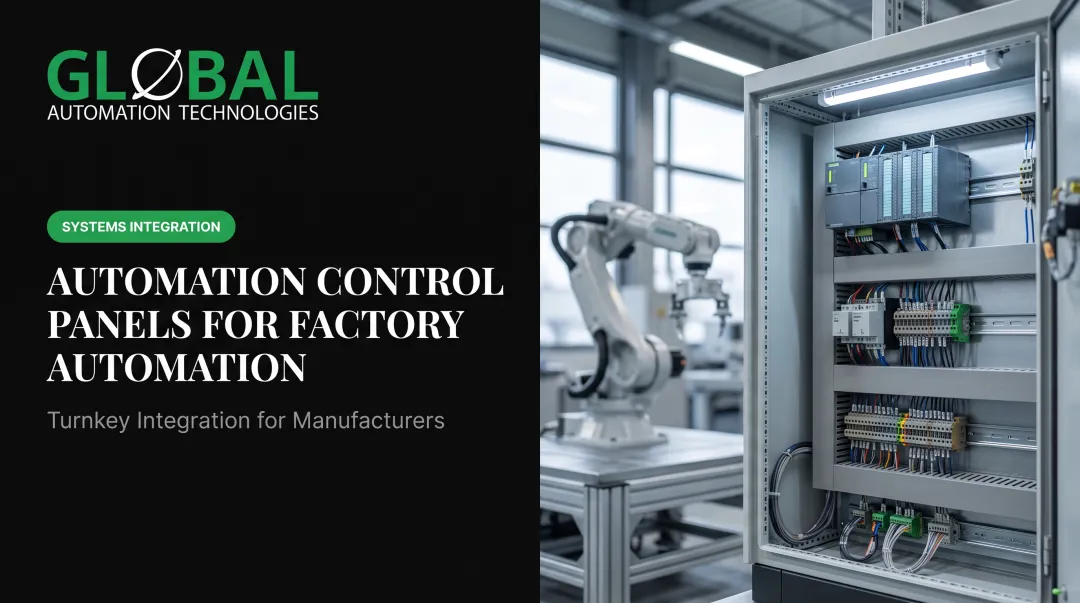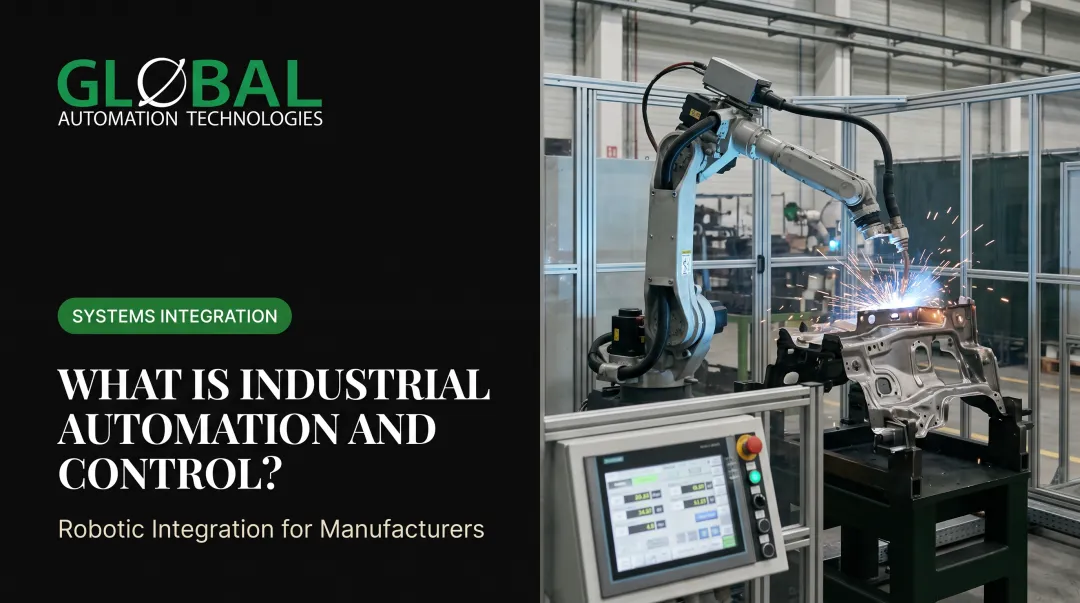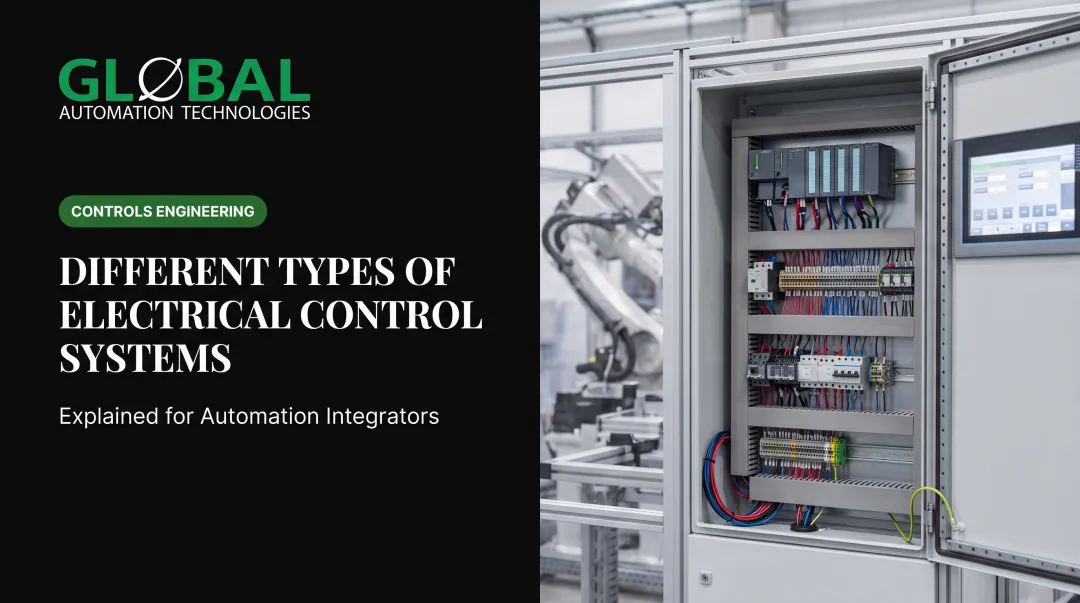

Control panels are the nervous system of automated manufacturing equipment. When they're built right, you barely notice them. When they're not, everything downstream stops.
The problem: engineers and plant managers evaluating new equipment often can't tell which panel features actually matter for uptime, safety, and code compliance until something goes wrong. This guide breaks down the core components, protective features, safety elements, and regulatory standards that separate a well-built industrial control panel from one that's a liability waiting to happen.
Key Takeaways
- Control panels combine power distribution with logic, monitoring, and automation control. A breaker box does not
- NEMA and UL ratings determine whether an enclosure survives its actual operating environment
- UL 508A governs component selection and construction for panels rated 1,000V or less
- SCCR verification under NEC 409.22 prevents installing a panel that can't handle available fault current
- Panel features only deliver value when matched to the equipment and process they control
What Is an Industrial Electrical Control Panel?
An industrial control panel (ICP) is defined under NEC 409.2 as an assembly of two or more power-circuit components, control-circuit components, or a combination of the two. Think PLCs, relays, terminal blocks, contactors, drives, and overcurrent protective devices, all housed in one enclosure.
That enclosure centralizes command, monitoring, and protection for a piece of machinery or an entire production cell. Most panels built for U.S. manufacturing are built and listed under UL's industrial control panel program, which evaluates component selection, wiring practices, enclosure ratings, and NEC conformance.
How Control Panels Differ From a Standard Breaker Box
A breaker box, also called a load center, only distributes power to branch circuits. It's the residential or light-commercial equivalent of a highway on-ramp, moving electricity from point A to point B.
A control panel does more:
- Adds logic and sequencing through PLCs and relays
- Monitors process variables in real time
- Enables automation by controlling motors, actuators, and safety devices
- Protects equipment and operators with interlocks and overcurrent devices
It still takes supply from an upstream breaker box or distribution system—the intelligence lives in the panel.
You'll find ICPs wherever machines need coordinated control, not just raw power:
- Robotic work cells
- Machine tending stations
- Painting and dispensing lines
- Automated assembly systems
- Conveyor and material handling lines
Key Components That Define Control Panel Functionality
Every panel is only as good as the components inside it and how well they're integrated. Five categories determine whether a panel performs reliably or becomes a recurring maintenance headache.
Programmable Logic Controllers (PLCs) act as the panel's brain. They continuously scan inputs, process logic, and drive outputs, determining exactly how the equipment behaves cycle after cycle.
Human-Machine Interfaces (HMIs) give operators a window into what's happening inside the panel. Touchscreen displays show fault codes, cycle counts, and process variables, cutting troubleshooting time compared to guessing from a blank enclosure.
Circuit breakers, relays, and contactors protect the circuit and switch power where it's needed:
- Breakers stop overcurrent and short-circuit events before they cause damage
- Relays isolate signals and amplify control logic
- Contactors handle final switching for motors and actuators
- In safety circuits, dropping a contactor is often what removes power from hazardous motion
Terminal blocks and wire management rarely get attention until something fails. Organized, labeled terminal blocks and wireways turn a two-hour fault-tracing job into a fifteen-minute fix.
Power supplies and transformers step down incoming voltage to clean, stable levels for sensitive control-level devices. Skip this step and PLCs and sensors see voltage swings that trigger nuisance faults or kill components outright.
Poorly matched or poorly wired components are a common driver of unplanned downtime. Plants that run to failure feel it first—aging panel parts rarely warn you before they quit.

Enclosure & Environmental Protection Features
The enclosure is a control panel's first line of defense. Everything inside it—PLCs, relays, and terminal blocks—depends on that box keeping out dust, moisture, chemicals, and physical impact.
NEMA Ratings and What They Actually Cover
NEMA enclosure ratings tell you what environment a panel is built to survive:
| NEMA Type | Environment |
|---|---|
| Type 1 | Indoor, general purpose; protects against dust and accidental contact |
| Type 4 | Indoor/outdoor; withstands windblown dust, rain, and hose-directed water |
| Type 4X | Same as Type 4, plus added corrosion resistance |
| Type 12 | Indoor, no knockouts; protects against dust, dripping water, and light splashing |
UL listings and IP ratings validate these protections independently. Inspectors, insurers, and OEM specs frequently require them as proof of build quality. NEMA and IP codes come from different testing standards, so a panel rated for one doesn't automatically carry the other.
Choosing the Right Enclosure Material
- Carbon steel — general indoor use, low-corrosion environments
- Stainless steel (304/316) — washdown areas, food/beverage, and chemical exposure; 316 handles chlorinated water and marine environments
- Aluminum — lightweight, corrosion-resistant, common in petrochemical and outdoor infrastructure
- Polycarbonate/fiberglass — corrosive environments and outdoor exposure; avoid strong alkalis or acids
Thermal Management
Thermal management matters just as much as material choice. Filtered fans, heat exchangers, and A/C units prevent heat buildup from cooking components, particularly in panels running VFDs or high-current loads where internal temperatures climb fast.
Safety & Layout Features That Reduce Downtime
Safety features protect people. Layout features protect your maintenance schedule. A well-designed panel handles both.
Emergency stop switches and safety relays shut equipment down during hazardous conditions. Resetting an E-stop should never automatically restart the machine. It should only clear the fault; a separate, deliberate start command is required to resume operation.
Monitored safety relays typically open outputs and de-energize redundant contactors when a fault is detected. That adds protection beyond a single switch.
Surge protection devices guard sensitive electronics against voltage spikes from lightning strikes or utility grid switching. Under UL's certification requirements, surge protection used in an ICP must comply with UL 1449, with connecting conductors kept short and free of unnecessary bends.
Safety hardware limits damage when something goes wrong. Layout discipline—how the panel is labeled, documented, and organized—decides how fast you get back online.
Labeling and documentation cut troubleshooting time sharply:
- Clearly labeled wires and components
- Complete schematics on hand at the panel
- Test records available for maintenance teams
- Arc-flash labels showing voltage, incident energy, and required PPE where applicable
NFPA has pointed to required labeling as one of the most effective tools for improving electrical work safety, and it pays off just as much during a 2 a.m. fault call as it does in an audit.

Regulatory Standards Every Control Panel Should Meet
Compliance isn't optional paperwork. It's what keeps a panel legally installable and insurable.
NEC Article 409 (NFPA 70) governs wiring clearances, short-circuit current ratings (SCCR), and general electrical safety for panels operating under 600V.
Section 409.22 is non-negotiable: a panel cannot be installed where available short-circuit current exceeds its marked SCCR. Skipping this check is one of the fastest ways to end up with a panel that fails catastrophically instead of tripping safely.
UL 508A is the primary U.S. certification standard that proves an industrial control panel meets those safety expectations. It governs:
- Component selection and spacing
- Wiring methods
- Enclosure environmental ratings
- Motor protection
- Safety markings and NEC conformance
UL 698A comes into play for panels operating near hazardous locations, like paint booths or dispensing areas. This standard specifically addresses panels in unclassified locations whose circuits extend into classified hazardous zones. Don't assume UL 698A applies just because the process name sounds hazardous. Confirm the area classification and panel location first.
Why Control Panel Features Matter for Automation Integration
None of these features matter in isolation. A panel with a perfect UL 508A build and a flawless SCCR rating still fails if it isn't matched to the equipment it's supposed to run, whether that's a robotic machine tending cell, a painting system, or a material handling line.
This is where integration expertise closes the gap between a technically compliant panel and one that actually keeps a production line running. At GLOBAL Automation Technologies, controls engineering isn't an afterthought bolted onto a robot cell. It's built in from the concept phase through commissioning:
- PLC programming and fault handling designed around the specific process
- E-stop coordination across robots, conveyors, and peripheral equipment
- SCADA and IoT connectivity for real-time visibility into panel performance
- Technical documentation included in project closeout
GLOBAL has built a proven global base of robotic deployments over 17+ years as a Level 5 FANUC Authorized System Integrator, primarily on FANUC platforms. That work spans welding, painting, dispensing, material handling, and machine tending, so the controls team has seen how panel design choices play out under real production conditions—not just on paper.
That same expertise is available without a full turnkey build. Through its technical staffing offering, GLOBAL places controls engineers on a contract, contract-to-hire, or direct-placement basis. Plants get specification, programming, or maintenance support without committing to a full-scale integration project.
Frequently Asked Questions
What is an industrial control panel?
An industrial control panel (ICP) is an enclosed assembly of components, such as PLCs, relays, and breakers, that controls and monitors machinery. It's typically built to NEC Article 409 and certified under UL 508A construction standards.
What is the difference between a breaker box and an industrial control panel?
A breaker box only distributes power to circuits. An industrial control panel adds logic, monitoring, and automation control on top of that power distribution, enabling equipment to operate automatically.
How much does an industrial electrical control panel cost?
Cost varies widely based on component complexity (PLC-based vs. relay-based), enclosure rating, and customization needs. Request a quote from a systems integrator for an accurate estimate tied to your specific application.
What is the NEC code for industrial control panels?
NEC Article 409 (part of NFPA 70) governs industrial control panels. Section 409.22 requires the panel's marked short-circuit current rating (SCCR) to meet or exceed the available fault current at the installation point.
What is UL 508A and why does it matter for control panels?
UL 508A is the primary U.S. safety standard for industrial control panels rated 1,000V or less. Certification confirms proper spacing, wiring, and construction—helping panels pass inspection and satisfy insurance and code requirements.
How often should an industrial control panel be inspected or maintained?
Follow OEM-recommended maintenance schedules, paired with periodic thermal imaging and visual inspection of wiring, labels, and connections. Inspection frequency should reflect actual operating conditions and risk level, not a one-size-fits-all interval.