
The math backs this up. The Manufacturing Institute and Deloitte project US manufacturers may need up to 3.8 million workers between 2024 and 2033, with as many as 1.9 million of those positions going unfilled. That's not a distant problem. It's a capacity constraint hitting plant floors right now.
This guide breaks down what automated equipment actually is, the main types used in manufacturing, real benefits and ROI math, and where the technology is headed. We're drawing on GLOBAL Automation Technologies' 17+ years integrating 700+ FANUC robots across 22 countries as the practical lens throughout.
Key Takeaways
- Robotic arms, CNC machine tending, AGVs, and controls now serve logistics, healthcare, and industries far beyond automotive
- Labor scarcity is the strongest automation business case right now, ahead of turnover alone
- AI-assisted simulation and predictive maintenance cut programming time from weeks to days
- Well-matched applications like machine tending often pay back within 12-18 months
What Is Automated Equipment?
Automated equipment refers to machines and systems that use sensors, controllers, and actuators to perform tasks with minimal human intervention. Four components make this work:
- Sensors — detect position, presence, temperature, or pressure
- Controllers (PLCs or DCS) — the decision-making layer that processes sensor input and issues commands
- Actuators — motors, cylinders, and grippers that physically execute the task
- Software/programming layer — ties everything together into a repeatable sequence
Automated vs. Autonomous
Conventional automated equipment executes a fixed, programmed sequence: reliable, but not adaptive. NIST describes autonomous systems as adding advanced algorithms, including AI, that let the system select its own actions rather than just execute a script.
Most industrial robots today fall into the first category, with AI-enhanced capabilities like machine vision layered on for specific tasks such as bin picking, inspection, or dispense verification.

Is Your Task a Good Fit?
Automation isn't right for every process. Automation works best for tasks that are:
- High-volume and repeated constantly
- Well-defined with minimal judgment calls
- Physically strenuous, hazardous, or precision-critical
- Consistent in part geometry or process parameters
Judgment-heavy, low-volume, highly variable work is a harder sell. The integration cost rarely pays back fast enough.
Types of Automated Equipment Used in Manufacturing
Robotic Systems (Arms & Industrial Robots)
Industrial robots handle welding, assembly, material handling, and machine tending. Handling is the single largest application category worldwide, according to the International Federation of Robotics.
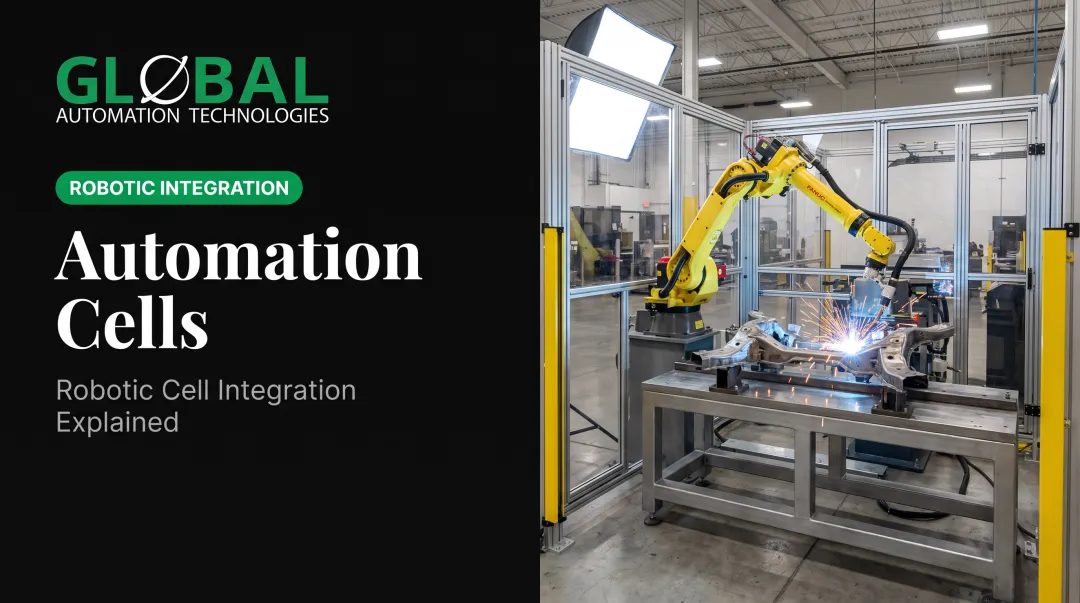
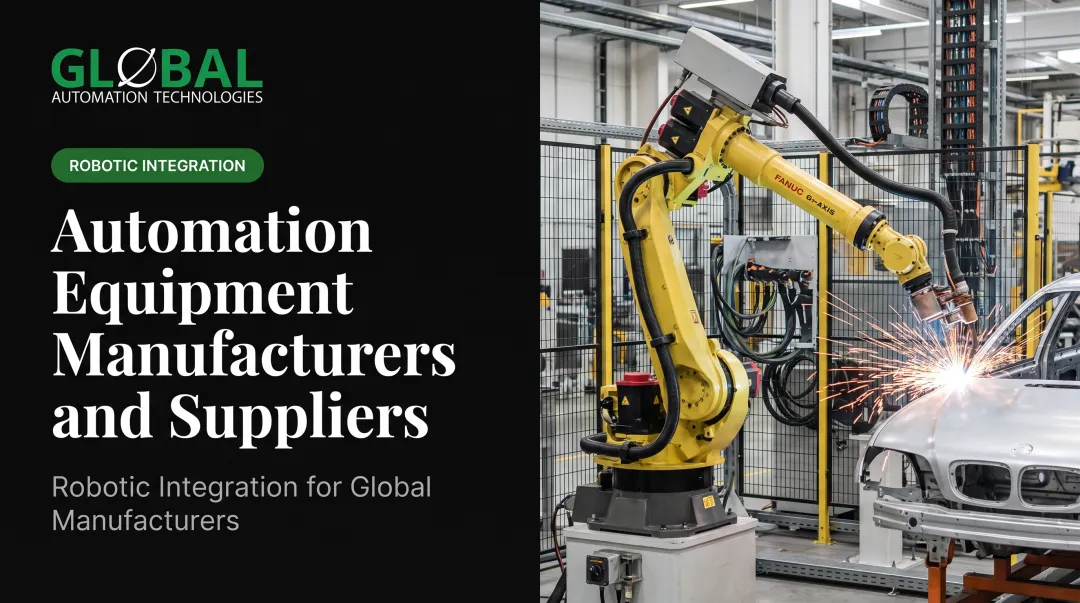
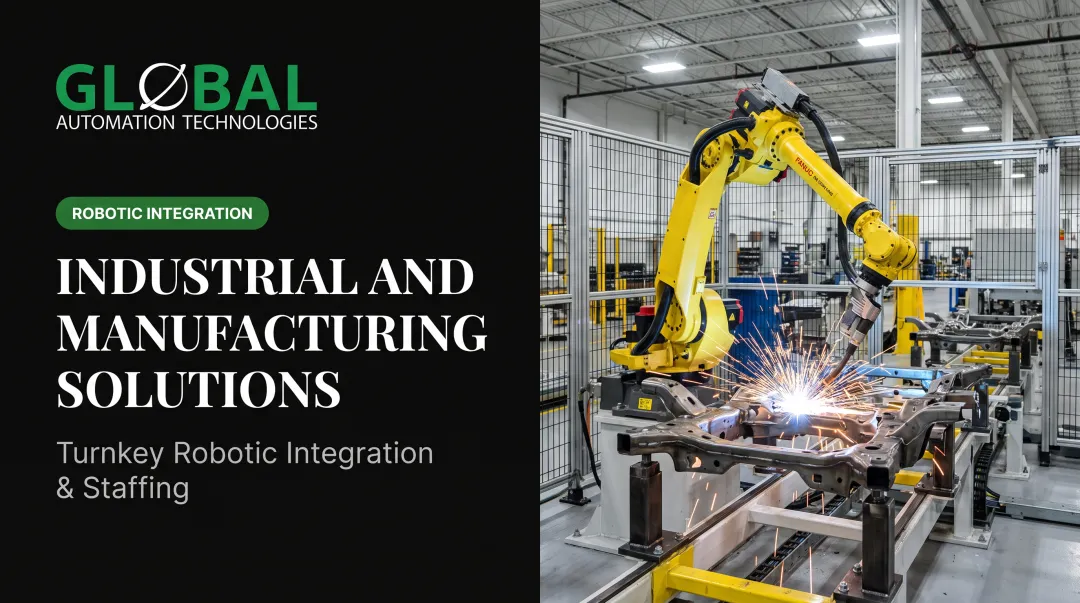
GLOBAL, a Level 5 FANUC Authorized System Integrator, primarily deploys FANUC robots for hazardous and high-precision work: automotive paint booths, structural adhesive dispensing, and welding cells where consistency and operator safety both matter.

Automation Control Systems
PLCs and DCS platforms act as the coordinating brain across a production line. PLCs excel at fast, discrete control such as interlocks and standalone machine logic. DCS platforms handle coordinated batch or continuous-process control, especially where advanced PID loops are involved.
In practice, integrators like GLOBAL manage the handoff between robot and machine controls directly. That includes robot-to-conveyor PLC integration for speed matching, trigger signals, and emergency-stop coordination. Press-tending systems sync to press controls for pick-and-place at production speed.
Automated Guided Vehicles & Logistics Automation
AGVs, mobile manipulators, and automated sorting systems keep material flowing between stations. This segment is growing fast. An IFR-based industry report counted nearly 113,000 transport and logistics robots sold in 2023, up 24% year over year.
Robotic material handling (palletizing, bin picking, conveyor integration, and inter-station transfer) supports this same material-flow goal even without a mobile chassis involved.
Specialized Process Automation Equipment
Robotic painting, coating, and dispensing systems are built around one part, one process, and tight tolerances. GLOBAL's painting systems hold film build within specification, using repeatable spray patterns that eliminate the variability of a human operator.
Dispensing cells hit sub-millimeter path accuracy with real-time bead-width and continuity checks, catching defects before parts move downstream.

Key Benefits of Implementing Automated Equipment
Worker safety is the clearest win. OSHA's ergonomics guidance flags heavy lifting, awkward postures, and repetitive tasks as musculoskeletal risk factors.
Across 2023-2024, BLS recorded 946,290 DART cases tied to overexertion, repetitive motion, and bodily conditions in private industry. Painting also carries isocyanate exposure risk. Pulling operators out of the booth removes that exposure entirely.
Productivity gains show up because robots don't fatigue or lose focus on the 400th repetition of a shift. That translates into:
- Consistent output across every shift, including overnight and unattended runs
- Higher spindle utilization on CNC machine-tending cells
- Operators redeployed to inspection, programming, and process improvement
Product consistency follows the same logic. GLOBAL's film-build consistency comes from eliminating manual spray variability: fewer defects, less rework, and tighter scrap control.
Those quality and labor gains show up in payback timelines. GLOBAL states that machine-tending cells typically pay for themselves in 12 to 18 months, driven by higher spindle utilization and fewer direct labor hours per shift. That figure is concrete enough to plan capital budgets around.

Is Automated Equipment Worth the Investment? (ROI Considerations)
Whole-cell economics beat robot-price math every time. Automate.org's analysis found the robot itself can represent only about one-third of a turnkey installation cost: tooling, guarding, conveyors, programming, and integration make up the rest.
Main cost factors to budget for:
- Equipment (robot, tooling, fixtures, guarding)
- Integration and engineering (design, programming, simulation, controls)
- Training for operators and maintenance staff
- Ongoing maintenance and wear-item replacement
To calculate payback, compare labor savings, scrap reduction, and throughput gains against total upfront investment, not just the sticker price of the robot arm.
Real-world results vary widely. FANUC's Swivellink case study reported a 33-week ROI on a machine-tending deployment, while Automate.org's modeled example landed closer to two years. The gap comes down to shift structure, utilization, and labor assumptions—not a universal timeline.
Application fit matters more than most buyers expect.
- High-volume, repeatable tasks (machine tending, structural dispensing) pay back fast
- Low-volume, highly variable processes rarely do
Partnering with an integrator that also staffs can protect ROI after install. GLOBAL (automation solutions, services and technical staffing under one roof) means the same technical expertise used to design a cell can stay on-site through commissioning, launch, and troubleshooting. That closes the gap between "installed" and "actually running well," where ramp-up delays and hidden support costs often pile up.

Emerging Trends Shaping the Future of Automated Equipment
Three shifts are changing how manufacturers plan automated equipment projects.
AI-assisted simulation is compressing programming timelines. GLOBAL's engineers model and test robot programs before deployment, cutting programming time from weeks to days. Deloitte's 2025 Smart Manufacturing Survey found 29% of manufacturers already using AI/ML, with another 23% piloting it.
Predictive maintenance is moving from pitch deck to plant floor. GLOBAL uses AI-driven health assessments to flag equipment issues before they cause downtime, protecting production schedules and maintenance budgets. Industry-wide adoption data is still thin here — treat vendor claims with skepticism until you see your own facility's numbers.
Flexible automation is opening smaller batch runs to robotics. High-mix lines can automate without massive volume when cells support:
- Cobot-assisted machine tending
- Vision-guided handling of randomly oriented parts
- Quick-changeover programming
That model fits data center infrastructure manufacturers and heavy equipment builders as well as high-volume automotive plants.
Frequently Asked Questions
What is automated equipment?
Automated equipment refers to machines or systems (such as robotic arms, CNC tending cells, and AGVs) that use sensors, controllers, and actuators to perform tasks with little human intervention. It is widely used across manufacturing, logistics, and other industrial settings.
What industries use automated equipment the most?
Automotive and electrical/electronics manufacturing lead installation volumes, but heavy industry, logistics, aerospace, and general industrial plants rely on it heavily too. Non-automotive applications collectively outweigh automotive globally.
How long does it take for automated equipment to pay for itself?
It varies by application, but well-matched processes like machine tending typically pay back in 12 to 18 months. High-volume, repeatable tasks generally see faster returns than low-volume, variable ones.
Does automation eliminate manufacturing jobs?
Automation tends to shift roles rather than erase them. Operators often move into inspection, programming, and process improvement instead of leaving manufacturing entirely. Some local displacement happens, but it has not broadly accelerated job loss across automation-exposed occupations.
What maintenance does automated equipment require?
Regular calibration, inspection cycles, and increasingly, AI-driven predictive maintenance that flags developing issues before they cause downtime. Vision and flow-monitoring systems also catch quality issues in real time.
How do I know if a task is a good fit for automation?
Look for high-volume, repeatable, well-defined tasks with consistent part geometry. Judgment-heavy or highly variable low-volume work usually doesn't pay back fast enough to justify the investment.