
The numbers back this up. Deloitte and The Manufacturing Institute estimate the US will need as many as 3.8 million net new manufacturing employees between 2024 and 2033, and roughly 1.9 million of those roles could go unfilled without major shifts in workforce strategy, according to their 2024 workforce report.
Automation gets discussed as a buzzword in boardrooms, but its real value shows up somewhere much less abstract: daily throughput numbers, defect rates, and how fast a production line recovers after a demand spike. This article breaks down what automation in CPG actually looks like on the floor, what it delivers, what happens when it's skipped, and how manufacturers get the most out of it.
Key Takeaways
- Integrated automation—robotics, workflow tools, and AI analytics—beats one-off equipment upgrades
- Highest-impact gains: higher throughput, consistent quality, and sharper demand visibility
- Skipping automation compounds costs through inconsistent output and reactive firefighting
- Sustained ROI depends on applying automation across functions with a capable engineering partner
What Is Automation in the CPG Context
Automation in CPG means using robotics, software, and AI-driven systems to handle repetitive, rules-based, or data-heavy tasks with minimal manual intervention. That stack forms a layer across almost every part of the value chain.
You'll typically find it applied in:
- Packaging and filling lines — dosing, capping, sealing
- Palletizing and case packing — end-of-line stacking and load building
- Warehouse and logistics — conveyor systems, sortation, inventory tracking
- Quality inspection — vision systems checking labels, fill levels, and seals
- Back-office processes — invoicing, compliance documentation, demand planning

The mistake a lot of plant leaders make is framing automation purely as "replacing labor." That's a narrow view. The actual goal is margin protection, consistency, and the ability to scale production without scaling headcount at the same rate.
Consider dispensing and sealing work as an example. Precision material delivery — controlling flow rates, bead paths, and volume in real time — applies just as directly to filling sauces, lotions, or adhesives on a CPG line as it does to industrial sealant applications. The underlying motion control and verification technology doesn't change much; the material does.
Key Advantages of Automation in CPG
Each advantage below ties to something CPG leaders already track on a weekly or monthly basis: throughput, cost per unit, defect and recall rates, and inventory accuracy. These aren't abstract efficiency claims — they're line items.
Higher Production Throughput and Operational Efficiency
Automating packaging, filling, and end-of-line tasks — palletizing, case packing, case sealing — removes the bottlenecks that come from manual handoffs. Robotic cells run through breaks, shift changes, and overnight hours without losing pace.
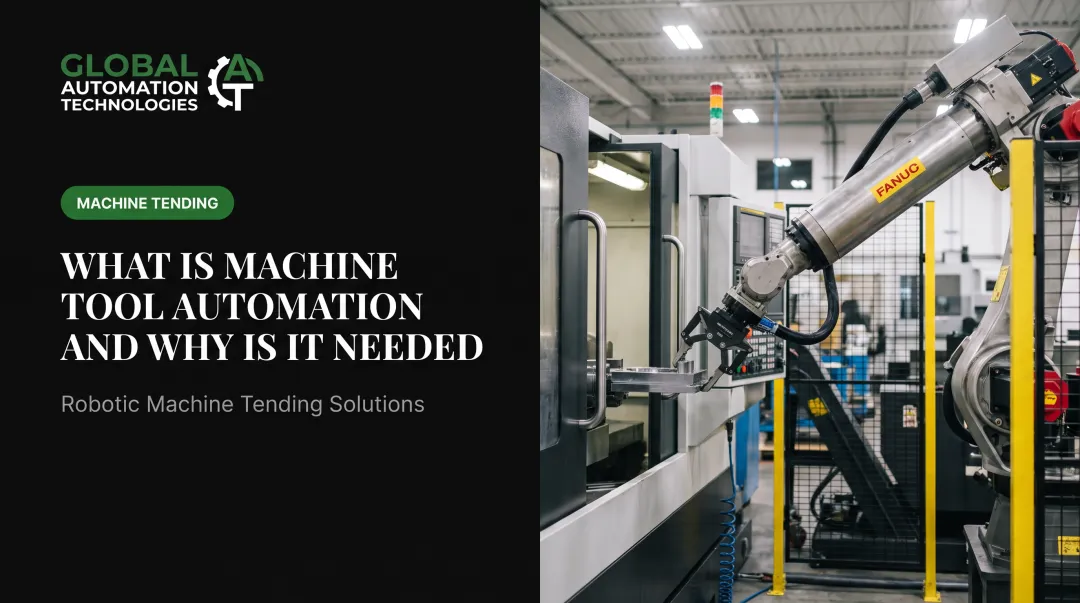
Machine tending shows the same pattern. When a robot runs the load-open-close cycle on CNC machines, presses, or injection molding equipment, it extends run time beyond a single shift, between scheduled maintenance windows, and raises spindle utilization.
Machine tending cells in high-volume manufacturing typically pay for themselves in 12 to 18 months. The math is straightforward: more parts per shift with fewer direct labor hours.
Those cell-level gains show up in industry data. Deloitte's 2025 smart manufacturing survey of 600 executives found manufacturers reporting average improvements of 10%–20% in production output and 7%–20% in employee productivity after adopting smart manufacturing initiatives.
One household-goods manufacturer, RMR Solutions, automated its repacking process with a collaborative robot and jumped from about 2,500 cases on its best manual day to roughly 3,700 cases per day.
Fewer manual handoffs also mean fewer turnover-driven interruptions. Repetitive, ergonomically demanding roles are the hardest to keep staffed, and every vacancy creates downtime risk. Automated cells remove that variable, which lets production planners commit to tighter delivery windows with less risk of missing them.
KPIs this affects: units per hour, Overall Equipment Effectiveness (OEE), downtime frequency, labor cost per unit.
This matters most for high-SKU-count operations, continuous multi-shift production demands, and facilities that can't keep repetitive roles filled long enough to hit consistent output.
Consistent Quality Control and Regulatory Compliance
Automated inspection catches defects, labeling errors, and process deviations before a product moves downstream, not after it reaches a retailer's shelf. In regulated categories, that timing difference is the whole point.
On dispensing lines, vision inspection paired with flow monitoring can catch a surprising range of issues in real time:
- Off-spec bead width (too wide or too narrow)
- Missed paths along the programmed route
- Thin beads from flow-rate deviations that weaken a seal
- Inconsistent volume or placement at the point of application
This is the difference between automated dispensing and simply bolting a gun onto a robotic arm. Vision and flow data are built into the process itself, so no defective part advances to the next station.
Allianz Global Corporate & Specialty analyzed hundreds of product recall insurance claims across 28 countries and found that a significant food and beverage recall claim averages almost $9.5 million. Rework and containment at the source cost a fraction of that.
Automated traceability compounds the benefit. Batch and lot tracking built into the line simplifies retailer compliance audits and speeds recall response if one is needed.
KPIs this affects: defect rate, first-pass yield, compliance audit pass rate, recall frequency.
This matters most in regulated categories — food, beverage, personal care — facing frequent retailer audits and high SKU variability.
Smarter Supply Chain and Demand Forecasting
AI-driven forecasting connects demand signals directly to production scheduling and procurement. When ERP, MES, and WMS systems share data in real time, a shift in retail demand automatically adjusts forecasts, production orders, and purchasing — instead of waiting for someone to notice a gap in a weekly report.
The payoff shows up in working capital. McKinsey reports that autonomous supply-chain planning at several major CPG companies has delivered up to 20% lower inventory and 10% lower supply-chain cost, with SKU-level forecast accuracy improving 10%-12% in one documented implementation.
Tighter forecasts cut both stockouts and overstocking, two problems that drain cash flow from opposite directions. Capital that was trapped in excess inventory can move back into operations.
Speed compounds the advantage. Brands that catch a demand shift within days, rather than weeks, can capture trend-driven sales before slower competitors react.
KPIs this affects: inventory turnover, forecast accuracy, order fill rate, working capital tied to inventory.
This matters most for brands juggling multiple channels — retail, ecommerce, DTC — plus promotional cycles or short-shelf-life products where a forecasting miss becomes expensive fast.

What Happens When Automation Is Missing or Ignored
Manual, disconnected processes don't stay a minor inconvenience. The risk compounds as SKU count, sales channels, and volume all grow at once.
Common consequences include:
- Inconsistent output and quality between shifts or operators
- Higher error and recall rates from gaps in manual inspection
- Reactive firefighting instead of proactive planning, worsened by labor shortages
- Rising per-unit costs as inefficiencies scale with volume
- Slower channel expansion, SKU growth, or acquisitions without matching headcount growth
None of these show up overnight. They creep in gradually until a plant manager realizes the team is spending more time correcting problems than preventing them. By the time leadership spots the pattern in a quarterly review, that inefficiency has usually been baked into operations for months.
How to Get the Most Value from Automation in CPG
Automation pays off most when it's applied consistently across the value chain (production, warehouse, and back-office) rather than as a one-off pilot in a single department. End-of-line projects such as case sealing, palletizing, and case packing are natural starting points because they sit at the intersection of throughput, labor, and packaging quality.
A few principles make the biggest difference:
- Review outcomes on a set cadence. OEE, defect rate, and forecast accuracy need to be reviewed and acted on regularly, not logged into a dashboard nobody checks.
- Sequence projects deliberately. Prove ROI on simpler cells first, then use those learnings to de-risk higher-complexity integrations.
- Choose a partner who provides both the system and the people. This is where a lot of automation investments stall out.
A robotic cell sitting idle because nobody on staff knows how to run or maintain it is an expensive paperweight. Manufacturers get the most value when a provider delivers both the engineered system and the skilled engineers to operate and maintain it.
That's the model GLOBAL Automation Technologies applies across automotive, heavy industry, and other high-volume manufacturing environments. The company pairs automation solutions and engineering services with technical staffing, so the same organization that builds the cell can also supply the controls and mechanical engineers who keep it running.
GLOBAL's engineers use AI-assisted simulation to model and test robot programs before deployment. That cuts programming timelines from weeks to days and reduces the surprises that typically show up during commissioning.
For CPG operations specifically, the transferability runs deep. Robotic material handling (pick-and-place, palletizing, conveyor integration) maps almost directly onto case handling and end-of-line packing. Dispensing and sealing technology built for automotive sealants applies the same precision to filling and dosing applications. If you're evaluating where to start, reach out to discuss your specific line rather than guessing at sequencing on your own.
Conclusion
Automation's value in CPG comes down to three things: control, consistency, and margin protection in an industry defined by thin margins and constant operational pressure. These aren't separate wins. Tighter process control drives consistency on the line, and that consistency is what protects margins when every basis point counts.
Automation isn't a one-time installation you check off a list. It's an ongoing practice that scales only as well as the technology and the engineering talent behind it.
Frequently Asked Questions
What does CPG stand for?
CPG stands for consumer packaged goods: products consumers use regularly and replace frequently, such as food, beverages, household items, and personal care products.
What is CPG in SAP?
Within SAP, CPG refers to the Consumer Products industry solution set: modules and best-practice processes tailored for consumer goods manufacturers covering supply chain, trade promotion, and production planning.
What is CPG in AWS?
AWS offers a Consumer Packaged Goods industry vertical with cloud services for data analytics, supply chain, forecasting, and IoT. These tools help CPG companies run automation and AI workloads at scale.
What are the main types of automation used in CPG manufacturing?
CPG automation typically spans three layers:
- Physical automation: robotics, conveyors, and palletizers
- Back-office automation: RPA for invoicing and compliance
- Analytics-driven automation: AI demand forecasting and predictive maintenance
How much does CPG automation cost and what kind of ROI can manufacturers expect?
Cost and complexity vary by project. Case sealing tends to be low-cost and high-ROI, while case packing is higher-cost and more complex. Engineered machine tending cells often reach payback in roughly 12–18 months.
Is automation replacing jobs in the CPG industry?
Automation primarily shifts roles from manual, repetitive tasks toward knowledge-based oversight of robotic systems. It often improves workplace safety and creates advancement paths rather than simply cutting headcount.