
Automation has become the standard response, and it now operates on two layers that must work in sync: the software managing orders and inventory, and the physical robotics that pick, pack, and move product. Current robotics and automation adoption sits at just 31%, but industry professionals predict that figure will hit 83% within five years, according to MHI's 2024 Industry Report.
This guide breaks down what automated fulfillment actually involves, the technologies driving it, how to vet an automation partner, and how to calculate real ROI before you commit capital.
Key Takeaways
- Pairing OMS/WMS software with robotics cuts manual touchpoints across the order lifecycle.
- Reliability outweighs raw speed; most consumers prefer free standard shipping over paid expedited delivery.
- Full turnkey partners who deliver both systems and staffing reduce handoff friction and speed time-to-value.
- Machine tending and material handling cells often pay for themselves within 12 to 18 months.
- Simulation tools compress deployment timelines from weeks to days before a system ever touches the floor.
What Is Automated Order Fulfillment?
Automated order fulfillment uses software and physical robotics to manage receiving, processing, picking, packing, and shipping with little to no manual intervention. Three interconnected systems make it work:
- Inventory management — tracks stock levels across locations in real time
- Order management — captures, verifies, and routes orders to the right fulfillment point
- Shipping/fulfillment automation — physically moves, picks, packs, and ships the product
How an Automated Fulfillment Workflow Actually Runs
Here's what happens between "order placed" and "package shipped" in a mature automated system:
- Order capture and verification — The system checks payment validity, fraud signals, and stock availability the instant an order is submitted, before it's ever routed anywhere.
- Real-time inventory allocation — Smart routing logic assigns the order to the optimal fulfillment location based on stock levels, proximity, and current workload.
- Automated picking, sorting, and packing — Robotics take over here. Goods-to-person systems, robotic arms, and conveyor sortation move items from storage to a packed, labeled box with minimal human handling.
- Shipping label generation and tracking — Labels print automatically, tracking numbers generate instantly, and delivery confirmation feeds back into the order record.

Each step used to require a person checking a screen or walking a warehouse aisle. Now it happens in seconds. That move from manual checkpoints to continuous automated flow is why more manufacturers and distributors are adopting these systems.
Key Benefits of Automating Order Fulfillment
Automating order fulfillment improves accuracy, scale, and cost control alongside faster throughput.
Core gains include:
- Eliminates manual data entry that drives most pick errors and mis-shipments by cutting human touchpoints where mistakes happen
- Absorbs peak-season volume with longer shifts or added throughput capacity instead of proportional headcount growth
- Compounds savings from lower labor dependency, fewer error-driven returns, and optimized inventory carrying costs
- Improves internal decisions and customer communication with real-time tracking, ending "let me check on that" calls
Speed still matters, but not the way most operations assume. McKinsey's survey of more than 1,000 US consumers found that 90% would wait at least two to three days for delivery, and more than 95% preferred free standard shipping over paid expedited options.
Fewer than 5% prioritized maximum speed regardless of price. The ROI case centers on reliable delivery windows without rush shipping or overtime labor.
Core Technologies Behind Automated Fulfillment Systems
Software gets the fulfillment process started. Robotics gets the product moving. Here's how the layers stack:
| Technology | Role in Fulfillment |
|---|---|
| OMS | Manages order lifecycle: entry, inventory sync, fulfillment routing |
| WMS | Coordinates labor, space, equipment, and material flow inside the facility |
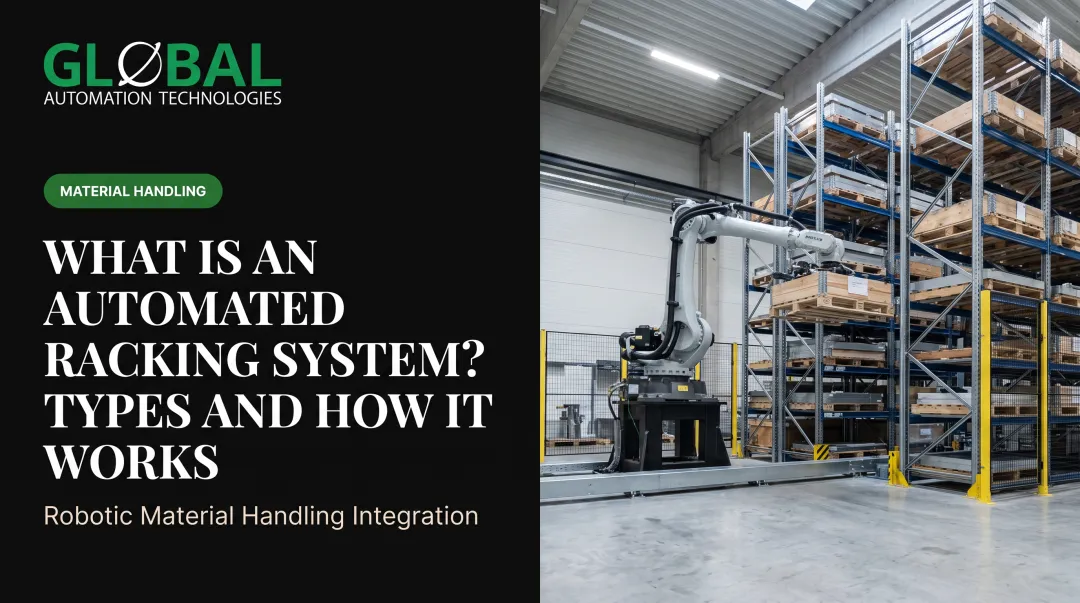
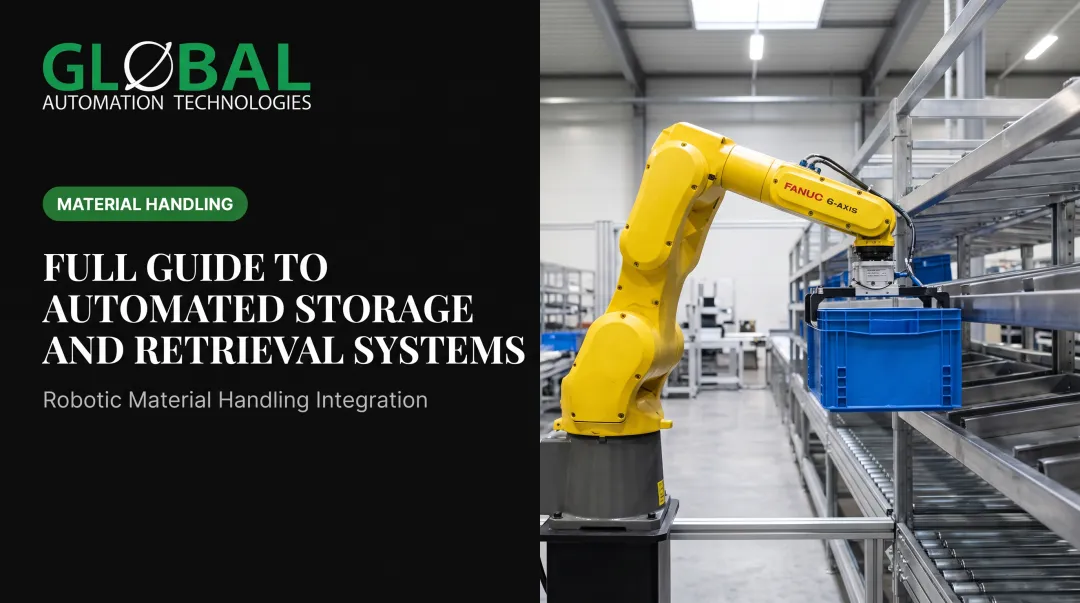
| AS/RS | Handles high-density, high-speed storage and retrieval |
| Conveyor/sortation | Moves and consolidates goods for outbound shipping |
| Barcode/RFID/vision | Validates accuracy during picking and packing |
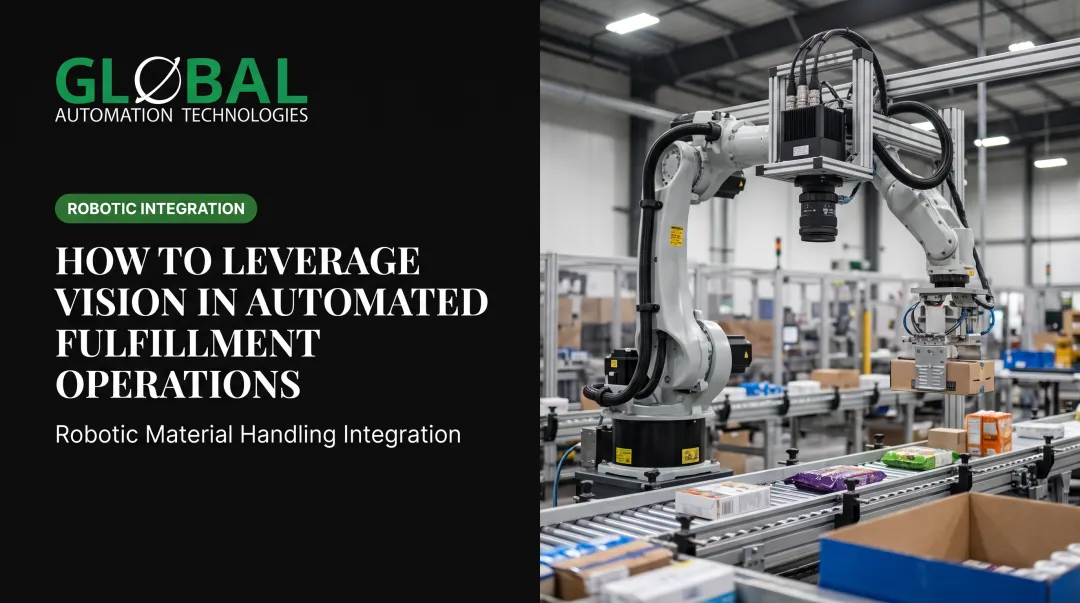
Robotics is where the physical work gets done. Goods-to-person systems bring inventory to a fixed picking station instead of sending a worker down aisles. Robotic piece-picking handles individual SKUs with vision-guided precision, cutting labor strain and raising throughput per shift.
This isn't limited to ecommerce warehouses anymore. Robotic machine tending and material handling systems—the kind integrators like GLOBAL Automation Technologies build for automotive and heavy industry plant floors—are moving into distribution and fulfillment environments.
Applications that transfer directly include:
- Palletizing and depalletizing
- Part transfer and conveyor integration
- Vision-guided pick-and-place
The same principles that keep a CNC line fed with parts apply to keeping a fulfillment line fed with orders.
AI-assisted simulation and predictive maintenance round out the stack. Simulation tools let engineering teams model and test robot programs before deployment, catching collision risks and inefficiencies in a virtual environment instead of during live commissioning. Predictive health assessments flag equipment issues—worn actuators, drifting sensors—before they cause unplanned downtime.
Integration layers (APIs) tie it all together, connecting ecommerce platforms, ERP/CRM, WMS, and robotic controls into one workflow instead of five disconnected systems.

How to Choose the Right Automation Partner
Not every automation vendor operates the same way, and the differences matter more once you're mid-project.
Look for full turnkey capability. A partner who handles layout, design, build, programming, installation, commissioning, and ongoing support avoids the handoff gaps that happen when you're coordinating three separate vendors for one system.
Consider the staffing question early. A robotic system is only as good as the engineers who run and maintain it. GLOBAL Automation Technologies, which holds Level 5 status in FANUC’s Authorized System Integrator program, keeps three offerings distinct: automation solutions builds the robotic cell, engineering services places GLOBAL's own engineers on customer contracts, and technical staffing recruits controls, mechanical, and project management engineers into the roles that keep it running.
Because that work sits under one roof, engineers placed on your floor already understand the system's architecture instead of learning it from scratch.
Check cross-industry problem-solving depth. A partner who's solved similar throughput and accuracy problems in automotive body shops or aerospace assembly brings that experience to a fulfillment application. Ask about:
- Countries and facilities worked in—not just headquarters location
- Systems integrated across different industries
- Solutions adapted from one vertical to another
That last point matters more than it sounds. A welding fix from an automotive line and a picking bottleneck in a distribution center are different problems solved with the same applications-first thinking.
Steps to Implement Automated Order Fulfillment
Rolling out automation without a plan is how projects stall in phase two. Follow a structured sequence instead:
- Audit current workflows — Identify where errors, cycle-time delays, and labor costs concentrate. You can't automate what you haven't measured.
- Define objectives and select the right mix — Software-only automation suits lower-complexity operations; robotics-integrated automation makes sense once order volume and SKU count justify the investment.
- Pilot and simulate before full rollout — Validate robot programs and layouts in a virtual environment with AI-assisted simulation before you touch the floor. Tasks that once took weeks of on-floor programming can be modeled and tested in days, cutting deployment risk significantly.
- Train teams and monitor post-launch — Real-time performance data should drive iteration, not a one-time setup and walk-away approach.
Skipping the audit step is the most common mistake. Teams jump straight to a full system commitment without knowing which bottleneck is actually costing them the most.
Calculating the ROI of Fulfillment Automation
The basic formula is simple:
ROI = (Total Savings − Total Costs) ÷ Total Costs × 100
Build the inputs carefully:
- Total costs: upfront investment, training, and ongoing maintenance—not just equipment price
- Total savings: labor reduction, error and return reduction, and throughput gains
Payback timelines vary by technology. AutoStore reports that its AS/RS systems typically deliver payback within one to three years, based on capital expenditure and annual maintenance fees, according to the company's Q1 2022 investor report. That's a vendor-specific benchmark, not a universal guarantee, so treat it as a planning range rather than a promise.
For comparison, robotic machine tending and material handling cells typically pay for themselves in 12 to 18 months, one of the faster payback windows in plant-floor automation. Longer runtime between scheduled maintenance windows plus reduced labor hours compounds faster than most teams expect.

Model best-case and worst-case scenarios. Those payback ranges shift with volume and labor assumptions, so stress-test the model before you commit. Run your ROI calculation against:
- Peak-season volume assumptions
- Baseline off-season volume
- A conservative labor-savings estimate versus an aggressive one
If your worst-case scenario still shows payback under three years, you likely have a solid business case.
Frequently Asked Questions
What is the difference between order processing automation and order fulfillment automation?
Order processing automation handles the transactional software steps: data capture, verification, and routing. Order fulfillment automation extends into physical handling—picking, packing, and shipping—often through robotics.
How much does it cost to implement automated order fulfillment?
Costs vary widely based on scale and whether you're deploying software-only tools or robotics-integrated systems. Start with a phased approach targeting your highest-impact bottleneck rather than a full overhaul.
What industries benefit most from automated fulfillment systems?
Ecommerce and retail distribution see clear gains. Manufacturing, automotive, and heavy industry benefit just as much wherever high-volume material handling and consistent throughput matter.
Can small or mid-sized businesses use automated order fulfillment technology?
Yes. Modular solutions—smaller robotic cells and targeted software tools—let smaller operations automate a specific bottleneck without a full warehouse overhaul.
How long does it take to implement an automated fulfillment system?
Timelines range from a few weeks for software-only automation to several months for robotics integration. Simulation tools can compress that timeline significantly by validating designs before physical build.
What's the difference between software automation (OMS) and physical automation (robotics) in fulfillment?
OMS software manages data, orders, and inventory decisions. Robotics executes the actual movement, sorting, and handling of goods. Most mature fulfillment operations run both together.