
Automation gets discussed constantly in trade publications and conference panels, but the real proof is in numbers your shop already tracks: spindle uptime, scrap rate, on-time delivery percentage. Those metrics don't lie, and they're exactly where automation earns or loses its keep.
This article breaks down what machine tool automation actually does on the floor, why manufacturers need it right now, and what measurable results it produces once it's running.
TL;DR
- Machine tool automation applies control systems, robotics, and software so loading, machining, and monitoring run with minimal manual work
- It directly addresses labor shortages, cost pressure, and quality that has to hold at production volume
- Measurable wins show up as higher throughput, tighter precision, and safer cells
- Skip it and you typically inherit inconsistent output, more scrap, and headcount that only scales cost
- Real ROI depends on pairing the right cell with engineers who can program and keep it running
What Is Machine Tool Automation
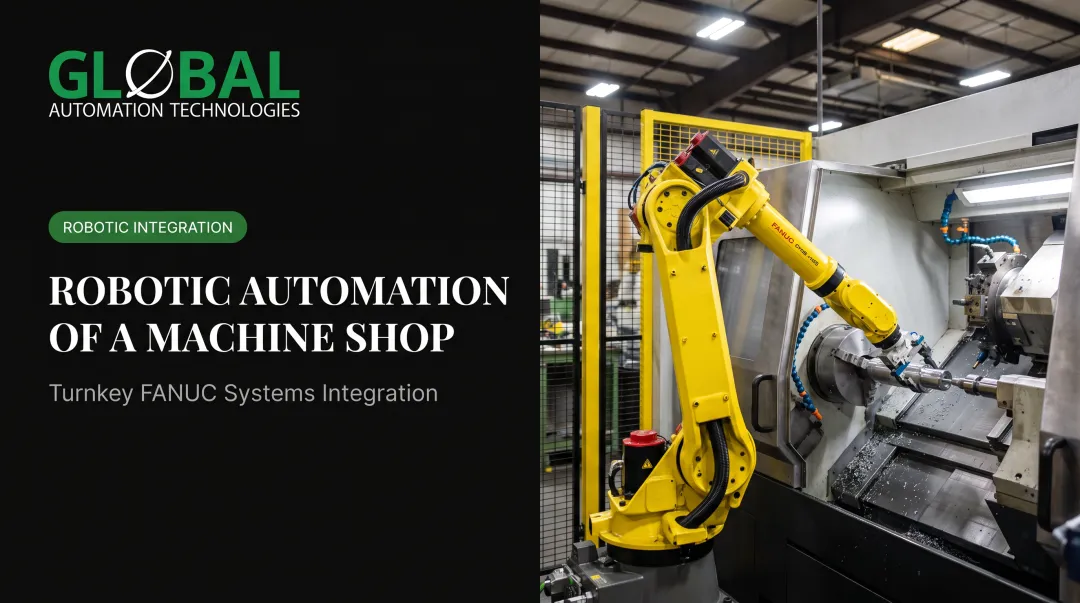
Machine tool automation is the use of control systems, robotic loaders and unloaders, and monitoring software to run machining operations with minimal human hands-on involvement. Instead of an operator opening a door, placing a part, closing the door, and hitting start hundreds of times a shift, a robot or automated feeder does it.
You'll typically see it applied in:
- CNC milling and turning centers with robotic machine tending arms
- Bar feeders that automatically load raw stock into lathes for unattended runs
- Pallet systems that stage multiple jobs so a machine can switch between parts without operator intervention
- In-process inspection, such as automated probing that checks dimensions mid-cycle and flags or corrects out-of-tolerance features

The goal is higher spindle utilization, throughput, and consistency. Those outcomes matter far more to your bottom line than headcount reduction alone.
Key Advantages of Machine Tool Automation
The advantages below aren't theoretical. Each one ties directly to a metric you're probably already reporting on: cost per part, scrap rate, throughput, or safety incidents. Here's how automation moves those numbers.
Increased Productivity Through Extended Runtime
Automation lets machines keep cutting through lunch breaks, shift changes, and into lights-out hours between scheduled maintenance windows, without anyone standing in front of the control panel. Robotic loaders, bar feeders, and pallet systems keep material flowing so the spindle rarely sits idle between parts.
That idle time adds up fast. Every minute a spindle waits for an operator to reload is a minute of lost capacity, capacity you'd otherwise have to buy with another machine or another shift of labor.
One documented example makes the case well: a manufacturer running two FANUC ROBODRILLs with robotic loaders increased output from 100 to more than 150 parts per eight-hour shift, operating 20 to 24 hours a day.
FANUC reported a 33% production-efficiency increase from the change, according to FANUC America's case study on robotic CNC machine tending.
This kind of extended, lights-out runtime changes how shops plan capacity. Instead of adding machines and operators to meet growing demand, you extend the hours your existing equipment already runs.
KPIs this affects:
- Spindle utilization rate
- Parts produced per shift
- Overtime and labor cost
- Overall throughput
Robotic machine tending cells often pay back in roughly 12 to 18 months through this added runtime beyond a single shift. High labor-cost regions, high-volume operations that run lights-out between scheduled maintenance windows, and high-mix shops juggling frequent changeovers tend to see the biggest lift.
Enhanced Precision and Consistent Quality
Manual loading introduces variability: clamping pressure differs slightly from person to person, fatigue creeps in over a long shift, and technique shifts between operators. Automated loading removes that variability entirely. Every part gets the same clamping pressure, the same positioning, the same cycle execution, regardless of who's on shift.
That consistency compounds over long production runs. Small variances that seem harmless on their own start stacking into real losses (scrap, rework, and blown tolerances) once you're running thousands of parts.
Automated on-machine probing adds another layer, confirming part position and dimensions mid-cycle and triggering alerts or cutter compensation before a bad part is finished, according to Modern Machine Shop's coverage of automated probing.
In tight-tolerance industries like automotive and aerospace, one out-of-spec part can hold up an entire delivery.
KPIs this affects:
- Scrap rate
- First-pass yield
- Rework hours
- Tolerance conformance
GLOBAL's machine tending systems can be built with optional vision systems for part recognition, orientation verification, and quality checks between operations. That setup answers the consistency demands of high-volume, tight-tolerance production, especially in regulated industries and long runs where a single certification failure carries real cost.
Improved Workplace Safety and Reduced Dependency on Scarce Skilled Labor
Machine tending is repetitive and physically demanding: bending, reaching, lifting parts, handling sharp edges hundreds of times a shift. Automation takes that work off an operator's plate entirely, freeing skilled staff for programming, setup, and process oversight instead.
The safety math backs this up. OSHA reported an estimated 2.6 million nonfatal private-sector injuries and illnesses in 2023, or 2.4 cases per 100 full-time-equivalent workers, according to OSHA's 2023 Work-Related Injury and Illness Summary.
OSHA also flags moving machine parts as a cause of crushed hands, amputations, and burns, and requires hazardous functions to be guarded.
Beyond safety, there's the labor angle. Skilled machinists are hard to find and harder to retain. Automation lets fewer experienced operators oversee more machines instead of competing for scarce talent in a shrinking labor pool.
KPIs this affects:
- Incident and injury rate
- Absenteeism
- Recruitment and retention cost
- Machines-per-operator ratio
Expect the strongest impact in labor-constrained regions, hazardous or physically demanding processes, and growth phases where hiring simply can't keep pace with order volume.
What Happens When Machine Tool Automation Is Missing or Ignored
Staying manual too long doesn't just mean leaving efficiency gains on the table. It creates compounding problems:
- Inconsistent output between shifts and operators, with quality and pace tied to who is running the machine
- Higher scrap and rework from manual handling errors that automated loading would have prevented
- Reactive firefighting instead of predictable, plannable production
- Rising per-unit costs as automated competitors cut prices while your shop absorbs higher labor and material costs
There's also a structural problem: scaling output without automation usually means scaling headcount proportionally.
That's a tough ask when U.S. manufacturing could need as many as 3.8 million additional employees between 2024 and 2033, with up to 1.9 million positions projected to go unfilled, according to The Manufacturing Institute's 2024 workforce projections.
Chasing growth through headcount alone puts you in direct competition for a labor pool that keeps shrinking.
How to Get the Most Value from Machine Tool Automation
Automation delivers the most value when it's applied consistently across every shift, not treated as a one-off patch for the night crew. Uptime, scrap rate, and cycle time need to be tracked continuously, and those insights need to drive action, not just sit in a spreadsheet.
A few principles worth following:
- Start with an actual-state analysis: evaluate your parts, machine type and age, and available floor space before choosing an automation approach
- Match the approach to the application: direct robot loading typically fits larger lot sizes, while pallet systems suit low-lot, high-complexity work
- Track outcomes weekly, not annually: uptime and scrap trends only become useful if someone's reviewing and acting on them
- Staff for the system, not just the install: hardware alone doesn't run itself

That last point is where a lot of automation projects stall. A robotic cell is only as good as the engineer who programs, maintains, and optimizes it.
Manufacturers increasingly look for one partner who supplies both the automated system and the people to run it. GLOBAL Automation Technologies builds and integrates the machine tending cell through its automation solutions and engineering services work, and its technical staffing separately places controls engineers, mechanical designers, and commissioning specialists into customer roles on a contract, contract-to-hire, or direct-hire basis. As a 17-plus-year, Level 5 FANUC Authorized System Integrator, GLOBAL brings deep experience programming and supporting FANUC robotic cells like the ROBODRILL tending systems described above.
Conclusion
The real value of machine tool automation is the control and consistency it brings to daily production. Hardware matters, but productivity and quality gains only compound when the system is properly maintained and staffed by people who understand it.
Treat automation as an ongoing operational practice, not a one-time equipment purchase, and it keeps paying off long after the initial install.
Frequently Asked Questions
What is machine tool control in manufacturing automation?
Machine tool control refers to the CNC or PLC-based systems that direct tool paths, spindle speeds, and machine movements automatically. It's the "brain" that executes programmed instructions without manual input.
What's the difference between CNC machining and machine tool automation?
CNC machining automates the cutting process itself. Machine tool automation extends further, adding automated loading, unloading, tool changing, and monitoring around that CNC process.
How much does machine tool automation cost to implement?
Costs vary widely by scope. A simple part loader costs far less than a full robotic tending cell with vision or multi-machine capability. Final budget depends on cell complexity, robot count, and integration requirements.
What is robotic machine tending?
Robotic machine tending uses a robot to automatically load and unload parts from a CNC machine. It enables extended runtime beyond a single shift, including lights-out running between scheduled maintenance windows, without a dedicated operator at the machine.
Can machine tool automation work with older or legacy machines?
Many legacy machines can be retrofitted with automation, depending on available interfaces and physical access. Newer machines are generally easier and less costly to automate.
How long does it take to see ROI from machine tool automation?
ROI timelines depend on production volume and labor costs. Many machine tending and automation cells reach payback within 12 to 18 months of going live.