
In July 2024, OSHA cited a Houston metal finisher for more than 40 safety hazards, including uncontrolled exposure to triglycidyl isocyanurate and total dust, and proposed over $338,000 in penalties. That's the real cost of leaving powder application to chance.
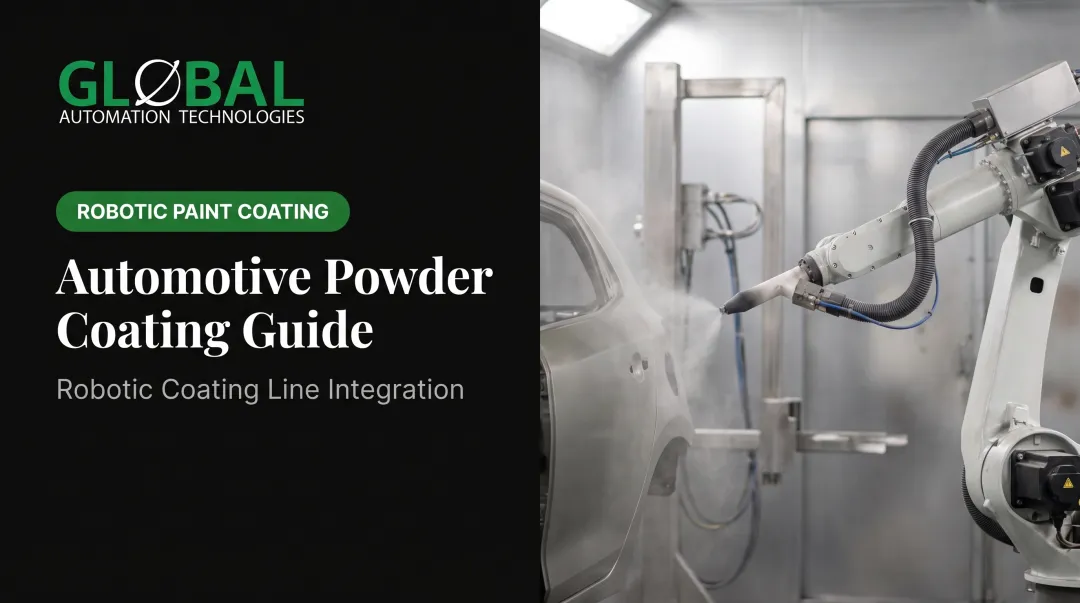
Robotic powder coating systems fix this by applying powder with repeatable precision, pulling operators out of the booth, and running production around the clock. This guide breaks down how the technology works, what it costs, where it's used, and how to pick the right integration partner.
Key Takeaways
- Robots deliver repeatable film-build accuracy that cuts rework and powder waste vs. manual guns
- Nordson reports robotic guns can cut powder use by up to 45% vs. manual spraying
- Automation pulls workers out of booth dust exposure and enables unattended production shifts
- Costs scale with part complexity and mix—quote from a real process study, not guesswork
- Robot architecture (articulated, linear, or 7th-axis) hinges on part geometry and line layout
What Are Powder Coating Robots and How Do They Work
What Are Powder Coating Robots and How Do They Work?
Powder coating is an electrostatic dry-finishing process. A gun charges powder particles that cling to a grounded workpiece. Heat then cures them into a hard, cross-linked finish, according to the Powder Coating Institute. No solvents, no VOC-heavy overspray drifting through the plant.
Manufacturers are shifting from handheld guns to robotic arms because manual application depends on a person maintaining perfect gun distance, angle, and speed for an entire shift. That's hard to sustain. A robot holds those parameters steady on every part, every shift.
Types of Robots Used in Powder Coating
- Articulated 6-axis robots — Best for complex geometries, recesses, and cut-ins. FANUC's Paint Mate line, for example, is built specifically for finishing work.
- Cartesian/linear reciprocators — Move guns vertically or horizontally in repeatable strokes. Ideal for flat or simple parts moving at volume.
- 7th-axis linear track systems — Extend a robot's reach along a conveyor line, useful for long parts or multi-station booths.
| Architecture | Best fit | Trade-off |
|---|---|---|
| Linear reciprocator | Flat, repetitive parts | Least path flexibility |
| 6-axis articulated | Contours, recesses | More programming required |
| 7th-axis rail robot | Extended envelope | More booth space, guarding |

Core System Components
A powder coating cell isn't just a robot with a gun bolted on. It includes:
- Robot arm — matched to part geometry and reach requirements
- Powder delivery system — dense-phase pumps or venturi injectors; dense phase holds steadier output over long runs
- TCP calibration — keeps the gun tip on the intended path
- Communication protocols — link the robot and gun controllers for triggering, flow rate, and fault handling
Vision systems can also adjust spray coverage in real time as irregular shapes move through the booth, catching gaps before they become rejects.
Programming Methods Explained
- Point-to-point/teach-in — An engineer manually teaches the robot each position along the path. Reliable for stable, low-mix parts.
- Lead-through/self-teaching — The robot "learns" by mirroring a technician's hand-guided motion, capturing a human finisher's natural technique.
- Offline 3D simulation — Programs are built and tested in software before the robot ever touches the line, based on CAD data or 3D scans.
GLOBAL's AI-assisted simulation tools belong in that third group. They cut robot programming time from weeks to days by letting engineers model and optimize paths before deployment. That matters most in high-mix operations, where every new part once meant days of manual re-teaching.

Key Benefits of Robotic Powder Coating Systems
Robotic powder coating improves quality, cost, throughput, and safety beyond what manual spray can sustain.
- Consistency: Robots apply the same spray pattern every cycle. GLOBAL's robotic coating systems hold film build within specification, a level of repeatability a human hand can't match shift after shift.
- Less waste, lower cost per part: Nordson customer data shows robotic guns reducing powder consumption by up to 45%, with one case reporting roughly 30% powder savings and consistent film build over three shifts.
- Higher throughput: A Nordson case study on structural steel profiles cut a 20-hour manual job down to a single 8-hour shift, with a 40% cut in annual powder use. Robots skip breaks and booth-entry downtime between parts.
- Worker safety: Removing operators from the booth cuts exposure to airborne powder, isocyanate-containing formulations like TGIC, and combustible dust. Those are the same hazards OSHA flagged in its 2024 enforcement action.
- In-process defect detection: Machine-vision inspection flags runs, sags, or missed coverage in real time and can trigger a robotic touch-up before the part moves to the cure oven.

Those gains line up with broader adoption of powder finishing. The global powder coatings market was valued around $16.3 billion in 2025, according to MarketsandMarkets, and is projected to grow steadily through 2031.
Industries and Applications Using Powder Coating Robots
Powder coating robots show up on lines that need consistent finish quality, corrosion protection, and high throughput. Common deployments include:
- Automotive & EV manufacturing — Wheels, bumpers, and chassis components need uniform coverage that holds up to road exposure. Powder primer work is increasingly robot-mounted for consistency.
- Heavy equipment & industrial manufacturing — Construction, agricultural, and mining equipment need thick, corrosion-resistant coatings. One forklift manufacturer retrofitted three booths with dual coating robots and saw smoother, more reproducible finishes.
- Consumer goods & data center infrastructure — Appliances, electrical enclosures, and server racks need attractive finishes with frequent color changes. One industrial cabinet manufacturer runs 15–20 shades per day with changeovers in 15–20 minutes.
How Much Does a Robotic Powder Coating System Cost
Cost depends on several variables, and there's no universal price tag. The main drivers include:
- Robot hardware: number of robots, reach, and axis count
- Powder delivery equipment: guns, pumps, and controllers
- Booth and conveyor integration: airflow design, speed synchronization, recovery systems
- Programming and software: offline simulation, path optimization
- Training and compliance: hazardous-area engineering, operator training, commissioning support
Upfront investment runs higher than a manual booth setup. Most robotic cells still pay for themselves through reduced material waste, fewer rework hours, and higher throughput.
GLOBAL's benchmark for machine-tending robotic cells is a 12 to 18 month payback, driven by more parts per shift and reduced direct labor. Similar logic applies to powder coating cells, though specific payback depends heavily on your part mix.
High-mix operations, where dozens of part types run through the same booth, need a deeper process analysis before quoting. Volume and variety both affect the math.
Choosing the Right Powder Coating Robot Partner
Not every integrator fits every application. Before signing a contract, weigh:
- Production volume — High-volume, low-mix lines favor different robot architecture than high-mix job shops
- Part complexity — Complex geometries need articulated robots and vision guidance; flat parts may only need reciprocators
- Existing line compatibility — Conveyor speed, booth dimensions, and PLC architecture all affect retrofit feasibility
- Integrator experience — Ask for specifics on robot count deployed, industries served, and post-installation support
A turnkey partner should cover the full lifecycle: layout, design, build, programming, validation, installation, training, and ongoing support. That's the difference between a vendor who drops off equipment and one who stays involved after startup.
GLOBAL Automation Technologies, which holds Level 5 status in FANUC’s Authorized System Integrator program, delivers both sides of that equation: automation solutions and the engineering talent to run and maintain the cells afterward.
With 17+ years in business and 700+ FANUC robots installed across 22 countries, GLOBAL builds FANUC-based powder coating systems around each client's part geometry, substrate, and finish requirements. The same partner then staffs the engineers who keep those cells running.
Frequently Asked Questions
How much does a robotic powder coating system cost?
Costs vary based on robot type, integration complexity, and booth setup, so there's no fixed price point. Most systems pay for themselves within 1 to 3 years depending on volume and part mix.
What is the latest robotic powder coating technology?
Current advances include AI-assisted offline simulation and hand-guided lead-through programming. Real-time vision inspection can also trigger a robotic touch-up before parts leave the booth.
Is robotic powder coating better than manual application?
Robots deliver tighter film build consistency, less material waste, and remove operators from hazardous powder dust exposure. Manual application still has a place for one-off or highly custom finishing work.
What industries benefit most from powder coating automation?
Automotive and EV manufacturing, heavy equipment, and general industrial manufacturing see the strongest gains, thanks to high part volumes and demanding durability requirements.
How long does it take to implement a robotic powder coating system?
Timelines vary by project scope, covering design, booth engineering, programming, installation, and commissioning. AI-assisted simulation can shorten the programming phase from weeks to days.
Can robotic powder coating systems be added to an existing production line?
Yes, but retrofits require careful conveyor speed synchronization, booth airflow validation, and PLC integration to avoid line stoppages. A process study upfront prevents surprises during installation.