
Industrial automation and control solutions (IACS) are the hardware, software, and engineering expertise that keep modern plants running without constant human intervention. This guide covers the core components, the main control system types, the real business case, and how to pick a partner who won't leave you holding the risk.
Key Takeaways
- IACS closes the loop—sensors, PLC/DCS/SCADA controllers, and actuators—so processes run with less manual intervention
- PLCs, DCS, and SCADA fit different plant sizes and industries: the wrong choice means costly rework later
- Automation pays back in higher throughput, fewer defects, and fewer safety incidents on the floor
- The right automation partner counts as much as the hardware—implementation and the engineers who keep it running
What Are Industrial Automation and Control Solutions?
Industrial automation and control solutions (IACS) integrate sensors, controllers, and software to automate industrial equipment and processes. The industrial control and factory automation market is projected to grow from $274.99 billion in 2025 to $435.24 billion by 2030, a 9.6% CAGR (MarketsandMarkets).
The goal is simple: replace manual, repetitive, or hazardous tasks with consistent, programmable control. A human operator gets tired, distracted, or hurt. A properly programmed controller doesn't.
Core Components of an Automation Control System
Every automation system, regardless of complexity, breaks down into the same building blocks:
- Input devices (sensors): Digital and analog sensors detect process conditions—temperature, position, pressure, presence—and feed that data to the controller
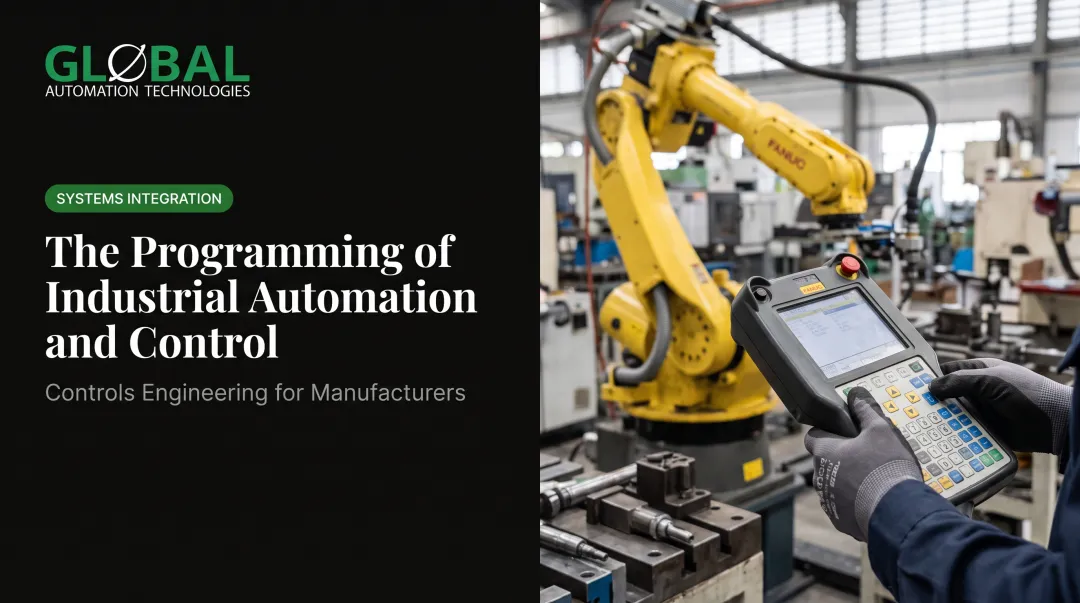
- Controllers (PLCs/PACs): The "brain" of the system, processing logic and issuing commands based on programmed rules
- Output devices/actuators: Motors, valves, and robots that physically execute the commanded action
- HMIs and industrial networking: Interfaces and networks that give operators process visibility and a way to intervene when needed

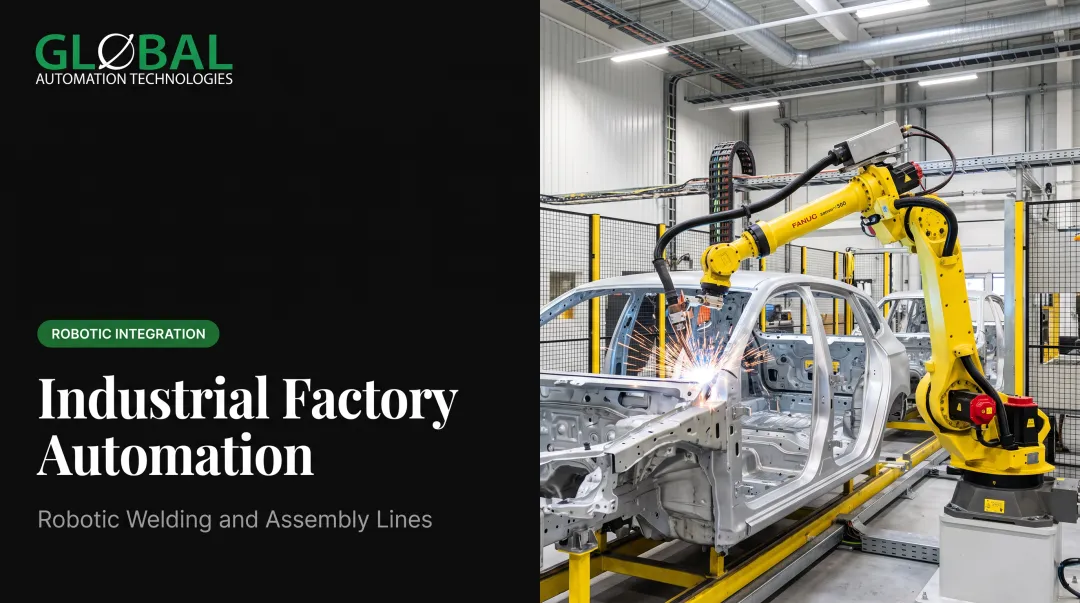
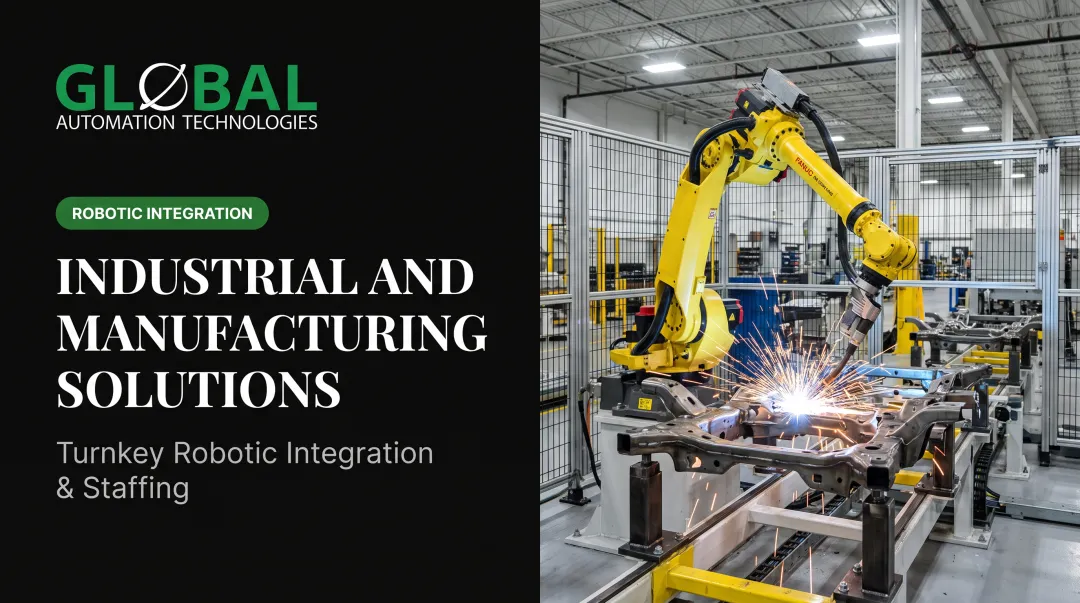
Robotics has become the dominant actuation layer in modern plants. FANUC-based robotic systems, for example, are purpose-built for precision tasks like welding, painting, and machine tending — jobs where a fraction of a millimeter matters and consistency can't waver cycle after cycle.
Types of Industrial Control Systems: PLC, DCS, and SCADA
Picking the wrong control architecture creates headaches for years. Here's how the three main types differ.
PLCs are ruggedized industrial computers built for discrete, machine-level control. Think assembly lines, packaging equipment, and automotive body shops: anywhere you need fast, repeatable logic tied to a specific machine or cell.
DCS takes a distributed approach, better suited to large, continuous processes like chemical plants or power generation, where dozens of local control loops need coordinated supervision.
SCADA operates one level up. It is a supervisory layer for monitoring and controlling operations spread across multiple sites, such as water treatment networks, pipelines, or multi-plant operations. The focus is centralized visibility over geographically dispersed assets, not real-time local control.
Which System Fits Your Plant?
| Plant type | Best-fit system |
|---|---|
| Single machine or production cell | PLC |
| Large continuous/batch process facility | DCS |
| Multi-site or geographically spread operations | SCADA |
| Brownfield plant needing IT + OT convergence | Edge controller |

These lines are blurring fast. Edge controllers now combine deterministic PLC-style control with IT-level computing, letting a single device handle both machine control and data analytics (ISA, 2022).
IIoT connectivity means a PLC on the floor can now feed data straight into a SCADA dashboard without a separate integration layer.
Business Benefits of Automation and Control Solutions
The case for automation isn't theoretical. Advanced production systems can unlock productivity gains of up to 60%, according to BCG's 2026 factory-of-the-future research (BCG). That figure is an upper bound, not a guarantee, but it still signals real upside.
Quality and consistency improve because a programmed controller executes the same motion, the same path, the same parameters, every single cycle. No fatigue, no drift, no Monday-morning variance.
Safety is where automation earns its keep fastest. Removing workers from paint booths, welding cells, and other hazardous environments eliminates direct exposure to fumes, arc flash, and repetitive strain risks.
OSHA documents robot substitution as a standard strategy for dangerous or repetitive tasks (OSHA). NIOSH also flags new risks—struck-by and caught-between hazards—that still require proper guarding and training.
ROI timelines are often faster than people expect:
- Robotic machine tending cells typically pay for themselves in 12-18 months
- Payback is driven by more parts per shift with fewer direct labor hours
- Gains come from extended unattended operation and eliminated idle time between manual load cycles
One real-world proof point: after Will-Burt Co. deployed FANUC arc-welding robots to address a welder shortage, the company gained 240-320 additional welding hours per week per robotic system, enabling roughly $4 million in additional contract fabrication work (FANUC).

How to Choose the Right Automation and Control Partner
The technology matters. So does the vendor delivering it. In a McKinsey survey of industrial executives, 71% cited robot capital cost as a barrier, 61% cited lack of automation experience, and 42% struggled to find a holistic end-to-end provider. A fragmented vendor landscape is a documented problem, not a theoretical one.
When you evaluate partners, weigh these factors:
- Full-lifecycle accountability (design through ongoing support)
- In-house ability to staff the cell after handoff
- Proof they can compress programming and commissioning time
- Experience in your process (welding, paint, dispense, tending, handling)
Why Turnkey Capability Reduces Risk
Piecing together separate vendors for design, build, programming, installation, training, and support creates gaps. When something breaks, everyone points fingers.
A single-source partner who owns the full lifecycle carries the accountability instead of splitting it across half a dozen contracts.
Automation Solutions, Services and Staffing
Here's a gap most integrators don't address: you get a working robotic cell, then discover you don't have the controls engineer to run it. GLOBAL Automation Technologies, a top-tier Level 5 FANUC Authorized System Integrator, built its model around solving exactly that.
GLOBAL pairs automation solutions and services—primarily FANUC platforms across welding, painting, dispensing, material handling, and machine tending—with a technical staffing division that supplies controls engineers, PLC programmers, and commissioning specialists on contract or direct-hire terms. One relationship covers both the system and the people to run it, so you are not chasing an integrator and a staffing agency separately.
AI as a Deployment Differentiator
AI-assisted simulation is changing how fast projects go live. Engineers can model and test robot programs before writing production code. That shortens programming timelines from weeks to days, instead of debugging live on the floor.
Predictive maintenance tools follow the same logic. They flag equipment health issues early so plants avoid unplanned downtime rather than reacting after a failure.
Frequently Asked Questions
What are examples of industrial control systems?
The three primary types are PLCs (used for discrete machine control like assembly lines), DCS (used in continuous processes like chemical plants), and SCADA (used for supervisory monitoring across dispersed sites like pipelines).
What do automation control solutions do?
They handle process control, machine automation, safety monitoring, and data collection. In practice, that means sensors detect conditions, controllers make decisions, and actuators carry out physical actions automatically.
Is SCADA an industrial control system?
Yes. SCADA is a type of ICS focused specifically on supervisory monitoring and control across geographically distributed operations, rather than real-time control of a single machine.
What industries rely most on industrial automation and control systems?
Automotive OEMs, heavy equipment manufacturers, and general industrial manufacturing lean heavily on automation. Chemical, pharmaceutical, and food and beverage processing also depend on it for continuous-process control.
How much does an industrial automation system cost?
Cost varies widely by scope, from a single machine-tending cell to a full turnkey line. As a benchmark, robotic machine tending cells typically pay for themselves in 12 to 18 months through labor and throughput gains.
What is the difference between a PLC and a DCS?
A PLC handles discrete, machine-level control for a specific piece of equipment or line. A DCS coordinates distributed control loops across an entire continuous process, like a refinery or power plant.