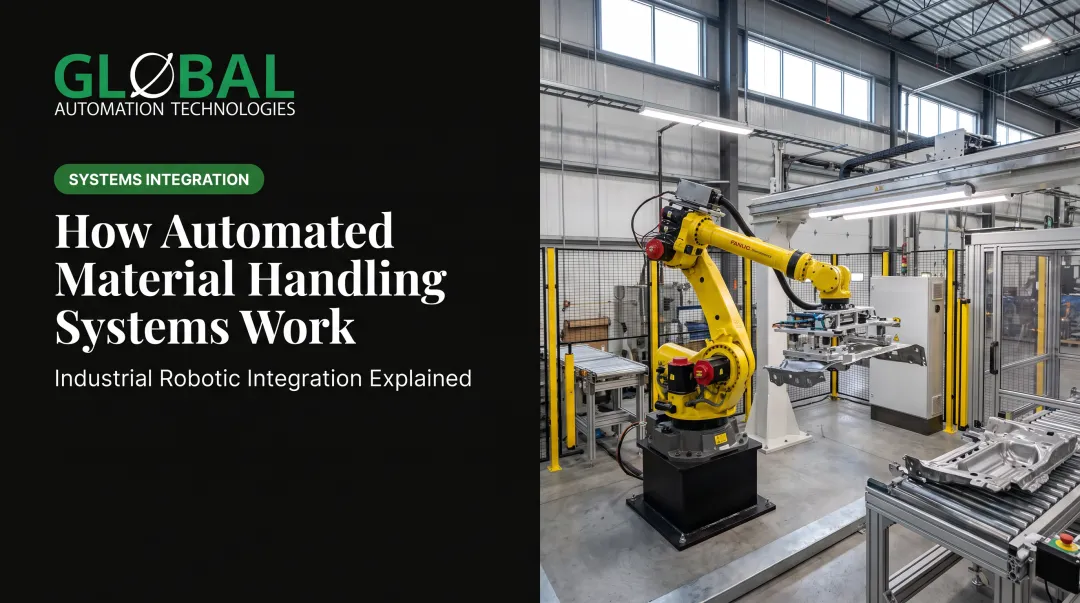

Automated material handling isn't a nice-to-have anymore. It's how plants stay staffed, stay safe, and stay competitive.
This article covers what automated material handling systems (AMHS) actually are, the equipment types available, real benefits and challenges, and how to pick an implementation partner. GLOBAL Automation Technologies, which holds Level 5 status in FANUC’s Authorized System Integrator program, has spent 17+ years deploying robotic material handling solutions for automotive, Tier 1, and heavy industry manufacturers, and we'll draw on that experience throughout.
Key Takeaways
- Labor shortages and throughput pressure are pushing AMHS from optional to essential
- AGVs suit fixed, repetitive routes; AMRs handle dynamic, changing layouts
- Machine tending cells typically pay for themselves in 12-18 months
- Built-in predictive maintenance flags issues before they cause unplanned downtime
- The right automation partner delivers both the system and the engineers to run it
What Is Material Handling Automation?
Automated material handling systems use technology, equipment, and software to move, store, and manage materials with minimal human intervention. Instead of workers physically carrying parts between stations, robots, conveyors, and mobile vehicles do the moving.
There are two broad categories:
- Fixed automation: Conveyors and fixed robotic cells built for one repeated task. Think a conveyor line feeding a press, or a robotic cell palletizing the same box shape all day.
- Flexible automation: Automated guided vehicles (AGVs), autonomous mobile robots (AMRs), and robotic arms that adapt to varying part types, routes, or production sequences.
Fixed systems win on raw throughput. Flexible systems win on adaptability. Most plants end up running a mix of both.
Why Manufacturers Are Investing Now
Investment is being driven by three pressures:
- Labor scarcity: nearly 4 million open manufacturing roles projected by 2033
- Safety pressure: regulators and insurers are less tolerant of manual handling near hazardous processes
- Throughput demands: customers expect faster turnaround with tighter margins
Grand View Research forecasts the global manufacturing automation market growing at a 9.7% CAGR through 2030, reaching $24 billion. That's the broader automation market, not automated material handling specifically, but it signals where capital is flowing.
What Are Automated Material Handling Systems Made Of?
Every AMHS relies on the same core building blocks working together:
- Sensors: proximity switches, photoelectric sensors, and RFID tags detect position, presence, and part identity
- Controllers/PLCs: receive sensor data and command actuators, motors, and valves
- Actuators: create the physical movement—lifts, gates, clamps, transfers
- WMS/software: manages inventory and material movement priorities at the system level
These components need to talk to each other reliably. Communication protocols like EtherNet/IP and EtherCAT connect controllers, drives, and safety devices with the real-time responsiveness that material handling demands.
Making those pieces work as one system starts well before install day. Modern integrators validate cell designs in simulation first. GLOBAL uses AI-assisted simulation to model, test, and optimize robot programs before code runs on the factory floor, typically cutting programming time from weeks to days.

Examples of Automated Material Handling Systems
These are the systems manufacturers evaluate most often when automating material flow:
Conveyor Systems
Fixed paths for continuous transport of bulk or discrete materials. Best suited to high-volume, repetitive movement between stable process steps.
Automated Guided Vehicles (AGVs)
Mobile robots that follow fixed paths (wires, magnetic strips, or lasers) for point-to-point transport. Ideal where routes rarely change.
Automated Storage and Retrieval Systems (AS/RS)
High-density storage using cranes, shuttles, or robotic arms for rapid retrieval. Toyota Automated Logistics reports AS/RS can increase storage density by up to 85% and exceed 1,000 transactions per hour. Those are vendor-stated figures, but they show the scale these systems can reach.
Robotic Arms for Machine Tending and Palletizing
Precision picking, placing, and loading/unloading of CNC machines and pallets. GLOBAL's robotic machine tending cells extend unattended operation and typically pay for themselves in 12-18 months through higher spindle utilization and reduced idle time between manual load cycles.
Sortation Systems
Sortation routes items to the correct destination automatically. In high-throughput facilities, it often works alongside conveyors and AS/RS so mixed SKUs keep moving without manual diverting.

What Is an AGV in a Warehouse? AGV vs. AMR
An AGV is a mobile robot that navigates a fixed, predefined path using wires, tape, or lasers. It's built for repetitive, point-to-point transport: moving the same part from Station A to Station B, hundreds of times a day.
An AMR (autonomous mobile robot) takes a different approach. It uses onboard sensors, LiDAR, and SLAM (simultaneous localization and mapping) to map its environment and navigate dynamically, adjusting on the fly when something blocks its path.
| Factor | AGV | AMR |
|---|---|---|
| Navigation | Fixed path (wire, tape, laser) | Dynamic, sensor-based |
| Best for | Stable, unchanging layouts | Flexible, evolving facilities |
| Setup complexity | Higher upfront infrastructure | Lower infrastructure, more software |
| Adaptability | Low: route changes require rework | High: reroutes automatically |

MHI's guidance backs this up: AGVs suit predictable environments with steady operating patterns, while AMRs fit less predictable settings where routes and priorities shift often.
Key Benefits of Automated Material Handling
Plants adopt automated material handling for gains they can track on the floor:
- Increased throughput. Continuous, high-speed material movement eliminates the stop-start rhythm of manual handling and keeps lines moving between shifts.
- Improved worker safety. Automation pulls operators out of heavy lifts, pinch points, and high-traffic forklift paths. GLOBAL's machine tending and part-transfer cells remove people from repetitive strain and hazardous handling zones entirely.
- Better quality control. Vision-guided robots place parts the same way every cycle. In-process checks catch mis-picks, orientation errors, and damaged parts before they move downstream.
- Lower long-term costs. Upfront investment is real, but payback shows up fast in the right applications:
- Machine tending cells: 12-18 month typical payback
- Higher spindle utilization from reduced idle time
- Fewer labor hours spent on repetitive loading/unloading
- Scalability. Modular cells and mobile robots let plants add capacity without expanding the building footprint.
Challenges and How to Overcome Them
Automation isn't friction-free. Here's what trips manufacturers up, and what actually helps:
- High upfront cost. There's no universal AMHS price tag. Cost depends on robot count, custom tooling, and integration complexity. Build a site-specific ROI model rather than relying on generic benchmarks.
- Integration with legacy systems. Older lines often weren't built with automation interfaces in mind. Retrofits require careful controls engineering and PLC integration to avoid downtime during changeover.
- Ongoing maintenance. Unplanned downtime erodes ROI fast. Predictive maintenance typically reduces machine downtime by 30-50% and extends machine life by 20-40%, per McKinsey. GLOBAL's AI-driven health assessments flag equipment issues before they stop the line.
Choosing the Right Automation Partner
A robotic cell is only half the equation. Someone has to program it, commission it, and keep it running when a fault code pops up at 2 a.m. Manufacturers often underestimate how much this second half matters.
GLOBAL's model covers both sides. We combine automation solutions, services and technical staffing under one roof, so a single call gets you the system and the engineers who know how to run it. Instead of hiring a systems integrator, then separately scrambling to find controls engineers, you get both from the same partner.
Our turnkey process covers the full lifecycle:
- Process study and planning — evaluate workflow, cycle times, and ROI
- Layout and engineering design — robot selection, tooling, fixtures, PLC integration
- Simulation and programming — validate the cell before it's built
- Build and integration — construct the complete cell
- Validation and commissioning — prove out the process
- Installation and launch — install, train, document
- Ongoing support — maintenance and health-assessment monitoring
We've deployed this process across automotive OEMs, Tier 1 suppliers, and heavy industry manufacturers, with 700+ FANUC robots installed across 22 countries. What matters is a partner that owns the full problem, from cell design through ongoing support.
Frequently Asked Questions
What is material handling automation?
Material handling automation uses equipment and software to move, store, and manage materials with minimal manual labor. It covers conveyors, robots, mobile vehicles, and the controls that coordinate them.
What are automated material handling systems?
They are integrated setups of equipment, controls, and software that move materials through a facility with little manual intervention. Common building blocks include conveyors, AGVs/AMRs, AS/RS, and robotic arms, chosen to match volume, speed, and flexibility needs.
What are some examples of automated systems?
Practical examples include palletizing cells at end-of-line, AGV/AMR fleets moving parts between workstations, sortation systems routing cartons, and machine tending cells that load and unload CNC equipment.
What is an AGV in a warehouse?
An AGV is a mobile robot that follows a fixed path (wires, tape, or lasers) to move materials repeatedly between set points. It fits stable layouts where routes rarely change.
How much does automated material handling equipment cost?
Costs vary widely based on robot count, custom tooling, and integration complexity, so there's no universal price range. Machine tending cells, for example, typically pay for themselves in 12-18 months through higher utilization and reduced labor.
Can small or mid-sized manufacturers benefit from automation?
Yes. Modular cells, collaborative robots, and AMRs have made automation accessible well beyond large enterprises, with phased entry points that don't require a full-line overhaul.