
According to MarketsandMarkets, the automated material handling equipment market is forecast to reach $51.22 billion by 2030, growing at 8.9% annually from $33.39 billion in 2025. This rapid adoption reflects manufacturers' urgent need to overcome labor shortages, increase throughput, and meet rising quality standards across automotive plants, distribution centers, food processing facilities, and heavy industry operations.
This guide explains how automated material handling systems actually work in practice—from the moment goods arrive at receiving docks through storage, retrieval, and final dispatch—not just theoretical descriptions of equipment.
Key Takeaways
- AMHS links conveyors, robots, AGVs/AMRs, AS/RS, and software to move, store, and track materials with minimal human intervention
- Four stages drive flow: receive/identify, auto-store, retrieve on demand, and coordinate outbound dispatch
- Documented results include 40–50% lower labor costs and throughput gains above 175%
- Choose equipment by material type, throughput needs, facility limits, and WMS/ERP integration fit
- Deploy successfully with workflow analysis, phased rollout, operator training, and ongoing data-driven optimization
What Is Automated Material Handling?
Automated material handling (AMHS) refers to integrated systems of equipment, sensors, and software that transport, store, organize, retrieve, and track materials throughout manufacturing facilities, warehouses, and distribution centers with minimal manual intervention.
The operational gap AMHS solves is straightforward: manual material handling cannot scale efficiently. Human operators face speed limits, fatigue, repetitive strain injuries, and error rates that climb with volume.
When a facility processes thousands of movements per day, manual methods create bottlenecks, safety hazards, and quality inconsistencies. Those issues hit production capacity and customer delivery commitments directly.
What AMHS is not:
- Simple mechanization like forklifts or hand trucks without system coordination
- Standalone robots operating independently without integration
- Warehouse-only solutions—AMHS spans receiving through production to shipping
AMHS remains central to manufacturing automation because it delivers measurable returns. OPEX reports that automated systems typically achieve payback in 2-3 years while operating for over 10 years. These systems run 24/7 without fatigue, integrate with ERP, MES, and WMS platforms for real-time visibility, and scale modularly as demand grows.
Early AMHS installations were fixed conveyor lines moving materials along predetermined paths. Modern systems combine industrial robots, AI-driven routing, machine vision, predictive maintenance, and flexible layouts that adapt as production needs change.
Companies like GLOBAL Automation Technologies integrate FANUC-based robotic material handling with vision-guided picking, palletizing, and machine tending. Those systems serve automotive, heavy equipment, and industrial manufacturers across North America and 22 countries worldwide.
How Does Automated Material Handling Work?
AMHS moves materials through a coordinated sequence of stages. Control software directs equipment, tracks location, optimizes routing, and keeps each item on schedule from receipt to outbound.
Receiving and Identification
Materials enter when goods arrive by truck or rail and pass through receiving docks. There:
- Barcode scanners, RFID readers, or vision systems identify items and capture part numbers, quantities, lot codes, and supplier data
- Data feeds warehouse management systems (WMS) or manufacturing execution systems (MES), creating digital records that follow materials end to end
- Cognex systems achieve read rates up to 99.9%, even on damaged or poorly printed labels
Triggers vary by operation. Continuous-flow systems keep conveyors running; demand-driven operations dispatch AGVs only when production calls for material. More advanced setups use predictive algorithms to stage materials ahead of scheduled demand.
Common bottlenecks at receiving:
- Damaged or missing labels that prevent automatic scans, requiring manual intervention
- Non-standard packaging that doesn't fit automated handling equipment
- Network connectivity issues that disrupt data transmission between scanners and control systems
Automated Storage and Placement
Once identified, materials move via conveyors, AGVs, or robotic systems to designated storage locations. AMHS software calculates optimal placement based on:
- Item velocity — high-turnover materials sit near pick points to cut travel distance
- Size and weight — heavy items on lower levels; lighter loads higher to use vertical space
- Temperature needs — cold, freezer, or ambient zones by product spec
- Available capacity — balance storage density against retrieval speed
During execution:
- Conveyors move items on fixed paths at 70 to 400 feet per minute
- AGVs and AMRs navigate with magnetic, laser, or vision guidance at ±5 mm positioning accuracy
- Robotic arms transfer loads to AS/RS cranes that place them in racks up to 40 meters high
Key performance variables at this stage:
- Storage density — items per square foot
- Retrieval speed — items per hour
- Inventory accuracy — share of correct locations
- System utilization — time equipment spends moving material versus sitting idle
Retrieval and Order Fulfillment

When production or fulfillment needs material, the WMS or MES checks inventory, selects the best items to pull, and dispatches equipment to those locations. The system applies:
- FIFO/LIFO rules — first-in-first-out for perishables; last-in-first-out for stable stock
- Expiration dates — pull nearest-to-expire first to cut waste
- Lot traceability — batch numbers for quality control and recalls
Monitoring and correction mechanisms:
- Sensors confirm items are retrieved correctly from designated locations
- Weight scales verify quantities match order requirements
- Vision systems inspect for visible damage before items proceed to packing
- On mismatches (wrong item, damage, or quantity error), the system alerts operators and updates inventory records automatically
Done well, retrieval protects the operation in four ways:
- Fewer line stoppages from material shortages
- Complete, accurate orders with less return and rework
- Inventory records you can trust for financial reporting
- Real-time visibility into material availability plant-wide
Daifuku's 2016 system for Toho Pharmaceutical reached 99.99999% shipment accuracy with half the personnel and double the productivity.
Dispatch and Outbound Processing
Retrieved items arrive at packing stations, production lines, or shipping docks. There the control system coordinates consolidation, packaging, routing labels, and staging for truck loading.
Output integration:
- Shipping systems receive advance notice of outbound loads for dock scheduling
- Carriers get automatic notifications when orders are ready for pickup
- ERP systems update to reflect inventory depletion and trigger replenishment orders from suppliers
- Production schedules adjust based on material availability and shipping commitments
Output quality links to measurable outcomes:
- On-time shipment rate — share shipped by the promised date
- Order accuracy — orders with correct items and quantities
- Damage rate — items damaged during handling
- Throughput capacity — volume processed per shift or day
Types of Automated Material Handling Equipment
AMHS comprises multiple equipment categories for different materials, layouts, and throughput needs. Most effective systems integrate several types working in coordination.
Conveyor Systems
Conveyors use belts, rollers, or chains to transport materials along fixed paths at consistent speeds. They excel in high-volume, continuous-flow operations with predictable routing, such as assembly lines and sortation applications.
- Advantages: Reliable, low maintenance, and high throughput on repetitive routes
- Limitations: Inflexible when routes change, space-heavy, and unable to adapt around obstacles
Automated Guided Vehicles and Autonomous Mobile Robots
AGVs follow fixed paths using magnetic tape, embedded wires, or laser guidance. They suit repetitive transport between fixed points where routes rarely change.
AMRs use sensors and AI to navigate dynamically, avoid obstacles in real time, and adjust routes based on traffic and priority.
Interact Analysis forecasts mobile robots growing at 19% annually through 2030, well ahead of fixed automation's 2.4% growth rate. Within that segment, AGV revenue share is projected to fall from 33% to 20% as AMRs gain ground on flexibility.
- AGV strengths: Proven reliability on fixed routes, lower initial cost, simpler programming
- AMR strengths: Dynamic routing, real-time obstacle avoidance, easier layout changes
Robotic Systems for Material Handling
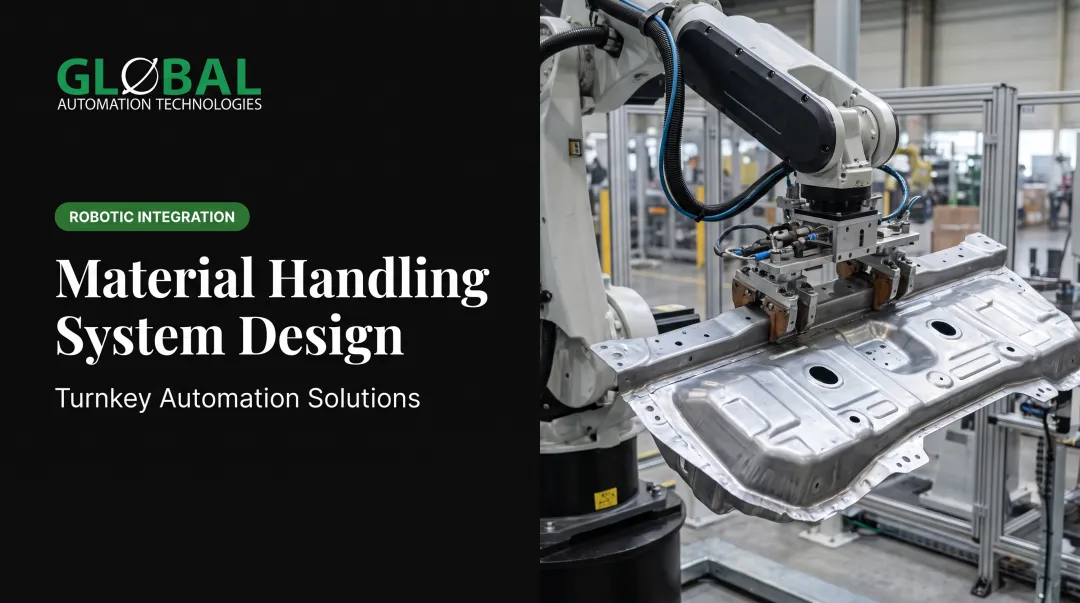
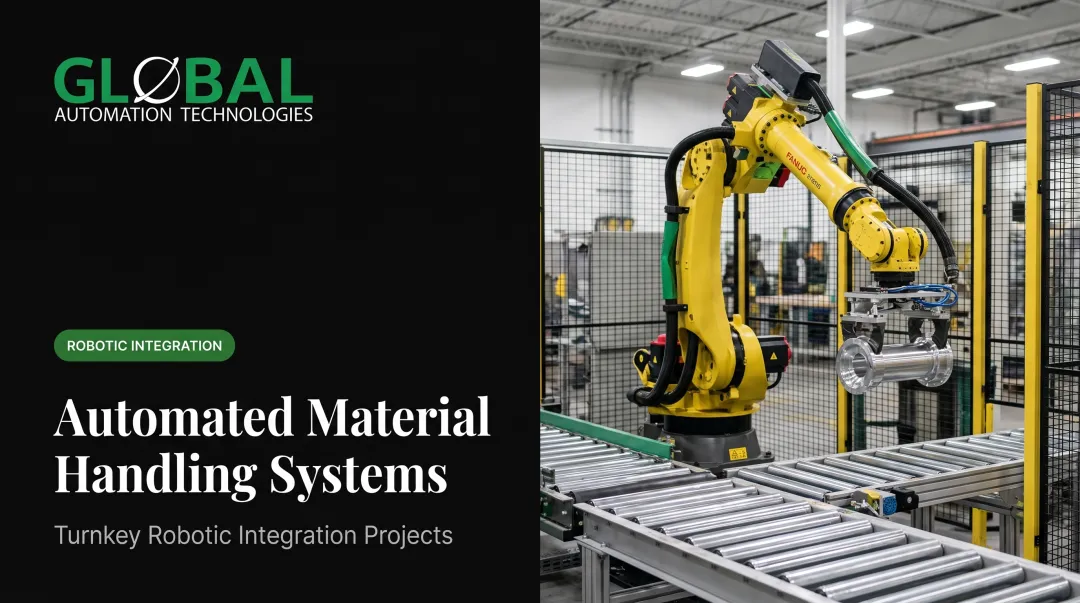
Industrial robotic arms equipped with grippers, suction cups, or specialized end-effectors pick, place, palletize, and load/unload materials. These systems handle payloads from 5 kg to over 800 kg depending on model selection.
In optimized cells, FANUC palletizing robots reach up to 30 cases per minute. High-speed handling cells can run between scheduled maintenance windows with cycle times under one second.
GLOBAL Automation Technologies, a top-tier Level 5 FANUC Authorized System Integrator, has integrated 700+ FANUC robots worldwide for automotive and heavy-industry material handling, from vision-guided pick-and-place to machine tending.
Machine tending stands out on ROI: cells that load and unload CNC machines, presses, and injection molding equipment typically pay back in 12–18 months through higher spindle utilization, longer unattended runs, and operators moved to higher-value work.
AS/RS Systems
Automated Storage and Retrieval Systems use cranes or shuttles moving on rails within high-bay racking structures to store and retrieve pallets or containers automatically. These systems maximize vertical space, with installations reaching heights up to 40 meters.
Kardex reports that AS/RS can cut floor space needs by up to 85% versus conventional shelving while speeding retrieval. Best fit: facilities that need high-density storage, large SKU counts, and fast retrieval cycles.

Sortation Systems
Sortation equipment automatically diverts items to designated destinations using shoe sorters, pop-up wheels, tilt trays, or cross-belt mechanisms. These systems excel in distribution centers processing thousands of orders per hour with varying destinations.
Honeywell's cross-belt and tilt-tray systems handle up to 27,000 items per hour in optimized configurations. Sortation systems enable e-commerce fulfillment centers to process high order volumes with minimal labor while maintaining accuracy.
Palletizing and Depalletizing Robots
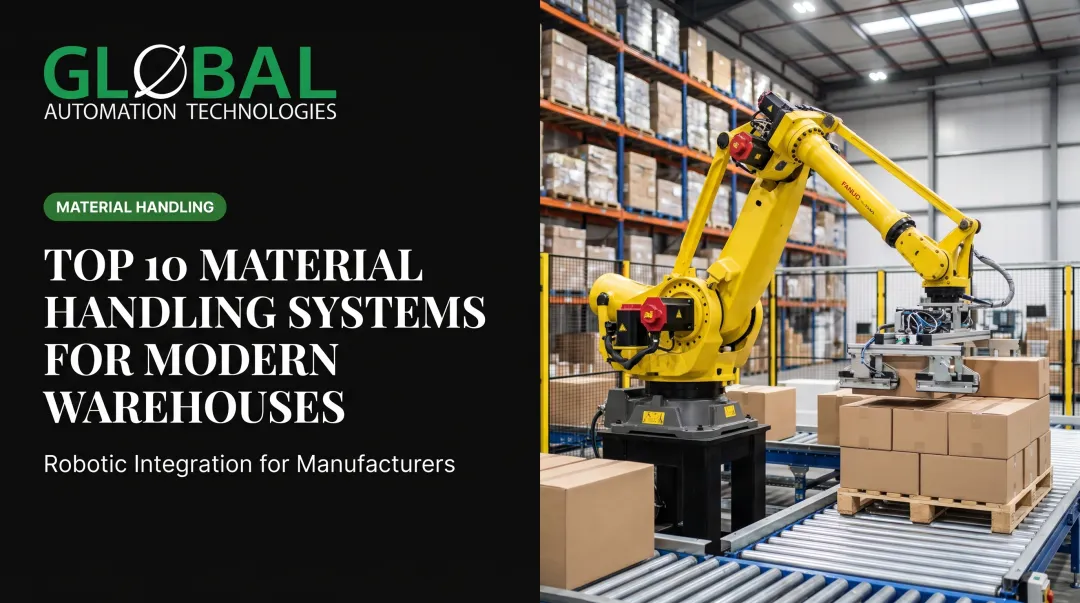
Automated systems stack products onto pallets in optimized patterns (palletizing) or break down incoming pallets (depalletizing). Common uses include end-of-line packaging, shipping prep, and receiving.
Modern robotic palletizers build patterns that improve load stability and cube utilization, which lowers freight cost and shipping damage. Versus manual stacking, they raise throughput and cut repetitive-strain exposure on the line.
Where Automated Material Handling Is Used
Manufacturing Workflow Integration
AMHS shows up across the full production path. It moves raw material at receiving, shuttles work-in-process between machining centers, transfers finished goods to packaging, and supports outbound shipping.
Those flows have to stay aligned with production schedules, quality inspection points, and just-in-time delivery windows.
Balluff's 2025 AutoStore implementation delivered a 177% throughput increase and finished deployment in six months without stopping operations—a clear signal of what AMHS can do in high-volume plants.
Optimal Environments and Conditions
AMHS performs best in:
- High-volume operations moving hundreds to thousands of loads per day, so automation cost spreads across many transactions
- Consistent material sizes and weights that fit standardized handling equipment
- Extended-shift throughput needs, where labor cost and staffing limits make continuous operation the better economics
- Strict traceability environments—automotive, food and beverage, pharmaceuticals—where automated tracking supports compliance
Industry-Specific Variations
Automotive plants rely on AMHS for sequenced parts delivery to the line, so components arrive just-in-time and in build order. Daifuku's automotive setups cover automated parts storage and supply, temporary sortation, and AS/RS painted-body storage with sequencing.
Sanitation drives different choices in food processing. Shuttleworth's Easy Clean 500 systems use 304 stainless steel built for heavy washdown where hygiene rules are non-negotiable.
Cold storage adds another constraint: gear rated for deep freeze. Dematic's high-bay AMHS for Agristo runs near −25°C (−13°F), holds 43,000 pallets, and moves about 200 inbound and 600 outbound pallets per hour in frozen conditions.
In heavy industry—steel, mining equipment, construction machinery—the priority is capacity and durability. Systems must handle multi-ton loads with rugged components that hold up on harsh production floors.

Implementing Automated Material Handling Systems
Assessment and Planning Phase
Successful implementation starts with a clear picture of how material moves today:
- Map material flow paths: Document where materials enter, how they move through production, and where they exit
- Collect volume data: Measure daily movements, peak demand periods, seasonal variations, and growth projections
- Define objectives: Set specific targets for throughput improvement, accuracy goals, labor reduction, and safety enhancement
- Evaluate infrastructure: Assess floor load capacity, ceiling height, electrical power availability, network connectivity, and physical constraints
Build the ROI case from labor savings (reduced headcount or redeployment), throughput gains that support revenue growth, fewer errors that cut rework and returns, and safety improvements that lower workers' compensation claims.
MHI recommends collecting 12-24 months of order data so you understand true operational patterns before locking requirements.
Equipment Selection and Integration
Choose AMHS components that match your materials (size, weight, fragility), throughput needs (items per hour), and facility limits (space, budget). Software must integrate with existing WMS and ERP systems so data moves without manual handoffs.
GLOBAL Automation Technologies combines automation solutions, services and technical staffing under one roof. That approach lowers implementation risk: the system builder knows what engineering talent is needed, and the staffing team understands what the system requires. One call delivers both the FANUC-based robotic system and the controls engineers, PLC programmers, and commissioning technicians to put it live.
Key integration considerations:
- Controls compatibility: Ensure new equipment communicates with existing PLCs, SCADA systems, and enterprise software
- Scalability: Select modular systems that expand as production grows without complete replacement
- Vendor coordination: Minimize the number of suppliers responsible for different system components to reduce finger-pointing when issues arise
Deployment and Optimization
Roll out in phases, starting where ROI is clearest and operational risk stays manageable:
- Pilot testing in one production area identifies issues before full deployment
- Operator training on system supervision, exception handling, and basic troubleshooting reduces downtime
- Continuous monitoring optimizes routing algorithms, equipment utilization, and maintenance schedules based on real operational data
Modern Materials Handling reports that AMR deployments typically take days to weeks while AGV installations require weeks to months. Full AMHS projects demand careful sequencing: requirements definition, equipment selection and RFP, business case approval, phased go-live, training, and post-launch optimization.

Even with solid sequencing, projects still stall when teams hit common pitfalls:
- Automating broken processes without fixing the underlying workflow
- Underestimating integration complexity between systems
- Sizing equipment for average demand instead of peak periods
- Underfunding maintenance programs
- Weak change management that leaves operators unprepared
Conclusion
AMHS transforms material handling from labor-intensive manual work into coordinated, software-driven systems. Equipment moves materials through receiving, storage, retrieval, and dispatch with less manual handling and higher accuracy.
Understanding how AMHS operates—equipment types, stages, integration needs, and implementation tradeoffs—helps manufacturers judge options on their merits. That clarity makes it easier to match technology to the facility and plan a deployment that lifts throughput, trims handling cost, and improves safety in ways you can measure.
Industry forecasts put the market near $51.22 billion by 2030 as more plants treat automated handling as standard competitive infrastructure. Whether you process hundreds of movements a day or tens of thousands, AMHS scales with that volume.
Frequently Asked Questions
What is automated material handling?
Automated material handling is the use of integrated equipment (conveyors, robots, AGVs, AS/RS) and control software to transport, store, and track materials throughout facilities with minimal manual labor, increasing speed, accuracy, and safety.
Which equipment is best for automated material handling?
The right equipment depends on your requirements: conveyors for fixed high-volume routes, AMRs for flexible transport, robotic systems for picking and palletizing, and AS/RS for high-density storage. The most effective AMHS setups combine several equipment types.
What are the three main types of material handling systems?
(1) Transport systems that move materials (conveyors, AGVs, AMRs), (2) Storage systems that hold inventory (AS/RS, automated pallet racking), and (3) Unit load formation systems that consolidate items (palletizers, case packers).
What is an AGV in a warehouse?
An Automated Guided Vehicle is a mobile robot that transports materials along predefined paths using magnetic tape, wires, or laser guidance. AGVs are reliable on repetitive routes but less flexible than AMRs that navigate dynamically.
What are the 10 essential principles of material handling?
The Material Handling Institute (MHI) outlines 10 principles for effective AMHS design: planning, standardization, work efficiency, ergonomics, unit load, space utilization, system integration, automation, environmental impact, and life cycle cost. They help systems deliver long-term value beyond purchase price.
What are common examples of material handling equipment?
Common examples include conveyor belts, robotic palletizers, AGVs and AMRs, automated storage cranes, sortation systems, picking robots, and gantry systems. "Automated MHE" refers to equipment that needs minimal human operation.