
Introduction: Understanding Plant Automation in Modern Manufacturing
Manufacturing faces a talent crisis: 65% of manufacturers identify attracting and retaining workers as their primary business challenge, and 1.9 million positions may go unfilled through 2033. At the same time, global industrial robot installations reached 542,000 units in 2024, with operational stock climbing to 4.664 million worldwide.
Plant automation uses robotics, control systems, sensors, and intelligent software to manage manufacturing operations with minimal manual intervention. It redeploys talent from repetitive, hazardous tasks to higher-value inspection, programming, and process-improvement work.
For automotive OEMs, Tier 1 suppliers, heavy equipment manufacturers, and high-volume production environments, automation is now essential infrastructure. This guide covers how plant automation works, where it delivers the strongest returns, and what successful implementation requires.
Key Takeaways
- Robotics, PLCs, vision systems, and MES deliver measurable gains in productivity, quality, cost, and safety
- Deloitte: manufacturers see 10–20% output gains and unlock 10–15% extra capacity with smart manufacturing
- Start with baseline metrics, ROI modeling, infrastructure assessment, and an experienced integrator
- Roll out in three phases: engineering and simulation, pre-test and build, then commissioning with training
- Pair automation systems with embedded engineering talent to sustain performance long-term
What Is Plant Automation and Why Does It Matter?
Plant automation is the integration of control systems, industrial robotics, sensors, and software to manage manufacturing processes with reduced manual intervention. Scope runs from single-cell robotic workcells for tasks like machine tending or spot welding to fully integrated lines covering material handling, assembly, welding, painting, inspection, and packaging.
Business drivers pushing manufacturers toward automation include:
- Labor shortages: With 3.8 million manufacturing workers needed through 2033 and nearly half those roles at risk of going unfilled, automation relieves pressure on hard-to-fill positions.
- Quality consistency: Robotic systems deliver repeatable precision that manual operations struggle to match shift after shift.
- Throughput and scale: Manufacturers must increase output without proportional headcount growth.
- Safety: Removing workers from hazardous spray booths, welding environments, and repetitive-motion tasks reduces injury risk.
Measured results support those drivers. Deloitte's 2025 survey of 600 large US manufacturers reported average improvements of 10-20% in output, 7-20% in employee productivity, and 10-15% in unlocked capacity. McKinsey notes that automation payback expectations have compressed from five to eight years historically to one to three years today.

Plant automation does not eliminate human workers entirely. It redeploys them to inspection, troubleshooting, programming, and continuous-improvement roles while machines handle repetitive, precision-dependent, or hazardous work.
A FANUC machine-tending case reported 33% higher production efficiency and 33-week ROI when labor relief and machine utilization gains were measured directly.
Key Technologies Driving Modern Plant Automation
Industrial Robotics and Robotic Cells
Industrial robots—articulated, SCARA, and collaborative models—form the backbone of automated manufacturing cells. They execute common production tasks with consistent precision:
- Welding, assembly, and machine tending
- Material handling and dispensing
- Painting and spraying
OSHA identifies these as standard industrial robot functions across discrete manufacturing.
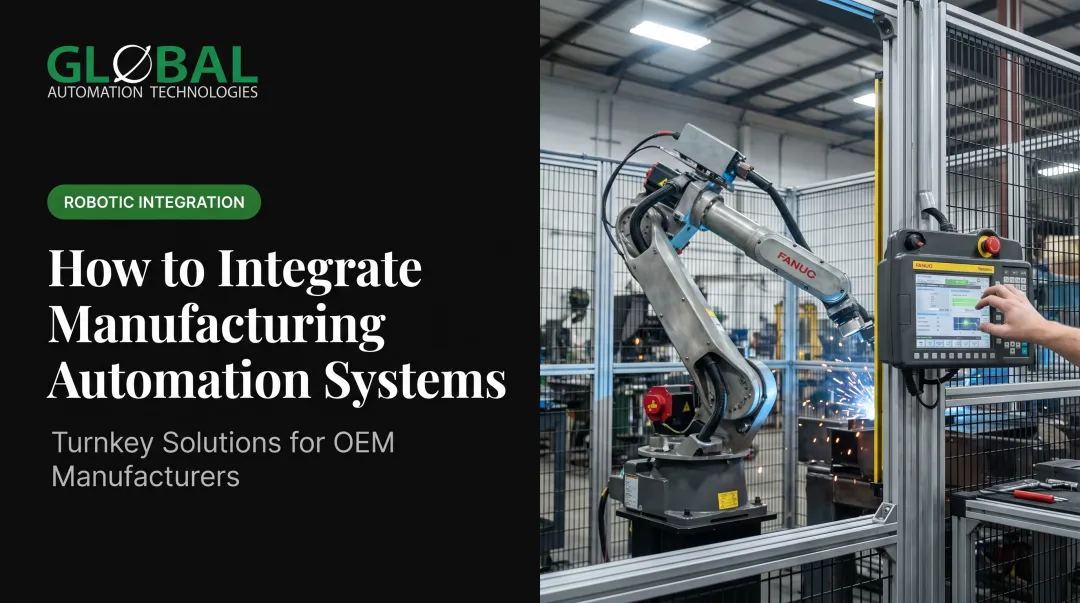
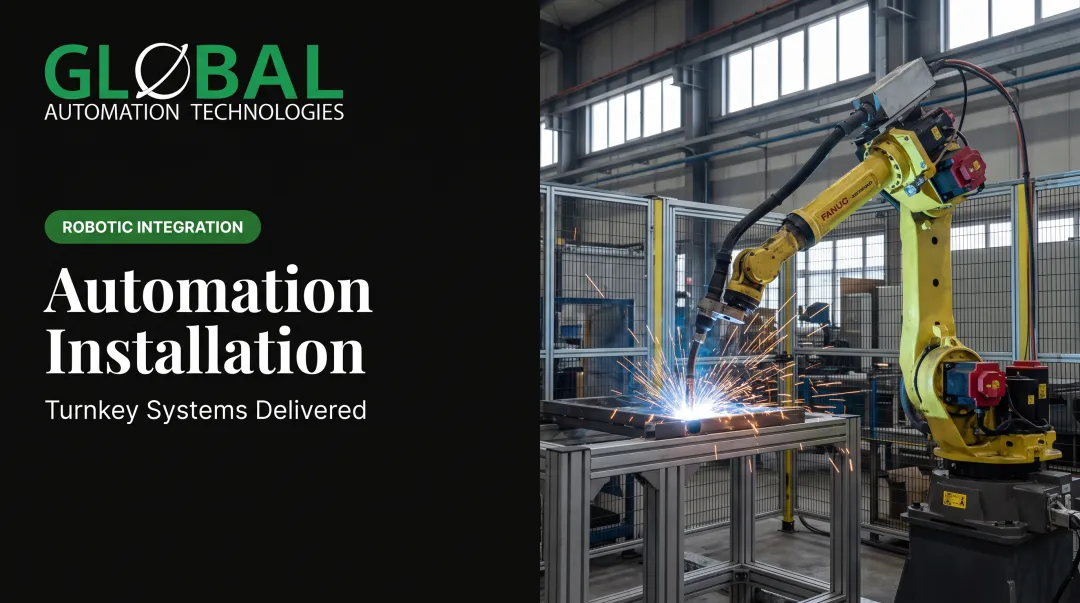
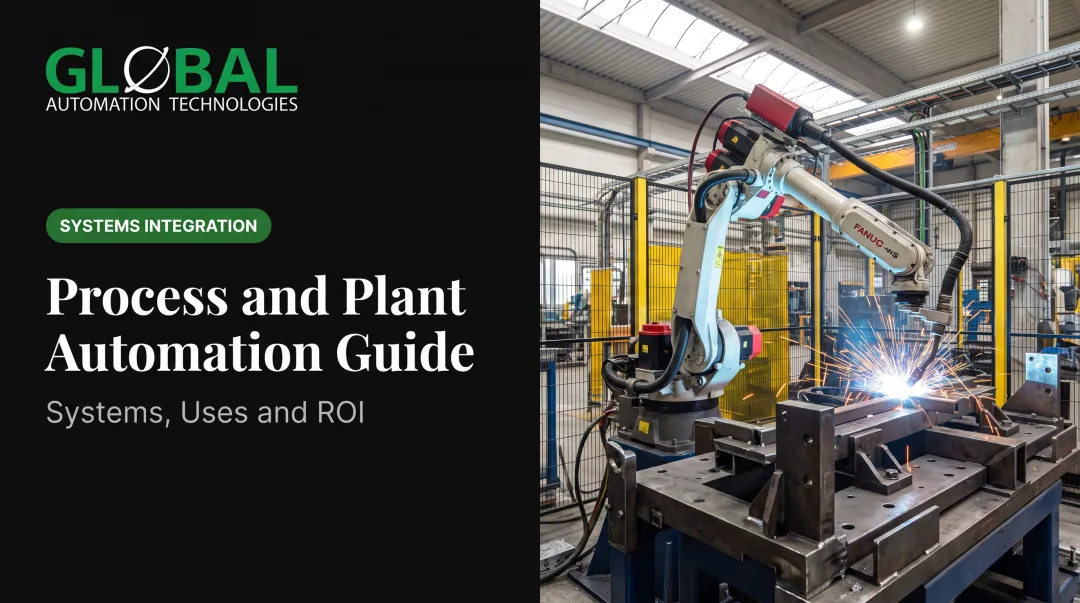
Robot brand selection matters. Manufacturers prioritize platforms with proven reliability, field support, and deep integration ecosystems. Purpose-built robots like FANUC models are widely deployed in demanding environments, especially automotive body shops, paint booths, and high-volume assembly lines.
GLOBAL Automation Technologies, a Level 5 FANUC Authorized System Integrator and #1 purchaser of FANUC robots among North American integrators in 2025, has installed 700+ FANUC robots across 22 countries on these platforms.
Programmable Logic Controllers (PLCs) and Distributed Control Systems (DCS)
PLCs orchestrate machine logic, sequence operations, and manage input/output signals across production equipment. NIST defines PLCs as deterministic controllers managing sensors, actuators, interlocks, and cell sequences.
DCS platforms provide supervisory control over multiple localized controllers and can coordinate complex processes. They are less common in cell-centric robot applications than PLC/robot-controller architectures.
Manufacturing Execution Systems (MES) and SCADA
MES platforms manage, monitor, and control production processes across the shop floor. They provide real-time information on work orders, equipment status, and resource allocation. Siemens MES solutions bridge the gap between shop-floor devices and enterprise ERP systems.
SCADA (Supervisory Control and Data Acquisition) systems provide plant-level oversight. Core functions include:
- Collecting supervisory data and delivering HMI interfaces
- Generating alarms and tracking performance trends
- Logging data and executing high-level control actions
SCADA is a control platform, not a robot type: a critical distinction often confused in vendor literature.
Vision Systems and Quality Inspection Automation
Automated vision systems use cameras, sensors, and AI algorithms to verify part quality, detect defects, ensure compliance, and guide robotic operations without manual inspection.
ABB's 3D inspection cell uses white-light sensors to create digital models and compare them against CAD. It achieves inspection speeds 10 times faster than traditional CMM methods, with accuracy below 100 micrometers.
Siemens Inspekto integrates with PLCs or MES/ERP platforms and can configure inspection routines from just 20 good samples, accelerating deployment without extensive AI expertise.
AI-Assisted Simulation and Predictive Maintenance
Emerging AI tools accelerate robot programming through offline simulation, optimize production parameters, and predict equipment failures before downtime occurs. FANUC ROBOGUIDE supports offline programming and testing, reducing setup effort by validating reach, paths, collisions, and cycle assumptions before production deployment.
FANUC AI Servo Monitor builds a normal-operation model of CNC servo and spindle performance, then scores deviations to flag potential issues.
GLOBAL Automation Technologies uses AI-assisted simulation to cut robot programming time from weeks to days. The same toolkit supports AI-driven health assessments that flag equipment problems before failures occur.

How to Plan and Prepare for Plant Automation Implementation
Conduct a Comprehensive Process Assessment
Document current workflows, identify bottlenecks, and measure baseline performance metrics before automation design begins. McKinsey recommends inventorying tasks that available technology can automate, then identifying labor, throughput, quality, safety, and changeover constraints around each candidate.
Preserve baseline data including:
- Cycle times and takt time requirements
- Throughput capacity and OEE (Overall Equipment Effectiveness)
- Scrap rates, rework percentages, and first-pass yield
- Downtime frequency and root causes
- Staffing levels and labor hours per unit
- Material flow and staging constraints
Map material flow to understand where automation delivers the highest impact. Constrained cells where additional capacity has immediate revenue value should be prioritized.
Define Clear Goals and Success Metrics
Set specific, measurable automation objectives: increasing throughput by 25%, reducing defects to below 0.5%, cutting direct labor costs by 40%, or eliminating operator exposure to hazardous environments. Establish KPIs to track progress across multiple dimensions:
- Constraint KPI: Cycle time or throughput
- Reliability KPI: OEE or downtime frequency
- Quality KPI: Scrap/rework rate or first-pass yield
- Labor / Safety / Maintenance KPIs: Hours per unit, incident rate, or MTTR
McKinsey advises including productivity, throughput, quality, safety, training, maintenance, and turnover effects in the business case, not just labor savings alone.
Calculate ROI and Build a Financial Justification
Model automation ROI by comparing capital investment against projected savings. A3's ROI methodology includes robot, tooling, guarding, conveyors, programming, integration, installation, utilities, fixtures, training, site preparation, IT infrastructure, energy, maintenance, and refurbishment costs.
Benefits to quantify:
- Direct and indirect labor reduction or redeployment
- Productivity gains from higher throughput and uptime
- Scrap and rework elimination
- Material savings (reduced overspray, waste, consumables)
- Quality improvements and warranty cost reduction
- Safety and ergonomic benefits
Machine tending and material handling cells often deliver payback in 12-18 months through increased parts per shift, higher spindle utilization, and reduced direct labor hours. Run sensitivities for shift patterns, utilization rates, labor rates, duty cycles, maintenance costs, and product mix variability.

Evaluate Facility Infrastructure and Layout
Assess floor space, power capacity, network infrastructure, and material flow constraints early. Determine whether existing layouts can accommodate automation or require reconfiguration.
Key infrastructure considerations:
- Available floor space and ceiling clearance
- Electrical capacity and distribution
- Compressed air and utilities
- Network connectivity and OT/IT segmentation
- Material staging and flow paths
- Safety guarding and operator access zones
For paint and coating systems, evaluate booth layout, airflow management, exhaust capacity, and explosion-proof electrical requirements.
Identify the Right Implementation Partner
A3 integrator certification requires demonstrated experience, on-site audits, practical personnel assessments, and safety training; certification lasts two years. CSIA certification requires membership, preparation against audit criteria, and an audit application.
Look for partners with:
- Deep application expertise in your industry and processes
- Proven project methodology with defined phase gates
- In-house engineering, fabrication, and controls capabilities
- Both the automation system and skilled personnel for long-term support
- References from comparable installations
GLOBAL Automation Technologies combines automation solutions, services and technical staffing, supplying both the turnkey automation system and the controls engineers, robot programmers, and technicians to support it long-term. That approach, founded in 2009, now spans 110+ team members and project experience across 22 countries.
Step-by-Step Implementation Process
A disciplined three-phase approach moves plant automation from design through live production with fewer surprises and less downtime.
Phase 1: Detailed Design and Engineering
Develop CAD layouts, robot simulations, control system architecture, and bill of materials. Validate reach, paths, collision zones, cycle assumptions, PLC/MES interfaces, and recovery logic offline before hardware fabrication begins.
Key activities:
- Process study and baseline documentation
- Robot selection, reach/payload analysis, and tooling design
- Fixture and guarding design
- PLC programming and HMI development
- Vision system configuration
- Offline simulation and cycle-time validation using tools like FANUC ROBOGUIDE
Phase 2: Equipment Fabrication, Assembly, and Pre-Testing
Build control panels, program PLCs and HMIs, integrate robots, and validate functionality in a controlled environment before shipment. Per Assembly Magazine project management guidance, define methods, materials, and resources for supplier and factory acceptance testing up front.
Key activities:
- Control panel fabrication and wiring
- Robot programming and tooling integration
- Vision system calibration
- Factory Acceptance Test (FAT) against agreed test plan
- Packaging and logistics preparation
Testing the complete cell at the supplier's facility reduces on-site commissioning risk and production disruption.
Phase 3: On-Site Installation, Commissioning, and Production Validation
Install hardware, connect to existing systems, run test cycles, train operators, and transition to full production with minimal downtime. A3 robotic safety training helps commissioning teams complete risk assessments and practice safe recovery procedures.
Key activities:
- Mechanical installation and utilities connection
- I/O checkout and controls integration
- Safety validation and guarding inspection
- Site Acceptance Test (SAT) with production parts
- Operator training and documentation handoff
- Controlled production ramp-up
- Sustained performance verification against acceptance criteria
Timelines vary by application. A 2021 Assembly Magazine microfactory case reported three to six months from design to FAT and a 17% throughput increase (437 to 510 units/hour).

Multi-line integrations can take 6–12 months depending on product variants, safety validation, MES interfaces, plant shutdown windows, and ramp-up requirements.
Common Challenges and How to Overcome Them
Plant automation projects stall for predictable reasons. Address these four early and you protect timeline, budget, and buy-in.
Integration with Legacy Equipment and Incompatible Protocols
OT environments mix standard and proprietary communication protocols and are increasingly connected to IT networks. NIST recommends inventorying interfaces early, using controlled gateways where necessary, and segmenting OT with firewalls and an enterprise/OT DMZ.
Work with integrators experienced in multi-vendor environments and hardware-agnostic software platforms. GLOBAL Automation Technologies supports robot retrofits, new equipment integration, manual-process automation, and model-year changeovers. That work includes coordinating machine interfaces, PLCs, conveyors, and press controls.
Workforce Resistance and Skills Gaps
Deloitte's survey found 48% of manufacturers struggled filling production/operations-management roles and 35% cited adapting workers to the future factory as a top concern.
Address resistance through:
- Early employee engagement in cell design and recovery logic
- Comprehensive training on controls, maintenance, safety, and troubleshooting
- Clear communication that automation shifts operators into inspection, programming, and process improvement roles
- Technical staffing support to supplement internal teams during ramp-up
Underestimating Project Scope and Timeline
Deloitte identifies leadership buy-in, investment allocation, resource availability, change adoption, and value realization as primary headwinds. In the same survey, 52% of respondents established a central smart-manufacturing team to govern initiatives.
Reduce scope risk by:
- Starting with pilot projects in constrained, high-value cells
- Phasing implementation to validate performance before scaling
- Freezing acceptance criteria and establishing stage-gate reviews
- Working with integrators who provide realistic timelines and budget transparency
- Using a named project owner accountable for execution

Operational and Cyber Risk
Per Deloitte's smart manufacturing survey, 65% of manufacturers rank operational risk first or second, and 68% ran a cyber risk or maturity assessment in the prior year.
Build these into acceptance criteria before final sign-off:
- Safety validation and cybersecurity controls
- Backup and recovery procedures
- Manual fallback modes
- Production-ramp tests
Frequently Asked Questions
What is plant automation?
Plant automation is the use of control systems, robotics, and software to operate manufacturing processes with minimal human intervention. ISA defines automation as the creation and application of technology to monitor and control production and delivery, improving productivity, quality, and safety.
What are some examples of automation technology?
Common automation technologies include industrial robots, PLCs, SCADA systems, automated conveyors, machine vision inspection, robotic welding and painting cells, MES platforms, collaborative robots, and AI-driven predictive maintenance tools.
How much does plant automation cost?
Costs vary with application complexity and scale, including robots, tooling, vision, conveyors, controls, software, installation, training, and maintenance. Many machine-tending and material-handling cells reach ROI in 12–18 months through labor savings, higher throughput, and less scrap.
What are the steps to implement plant automation?
Start by baselining processes, setting KPIs and ROI targets, and choosing technology plus an integration partner. Then design with offline simulation, build and factory-accept (FAT), install and site-accept (SAT), train operators, and keep optimizing performance.
What industries benefit most from plant automation?
Automotive OEMs and Tier 1 suppliers, EV production, heavy equipment manufacturing, agricultural equipment, aerospace and defense, data center infrastructure, commercial vehicles, and high-volume assembly operations benefit most. These industries require precision, consistency, scalability, and often involve repetitive, hazardous, or quality-sensitive tasks.
How long does it take to implement plant automation?
Timelines depend on scope: simple robotic cells often take 8–12 weeks from design to commissioning; complex multi-line integrations can run 6–12 months. Phased rollouts limit downtime, while tooling, safety validation, controls/MES interfaces, and shutdown windows affect the schedule.
About GLOBAL Automation Technologies
Founded in 2009, GLOBAL Automation Technologies delivers turnkey automation solutions, services and technical staffing for automotive OEMs, EV manufacturers, Tier 1 suppliers, and heavy industry across North America and internationally.
With 110+ team members, offices in 4 countries, and 700+ FANUC robots installed, GLOBAL covers welding, painting, dispensing, material handling, machine tending, and assembly, and can embed controls engineers, robot programmers, and project managers for ongoing support. As a Level 5 FANUC Authorized System Integrator and #1 purchaser of FANUC robots among North American integrators in 2025, GLOBAL supports projects from feasibility through commissioning, training, and lifecycle optimization.
Contact: info@globalat.com | +1 (810) 877-0329