
Key Takeaways
- True material handling cost spans every dollar spent moving, storing, protecting, and controlling materials from receiving to shipment
- Labor, equipment ops and maintenance, floor space, damage, and process waste drive most of the spend
- Automation and robotics often pay back in 12–18 months while raising throughput, consistency, and safety
- Hidden costs buried in overhead cause most facilities to chronically underestimate total handling spend
What Are Material Handling Costs?
Material handling costs are the total expenses of moving, storing, protecting, and controlling materials across manufacturing, from receiving through production and final shipment. They include costs you can measure directly and indirect costs that often sit in overhead.
Direct costs include labor wages and equipment purchases. Indirect costs include damaged goods, wasted floor space, and production downtime.
Value-added work transforms the product. Material movement does not. Each time material is touched, moved, or transferred, cost builds without improving the finished part. That is why material handling optimization aims to cut unnecessary movement while keeping production flowing.
Many manufacturers still underestimate the full bill because major pieces hide in overhead or indirect categories:
- Facility costs allocated across production departments
- Damage booked as scrap or rework
- Equipment idle time buried in general overhead
Without deliberate tracking and allocation, that burden stays invisible until a focused cost analysis brings it into view.
Components of Material Handling Costs
Labor Costs
Direct labor is the most visible component: wages and benefits for material handlers, forklift operators, warehouse staff, receiving clerks, and shipping personnel.
According to the U.S. Bureau of Labor Statistics (May 2024), hand laborers and material movers earn a median $18.12 per hour ($37,680 annually), while industrial truck and tractor operators earn a median $46,390 per year.
Indirect labor costs add another layer: supervisors who coordinate material flow, training time for new equipment or processes, and downtime when workers wait for delayed materials or equipment repairs.
Equipment Costs
Capital costs include the purchase or lease of forklifts, conveyors, pallet jacks, automated systems, and specialized material handling tools. A 2025 industry survey of nearly 150 companies found an average fleet of 23 trucks with $214,000 in planned 2025 spending and 7.9-year average truck retention.
Operating costs accumulate daily:
- Fuel for internal combustion equipment
- Electricity for electric trucks and conveyors
- Scheduled maintenance, unexpected repairs, and depreciation
- Idle time from poor scheduling, unbalanced workloads, or bottlenecks
Storage and Space Costs
Every square foot of warehouse and storage space carries cost: rent or mortgage, utilities, climate control, lighting, property taxes, and insurance. Allocate those facility costs to storage by square footage, cubic volume, or another rational basis.
Inefficient space utilization compounds the bill. Facilities that ignore vertical space pay for cubic feet they never use. Inventory holding adds burden through insurance, obsolescence risk, and capital tied up in stored materials instead of productive work.
Damage and Loss Costs
Product damage from improper handling, poor storage, or rough transport creates several cost streams:
- Direct material value lost
- Labor and materials for rework
- Scrap disposal costs
- Customer claims for damaged goods
Workplace injuries add costs well beyond workers' compensation premiums. In 2021-22, transportation and material-moving occupations recorded:
- Contact with objects/equipment: 112,230 days-away cases and 88,950 job-transfer or restriction cases
- Overexertion: 165,690 days-away cases and 163,460 job-transfer or restriction cases
Process Inefficiency Costs
Process waste multiplies handling cost without adding value:
- Excessive moves and unnecessary touches
- Bottlenecks from material shortages or congestion in receiving and storage
- Machine idle time while production equipment waits on materials (lost revenue and contribution margin)
According to Deloitte research, poor maintenance strategies can reduce plant productive capacity 5-20%, with unplanned downtime in industrial manufacturing estimated at $50 billion annually.
How to Calculate Material Handling Costs
Start with one formula that rolls up the major cost categories:
Total Material Handling Cost = Labor Costs + Equipment Costs + Storage Costs + Damage Costs + Overhead Allocation
Follow these steps:
- Identify direct labor costs — Sum wages and benefits for everyone dedicated to material handling
- Calculate equipment costs — Add depreciation or lease payments, energy, maintenance, and repairs
- Allocate facility costs — Assign rent, utilities, and property costs to storage by square footage or cubic volume
- Quantify damage and loss — Track scrap, rework, and disposal tied to handling damage
- Assign overhead — Allocate supervision, training, and admin support by labor hours, headcount, or another consistent basis

Example calculation: A mid-size plant books these annual figures:
- Labor (wages and benefits): $450,000
- Equipment (depreciation, fuel, maintenance): $200,000
- Storage (space, utilities, insurance): $150,000
- Damage and rework: $50,000
- Overhead (supervision, training, admin): $50,000
Total material handling cost = $900,000
For benchmarking, also calculate cost per unit handled (total cost ÷ units moved) or cost per production hour (total cost ÷ production hours). Those ratios make it easy to compare periods, facilities, or product lines and to measure whether improvement work is paying off.
10 Proven Strategies to Reduce Material Handling Costs
Strategy 1: Optimize Warehouse Layout and Material Flow
Analyzing material flow patterns can eliminate backtracking, reduce travel distances, and cut handling time. A 2025 simulation study of warehouse layouts found that optimized storage strategies reduced travel distances by 20-37% and handling time by 15-30% compared with random storage placement.
Actionable steps:
- Map current material flow from receiving through production to shipping, documenting all touches and movements
- Identify backtracking, cross-traffic, and unnecessary detours in the current layout
- Place high-velocity items closest to shipping areas to minimize travel distance for the most frequently moved materials
- Create straight-line workflows that move materials progressively from receiving through value-added operations to shipping
Strategy 2: Maximize Vertical Space Utilization
Most warehouses underutilize available vertical space, paying for cubic feet they never use. Vertical storage systems such as high-bay racking, mezzanines, and automated storage/retrieval systems can increase capacity without expanding the building footprint.
Calculate cost per cubic foot rather than cost per square foot to reveal the true opportunity. If your facility pays $8 per square foot annually but uses only 12 feet of 24-foot ceiling height, your effective cost per cubic foot of utilized space doubles.
Implementation approach:
- Conduct a vertical space audit measuring usable ceiling height and current storage height
- Evaluate high-bay racking, mezzanine platforms, or vertical lift modules based on product characteristics and access frequency
- Calculate ROI comparing the cost of vertical systems against building expansion or off-site storage alternatives
Strategy 3: Implement Proper Inventory Slotting
ABC analysis classifies inventory by velocity (movement frequency) and allocates prime locations to the fastest-moving items. Proper slotting reduces picking time, minimizes travel distance, and improves order fulfillment speed.
Slotting methodology:
- A items (high velocity): Place in the most accessible locations closest to packing and shipping
- B items (medium velocity): Assign to secondary locations with moderate access
- C items (low velocity): Store in less accessible areas or higher rack positions
Review and adjust slotting quarterly as demand patterns shift, new products launch, and seasonal variations occur.
Strategy 4: Reduce Material Touches and Handling Frequency
Every additional touch adds cost without adding product value. Minimizing touches requires rethinking traditional receiving, storage, and movement processes.
Reduction strategies:
- Direct-to-line delivery: Coordinate with suppliers to deliver materials directly to the production line, bypassing receiving and warehouse storage
- Vendor-managed inventory (VMI): Shift inventory management responsibility to suppliers, reducing internal handling and storage
- Cross-docking: Transfer incoming materials directly to outbound shipping without intermediate storage for items that don't require warehousing
Cross-docking works when inbound and outbound schedules align and materials don't require quality inspection, kitting, or value-added processing before shipment.

Strategy 5: Invest in Appropriate Material Handling Equipment
Equipment selection directly impacts efficiency, cost, and safety. The right equipment for your operation depends on load characteristics (size, weight, fragility), movement frequency, travel distance, and volume requirements.
Selection framework:
- Manual handling: Appropriate for low-volume, short-distance moves of light materials
- Powered equipment (forklifts, pallet jacks): Best for moderate to high volumes, heavier loads, or longer distances
- Automation and robotics: Justified for high-volume, repetitive tasks requiring consistent speed and accuracy
Conduct total cost of ownership analysis comparing purchase price, operating costs (fuel, electricity, maintenance), productivity gains, and expected service life. Avoid under-investing that locks in inefficiency, and over-investing in equipment that sits idle.
Strategy 6: Implement Predictive Maintenance Programs
Scheduled, predictive maintenance cuts unexpected equipment failures and the production disruptions that follow. According to 2017 Deloitte research on predictive maintenance technologies, manufacturers adopting predictive approaches achieved:
- 20-50% reduction in equipment planning and downtime
- 10-20% increase in equipment uptime and availability
- 5-10% reduction in overall maintenance costs
Equipment breakdowns create cascading costs: emergency repair expenses, expedited parts shipping, production losses during downtime, and potential damage to materials being handled when equipment fails unexpectedly.
Maintenance program elements:
- Establish scheduled inspection and service intervals based on manufacturer recommendations and operating conditions
- Track mean time between failures (MTBF) to predict when components will need replacement
- Monitor mean time to repair (MTTR) to identify chronic problem equipment or maintenance skill gaps
- Use sensor data and condition monitoring to predict failures before they occur
Strategy 7: Minimize Product Damage Through Proper Handling
Product damage creates multiple cost impacts: lost material value, rework labor and materials, scrap disposal, and customer claims.
Poor handling practices also drive injury costs. OSHA identifies improper lifting, pushing, pulling, awkward postures, and repetitive motions as risk factors for musculoskeletal disorders that cut productivity and raise injury expenses.
Damage reduction tactics:
- Provide task-specific training on proper handling techniques matched to product characteristics (fragile, heavy, awkward shape)
- Invest in appropriate packaging and protective materials to prevent damage during movement and storage
- Implement quality checkpoints at receiving, storage, and shipping to detect damage early before it propagates downstream
- Use ergonomic material handling equipment and methods to reduce physical strain and handling errors
Strategy 8: Standardize Processes and Train Personnel
Standard operating procedures (SOPs) reduce variability, errors, and training time. A 2024 NIST case study documented a manufacturer that used Lean methods, value-stream mapping, 5S, and process standardization to achieve $600,000 in cost savings and $1.035 million in increased sales.
Standardization approach:
- Document best practices for all material handling tasks including receiving, put-away, picking, packing, and shipping
- Create visual work instructions with photos or diagrams showing proper techniques and sequences
- Implement comprehensive training programs covering equipment certification, safety protocols, and quality standards
- Establish performance metrics and provide ongoing coaching to reinforce standards and identify improvement opportunities
Strategy 9: Deploy Automation and Robotics
Robotic systems deliver consistent performance around the clock, eliminating variability from fatigue, distraction, or skill differences. Automation candidates include repetitive, high-volume tasks such as:
- Machine tending: Loading and unloading CNC machines, presses, and molding equipment to maximize equipment utilization
- Palletizing and depalletizing: End-of-line case stacking and inbound pallet breakdown
- Pick and place: High-speed part transfer for assembly, packaging, and material flow
- Part transfer: Moving components between stations with precise positioning and orientation
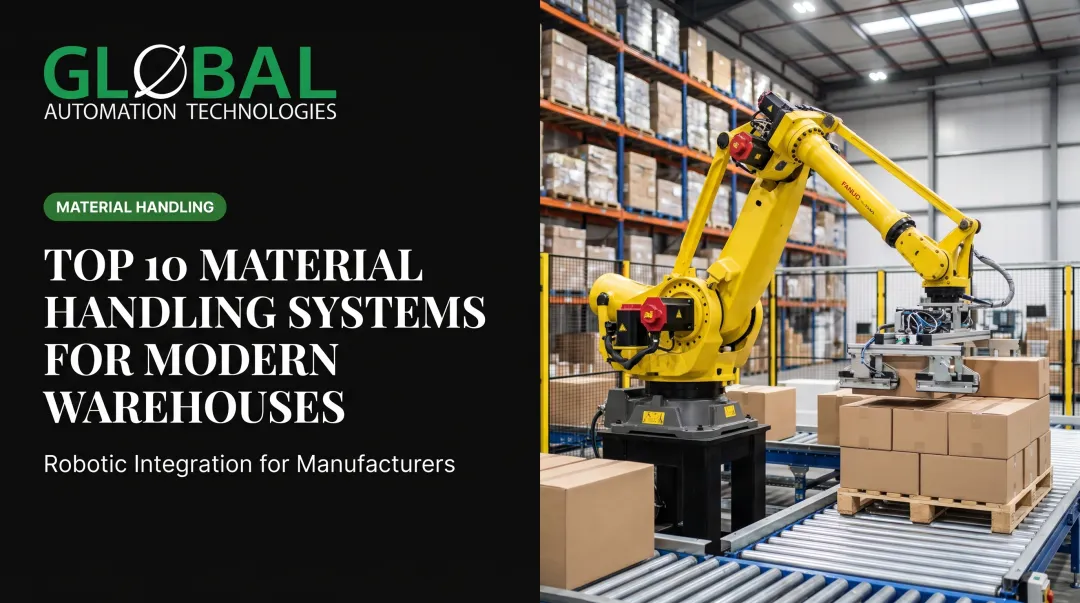
GLOBAL Automation Technologies, which holds Level 5 status in FANUC’s Authorized System Integrator program, engineers robotic material handling cells using FANUC robots integrated with vision guidance, conveyor systems, and machine controls. The cells hold consistent cycle times, support operation beyond a single shift between scheduled maintenance windows, and take workers off repetitive lifting. Machine tending systems typically pay back within 12-18 months through higher equipment utilization and lower labor demand.
Vision-guided systems can locate and pick randomly oriented parts from bins, adapt to multiple part types without retooling, and verify placement accuracy in real time, offering flexibility fixed automation cannot match.
Strategy 10: Adopt Data-Driven Continuous Improvement
Warehouse management systems (WMS) and material tracking technology capture handling data that reveals improvement opportunities invisible to casual observation. The Material Handling Institute (MHI) recommends tracking:
- Order lines picked per hour and labor productivity per FTE
- Dock-to-stock time and inventory/picking accuracy rates
- Cost per order and cost per unit shipped
- Cube and storage utilization
- Overtime percentage and system uptime
- Safety incident rate
Establish baseline metrics before implementing changes, then track improvement over time. A 2020 study of three distribution warehouses found labor productivity increased 40% overall (33-51% by location) after WMS implementation, though equipment, layout, and work organization also changed during the study period.
Conduct regular time-motion studies to identify bottlenecks, wasted motion, and process inefficiencies. Focus improvement efforts on the constraints that limit overall system performance rather than optimizing isolated steps.
The ROI of Automated Material Handling Systems
Automation investment decisions require careful analysis of costs, benefits, and risks. McKinsey research found that only about 20% of North American warehouses have adopted any automation. The same mismatch risk applies on the plant floor: payback stretches out fast when material handling systems are poorly matched to real operational needs.
Multiple benefit streams beyond labor savings:
Automation delivers value through several mechanisms working simultaneously:
- Faster, more consistent cycle times that raise throughput from existing facilities
- Precise positioning that cuts handling damage and placement errors
- Lower injury risk and workers' compensation costs by pulling people out of repetitive lifting and machine loading
- Lights-out capacity on second/third shifts or unmanned weekend production
Decision framework for automation investment:
Calculate total cost of ownership across the full lifecycle:
- System purchase price, installation, and integration
- Programming, commissioning, and operator training
- Ongoing maintenance, spare parts inventory, and energy use
Compare that total with current-state costs plus the cost of waiting: higher unit costs versus competitors, limited ability to scale with demand, and continued safety exposure.
A McKinsey case study of a regional grocer's distribution center retrofit delivered 20% run-rate savings, 4x productivity improvement, 15-20% faster response time, and 20% space reduction.
The same research also flags the downside. One company spent over $150 million on a fully automated facility, then watched advanced picking features sit underused because inventory forecasting and channel planning never caught up.
Keys to successful automation:
- Clearly define operational needs and performance requirements before selecting technology
- Redesign processes to take full advantage of automation capabilities rather than simply automating existing inefficient workflows
- Secure frontline worker buy-in through early involvement and transparent communication about how automation will change roles
- Build or acquire automation expertise—internal or through integration partners—to support implementation and ongoing optimization

Frequently Asked Questions
What are material handling costs?
Material handling costs encompass all expenses related to moving, storing, protecting, and controlling materials throughout manufacturing and distribution, from raw material receipt through production and finished goods shipment.
How do you calculate material handling costs?
Sum labor costs (wages, benefits, supervision), equipment costs (purchase, operation, maintenance, depreciation), storage costs (facility space, utilities, insurance), damage and loss costs, and allocated overhead. Divide by units handled or production hours for per-unit cost metrics.
What do material handling costs cover?
Main categories include direct labor wages, equipment purchase and operation, facility space and utilities, packaging materials, inventory carrying costs, product damage and loss, workplace injury costs, and process inefficiency costs such as bottlenecks and machine idle time.
How does automation reduce material handling costs?
Automation cuts labor needs, speeds throughput with consistent cycles, and reduces handling damage and positioning errors. It also improves space use, supports operation beyond a single shift between scheduled maintenance windows, and keeps workers out of repetitive lifting and other high-strain tasks.
What is the ROI timeline for automated material handling systems?
ROI varies by application, production volume, labor costs, and current inefficiency. Robotic machine tending cells typically pay back within 12–18 months; more complex systems, such as automated storage and retrieval, often take longer as labor, throughput, quality, and safety gains stack up.
Material handling costs are a substantial but often underestimated share of manufacturing expenses. Measure them, pinpoint the largest drivers, and improve layout, processes, and targeted automation to cut cost while lifting throughput, quality, and safety.
For robotic material handling, GLOBAL Automation Technologies builds turnkey pick-and-place, palletizing, machine tending, and vision-guided systems on FANUC robots with integrated controls. Contact GLOBAL at +1 (810) 877-0329 or info@globalat.com to discuss your challenges.