
That capability is becoming less optional. In MHI's 2024 survey of more than 1,700 manufacturing and supply chain leaders, 55% were increasing supply-chain technology investment, and 42% planned to spend over $10 million on it, according to MHI's 2024 industry report. SKU counts keep climbing, e-commerce volume keeps growing, and warehouse labor keeps getting harder to find.
Here's the catch: bolting a camera onto a robot doesn't guarantee results. Vision type, lighting, integration depth, and calibration all determine whether a system succeeds or stalls out in production. This article walks through the exact steps, requirements, and mistakes to avoid.
Key Takeaways
- Vision systems convert camera feeds into real-time pick, sort, and inspection decisions on the floor
- Integration quality and lighting control matter more than camera specs alone
- 2D vision handles flat, single-layer picking; 3D vision is required for random bin picking and mixed pallets
- Skipped validation and unplanned lighting conditions cause more failures than algorithm limitations
- Scoping the right hardware with experienced integration talent is what separates a pilot from a production line
How to Leverage Vision in Automated Fulfillment Operations
Step 1: Define the Fulfillment Task and Vision Requirement
Start by naming the exact job vision needs to do. Piece picking, random bin picking, palletizing, sortation, label verification, and safety monitoring each demand different sensor setups and processing logic.
Next, look at item variability:
- Size and shape - uniform boxes versus irregular parts
- Packaging material - matte cardboard, reflective film, or transparent poly bags
- Presentation - single-layer conveyor feed versus random bin
This variability determines whether you need 2D or 3D vision. Before selecting anything, map your current error rates or bottlenecks. Without a baseline, you won't know if the system actually improved anything.
Step 2: Select the Right Vision Hardware and System Type
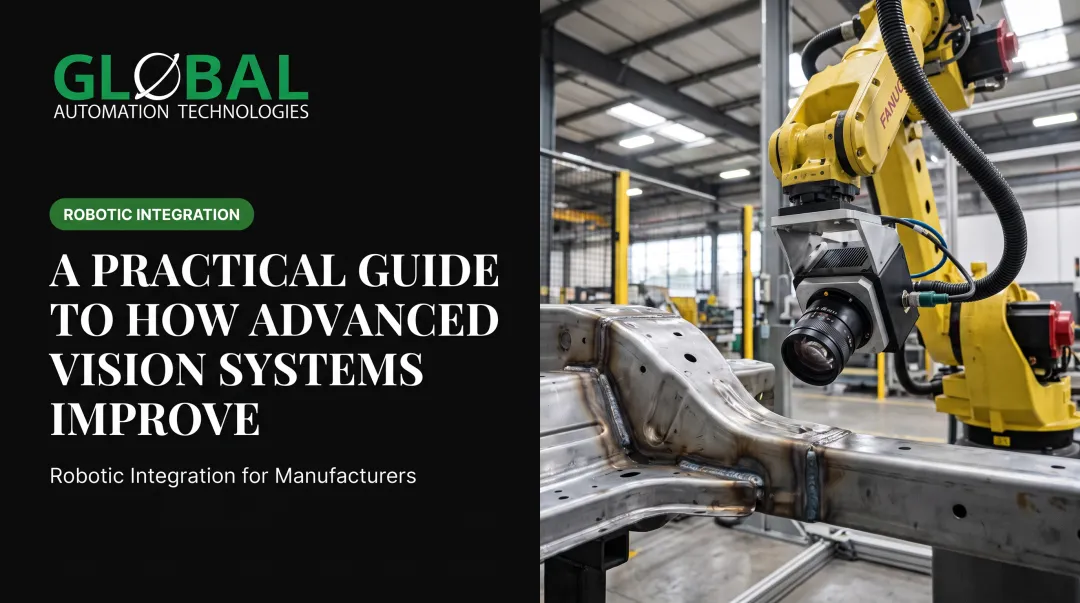
FANUC describes 2D vision as suited for detecting parts on moving conveyors and reading labels. A3 notes that effective random bin picking requires a point-cloud map generated by reprojecting depth data into 3D space. In practice:
- 2D vision - flat, single-layer picking, barcode reading, and predictable conveyor presentation
- 3D vision - random bin picking, mixed pallets, and depth-sensitive handling
Camera placement is the next call:
- Robot-mounted cameras - flexible reach and a wider field of view
- Fixed-mount cameras - generally faster, more consistent cycle times
Confirm whether the vision system integrates directly with the robot controller, similar to FANUC's iRVision platform, rather than a separate standalone processing unit. Fewer handoffs in the data pipeline means fewer integration headaches later.
Step 3: Simulate and Pre-Validate Before Physical Deployment
Offline simulation lets you model the picking cell, test vision-guided paths, and flag collision or occlusion risks before anything touches the floor. AI-assisted simulation has shortened that work considerably.
At GLOBAL, this pre-deployment phase is where AI-assisted programming compresses robot programming from weeks to days, cutting startup risk before commissioning begins. Catching a collision path or occlusion problem in simulation is far cheaper than finding it after installation.
Validate against a real sample set of SKUs and packaging conditions, including edge cases like:
- Transparent film that scatters light unpredictably
- Overlapping or stacked items in a bin
- Damaged or partially obscured labels
Skipping this step is one of the most common reasons pilots underperform once they hit production volume.
Step 4: Integrate Vision with Robot Controls, WMS, and Databases
Vision output, meaning part location, orientation, and barcode data, has to connect directly to the robot controller so pick and place instructions generate automatically. Vision and scan data also need to link to the warehouse management system or SKU database so handling instructions—gripper type, pick surface, exception rules—travel with the product. Without that link, the vision system knows what it sees, but nothing downstream knows what to do about it.
Build exception-handling logic for low-confidence reads. Items the system can't identify with certainty should route to manual review, not stall the line. A conveyor that stops every time a camera hesitates becomes a bottleneck with extra hardware.
Step 5: Deploy, Calibrate, and Monitor in Production
Run calibration under actual production lighting and line speeds, not lab conditions. Ambient light, vibration, and real-world part flow behave differently than a controlled test bench.
Set up ongoing performance monitoring for:
- Pick success rate - how often the system executes a correct pick on the first attempt
- False reads - misidentified parts or barcodes
- Cycle time - whether vision processing keeps pace with line speed
Finally, build a recurring recalibration and camera maintenance schedule into standard upkeep. A3 notes that recalibration is typically needed whenever system conditions such as lighting or focal length shift, so treat this as a maintenance line item, not a one-time setup task.

When Should You Use Vision-Guided Automation in Fulfillment?
Vision-guided automation isn't the right fit for every fulfillment task. Its value scales with SKU variability, order volume, and the cost of a mispick reaching a customer.
Where It Makes the Most Sense
Vision earns its keep when:
- High-mix SKUs need mixed-packaging or random bin picking that barcode-only systems miss
- Manual inspection is already a bottleneck or a documented source of shipping errors
- Mispick cost is high — chargebacks, returns, or customer penalties wipe out thin margins
- Order volume is rising faster than you can staff accurate pick lines
If your SKU mix is stable and packaging is uniform, simpler methods may serve you better.
What You Need Before Getting Started
Before scoping hardware, gather three things:
- Baseline data — SKU dimensions, packaging types, and current error or throughput rates
- Engineering talent — integrators who can handle vision setup and robot programming
- A realistic ROI model — built on your labor cost, error rate, and volume, not a generic benchmark
A misconfigured cell underperforms no matter how good the cameras are. On payback, machine tending cells commonly return investment in 12 to 18 months through more parts per shift and fewer direct labor hours. Vision-guided picking follows the same logic: your numbers drive the timeline, which is why a scoping pass beats an industry average.
Talent is often the harder gap. GLOBAL, a Level 5 FANUC Authorized System Integrator, pairs turnkey vision-guided cells with contract or direct-hire controls and robotics engineers, so the system and the people to run it arrive together.
Key Parameters That Affect Vision System Performance in Fulfillment
The same camera hardware can produce wildly different results depending on a handful of variables teams often underestimate during planning.
Lighting and Environmental Conditions
Poor lighting is the single most common cause of machine vision failures, according to Cognex's guidance on lighting for machine vision. Controlled or supplemental lighting stabilizes accuracy across shifts.
Uncontrolled ambient light causes accuracy to drift with time of day. That drift often looks like a hardware fault when it isn't.
Object and Material Variability
Transparent, reflective, or black items scatter or absorb light differently than standard test parts. A system that performs flawlessly on cardboard boxes in a demo may fail entirely on shrink-wrapped or glossy packaging. If you don't validate against your actual production material mix, strong test results won't translate to the floor.
Processing Speed and Latency
The vision system has to return position and orientation data fast enough to match conveyor speed or robot cycle time. When latency and line speed don't align, bottlenecks form and erase the gains vision was meant to deliver.
Calibration Accuracy and Drift
Vibration, temperature swings, and mechanical wear can gradually shift camera-to-robot alignment. The result isn't a sudden failure. It's a slow, creeping rise in miss rates that gets mistaken for a hardware problem when it's really a maintenance gap.

Common Mistakes and Troubleshooting When Using Vision in Fulfillment
Common Mistakes to Avoid
- Selecting hardware by cost, not task fit - using 2D vision for random bin picking that actually needs 3D depth data
- Skipping validation against real SKUs and lighting - relying on vendor demo conditions; the Association for Advancing Automation (A3) flags this often, because demo parts rarely match real production variables
- Underestimating integration work - connecting vision output to WMS/ERP systems and exception-handling workflows takes more engineering time than most teams budget for
When those gaps show up on the floor, failures usually look like accuracy drift, false reads, or sudden misses. Use the checks below to isolate the cause quickly.
Troubleshooting Common Issues
| Problem | Likely Cause | What to Check |
|---|---|---|
| Inconsistent pick accuracy across shifts | Changing ambient light or glare at certain times of day | Audit lighting near the vision station; add supplemental or diffused lighting |
| Rising false reads or missed picks over time | Calibration drift from vibration or thermal changes | Run a scheduled recalibration routine; inspect camera mounts for looseness |
| Sudden false rejects on known-good SKUs | New packaging, labels, or reflective finishes the model never saw | Re-train or re-validate on current SKUs; adjust exposure and polarizing filters |
Most vision failures don't come from the algorithm itself. They come from skipped validation, mismatched hardware, or lighting nobody accounted for during planning.
Alternatives to Vision-Guided Automation in Fulfillment
Vision isn't always the most cost-effective starting point. Simpler methods can fit lower-complexity operations just fine.
When vision-guided automation is overkill, these approaches often work better:
- Barcode/RFID-only tracking: Strong fit for uniform packaging, reliable labels, and low SKU variability. Cheaper and simpler to deploy, but blind to damaged labels, orientation issues, or unlabeled defects.
- Fixed mechanical guides or hard automation: Built for very high-volume lines running the same part shape continuously. Per-unit cost drops at scale, yet the setup turns inflexible the moment SKU mix or packaging changes.
- Manual picking with WMS-directed workflows: Right for low-volume or seasonal operations where automation capex isn't justified yet. You keep full flexibility for edge cases, but throughput has a ceiling and error rates stay tied to labor consistency.

The right choice comes down to matching complexity to cost, not defaulting to the most advanced option available.
Frequently Asked Questions
What is vision automated fulfillment?
Vision-guided automated fulfillment uses cameras, sensors, and computer vision algorithms so robots and systems can identify, locate, and verify items during picking, sorting, palletizing, and inspection.
What's the difference between 2D and 3D vision for fulfillment robots?
2D vision suits flat, single-layer picking and barcode reading on conveyors. 3D vision captures depth data, which is necessary for random bin picking and mixed pallet handling.
How much does a vision-guided robotic picking system cost?
Cost varies significantly based on camera type, SKU complexity, and integration scope. A needs assessment before budgeting gives a far more accurate number than a general estimate.
Can vision systems integrate with existing WMS or ERP software?
Yes, typically through APIs or middleware that sync scan and location data with existing warehouse software. The integration scope depends on your current systems and data architecture.
How long does it take to implement a vision-guided fulfillment system?
Timelines commonly range from a few months for a single cell to considerably longer for full-line integration, depending on SKU complexity and how much validation the project requires.
Do vision systems eliminate the need for barcodes?
No. Vision typically complements barcodes rather than replacing them, adding verification for damaged, misplaced, or unlabeled items that scanning alone would miss.
Vision-guided automation delivers the biggest gains when task, hardware, and integration match real SKU variability and volume. Most failures trace back to skipped validation or poor lighting planning, not the vision algorithm itself.
Pairing the right vision system with experienced integration support—from layout through commissioning—is what turns a pilot into a reliable production line. GLOBAL Automation Technologies builds that turnkey path for manufacturers moving vision-guided fulfillment into production.