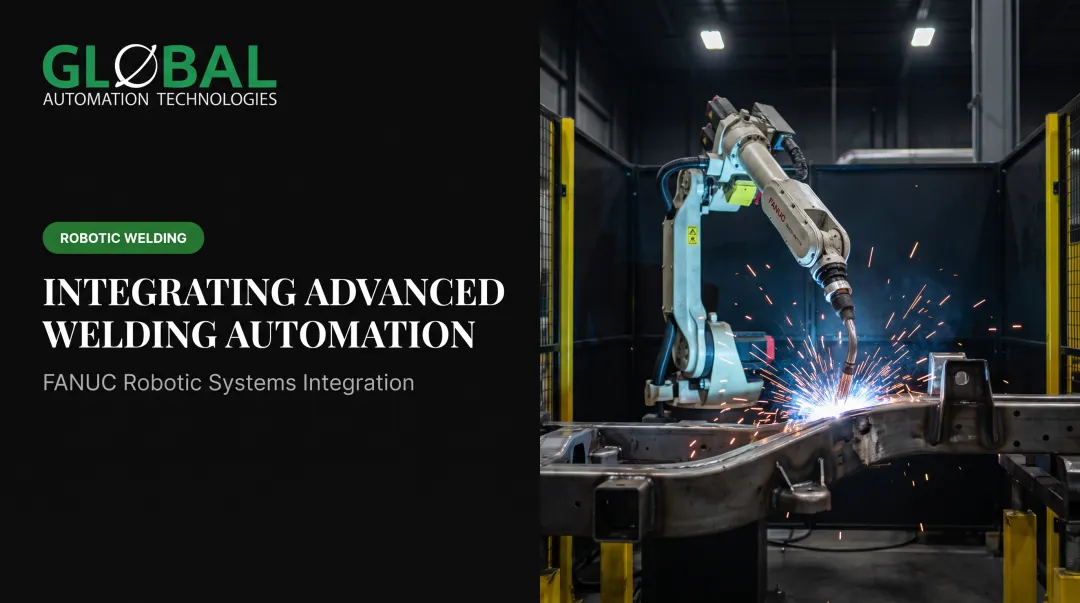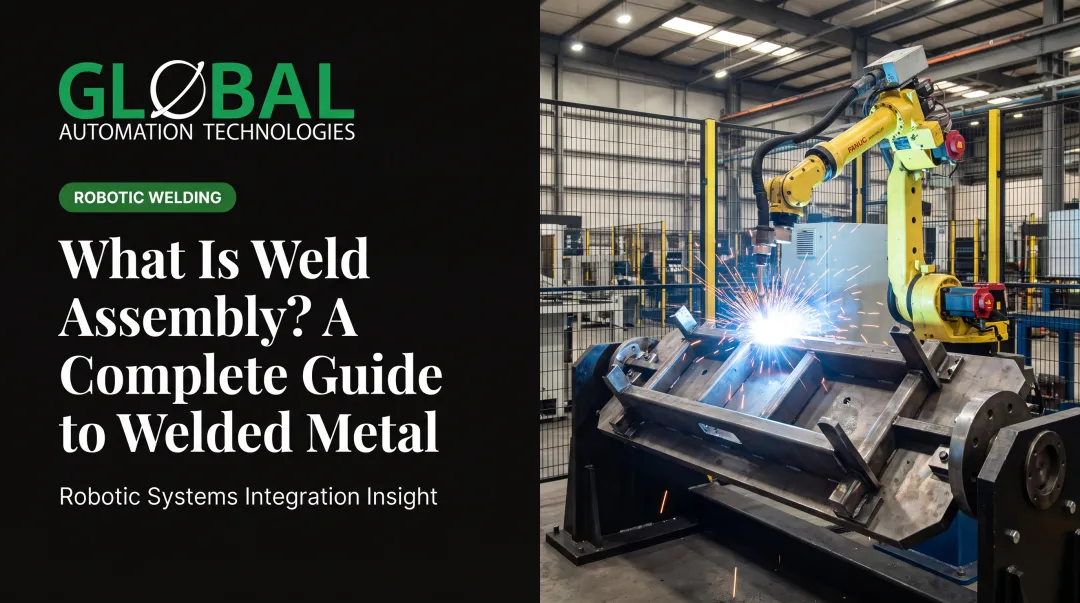

That gap between rising demand and shrinking labor supply is why welding automation keeps coming up in shop floor conversations. Not as a theoretical upgrade, but as a practical response to weld consistency problems, throughput bottlenecks, and safety incidents that show up every week.
This article looks at what welding automation actually changes for fabricators building frame rails, trailer walls, and tanker shells, not just what the equipment brochures promise.
Key Takeaways
- Robotic cells hold identical weld parameters every pass, cutting defect variability in structural work
- Drake Trailers cut cycle time 64% with a three-station robotic welding system
- Automation removes operators from arc flash, fumes, and heavy lifting on oversized structures
- Skilled engineering support—not robots alone—determines whether automation delivers lasting value
What Is Welding Automation
Welding automation uses robotic arms or servo-driven systems programmed to run precise, repeatable welds—spot welds, MIG passes, and structural seams—instead of relying on manual labor alone. In surface transport fabrication, those systems commonly handle:
- Frame rails and cross members
- Flatbed decks
- Trailer walls
- Shipping container structures
- Tanker shells
Automation scales structural weld capacity and frees experienced welders for custom repair and complex fabrication that still needs a human hand.
Key Advantages of Welding Automation in Surface Transport Fabrication
The advantages below aren't abstract. They map to metrics fabricators already track: defect rate, cycle time, delivery timelines, and safety incident rate. When the end product is a load-bearing vehicle structure, those numbers carry higher stakes than in most manufacturing contexts.
Consistent, High-Strength Structural Welds
Robotic welding cells execute programmed parameters—speed, angle, current, torch position—identically on every frame rail or cross member. Manual welding can't match that. Technique drifts weld to weld, shift to shift, welder to welder.
Modern cells add another layer. Vision or sensor-guided path correction follows actual seam geometry rather than a fixed nominal path. In-process quality validation flags inconsistencies before a part moves downstream.
Why this matters:
- Consistent penetration and bead geometry cut weak welds that fail under highway load cycling
- Fewer defects mean fewer warranty claims and less liability exposure
- Documented, repeatable procedures align more easily with AWS D1.1 and cargo-tank rules under 49 CFR 178.337-4
KPIs impacted: weld defect rate, first-pass yield, warranty/return rate, rework hours.
On safety-critical work—tanker shells carrying hazardous liquids, dump bodies under constant stress, trailer frame rails—a failed weld is a field safety incident, not a shop-floor inconvenience.
Faster Cycle Times and Higher Production Throughput
Robots don't get tired. Automated welding cells sustain continuous operation without the fatigue-related slowdowns that creep into manual welding by hour six of a shift. Large-payload robots handle long weld paths on flatbed decks and trailer frames while smaller robots simultaneously weld brackets and mounts in the same cell.
Drake Trailers put a three-station robotic welding system on heavy-haul trailer components and reported a 64% cycle-time reduction, with manufacturing time down 40–60% depending on the component. One operator now runs what previously needed three to four welding bays across two shifts.
KPIs impacted: units completed per hour, cycle time per unit, on-time delivery rate, capacity utilization.
Gains stack highest on standardized trailer or container runs—especially when welder shortages already cap manual output. If you can't hire your way to more capacity, cycle time is often the lever left.
Improved Operator Safety in Hazardous Welding Environments
Manual structural welding on oversized transport components means prolonged exposure to arc flash, fumes, and extreme heat, plus the physical strain of repositioning heavy frames by hand. Automation removes operators from that equation entirely.
Enclosed robotic cells pair fume extraction with positioners that rotate large frames and shells, eliminating the manual lifting and twisting that's common in structural welding on tanker shells and container walls.
Safety gains show up in three places:
- Fewer musculoskeletal injuries from prolonged welding on oversized components
- Lower respiratory exposure (NIOSH has documented fume spikes without local exhaust ventilation)
- Reduced workers' comp cost and simpler occupational safety compliance
KPIs impacted: recordable incident rate, workers' comp claims, absenteeism, safety audit results.
The payoff is largest on oversized or awkward joints—tanker shells and container walls especially—where manual setups force welders into strained positions for long stretches.

What Happens When Welding Automation Is Missing or Ignored
Fabricators relying solely on manual structural welding tend to hit the same wall eventually. The consequences compound quietly until they can't be ignored:
- Inconsistent weld quality across production batches, raising the risk of field failures and warranty claims
- Higher rework and inspection time spent catching defects after the fact instead of validating quality in-process
- Reactive scheduling and constant firefighting to meet delivery deadlines when skilled welder availability fluctuates
- Rising labor costs as demand for structural welders outpaces supply — average U.S. welding wages already near $26.76/hour
- Scaling difficulty when new fleet or container orders arrive without a matching increase in headcount
The math gets uglier every year. AWS-endorsed workforce data projects 320,500 new U.S. welding professionals will be needed by 2029, with roughly 80,000 openings a year through the decade.
Training a new structural welder takes six months to four years depending on the path. Fabricators betting entirely on manual labor are betting against a labor pool that's shrinking faster than it can be replaced.
How to Get the Most Value from Welding Automation
Installing robots on the floor isn't the finish line. Automation delivers its full value only when paired with proper upfront programming, ongoing process monitoring, and skilled engineering support to keep it running.
Simulation cuts startup risk. AI-assisted simulation and offline programming let engineers test weld paths, catch collision issues, and validate cycle times before any physical build begins. Pre-deployment work compresses programming timelines and means fewer surprises when the cell goes live.
In-process quality checks prevent expensive surprises. Real-time weld and bead quality validation, built directly into the welding cell rather than bolted on afterward, catches material or seam defects before parts move downstream into chassis or frame assembly. Catching a bad weld at the cell is a five-minute fix. Catching it during final assembly is a torn-apart structure.
Engineering support is what separates a purchase from a capability. A robotic welding cell is only as good as the team running it. An integrator that delivers both the system and the talent, such as GLOBAL Automation Technologies, which holds Level 5 status in FANUC’s Authorized System Integrator program, provides turnkey design, build, programming, training, and ongoing support plus contract or direct-hire engineering staffing. One call gets you the cell and the controls engineer, robot programmer, or commissioning specialist who keeps it running.
Predictive maintenance closes the loop. Tools that flag equipment health issues before they cause downtime are especially valuable for continuous-run welding cells producing high volumes of structural components. A cell down for an unplanned repair does more than sit idle. It breaks a link in the entire production schedule.

Conclusion
The real value of welding automation in surface transport fabrication shows up in structural weld consistency, faster throughput, and safer plant floors. Those advantages compound over time. Fewer field failures. Fewer injuries. More capacity to absorb freight demand without a proportional headcount increase.
Welding automation works best as an ongoing capability, not a one-time equipment swap. Pair the right technology with engineering support to program it, monitor it, and keep producing consistent welds shift after shift. That systems-plus-support model is how GLOBAL Automation Technologies helps manufacturers build welding capacity that holds up over time.
Frequently Asked Questions
Can you automate welding?
Yes. Robotic and servo-driven systems can automate spot, MIG, and structural seam welding for repetitive, high-volume applications like transport vehicle frames. Complex custom repairs still benefit from skilled manual welders.
What types of welding can be automated in truck and trailer manufacturing?
Resistance spot welding, MIG welding, and structural seam welding are most commonly automated for frame rails, cross members, brackets, and panel assemblies.
Is welding automation cost-effective for smaller trailer or fabrication shops?
Upfront cost is higher, but automated welding cells typically pay for themselves within 12 to 18 months through less rework, labor savings, and higher throughput. Exact payback depends on production volume and part complexity.
Does robotic welding fully replace human welders in surface transport fabrication?
No. Automation handles repetitive, high-volume structural welds while skilled welders remain essential for custom fabrication, quality oversight, and maintaining the robotic systems themselves.
How long does it take to implement a robotic welding cell?
Most cells take several weeks to a few months from design through commissioning, depending on scope and part complexity. AI-assisted simulation and offline programming compress robot programming timelines, which shortens overall deployment.
What industries benefit most from welding automation for transport vehicles?
Heavy equipment manufacturers, trailer and flatbed fabricators, shipping container producers, and tanker builders see the highest returns thanks to high-volume, safety-critical structural welding needs.