
Conveyor systems solve this by keeping material flowing on a fixed, predictable path. They're one of the oldest tools in industrial automation, yet they've evolved dramatically, now paired with sensors, PLCs, and even robotic controls that talk directly to the line.
This guide breaks down the major conveyor types, where they show up across industries, the real benefits they deliver, and how to pick the right system for your facility. We'll also cover how conveyors connect with robotic work cells, since that intersection is where a lot of production headaches either get solved or created.
Key Takeaways
- Conveyor systems reduce manual handling, cutting labor costs and injury risk across manufacturing and warehousing.
- Match conveyor type—belt, roller, chain, overhead, screw, pneumatic, or sortation—to material form, load weight, and handling needs.
- Automotive, heavy equipment, e-commerce, and food/beverage lines use conveyors to keep material moving and cut production bottlenecks.
- Choosing the right system depends on load type, throughput needs, floor space, and integration with existing automation.
- Synchronizing conveyors with robotic cells requires precise PLC-to-PLC communication and part tracking.
What Is a Conveyor System and How Does It Work?
A conveyor system is mechanical handling equipment that moves materials along a fixed path with minimal manual labor. Most setups use a belt, roller bed, or chain so workers are not hauling items station to station.
Most powered systems share a few core components:
- Motor/drive - provides the force that moves the belt, chain, or rollers
- Pulleys or rollers - guide and support the load along the path
- Belt or chain - carries the material along the line
- Idlers - reduce friction and wear as free-turning supports under the belt
- Sensors and photoeyes - detect part presence, position, and gaps
- Control system (PLC) - governs speed, start/stop timing, and fault handling
According to MHI's conveyor and sortation training materials, centralized control cabinets often house the PLCs, motor controls, and power source for an entire line. Newer decentralized architectures place drives and I/O closer to the motors and sensors. That shift speeds maintenance and makes future line expansion easier.

Manual vs. Automated Conveyor Systems
Not every conveyor needs a motor. Manual (gravity or push) systems rely on inertia and slope instead of powered drives. They suit low-throughput work such as small-parts staging or order picking in a low-volume warehouse.
Automated systems add motors, sensors, and PLC-driven controls for high-volume, hands-free material flow. Upfront cost is higher, but they scale far better once volume outgrows a gravity roller line.
Types of Conveyor Systems
Different loads need different conveyor mechanics. Here's how the major categories break down.
Belt Conveyors
Belt conveyors use a continuous belt looped over pulleys, driven by a motor. They're the workhorse of food processing, packaging, and general manufacturing, moving cartons, packages, and bulk goods across flat, inclined, or declined paths.
Belt material varies by application:
- Rubber: durable, handles heavier or abrasive loads
- PVC: common in food and packaging for easy cleaning
- Fabric: lightweight, flexible for lighter goods
Roller Conveyors
Roller conveyors come in gravity-driven and powered versions. Gravity rollers rely on slope or a manual push, while powered (live) rollers use motors, belts, or line shafts to drive rotation.
They're ideal for heavier loads with rigid, flat bottoms — pallets, totes, and automotive components moving between assembly stations.
Chain Conveyors
When loads get heavy and belts would wear out fast, chain conveyors take over. One or more motor-driven chain strands pull or directly support the load, making them a fit for high-torque applications like automotive assembly lines and pallet handling.
Overhead Conveyors
Overhead, or monorail, conveyors run on a track-mounted path above the work area, freeing up valuable floor space. Power-and-free variants let individual carriers stop, accumulate, or reroute independently, which is exactly why paint lines and automotive plants rely on them so heavily.
Robotic painting and dispensing cells often sit directly beneath or beside those tracks. GLOBAL Automation Technologies' controls engineers handle the trigger signals and part-tracking logic so a robot can apply coating or sealant accurately while the part keeps moving overhead.
Screw and Pneumatic Conveyors
Screw (auger) conveyors use a rotating flexible screw to move dry bulk solids. Getting the geometry right matters. A Hapman white paper notes that light or easily fluidized material can feed poorly at steep pickup angles because the auger needs a proper headload to function.
Pneumatic conveyors move powders like cement or flour through enclosed pipes using air pressure. Dilute-phase systems use higher air velocity for robust powders, while dense-phase systems run slower to protect fragile or blended products from breakage.
Gravity, Accumulation, and Sortation Conveyors
These specialized types manage queuing, spacing, and routing across multiple lines — the backbone of e-commerce fulfillment. Accumulation systems fall into three categories:
- Medium-pressure: retains some back pressure between products
- Zero-pressure: deactivates zones as products queue, avoiding pressure buildup
- Zero-contact: stops zones before products even touch, the lowest damage risk
Sortation systems use deflectors, diverters, pop-up devices, and cross-belt or tilt-tray mechanisms to route items to the correct destination automatically.

Common Uses and Industry Applications
Conveyors show up almost anywhere materials move at volume. These sectors rely on them most:
- Automotive and EV manufacturing — Move body panels, components, and sub-assemblies between welding, painting, and assembly. On EV battery lines, belt, flexible-chain, pallet, and accumulation conveyors route cells, modules, and packs while positioning parts for robotic handling, per ASSEMBLY magazine’s 2024 battery-line coverage.
- Heavy equipment and industrial manufacturing — Feed machine tending cells, carrying raw parts to CNC machines and finished parts to the next step.
- Warehousing and e-commerce distribution — Adapt as orders shift from full cases to each-picks and polybags. Modern Materials Handling reports rapidly deployable sortation systems now rated at 2,000 to 8,000 items per hour.
- Recycling, aggregates, and food/beverage — Use belt and chain conveyors for bulk handling to cut labor and loader costs on high-volume fixed routes.
- Data center infrastructure manufacturing — Move server racks, enclosures, and modular components through assembly and quality-check stations, much like other large-component lines.
Key Benefits of Conveyor Systems
The case for conveyors comes down to five practical advantages.
- Efficiency and throughput. Conveyors keep materials moving at a constant rate, eliminating the walking and waiting time that cuts into manual labor productivity on the production floor.
- Cost savings. Fewer labor hours on material transport, less product damage from inconsistent handling, and lower long-term operating costs than manual or loader-based transport.
- Workplace safety. Removing repetitive lifting and carrying cuts overexertion injuries. The Bureau of Labor Statistics recorded 946,290 days-away-from-work, restriction, or transfer cases from overexertion and repetitive motion—the largest injury category.
- Space utilization and scalability. Conveyors can run overhead, along walls, or through tight areas most forklifts can't navigate. Modular designs expand as production needs grow, without a full redesign.
- Consistency and quality control. Automated conveyors provide repeatable, controlled movement, reducing human error in sorting, positioning, and timing between production stages.
How to Choose the Right Conveyor System
Choosing the right conveyor means matching the system to your product, volume, layout, and automation stack. Start with these factors:
- Material type and load characteristics: weight, shape, fragility, and whether items can touch during transit
- Required throughput: peak units or tons per hour, plus buffering or queue space
- Available floor space: straight runs, inclines, curves, or overhead routing when floor space is tight
- Integration needs: how the conveyor ties into existing robotics, sortation, or automated storage and retrieval systems (ASRS)
Controls architecture matters as much as the mechanical layout. Centralized control simplifies troubleshooting from one location. Decentralized I/O shortens wiring runs and makes later expansion easier.
Then run the ROI math. Weigh installation and operating costs against labor savings, throughput gains, and reduced product damage over the system's expected life. A higher upfront cost that removes recurring damage or labor often beats a cheaper system on total cost of ownership.
Integrating Conveyors with Robotic Automation
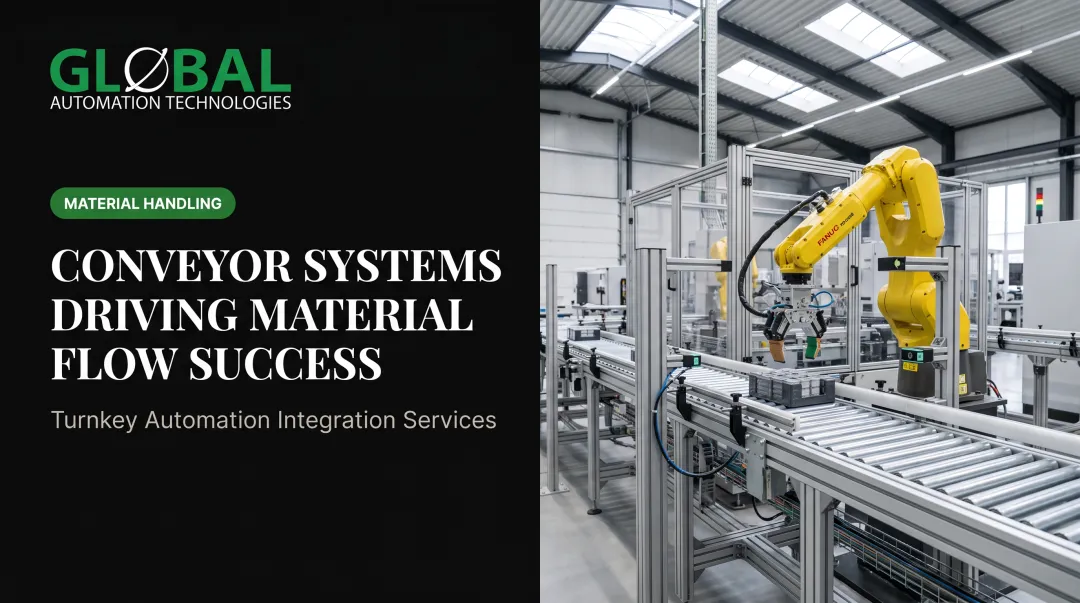
Conveyors are frequently the arteries feeding robotic work cells. They deliver parts to robots for machine tending, welding, dispensing, or painting, then carry finished parts onward to the next station. When this handoff isn't synchronized properly, you get misfeeds, positioning errors, or a line that stops every time a part shows up out of sequence.
GLOBAL Automation Technologies, a Level 5 FANUC Authorized System Integrator, designs turnkey robotic cells covering layout, programming, installation, and validation. Each cell integrates directly with conveyor-fed production lines, treating the robot and conveyor as one coordinated system. That means:
- Speed matching between robot motion and conveyor travel rate
- Trigger signals that cue robot actions at the right moment
- Moving part tracking, so the line doesn't need to stop for every pick
- Fault handling and E-stop coordination across both the robot controller and conveyor PLC
For applications with variable part presentation, GLOBAL also integrates FANUC iRVision and 3D area sensors, letting robots pick accurately even when parts arrive in random orientations on the conveyor.
Before equipment hits the floor, GLOBAL's AI-assisted simulation tools pre-validate robot-to-conveyor timing and cell layouts. Offline modeling and testing cut programming time from weeks to days and reduce costly rework from timing conflicts found after installation.
Frequently Asked Questions
What are conveyor systems used for?
Conveyors move materials efficiently across production lines, warehouses, and processing plants. They cut manual handling and sustain throughput levels that manual transport cannot match.
What are the main types of conveyor systems?
The primary categories are belt, roller, chain, overhead, screw, pneumatic, sortation, and accumulation conveyors. Each fits specific materials and jobs, from small packages and heavy pallets to dry bulk powders.
What is the difference between a manual and automated conveyor system?
Manual systems rely on gravity or human effort and work well for lower-volume needs. Automated systems use motors, sensors, and PLC controls for high-volume, hands-free operation.
How do I choose the right conveyor system for my facility?
Consider material type, load characteristics, throughput goals, available floor space, and how the conveyor needs to integrate with existing automation or sortation equipment.
What industries rely most heavily on conveyor systems?
Automotive, heavy equipment, industrial manufacturing, warehousing and e-commerce, recycling and aggregates, and food and beverage processing rely most heavily on conveyor technology.
How do conveyor systems work with robots on a production line?
Conveyors deliver parts to and from robotic cells for tasks like machine tending, welding, or painting. Tight integration between the robot controller and conveyor PLC keeps timing aligned so production stays continuous.