
The numbers explain why this feels so hard right now. Deloitte and The Manufacturing Institute project a net need for 3.8 million manufacturing workers between 2024 and 2033, with 1.9 million of those roles potentially going unfilled. Meanwhile, industrial-engineer employment is projected to grow steadily, adding to the competition for already-scarce talent.
This guide covers what outsourcing engineering services actually means, why manufacturers do it, the types available, the risks to manage, and how to pick a partner that won't create more problems than it solves.
Key Takeaways
- Outsourcing unlocks robotics and automation talent without permanent hiring commitments
- One partner for integration and staffing cuts delays between building the system and staffing it
- Cost, speed, and scale drive outsourcing—but quality control and IP need deliberate contracts
- AI-assisted simulation compresses robot programming from weeks to days
What Is Outsourcing Engineering Services?
Engineering outsourcing means contracting an external firm or professional to handle specific engineering work (design, integration, programming, staffing) instead of building an in-house team from scratch.
It breaks down into three models:
- Onshoring: hiring a domestic firm or contractor, keeping legal, cultural, and time-zone alignment simple
- Nearshoring: using a partner in a nearby country, balancing cost with proximity
- Offshoring: contracting further afield for a larger talent pool, at the cost of more complex governance
Nearshoring has picked up real momentum. Mexico's manufacturing sector, for instance, grew 5.2% in 2022 versus a 2.3% ten-year average, driven partly by nearshoring demand.
Geography is only half the picture. Project-based outsourcing delivers a defined result, like a finished robotic welding cell, while staff augmentation embeds contract engineers directly into your existing team.
Many manufacturers now blend both. GLOBAL Automation Technologies, which holds Level 5 status in FANUC’s Authorized System Integrator program, built its business around this idea: an automation solutions division and a technical staffing division under one roof, so clients aren't stuck coordinating a system builder and a separate staffing agency.
Why Manufacturers Outsource Engineering Services
Cost Efficiency and Specialized Expertise
Outsourcing avoids the overhead of full-time salaries, benefits, and training for roles that may only be needed for a defined project window. Deloitte notes that while outsourced hourly rates can look higher on paper, total project cost is often lower once fractional resourcing and reduced training burden are factored in.
Specialized skills are the bigger driver. Deloitte's 2025 Smart Manufacturing Survey found 69% to 72% of large-manufacturer executives reported moderate-to-significant hiring difficulty across engineering, OT, and automation-adjacent roles.
Simulation skills alone saw a 75% jump in demand according to Deloitte's manufacturing workforce research. Robotics programming and PLC expertise simply aren't sitting on every local job board.
Faster Timelines and Built-In Scalability
Dedicated outsourced engineering teams using AI-assisted simulation can compress robot programming from weeks to days by modeling and optimizing programs before anything touches the plant floor. That's the approach GLOBAL's engineering division uses. Teams test and refine robot code virtually so commissioning has fewer surprises.

Scalability matters just as much:
- Ramp up engineering headcount for a large integration project
- Scale back down once commissioning wraps
- Avoid carrying permanent payroll for peak-demand work
Reduced Risk and Sharper Focus
Turnkey partners with proven layout-to-commissioning experience reduce the odds of a failed startup or unplanned downtime. That frees internal teams to focus on production and strategy instead of chasing technical fires.
Types of Engineering Services You Can Outsource
Systems Integration & Robotics Engineering
One of the most commonly outsourced categories covers full automation cells, including:
- Robotic machine tending
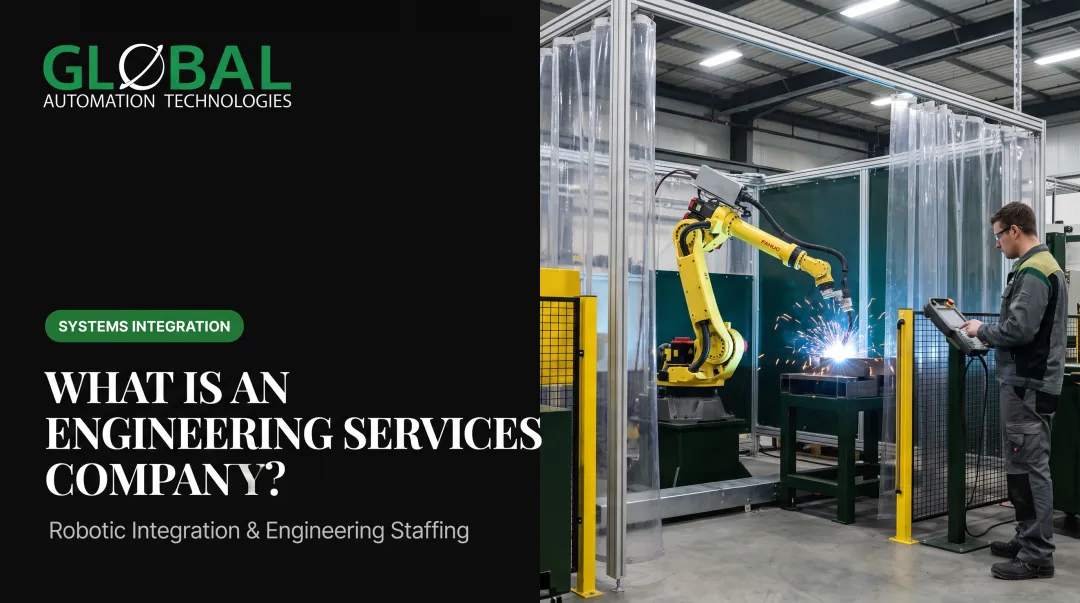
- Welding
- Dispensing and painting
- Material handling cell design
GLOBAL's turnkey scope, for example, runs the full lifecycle: layout, design, build, programming, validation, installation, commissioning, and training—not a single slice of the project.
Technical Staffing & Contract Engineering
Three models dominate here:
- Contract: short-term engineers for a defined project window
- Contract-to-hire: a trial period before permanent placement
- Direct placement: full-time hire with no contract phase
This covers controls engineers, robotics programmers, and process engineers, letting manufacturers absorb a project surge without growing permanent headcount.
Specialized Engineering Disciplines
Manufacturers also outsource individual disciplines across automotive, heavy equipment, and industrial work:
- Mechanical engineering
- Electrical engineering
- Controls engineering
- Process engineering
These specialists usually embed alongside your internal team rather than replace it.
Risks and Challenges of Outsourcing Engineering Services
Three risks show up most often when manufacturers outsource engineering work. Each is manageable if you set expectations before the contract is signed.
Quality control is the most cited concern. Clear deliverables, defined performance metrics, and regular audits matter more than a vendor's sales pitch. Ask upfront how progress gets measured and reported.
Intellectual property protection matters especially in automotive and defense-adjacent work. Strong NDAs are the baseline, not the whole solution. The World Intellectual Property Organization recommends pairing NDAs with technical and operational controls, not relying on paperwork alone. For defense-adjacent projects, contracts should also address controlled unclassified information handling and subcontractor flow-down requirements.
Communication and integration gaps show up when time zones and disconnected vendors slow decision-making. A system builder who doesn't talk to the staffing team creates handoff friction. Engineers show up without knowing what the system requires, or the system gets built without input from the people who'll run it. An integrated model, where one organization handles both, closes that gap by design rather than by extra coordination meetings.
How to Choose the Right Engineering Outsourcing Partner
Not every provider is built the same way. Here's what separates a strong fit from a risky one:
- Proven turnkey experience in your industry (automotive OEM, Tier 1, heavy equipment), not a generalist who's never touched your application
- Combined automation solutions, services and staffing under one roof, so you get one point of contact instead of two vendors shifting blame
- Modern engineering tools, including AI-assisted simulation and predictive maintenance, that cut programming time and flag equipment issues before downtime hits
- Cross-industry depth: GLOBAL, for instance, brings 17+ years in operation, offices in 4 countries, and project work in 22 countries

That last point matters more than it seems. A partner who's solved a bottleneck in automotive body-shop welding often brings that same lens to a heavy-equipment welding cell or an aerospace assembly line. That cross-pollination is something a single-industry shop can't offer.
Frequently Asked Questions
What does outsourcing mean?
Outsourcing means contracting an external expert or firm to perform tasks instead of hiring in-house. It applies to engineering, staffing, or full project delivery, depending on what the manufacturer needs.
What are the three types of outsourcing?
The three types are offshoring (distant-country partners), nearshoring (nearby-country partners), and onshoring (domestic partners). Each fits engineering work differently based on cost, time zones, and legal complexity.
What major companies use outsourcing?
Large OEMs and Tier 1 suppliers regularly outsource engineering and staffing. Ford selected Rockwell Automation for controls work across three EV assembly sites, and GM has publicly recognized external partners for turnkey conveyor-system engineering.
How much can manufacturers save by outsourcing engineering services?
Savings vary by project, but robotic machine tending cells commonly pay for themselves in 12 to 18 months through higher parts-per-shift output and reduced direct labor hours. There's no universal percentage. Total cost depends on scope and application.
Is outsourcing engineering right for every manufacturer?
It fits manufacturers facing skill gaps, project surges, or complex automation needs. Shops with stable, narrow in-house workloads often gain less from it.