
That gap matters. Many manufacturers struggle to choose between welding, mechanical fastening, and automation without fully understanding the tradeoffs. Get it wrong, and you're looking at costly rework, inconsistent quality, or missed production targets.
This guide breaks down what weld assembly actually is, the core processes and joint types behind it, how the workflow runs from design to inspection, and where robotic automation is changing the economics of welded production.
Key Takeaways
- Weld assembly forms a permanent metallurgical bond—not a fastener-based mechanical joint.
- Fillet, groove, and plug/slot welds handle most structural and sheet-metal joints.
- Choose MIG, TIG, resistance spot, or robotic arc based on material, thickness, access, and volume.
- Robotic weld assembly is displacing manual welding on high-volume, quality-critical lines.
What Is Weld Assembly?
Weld assembly is the process of joining two or more fabricated metal components using heat and/or pressure to create a continuous, permanent metallurgical bond at the joint. That's the key distinction from mechanical joining: a weld fuses the base materials together, while a bolted or riveted connection relies on discrete fastener points.
The components going into a weld assembly are typically cut, formed, or machined first. From there, they're fixtured, aligned, and welded to a finished dimensional tolerance. The weld is designed into the part from the start, not added as a late-stage fix.
Manufacturers favor weld assembly over mechanical joining for several reasons:
- Higher joint strength: the bond spans the entire joint length, not just a few fastener points
- Inherent leak-tightness: critical for tanks, enclosures, and fluid-carrying structures
- Better vibration resistance: no loosening over time the way bolted joints can
- No added fastener weight: nuts, bolts, and washers add mass a continuous weld does not
The Three Main Types of Welds
Nearly every structural or sheet-metal joint falls into one of three categories:
- Fillet weld: joins two surfaces at an angle (corner or tee joint) with a triangular cross-section; the most common type in structural and sheet-metal work
- Groove weld: joins piece edges within the joint, typically in butt joints, with full or partial penetration for maximum strength
- Plug or slot weld: fills a hole or elongated slot in one overlapping piece to fuse it to another when only one side is accessible

Why Weld Assembly Matters in Manufacturing
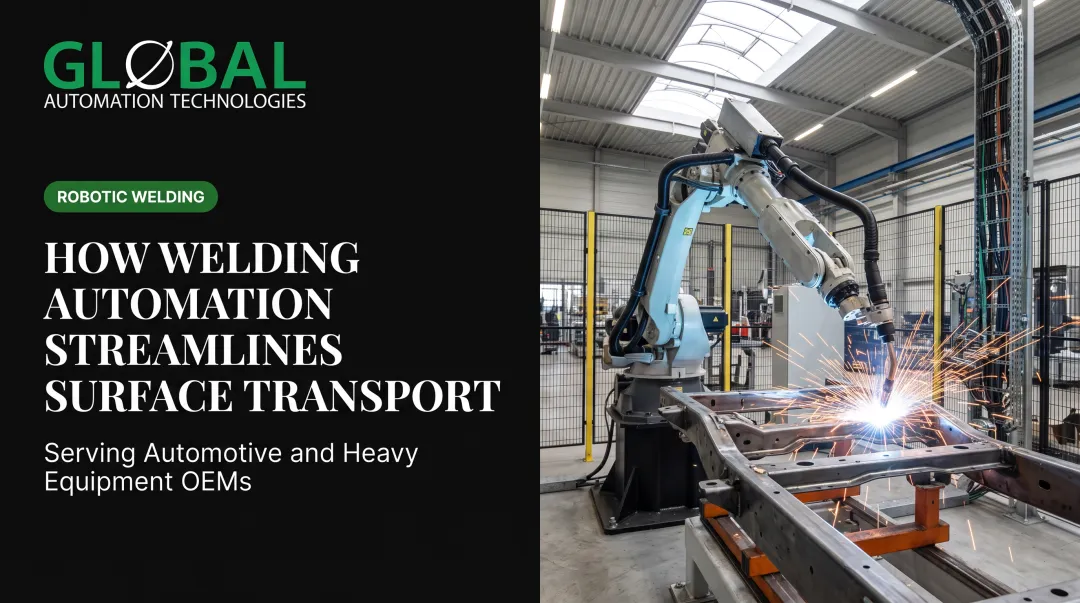
Weld assembly underpins structural integrity in the environments where failure isn't an option: automotive frames, heavy equipment chassis, and industrial enclosures that face constant vibration and load cycling.
The scale of this work is significant. Per the U.S. Bureau of Labor Statistics:
- 457,300 welders, cutters, solderers, and brazers employed in 2024
- 45,600 openings projected annually over the next decade, mostly from retirements and career changes
- Median wage of $51,000 per year, or $24.52 per hour, as of May 2024
That's a large skilled workforce dedicated to joining metal. It is one reason manufacturers watch weld quality, throughput, and labor capacity as closely as they watch whether a joint gets made at all.
Common Welding Processes Used in Weld Assembly
Choosing the right process comes down to four factors:
- Base material
- Material thickness or gauge
- Joint geometry
- Required production volume
Get any of these wrong, and you're inviting distortion, rework, or blown budgets.
MIG / GMAW (Gas Metal Arc Welding)
MIG is the production workhorse for carbon and stainless steel. A continuously fed wire electrode enters the weld pool while shielding gas protects it from contamination. The process is fast, reasonably tolerant of imperfect fit-up, and well-suited to automation. That combination makes it the default choice for structural frames and brackets across most fabrication shops.
TIG / GTAW (Gas Tungsten Arc Welding)
TIG uses a nonconsumable tungsten electrode to heat the joint, with filler added separately when needed. It's the process of choice for thin-gauge stainless, aluminum, and cosmetic or corrosion-critical joints, since it gives the finest control over heat input of any common process. The tradeoff is speed: TIG is slower and demands more operator skill.
Resistance Spot Welding
Spot welding uses pressure and current to create localized resistance heat, with copper-alloy electrode tips clamping the parts together. No filler metal and no shielding gas, just fast, repeatable joints. It's ideal for high-volume lap joints in panels and enclosures with many identical joins, which is why it dominates automotive body assembly.
Robotic Arc Welding
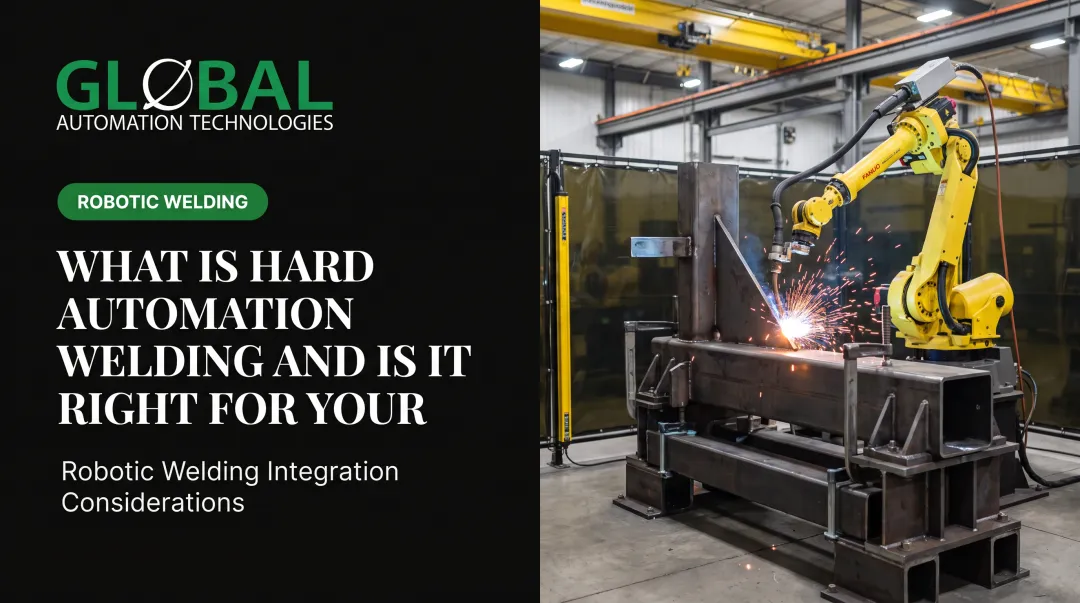
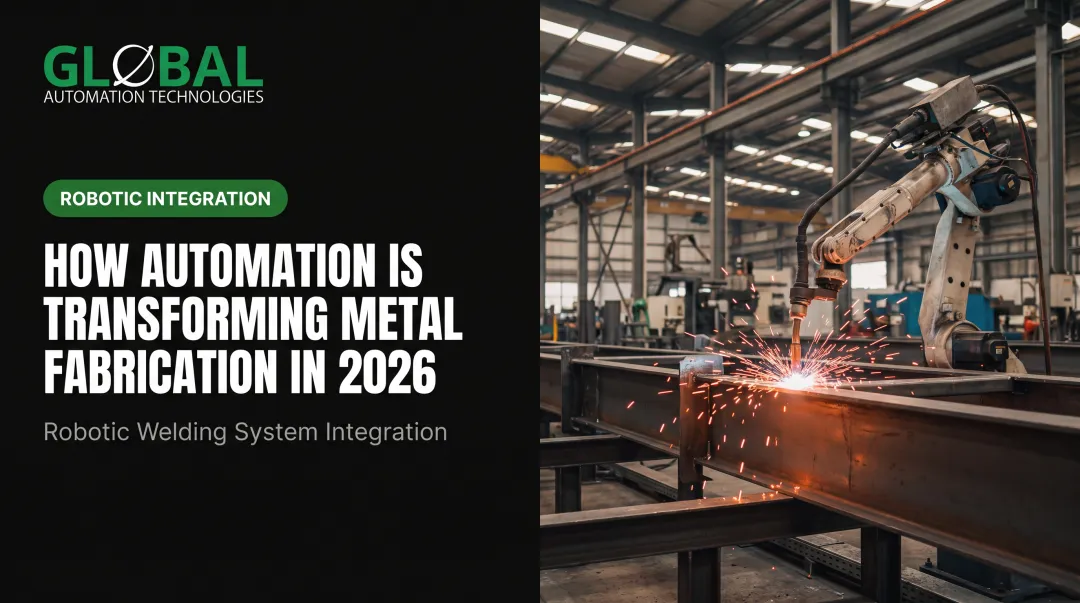
Robotic welding cells automate MIG and TIG processes to deliver consistent bead quality, repeatable cycle times, and production that runs beyond a single shift between scheduled maintenance windows. Once a program is validated, the robot repeats the exact same motion on every part. Manual welding simply can't guarantee that consistency shift after shift.
GLOBAL Automation Technologies, a top-tier Level 5 FANUC Authorized System Integrator, builds these cells around FANUC robotic platforms, using AI-assisted simulation to model, test, and optimize weld paths before a single weld hits steel. That approach compresses programming timelines and catches path or fixture problems in simulation instead of on the shop floor.
How the Weld Assembly Process Works: From Design to Inspection
Weld assembly begins on the print, long before any torch is struck. Here's how the process typically runs:
- Design and weld symbol callouts: Engineers specify weld type, size, length, and joint side on the print using AWS A2.4 symbol standards, removing guesswork on the shop floor.
- Fixturing and alignment: Technicians clamp and locate parts in a jig to hold tolerance and prevent movement or warping as heat is applied.
- Welding execution: Welders or robots run the joints to a qualified Welding Procedure Specification (WPS) that defines amperage, travel speed, and weld sequence.
- Distortion control: Balanced weld sequencing and controlled heat input prevent shrinkage-driven warping, especially on thin material.
- Quality inspection: Every weld gets a visual check. Structural or critical joints receive additional nondestructive testing.

Nondestructive testing methods commonly used:
| Method | Best for | Key limitation |
|---|---|---|
| Dye penetrant (PT) | Surface-breaking flaws on clean, non-porous welds | Won't detect subsurface defects |
| Magnetic particle (MT) | Cracks in ferromagnetic materials | Doesn't work on non-magnetic metals |
| Ultrasonic (UT) | Surface, near-surface, and internal flaws | Needs good surface contact and coupling |
| Radiographic (RT) | Subsurface defects via imaging | Usually requires two-sided access and radiation controls |
Which method you use still sits under code: AWS D1.1 governs most structural steel work, including procedure qualification, welder qualification, and acceptance criteria.
Weld Assembly vs. Mechanical Fastening: Choosing the Right Joining Method
Welding and mechanical fastening solve the same basic problem: joining metal parts. They just do it in different ways.
Strength and rigidity: A continuous weld distributes load across the entire joint with no added hardware. Fasteners concentrate load at discrete points and add weight through bolts, nuts, and washers.
Serviceability: Fasteners allow disassembly and field repair. A weld is permanent. The only way to undo it is to cut it out.
Production economics: The tradeoffs aren't just structural. In one structural-fabrication comparison, fitting and welding took 35% longer than fitting and bolting clips, and welders were paid 20% to 30% more than fitters doing comparable work. Robotic welding and better material handling can shift that math, but labor cost remains a real factor for manual shops.
Decision rule:
- Choose welding for maximum strength, vibration resistance, and sealed joints
- Choose fastening when the assembly must be serviced, reworked, or field-assembled
- Weigh both when volume, labor rates, and joint access pull in opposite directions
Why Manufacturers Are Shifting to Robotic Weld Assembly
Three pressures are pushing manufacturers toward automated weld assembly: a shrinking pool of skilled welders, inconsistent quality across shifts, and safety risks from fume and heat exposure.
The labor picture is stark. Industry data projects that roughly 330,000 new welding professionals will be needed in the U.S. by 2028, or about 82,500 welding jobs to fill annually through that period. That's not a gap most shops can hire their way out of.
Robotic weld assembly sidesteps the hiring race. Instead of competing for scarce welders, manufacturers get:
- Repeatable bead quality on every part, regardless of shift or operator fatigue
- Faster cycle times through optimized, programmed motion paths
- Extended running beyond a single shift, lights-out between scheduled maintenance windows, without quality drift
GLOBAL Automation Technologies supports manufacturers making this shift as a turnkey partner. Rather than sourcing a robotic welding system from one vendor and the engineers to run it from another, GLOBAL delivers both under a single contract.
That scope covers layout, programming, validation, installation, and commissioning of the welding cell, plus controls engineers, robot programmers, and project managers to keep it running.
Vision-guided quality checks add another layer of protection. Optional vision systems in GLOBAL's welding cells handle part identification, seam location, adaptive path correction, and weld quality verification.
Defects get caught before parts move downstream, not after final inspection. Real-time validation keeps every weld consistent, not just fast.
Frequently Asked Questions
What is weld assembly?
Weld assembly is the process of permanently joining two or more metal components through a fusion or resistance weld, creating a continuous metallurgical bond. It's used throughout frames, enclosures, and structural components.
What are the three types of weld?
The three primary weld types are fillet (joining angled surfaces like corners or tees), groove (joining edges in butt joints), and plug/slot (fusing overlapping pieces through a hole). These three cover most structural and sheet-metal work.
What welding process is best for automated production?
Robotic MIG or TIG welding is preferred for high-volume automated production. Both processes deliver consistent cycle times and repeatable bead quality that manual welding can't match shift after shift.
What is the difference between a weld assembly and a mechanical assembly?
A weld assembly uses a permanent metallurgical bond that fuses the base metals together. A mechanical assembly relies on fasteners like bolts or rivets, creating a reversible connection that can be disassembled for service.
How long does it take a robotic welding cell to pay for itself?
Payback timelines vary by application, part volume, and labor costs. As a benchmark, similar automated cells—such as robotic machine tending—often pay for themselves within 12 to 18 months.
Which industries rely most heavily on weld assembly?
Automotive OEMs and Tier 1 suppliers, heavy equipment manufacturers, and industrial enclosure producers depend heavily on weld assembly for structural components. Aerospace and agricultural equipment manufacturers also rely on it extensively.