
Introduction
Walk onto a modern factory floor and you'll notice something missing: rows of workers repeating the same motion for eight hours straight. In their place, six-axis arms weld, dispense, and fasten parts with a consistency no human hand can sustain shift after shift.
Automating those stations is no longer optional. U.S. manufacturers may need to fill up to 3.8 million jobs between 2024 and 2033, and more than 1.9 million of those positions could go unfilled if current workforce trends hold.
Manual lines also carry real risks: fatigue-driven errors, repetitive strain injuries, and quality that shifts from shift to shift. Robotic assembly lines address all three by handling repetitive, hazardous, or precision-critical tasks with programmable consistency.
This article covers how robotic assembly lines evolved and the components that make them run. You'll also see the configurations manufacturers use today, the benefits they deliver, and where the technology is headed next.
Key Takeaways
- Robotic assembly lines run sequential, programmed tasks across linked workstations for repeatable output.
- The model started with Ford’s 1913 moving line and advanced through Unimate, PLCs, and AI-driven systems.
- Spec the stack early: robots, end effectors, conveyors, vision, controllers, and safety hardware.
- Higher throughput and consistency come with tradeoffs—budget capital cost and skilled staffing up front.
What Is a Robotic Assembly Line? A Brief History
A robotic assembly line is the automated descendant of the traditional assembly line. Instead of workers moving station to station, or the product moving past stationary workers, programmable robots now perform the fastening, welding, dispensing, or inspection tasks once done by hand.
Three principles carry over from the manual era, just executed differently:
- Task specialization - each station performs one job repeatedly, but robots do it without fatigue or variance.
- Sequential workflow - parts move through a fixed order of operations, synchronized to the millisecond by controllers.
- Continuous product movement - robots track parts in motion using vision and sensor feedback, instead of waiting for a person to catch up.
Historical Evolution of Assembly Lines
| Era | Milestone | Why It Mattered |
|---|---|---|
| 1913 | Ford's moving assembly line at Highland Park | Cut Model T build time from roughly 12+ hours to about 90 minutes |
| 1961 | Unimate installed at GM's Ternstedt plant | First programmable robotic arm on a production line, handling hot die-cast parts |
| 1969-1980s | Programmable logic controllers arrive; robot investment accelerates | Factories gained digital control alongside a wave of spending on welding and material-handling robots |
| 1996 | Collaborative robots invented at Northwestern University | Introduced robots built to work directly alongside people, not just behind fences |
| Present | AI-integrated smart factories | Sensors, vision, and AI simulation tools now run alongside traditional PLCs and robots |
Software now drives the biggest gains on the line. AI-assisted simulation lets engineers model and test a robot's full program before it ever touches the production floor, compressing startup timelines from weeks to days.
Key Components of a Robotic Assembly Line
Every robotic assembly line, regardless of industry, relies on the same handful of building blocks working in sync.
Industrial Robots and End Effectors
Four robot types dominate assembly floors:
- Six-axis articulated robots - the most flexible option, able to approach a part from nearly any angle. Used for welding, fastening, and dispensing.
- SCARA robots - rigid vertically, fast horizontally. Common in electronics and appliance assembly where speed matters more than reach.
- Delta robots - overhead, parallel-link designs built for rapid, light-payload picking and placing.
- Collaborative robots (cobots) - designed to share workspace with people, often used for machine tending or operator-assisted tasks.

The robot itself is only half the equation. End effectors such as grippers, welding torches, screwdrivers, and dispensing nozzles determine what the robot actually does at each station.
Conveyor and Material Handling Systems
Conveyors, feeders, and shuttles set the tempo of the entire line. If a conveyor moves faster than a robot's cycle time allows, parts back up or get missed.
Material handling stays in lockstep with robot cycle times through two common approaches:
- Indexing conveyors that pause for each robot pass
- Continuous lines where robots track moving parts in real time
Sensors and Vision Systems
Machine vision and force/torque sensors act as the line's eyes and hands. They confirm a part is present and correctly oriented, guide robots through variable positions, and catch defects before they move downstream.
In one documented case, AI-powered machine vision reached 99% defect-identification accuracy on automotive seat inspection, cutting inspection time from 60 seconds to 2.2 seconds per unit.
GLOBAL Automation Technologies builds this kind of vision guidance directly into its robotic assembly cells: component presence and orientation checks, real-time bead-integrity validation on dispensing stations, and part tracking that lets robots work on parts without stopping the line.
Control Systems, MES, and AI Software
Robot controllers, PLCs, and manufacturing execution systems (MES) coordinate every station so the line runs as one system instead of isolated machines. This layer schedules jobs, tracks quality data, and flags problems before they cascade downstream.
AI-assisted simulation is changing how this layer gets built. Instead of writing and testing robot code live on the floor, engineers can now model, test, and optimize programs virtually first. GLOBAL Automation Technologies uses this approach to cut robot programming time from weeks to days, giving clients faster startups and fewer surprises during commissioning.
Safety Systems
Fencing, light curtains, and emergency stops remain standard on high-speed industrial robot cells. Collaborative robots require a different approach: speed-and-separation monitoring and power-and-force limiting instead of hard guarding.
The current U.S. baseline, ANSI/A3 R15.06-2025, adopts international ISO 10218 standards and requires a risk assessment specific to each installation. A "collaborative" robot isn't automatically safe for every task.
Types of Robots and Assembly Line Configurations
Types of Robots Used in Assembly
Different robot architectures fit different assembly tasks:
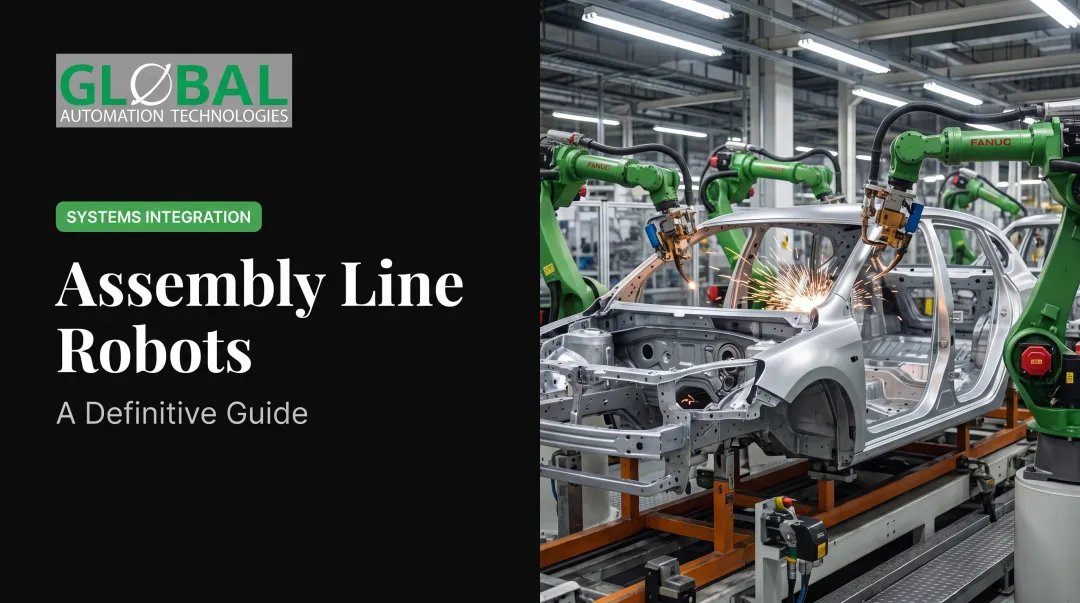
- Six-axis articulated robots — fastening and welding on automotive body structures
- SCARA robots — vertical insertion in electronics and small-appliance assembly
- Delta robots — high-speed picking and orienting parts before downstream stations
- Collaborative robots — operator-assisted work where people still make judgment calls
What Are the 4 Types of Assembly Lines?
Manufacturers organize robotic assembly lines into four categories:
- Single-model lines — one product configuration runs continuously under stable demand; best for high-volume, low-variation production
- Multi-model lines — different models run in separate batches on the same line, with changeover time between batches
- Mixed-model lines — multiple models from one product family run intermingled, with no significant setup between units
- Modular/flexible lines — tools, fixtures, and sometimes layout reconfigure on the fly for small-batch or multi-category work

Industries That Rely on Robotic Assembly Lines
Line configuration choice tracks closely with industry mix and volume. Global installation data shows where robotic assembly has taken hold: in 2023, automotive accounted for 25% and electronics for 23% of all industrial robot installations worldwide, with metal and machinery close behind at 14%.
GLOBAL Automation Technologies’ assembly automation work reflects that same concentration across:
- Automotive OEMs and Tier 1 suppliers (body shop, powertrain, final assembly)
- Electric vehicle manufacturers
- Heavy equipment and agricultural equipment producers
- Aerospace component and system assembly
- Appliance and general industrial manufacturing
The same robotic principles—fastening, inspection, traceability, transfer—apply across every one of these sectors. A dispensing cell designed for a vehicle door often transfers cleanly to an aircraft panel.
Benefits of Robotic Assembly Lines
Robotic assembly lines earn their investment through four measurable gains: throughput, quality, safety, and payback speed.
Throughput and uptime. Robots don't take breaks, and they don't slow down at hour seven of a shift. One NIST-documented cobot cell reported 50% higher throughput after automating a manual lifting and stacking process. Multiply that across a full line, and running well beyond a single shift—lights-out between scheduled maintenance windows—becomes realistic instead of a stretch goal.
Precision and consistency. Every cycle runs the same way, so scrap and rework drop once robots take over repetitive fastening, dispensing, or inspection tasks.
GLOBAL Automation Technologies builds test and inspection stations directly into its robotic assembly cells. Those stations capture torque values, serial numbers, and process parameters at each unit, catching quality issues at the station instead of at the end of the line.
Workplace safety. Pulling people out of repetitive-strain and hazardous tasks—reaching into a press, handling hot parts—cuts injury exposure directly. It also moves operators into higher-value work:
- Programming and cell oversight
- In-process inspection
- Process improvement instead of load-unload cycles
Shrinking payback windows. Automation used to carry a payback period of five to eight years. Industry-wide estimates now put that closer to one to three years.
For machine tending cells specifically, payback often lands in the 12 to 18-month range—more parts per shift, fewer direct labor hours to hit the same output.
Faster payback plus lower entry complexity on single-cell projects is why automation is no longer limited to large OEMs with dedicated budgets. Mid-sized manufacturers can start with one cell and scale from proven results.

Challenges and the Future of Robotic Assembly Lines
Investment and Integration Complexity
Robotic assembly lines cost real money upfront, and the range swings widely. A single robotic cell might run in the tens of thousands of dollars; a fully integrated multi-robot line—spanning fastening, dispensing, inspection, and traceability—can run into the millions.
Retrofitting an existing line adds another layer of complexity. New robots have to work around fixtures, conveyors, and floor space that weren't designed for automation.
The Skilled-Labor Gap
Robots don't program, operate, or maintain themselves. Manufacturers increasingly report that digital proficiency is now a core requirement for engineers, technicians, and operations staff, not a nice-to-have. That's a real constraint when the same workforce shortage from the introduction is already limiting hiring across the industry.
That is why many manufacturers look for a partner who can deliver both the robotic system and the engineers to run it.
GLOBAL Automation Technologies is built around that gap. Its automation solutions work designs and integrates the system—primarily on FANUC platforms—while its technical staffing places robot programmers, controls engineers, and commissioning specialists on contract, contract-to-hire, or direct-hire terms. Clients are not forced to choose between buying equipment and finding people to run it.
Where the Technology Is Heading
Three trends are shaping the next generation of robotic assembly lines:
- Predictive maintenance: AI models analyze robot performance data and flag issues before they cause downtime
- Adaptive vision: real-time 3D inspection and edge AI help robots adjust to part variation without stopping the line
- Collaborative robots: cobots were 10.5% of global industrial robot installations in 2023, and that share is still climbing
As these systems get more complex, partner track record matters more. GLOBAL Automation Technologies has integrated a proven global base of robots as a Level 5 FANUC Authorized System Integrator—experience that shortens time-to-production on a new line.
Frequently Asked Questions
What are assembly line robots?
Assembly line robots are programmable industrial machines that perform tasks like welding, fastening, placing, and inspecting parts on a production line. Many are guided by vision systems or force/torque sensors to handle part variation in real time.
What are the 4 types of assembly lines?
The four common types are single-model (one product, continuous run), multi-model (batched changeovers), mixed-model (variants run together with no setup time), and modular/flexible lines built for small-batch reconfiguration.
How much does it cost to set up a robotic assembly line?
Costs range from tens of thousands of dollars for a single robotic cell to several million for a fully integrated, multi-robot line. The final number depends on part complexity, throughput needs, and how much inspection and traceability the line requires.
How long does it take for a robotic assembly line to pay for itself?
Most robotic assembly lines pay for themselves in one to three years. Machine tending cells often land on the faster end, typically in the 12 to 18-month range.
What industries use robotic assembly lines the most?
Automotive and electronics manufacturing lead global robot installations, followed by metal and machinery production. Aerospace and heavy equipment manufacturers are also significant adopters of robotic assembly.
Can small and mid-sized manufacturers benefit from robotic assembly lines?
Yes. Scalable single-cell projects, feasibility studies, and flexible staffing models (contract, contract-to-hire, or direct hire) let smaller manufacturers adopt automation without hiring a large permanent engineering team.