
The right palletizing robot arm can transform your operation, boosting efficiency, reducing injury claims, and cutting the per-pallet labor cost. But with dozens of models on the market, which one is the right fit?
This guide breaks down the three best palletizing robot arms for 2026, selected for their payload, speed, and proven performance. We'll also cover the most important factor in any automation project: choosing the right integration partner.
Key Takeaways
- Palletizing robot arms are programmable robots that automatically stack products onto pallets, replacing manual labor.
- The best arms for 2026 are the FANUC M-410iC/185 for all-around use, the M-410iC/300 for heavy loads, and the M-410iC/50H for high-speed lines.
- Robot selection is only half the battle; success depends on an experienced integration partner who can design, program, and support the system.
- GLOBAL Automation Technologies delivers proven, FANUC-based palletizing systems backed by the engineering talent to ensure they run effectively.
Overview of Palletizing Robot Arms in Manufacturing
A palletizing robot arm is a multi-axis, programmable robot equipped with specialized end-of-arm tooling (EOAT), such as a clamp, vacuum gripper, or fork, to stack products onto a pallet. Unlike conventional palletizers that use fixed mechanical motions, robotic arms offer the flexibility to handle various SKUs, build complex patterns, and adapt to changing production needs with simple software adjustments.
As manufacturers across North America push to increase output and reshore production, these robotic systems have become essential for keeping pace. They address the ergonomic risks of manual stacking while delivering the consistent, multi-shift throughput that modern supply chains demand.
But choosing the right hardware is just the starting point. The real value comes from pairing the right robot with an integration partner who understands your process. Below are the three standout arms manufacturers are turning to in 2026, followed by the criteria you should use to select a partner.
Top 3 Best Palletizing Robot Arms in 2026
These FANUC models were selected for their payload versatility, proven reliability in high-volume North American plants, and clear fit across common case, bag, and mixed-load applications.
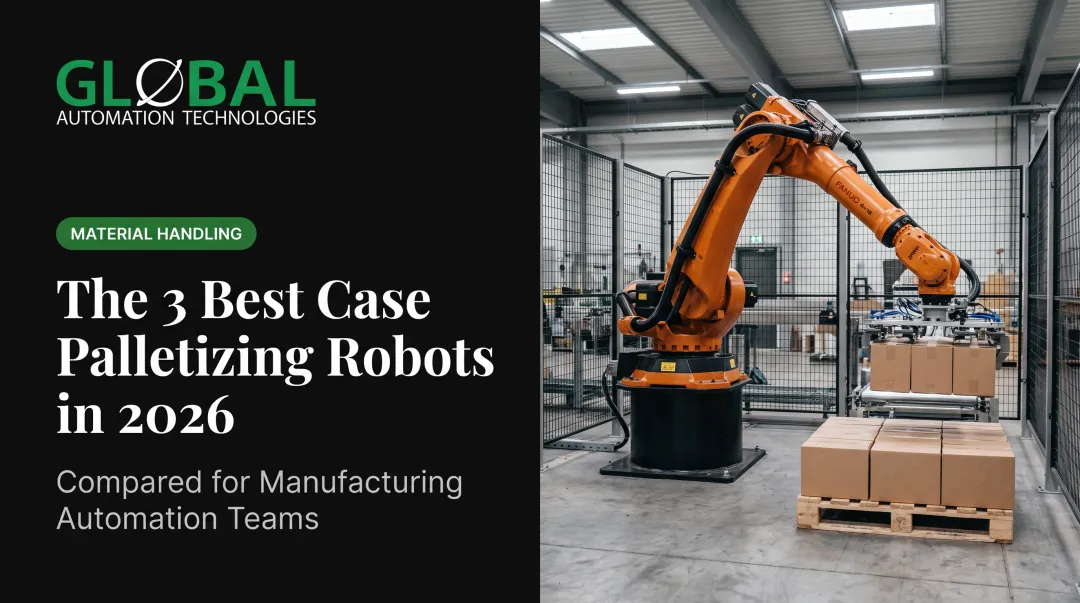
FANUC M-410iC/185
The M-410iC/185 is FANUC's most widely deployed 4-axis palletizing robot, purpose-built for handling a mix of boxes, bags, and cases. It's a common sight in food and beverage, consumer goods, and general manufacturing facilities.
Its balanced payload-to-speed ratio makes it the series workhorse. Plants that need one arm to cover varied SKUs get consistent throughput without dedicating a line to a single product.
| Specification | Details |
|---|---|
| Payload Capacity | 185 kg — standard cases, bags, and mixed loads |
| Reach | 3,143 mm horizontal — supports multi-pallet layouts |
| Best Fit | High-mix lines that need one arm for varied product types |
FANUC M-410iC/300
This heavier-duty variant of the M-410 series is designed for dense, high-weight unit loads. Think building materials, chemicals, and bulk bagged goods where each pick-and-place cycle tests the limits of the arm's mechanical structure.
The /300’s advantage is a reinforced structure and higher payload rating. On lines that move heavy loads every cycle, a purpose-built arm cuts the strain-related downtime risk that shows up when lighter arms run past their design limits.
| Specification | Details |
|---|---|
| Payload Capacity | 300 kg — heavy cases, drums, and bulk bags |
| Axis Configuration | 4-axis — stacking stability under heavy loads |
| Best Fit | Construction materials, chemicals, and heavy industrial goods |
FANUC M-410iC/50H
Engineered for speed, the M-410iC/50H is built for lighter loads moving at rapid cycle rates. That profile fits high-throughput beverage and consumer packaged goods (CPG) lines running continuous shifts.
It posts faster cycle times than the heavier-payload models in the series. Plants can raise throughput on high-volume lines without the footprint or cost of a heavy-payload system they don’t need.
| Specification | Details |
|---|---|
| Cycle Speed | Highest cycles per minute in the M-410iC series |
| Payload Capacity | 50 kg — lightweight cases, cartons, and packs |
| Best Fit | High-speed beverage, food, and CPG lines on continuous shifts |
Note on integration: Real-world performance depends heavily on programming and cell integration quality.
As a Level 5 FANUC Authorized System Integrator, GLOBAL Automation Technologies deploys all three models. AI-assisted simulation shortens programming from weeks to days, and predictive maintenance tools help flag issues before they cause unplanned downtime.

How We Chose the Best Palletizing Robot Arms
Too often, buyers compare robots on payload or price alone. A strong palletizing cell needs a broader read than either number. We based our picks on the factors that drive long-term performance and ROI.
Key Evaluation Criteria:
- Payload-to-Speed Ratio: The arm must handle the heaviest product plus end-of-arm tooling (EOAT) weight at a cycle speed that hits production targets.
- Reach and Axis Configuration: Reach has to cover every pallet and conveyor position in the cell. A 4-axis design usually fits palletizing’s vertical and horizontal moves best.
- Proven Deployment History: We favored models with a long reliability record in demanding manufacturing environments.
- Safety Compliance: Robots needed a clear path to standards such as ISO 10218 for safe design and integration.
- Integration and Support: Qualified integration partners matter. A great robot with poor programming is an expensive paperweight.
Conclusion
The "best" palletizing robot arm is the one correctly matched to your product mix, throughput goals, and floor layout, not simply the highest payload or the best-known brand. Before you decide, weigh total cost of ownership: integration timeline, scalability, and how you will run and maintain the cell.
Use this short checklist before you commit:
- Match payload, reach, and speed to your SKU mix and target cases per hour
- Confirm the cell fits your floor layout, infeed, and stretch-wrap or conveyor handoff
- Compare TCO across integration, tooling, software, training, and support—not sticker price alone
- Choose a partner who can commission the system and staff the engineers to keep it running
With 17+ years in automation and a proven global base of robotic deployments, GLOBAL Automation Technologies integrates turnkey FANUC palletizing cells and supplies the controls and mechanical talent to operate them. Its automation solutions, engineering services, and technical staffing keep selection, startup, and long-term performance tied to the same team.
Frequently Asked Questions
What is a palletizing robot arm?
It's a programmable robotic arm fitted with end-of-arm tooling (EOAT) that automatically stacks boxes, bags, or cases onto pallets. It replaces manual labor in repetitive, physically demanding end-of-line packaging tasks.
How much does a palletizing robot arm cost?
Standard, pre-engineered systems typically range from $130,000 to $300,000+, depending on payload, EOAT complexity, safety features, and integration scope. Fully custom cells for complex applications often run higher.
What is the difference between a robotic palletizer and a conventional palletizer?
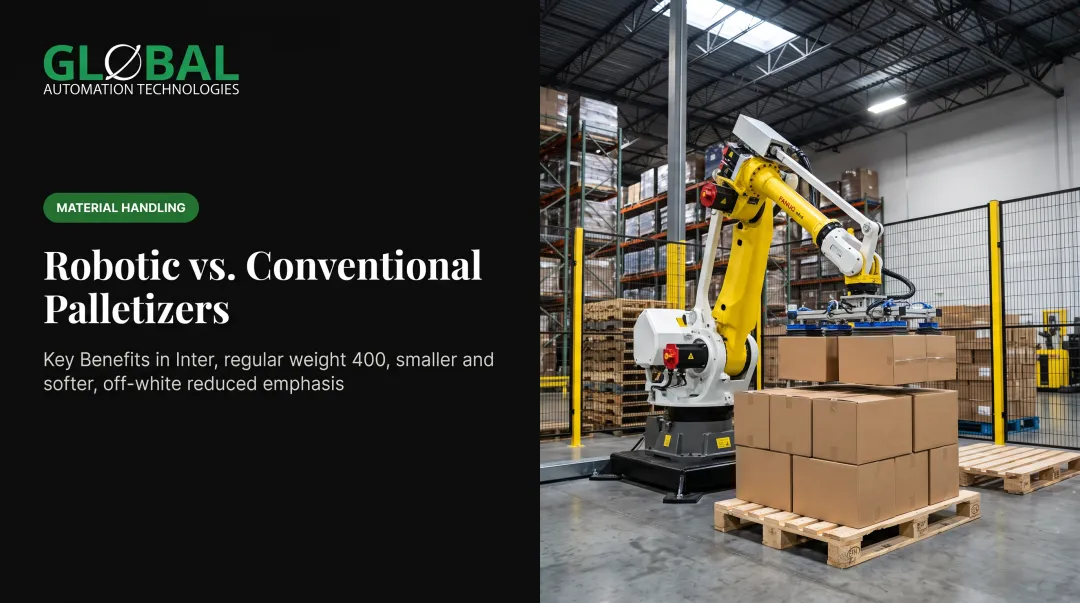
Conventional palletizers use fixed mechanical components to form and deposit layers in a set pattern. Robotic arms are highly flexible, using programmable software to handle different products, build custom patterns, and service multiple lines simultaneously.
How do I know what payload capacity I need for palletizing?
Calculate the weight of your heaviest single product or group of products to be lifted, then add the weight of the end-of-arm tooling. Choose a robot whose rated payload safely exceeds that total.
Are palletizing robot arms safe to operate near workers?
Yes, when properly integrated. Traditional arms run inside a safeguarded space with fencing and safety scanners per ISO 10218; collaborative models can work closer to people using force and speed limiting after a formal risk assessment.
How long does it take to see ROI from a palletizing robot arm?
Most systems deliver a return on investment within 12 to 24 months. Payback is driven by direct labor savings, higher throughput, and lower injury-related costs from manual lifting.