
Introduction
Manufacturing plants are running leaner than ever, and the pressure shows. Labor shortages, higher throughput targets, and tighter quality tolerances collide on the same shop floor—often in the same shift—and material movement is where that strain shows up first.
The numbers back this up. A Deloitte and Manufacturing Institute study projects manufacturers will need 3.8 million new employees between 2024 and 2033. As many as 1.9 million of those roles may go unfilled.
"Integration" often gets framed in abstract terms: cohesion, connectivity, coordination. On the floor, the payoff shows up in metrics plant managers already track—uptime, defect rates, safety incidents, and cost per part.
This article breaks down what an integrated material handling system actually is, the concrete benefits it delivers, and how manufacturers get the most out of one.
Key Takeaways
- Integrated systems move material as one continuous flow, not isolated manual stations
- Full integration delivers higher throughput, consistent quality, improved safety, and faster ROI
- Skipping integration leads to inconsistent output, rising costs, and reactive troubleshooting
- Value compounds when the system is monitored and optimized continuously—not installed and forgotten
What Is an Integrated Material Handling System?
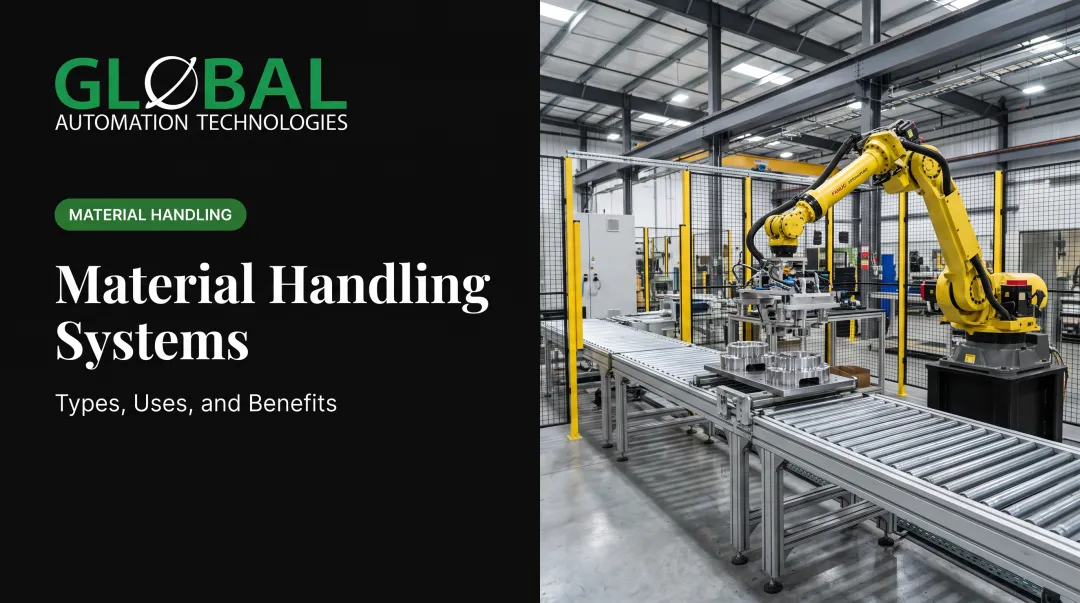
An integrated material handling system links equipment, robots, conveyors, machine tending cells, and storage through shared controls and software. Parts move as one connected flow instead of stopping at standalone stations for manual hand-offs.
You'll typically find integrated material handling in:
- Automotive and Tier 1 production lines, including body-in-white and seam sealer applications
- Robotic machine tending cells feeding CNC machines, lathes, presses, and injection molding equipment
- Dispensing and painting lines applying structural adhesives, PurFoam, or coatings
- Heavy equipment assembly operations
- Warehouse and distribution center operations
What matters is removing the manual hand-offs, blind spots, and bottlenecks between processes. Those gaps cut into output every shift.

Key Benefits of an Integrated Material Handling System
The benefits below tie directly to metrics plant managers already track, not theoretical advantages. Each one reflects how connected handling equipment changes day-to-day decisions on the floor, from scheduling to staffing to quality control.
Higher Throughput and Production Beyond a Single Shift
Integration links loading, tending, and transfer steps so material moves without waiting on a person to intervene. That means near-continuous cycles instead of stop-start production.
Robotic machine tending is the clearest example. When it's integrated with CNC or spindle operations, it extends run time into lights-out operation between scheduled maintenance windows and can let one cell feed multiple work centers through intelligent scheduling and buffer stations.
Why it matters:
- Reducing idle time between handling steps lifts output without adding shifts or headcount
- Assembly Magazine documented a case where automated CNC loading doubled machine productivity and cut the failure rate in half for overnight, unattended runs
- Predictable capacity gives management the confidence to commit to extended production schedules that run lights-out between scheduled maintenance windows
At GLOBAL, which holds Level 5 status in FANUC’s Authorized System Integrator program, machine tending systems replace the manual open-door, load-part, close-door, restart-cycle sequence. A robot handles those steps faster and more consistently, including setups where one robot serves multiple machines.
KPIs impacted: Cycle time, machine/spindle utilization, unattended run hours, units produced per shift.
Where it matters most: High-mix, high-volume lines; multi-shift operations; labor-constrained plants running near capacity.
Consistent Quality and Reduced Material Waste
Integration embeds inspection directly into the material flow instead of bolting it on afterward. Vision systems and flow monitoring catch defects at the handling step, not three stations downstream.
On dispensing lines, real-time bead monitoring flags deviations before a part advances. GLOBAL's robotic painting systems follow repeatable spray paths and validated process parameters, holding film build within specification shift after shift instead of varying with operator technique; full coverage and finish inspection, with robotic spot repair, happens downstream rather than live in the booth.
Why it matters:
- Catching defects at the point of handling avoids costly rework and scrap further down the line
- ASQ treats scrap and rework as internal failure costs—still expensive, but far lower than external costs like warranty claims and returns
- Quality data becomes part of active process control, not an after-the-fact inspection report
This shift changes how supervisors respond. Instead of reviewing scrap reports at the end of a shift, they're adjusting parameters in real time as the system flags drift.
KPIs impacted: Defect/scrap rate, rework hours, first-pass yield, material cost per part.
Where it matters most: Tight-tolerance parts, regulated coating and paint film specs, high-material-cost processes.
Improved Workplace Safety and Reduced Manual Handling Risk
Integration removes workers from repetitive lifting, hazardous transfer points, and exposure zones by letting connected equipment handle the transitions instead.
Robotic painting and dispensing cells are a direct example. Robots inside spray booths keep operators out of isocyanates, VOCs, overspray particulates, and—in powder coating—high-voltage electrostatic zones.
Why it matters:
- Fewer workers in manual lifting or exposure roles means lower musculoskeletal injury risk
- BLS recorded 502,380 MSD cases with days away from work in private industry (2021–2022); manufacturing logged 396,800 total recordable injuries in 2022
- OSHA flags heavy lifting, awkward postures, and repetitive tasks as leading MSD risks and top drivers of lost work time
Fewer injury claims translate to steadier staffing in hazardous roles and lower compliance exposure over time. That's not a soft benefit. It shows up directly in workers' comp costs and turnover.
KPIs impacted: Incident/injury rate, lost workdays, compliance citations, turnover in hazardous positions.
Where it matters most: Painting, welding, and heavy-lifting environments operating under strict safety compliance requirements.
Faster ROI Through Reduced Startup Time and Lower Total Cost of Ownership
Upfront integration planning, layout design, and simulation reduce surprises during commissioning. That shortens the time between capital commitment and actual production.
AI-assisted simulation is changing this timeline. Engineers can model, test, and optimize robot paths and cell layouts in a virtual environment before touching hardware. In practice, that has cut robot programming time from weeks to days.
Why it matters:
- Shorter commissioning windows mean equipment starts generating value sooner after capital is committed
- Well-integrated machine tending cells typically pay for themselves in 12 to 18 months, driven by more parts produced per shift with fewer direct labor hours
- Front-loading engineering work into simulation means fewer change orders and less rework once installation begins
KPIs impacted: Payback period, commissioning time, engineering change orders, total installed cost.
Where it matters most: Capital-intensive automation projects, tight production launch timelines, EV or new-model ramp-ups.

What Happens When Integration Is Missing or Ignored
Skip integration, and the consequences show up gradually, then all at once. Common patterns include:
- Inconsistent throughput because handling steps depend on manual timing between stations
- Higher defect rates from a lack of in-line inspection and data visibility
- Reactive firefighting when equipment and controls aren't communicating with each other
- Rising costs over time from waste, rework, and unplanned downtime
- Difficulty scaling to new products or volumes without redesigning individual stations one at a time
None of these show up on day one. They accumulate. A plant running disconnected stations might hit its numbers for months before a labor gap or a demand spike exposes exactly how fragile that setup was.
How to Get the Most Value from an Integrated Material Handling System
Integration works best when equipment, controls, and people are planned as one system from the start, not added piecemeal after problems appear.
A few practices separate plants that get lasting value from those that don't:
- Plan the whole system upfront — layout, controls, and staffing together, not equipment first and integration second
- Review outcomes on a regular cadence using KPI dashboards tied to the handling system's controls—not a one-time commissioning report that never gets opened again
- Pair integration expertise with trained engineering support so the people running the system understand its architecture, not generalists learning it from scratch
This last point is where a lot of upgrades stall. A material handling system is only as good as the team maintaining and programming it day to day.
That's the thinking behind GLOBAL Automation Technologies' model: automation solutions, services and technical staffing. A material handling upgrade comes with the controls engineers, robot programmers, and project managers needed to run it—not just the hardware.
Conclusion
The real value of an integrated material handling system is the control, clarity, and consistency it brings across throughput, quality, safety, and cost.
These benefits compound when the system is monitored and acted on continuously, not treated as a one-time install and forgotten. Integration works best as an ongoing practice, backed by a partner that can deliver both the system and the engineers to run it.
Frequently Asked Questions
What are common examples of material handling equipment (MHE)?
Common categories include conveyors, robotic arms, forklifts, AGVs and AMRs, storage and retrieval systems, and machine tending cells. Most facilities combine several of these across the production flow.
What is a material handling equipment (MHE) integrator?
An MHE integrator designs, connects, and commissions equipment from multiple manufacturers into one cohesive, functioning system. They handle everything from layout design and controls programming to installation and ongoing support.
What's the difference between material handling equipment and an integrated material handling system?
Equipment refers to individual machines, like a single conveyor or robot. An integrated system connects that equipment, controls, and workflows into one continuous material flow across the entire line.
How much does it cost to implement an integrated material handling system?
Costs vary widely based on scope, part geometry, and application type. ROI, such as machine tending cells paying back in 12 to 18 months, is a more useful planning metric than upfront cost alone.
Can an existing, non-integrated setup be upgraded into an integrated system?
Yes. Most facilities can integrate incrementally by connecting existing equipment through controls and simulation-based retrofits rather than a full rebuild, minimizing downtime during the transition.
Which industries benefit most from integrated material handling systems?
Automotive OEMs, Tier 1 suppliers, heavy equipment makers, and other high-volume or hazardous-process manufacturers see the strongest returns. Gains are largest where labor risk or tight tolerances are involved.