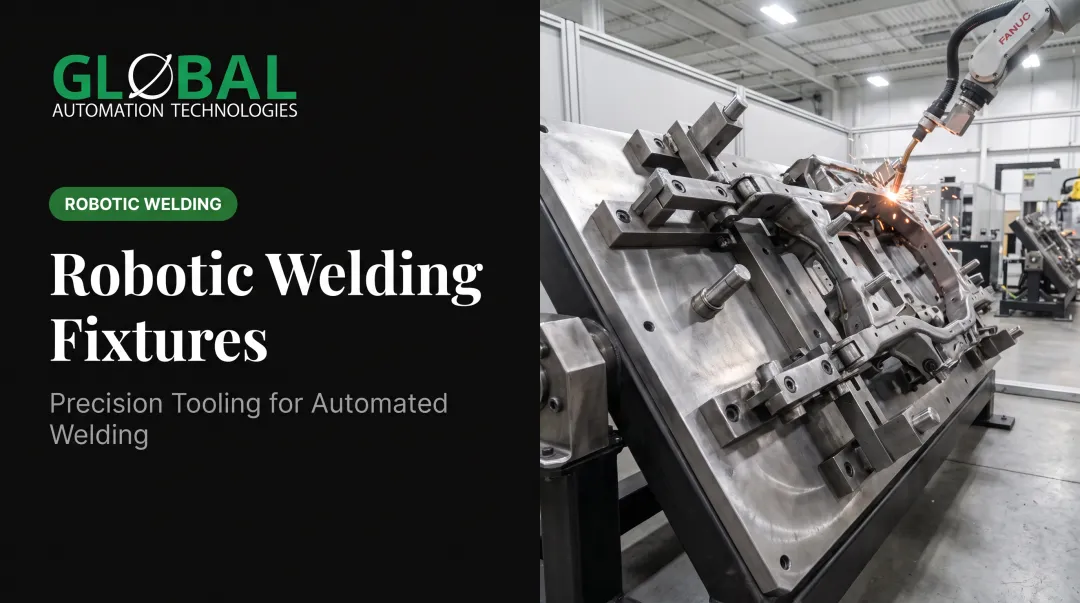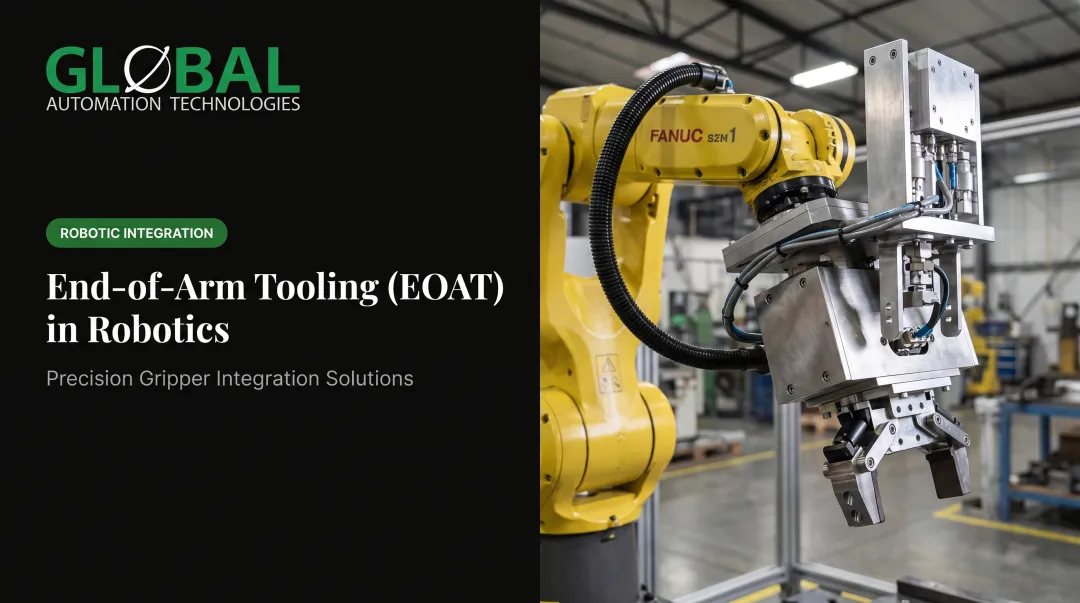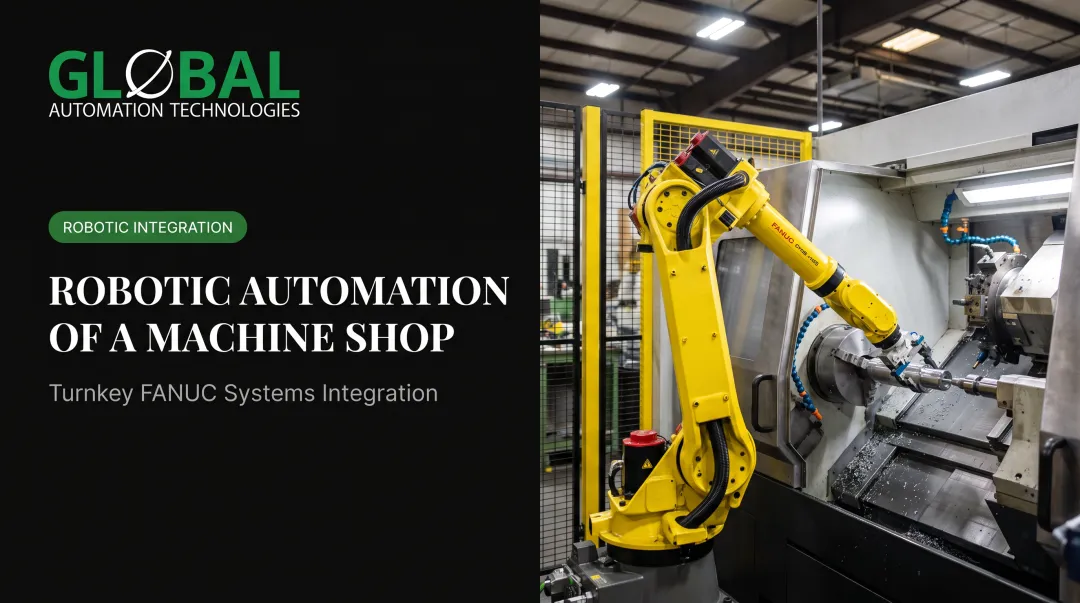

Fixturing decisions ripple into precision, cycle time, and cost simultaneously. Shops without a clear framework tend to swing to extremes: they either over-engineer a $15,000 fixture for a 50-piece run, or they under-build workholding for a high-volume job and watch tolerances drift as clamping surfaces wear.
This guide breaks down fixture types, design best practices, common mistakes, and what changes when robots start loading your machines.
Key Takeaways
- A CNC fixture locates and clamps a workpiece so the machine cuts it accurately, run after run.
- Custom, universal, or modular fixturing depends on part volume, geometry, and budget: not personal preference.
- Overbuilt and underbuilt fixtures both cost money; match complexity to the job.
- Robotic machine tending demands tighter repeatability and quick-change workholding than manual setups.
What Is CNC Fixturing?
CNC (Computer Numerical Control) is the automated process where software directs a machine tool's movements through programmed code. But the program only controls the cutting path. It has no idea where the part actually sits unless something holds it in a fixed, known position.
That's the fixture's job. A CNC fixture is a device that locates and clamps a workpiece in a repeatable position using mechanical structure and clamping force, so the programmed toolpath lines up with the physical part every single time.
Fixture vs. Jig vs. Clamp vs. Vise
These terms get used interchangeably on shop floors, but they mean different things:
- Fixture — positions and holds the workpiece; does not guide the cutting tool
- Jig — holds the workpiece and guides the cutting tool, a distinction that matters mostly in manual machining
- Clamp — the mechanical component that supplies holding force; often one part of a larger fixture
- Vise — a common type of clamp, using movable and stationary jaws to squeeze a part into position
A fixture can include multiple clamps. A vise is rarely called a fixture on its own, though it functions as a simple one.
Types of CNC Fixtures
Fixtures are typically classified two ways: by structure/operation and by power source. Most shops mix several types across machines and jobs.
Fixtures by Structure and Operation
Vises and soft jaws are still the default for standard and irregular parts. Soft jaws—machined or 3D-printed to match a part’s contour—clamp flat or contoured edges precisely without custom hard tooling for every job.
Modular fixture plates and pallets use standardized grids and dowel pins for quick-change repeatability. That payoff is largest in small-batch, high-mix shops. Jergens reports Ball Lock repeatability of ±0.0005 in (±0.03 mm) or better. In one documented case, a vise-to-table setup dropped from 60–90 minutes to 1–5 minutes after a ball-lock switch.

Vacuum fixtures hold thin, flat, or delicate parts with atmospheric pressure (about 14.7 psi theoretical maximum) and no mechanical marring. Seal quality, contamination, and part size all cut real-world holding force below that ceiling.
Specialty methods cover the edge cases:
- 4th/5th-axis fixtures for multi-sided access
- Expanding mandrels or collets for round parts
- Tab or window machining, where the stock acts as the fixture until final cutoff
Fixtures by Power Source
| Power Source | Best Fit |
|---|---|
| Manual/mechanical | Low-volume jobs, operator-loaded setups |
| Hydraulic | High-force clamping; steady force when part size varies |
| Pneumatic | Fast clamp cycles; common in automated cells |
DESTACO notes hydraulic clamps deliver high force from compact elements and stay consistent when part dimensions shift slightly—useful on production runs where stock tolerance moves batch to batch.
Fixture Design Best Practices
Good fixture design matches complexity to the job.
Keep it simple first. Weigh part volume against fixture complexity before adding features. A one-off prototype doesn't need the same fixture as a 10,000-unit production run.
Don't under-build for volume or precision. Aluminum or low-grade clamping surfaces wear fast under repeated cycles. If you're running high-precision parts at volume, budget for hardened locators and wear-resistant clamping surfaces from the start.
Reference only the datums that matter. Carr Lane's widely used 3-2-1 method applies six locators to control workpiece movement across three planes. Adding redundant locators that control the same axis can actually shift the part and hurt accuracy. More locators aren't automatically better.
Control clamping force deliberately. A 2023 study in Scientific Reports found that excessive clamping force on thin-walled aluminum parts caused elastic deformation and dimensional errors, while too little force failed to restrain the part at all. Direct clamping force toward locators or the most rigidly supported area of the part, not toward unsupported spans.
Account for tolerance stacking. Carr Lane's rule of thumb: fixture-locator tolerance should sit at 20-50% of the workpiece tolerance. If your part needs to hold ±0.005 in, your locators need to be tighter than that — otherwise the fixture itself becomes your biggest source of variation.

Standardize with plates and pallets. Sub-plates and pallet systems speed up changeover on repeat jobs and reduce the redesign work every time a similar part comes through.
Fixturing for Automated and Robotic Machine Tending
Manual machining tolerates a little operator correction: nudging a part, re-seating it, catching a chip under a locator. Robotic tending doesn't get that luxury. Fixtures have to support repeatable, unattended load/unload cycles with zero correction, because there's no operator standing there to fix a bad seat.
Quick-Change Is Non-Negotiable
Ball-lock systems and zero-point plates are the standard answer here. SCHUNK's VERO-S line claims up to 90% reduction in setup time and cost, with repeat accuracy below 0.005 mm, tight enough for robotic cells running unattended overnight.
Multi-part pallets matter too, especially on short-cycle jobs. If a part cuts in 90 seconds but a robot's load/unload cycle takes 45 seconds, fixturing multiple parts per pallet keeps the spindle fed and prevents the robot from becoming the bottleneck.
Where Automation Changes the Fixture Conversation
At GLOBAL Automation Technologies, which holds Level 5 status in FANUC’s Authorized System Integrator program, robotic machine tending cells are engineered around the machine, part geometry, and cycle time. Fixture integration is built into the cell design from day one, alongside:
- Gripper selection
- Part staging
- Safety guarding
Properly engineered fixturing with FANUC robotic cells raises spindle utilization by letting machines run through breaks, shift changes, and overnight hours instead of sitting idle between manual loads. These cells typically pay for themselves in 12 to 18 months, driven by that utilization gain plus labor redeployment.
Before hardware hits the floor, AI-assisted offline simulation models the robot, fixture, tooling, and part geometry together. Engineers test robot paths and check fixture clearance virtually, catching fixture-to-gripper collisions in simulation instead of during commissioning. That cuts robot programming time from weeks down to days.
Common CNC Fixturing Mistakes to Avoid
Ignoring machine compatibility. Table size, T-slot spacing, and available spindle power all need to match your fixture's footprint and clamping requirements. A fixture designed for one machine's T-slot pattern won't necessarily bolt onto another.
Neglecting maintenance. Kurt's vise maintenance guidance calls for:
- Daily/weekly: chip removal and seal inspection
- After every cleaning: check for chip entrapment and dry components fully
- Every 3–6 months: clean under the movable jaw, inspect thrust bearings, grease cavities, and oil the screw and vise bed
Skip it, and debris and wear build up in the mechanism. Clamping accuracy drifts, and a stuck vise is only the most obvious failure.

Underestimating total cost. Purchase price is rarely the real cost. Maintenance, versatility across future jobs, and scrap from a poorly designed fixture usually outweigh the upfront tooling spend.
Frequently Asked Questions
What does CNC stand for?
CNC stands for Computer Numerical Control, a manufacturing process where software directs machine tool movement through programmed code rather than manual operation.
What is a CNC fixture?
A CNC fixture is a device that locates and secures a workpiece in a fixed, repeatable position so the machine cuts accurately and repeatably to the program.
What is the difference between a fixture and a jig?
A fixture only holds and locates the workpiece. A jig also guides the cutting tool directly — a distinction that matters far more in manual machining than in CNC work.
What are the three main benefits of using a fixture or clamp?
The main benefits are improved dimensional accuracy, reduced setup and cycle time, and consistent part-to-part quality across a production run.
How do I choose the best material for a fixture?
Alloy or tool steel suits high-wear, high-volume applications where surfaces face repeated clamping cycles. Aluminum works fine for lighter-force, lower-volume fixtures.
Are CNC fixtures interchangeable between different machines?
It depends on table size, T-slot specifications, and mounting compatibility. Standardized systems like ball-lock or zero-point plates improve interchangeability across machines equipped with matching hardware.