
Rising labor costs, tighter throughput demands, and precision requirements have pushed manufacturers to automate this task first. It's often the easiest automation win with the fastest payback. This article covers what pick and place robots are, the main types available, where they're used, and how to pick the right one for your line.
TL;DR
- Pick and place robots move parts from pick points to place points with high speed, precision, and repeatability
- Industrial setups most often use articulated arms, SCARA, Cartesian, Delta, or collaborative robots (cobots)
- Shops deploy them for assembly, machine tending, packaging/palletizing, bin picking, and inspection
- Choose by payload, reach, speed, repeatability, and how the cell fits your existing line
What Is a Pick and Place Robot?
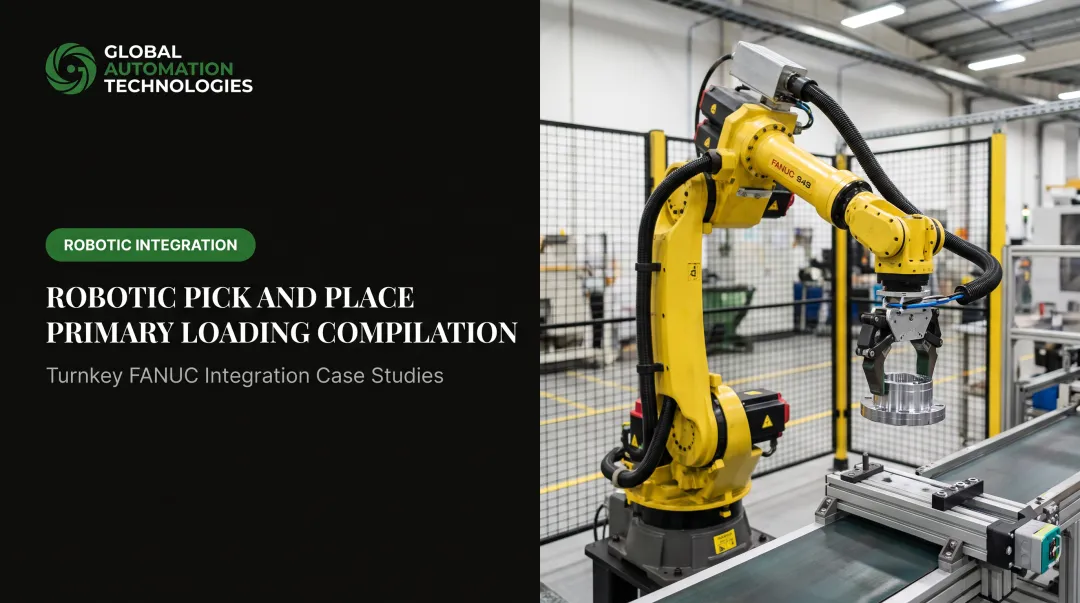
A pick and place robot is an automated system that picks up objects and moves them to a designated location using end-of-arm tooling, such as grippers, suction cups, or specialized fixtures. As FANUC puts it plainly: the robot "picks up a product or part and moves it to a programmed location."
You'll find these robots doing the unglamorous but essential work of manufacturing:
- Material handling: moving parts between stations or processes
- Machine tending: loading and unloading CNC machines, presses, or molding equipment
- Sorting: separating parts by type, orientation, or quality
- Packaging: placing finished goods into containers or onto pallets
On the floor, pick and place robots typically run inside a larger integrated cell, working alongside conveyors, vision systems, and PLCs rather than in isolation.
Why Pick and Place Robots Matter in Manufacturing
Manual material handling introduces variability that automation eliminates. Fatigue stretches cycle times. Repetitive lifting causes injuries. Attention lapses misplace parts and create downstream defects.
Industry data backs the shift. Robot density in factories reached 162 industrial robots per 10,000 manufacturing employees in 2023, more than double the level from seven years prior.
What breaks down without automation:
- Inconsistent cycle times from operator fatigue
- Quality variability from manual placement errors
- Safety incidents in repetitive or hazardous tasks
- Bottlenecks when demand spikes beyond available labor
Pick-and-place work such as machine tending shows the payoff clearly. At GLOBAL Automation Technologies, these cells typically pay for themselves in 12 to 18 months by raising parts per shift and cutting direct labor hours.
They also keep spindles running through breaks, shift changes, and overnight periods when a manual operation would sit idle.
Types of Pick and Place Robots
No single robot type handles every job well. The right choice depends on speed, precision, payload, and workspace constraints. Many manufacturers deploy several types together on one production line. A Delta robot might handle high-speed sorting, for example, then feed an articulated arm for final packaging.
Articulated Robotic Arms
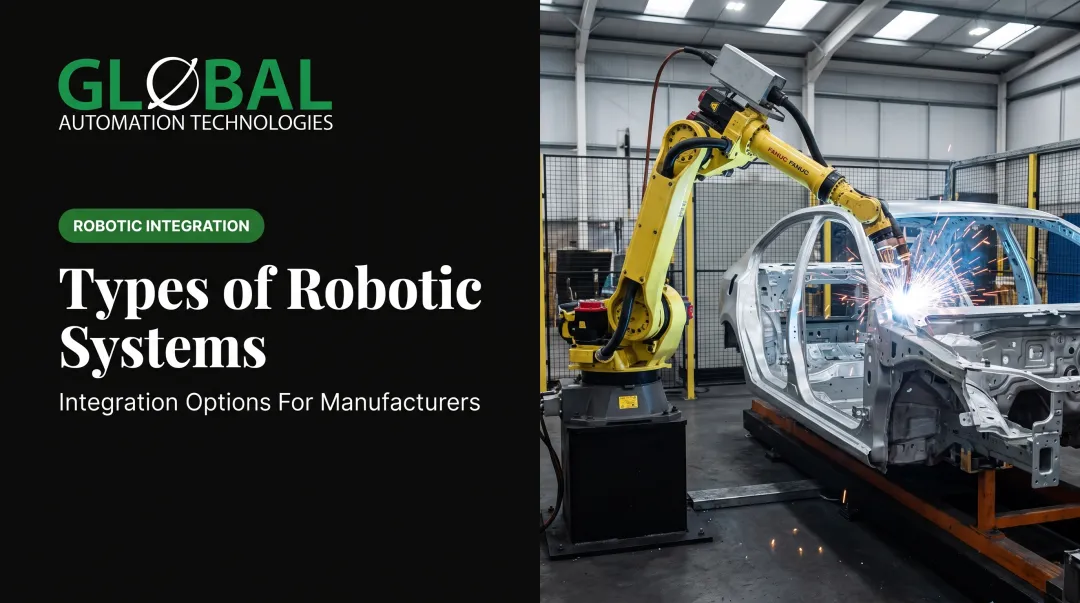
Multi-jointed arms with 4 to 6 axes mimic human arm movement, giving them the greatest flexibility and reach of any pick and place type. A representative model, the FANUC LR Mate 200iD, handles a 7 kg payload with a 717 mm reach and repeatability of ±0.01 mm.

- Best for: Automotive assembly, tasks needing part reorientation, complex 3D trajectories
- Strengths: Versatility, large work envelope, handles varied part geometries
- Limitations: Higher cost, slower than Delta robots for small, high-speed picks
SCARA Robots
The Selective Compliance Assembly Robot Arm design is optimized for fast horizontal motion with limited vertical travel. The Omron i4L, for instance, handles a 5 kg payload with cycle times around 0.54–0.57 seconds under test conditions.
- Best for: Small parts assembly, electronics, palletizing in tight spaces
- Strengths: High speed and repeatability for lightweight tasks
- Limitations: Limited vertical range and payload versus articulated arms
Cartesian (Gantry) Robots
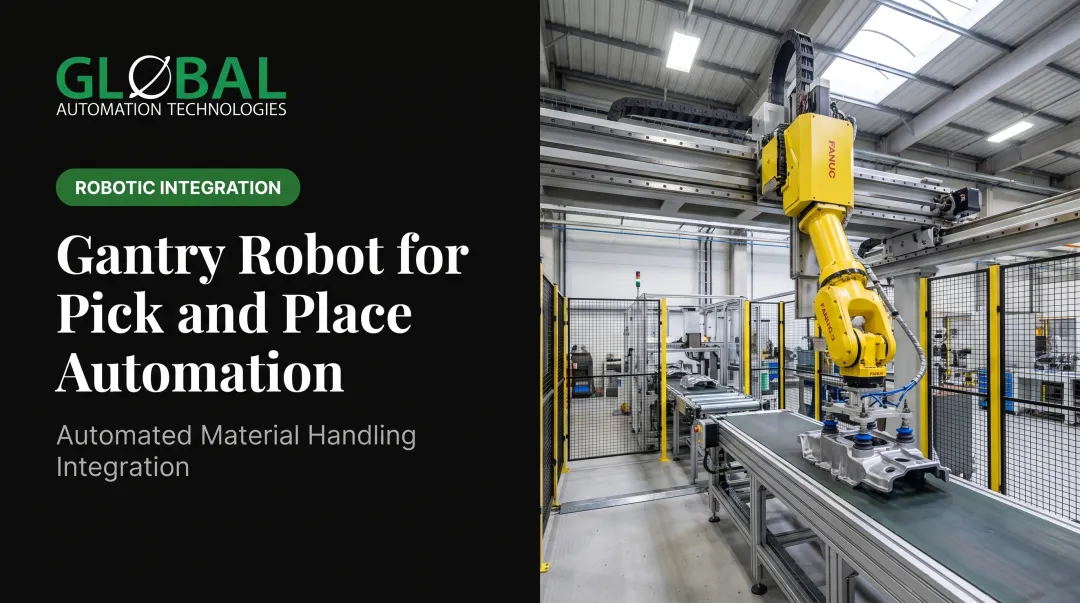
These move along linear X, Y, and Z axes using rail or gantry systems. Simpler mechanics than jointed arms translate to strong positional accuracy. The Yamaha XY-X family spans 13–30 kg payload with X/Y strokes up to 1250 mm.
- Best for: Structured, repetitive material transfer, palletizing, CNC part handling
- Strengths: Robust, modular, cost-effective for large work areas
- Limitations: Less flexible for complex or angled movements
Delta (Parallel) Robots
Spider-like machines use three arms connected via parallel linkages to a central plate. Built for speed. The Omron iX4-650H completes a tested cycle in as little as 0.37 seconds at a 2 kg payload.
- Best for: Food, pharmaceutical, and electronics sorting where speed beats payload
- Strengths: Exceptional speed and precision for small, lightweight items
- Limitations: Low payload capacity, limited reach
Collaborative Robots (Cobots)
Cobots include sensors and safety features that let them work directly alongside human operators without fencing. A model like the Universal Robots UR20 carries 20–25 kg with a 1750 mm reach, though heavier loads may run at reduced speed.
- Best for: Mixed manual-robotic lines, low-volume runs, facilities needing flexible reconfiguration
- Strengths: Quick deployment, adaptability, reduced safety infrastructure costs
- Limitations: Generally slower and lower payload than fenced industrial robots
GLOBAL, a top-tier Level 5 FANUC Authorized System Integrator, integrates cobots specifically for high-mix, low-volume production, where flexibility and fast changeover matter more than raw throughput. Operators and cobots share a workspace, with no guarding required.

Common Applications of Pick and Place Robots
Assembly
Robots transfer and position components onto sub-assemblies, then move finished parts downstream. ABB documented a real case where a manufacturer's aluminum die-cast assembly line rose from 5,000 to 6,000 sets per eight-hour shift, a 20% output gain, after installing five YuMi robot cells.
Machine Tending
Robots load and unload CNC machines, presses, and injection molding equipment. They replace the manual sequence of opening a door, loading a part, closing it, and starting the cycle.
GLOBAL's machine tending solutions, built primarily on FANUC robots, extend unattended operation through breaks, shift changes, and overnight runs. Each cell is engineered so spindles run as close to continuous utilization as the process allows.
In one documented FANUC case study at a facility running two ROBODRILL machines, the cell produced a 33% efficiency gain, processing 1,500 parts per week and paying for itself in roughly 33 weeks.
Packaging and Palletizing
Robots grab items and place them into containers or stack pallets at volume. A FANUC M-710iC/50 replaced a manual packaging bottleneck at a food facility previously staffed by 2-3 people. The cell kept pace with line speed and removed the labor constraint at that station.
Bin Picking and Inspection
Vision-guided robots identify parts in unstructured bins and flag defective items using integrated cameras. GLOBAL builds these systems using FANUC iRVision and 3D area sensors, deploying them across automotive, general industrial, and heavy equipment manufacturing.
The systems locate randomly oriented parts and verify component presence and quality in real time. Thin, overlapping, or deformable parts remain a genuine challenge industry-wide, so vision system selection matters as much as the robot itself.

How to Choose the Right Pick and Place Robot
The right robot depends on production goals, part characteristics, and facility constraints, not brand popularity or whichever robot a competitor is running. Industry guidance from the Association for Advancing Automation (A3) recommends deciding your cell layout and product route first, then working through specifications in order of priority.
Key factors to weigh:
- Payload and reach relative to your heaviest and largest parts
- Required speed and cycle time for target throughput
- Repeatability and precision tolerance (basic pick and place often needs less than insertion or inspection)
- Number of axes needed for part orientation complexity
- Integration compatibility with existing conveyors, vision systems, and controls
- Budget, including installation, programming, and total cost of ownership

On integration, GLOBAL's engineering teams commonly work through three areas:
- Conveyor coordination (speed, part triggers, fault handling)
- Vision system selection for variable part presentation
- Controls integration with PLCs and plant SCADA systems
Getting these wrong on paper is far cheaper than discovering it after installation.
Conclusion
Pick and place robots improve throughput, cut handling errors, and keep people out of repetitive or hazardous tasks. Articulated arms, SCARA, Cartesian, Delta, and cobots each fit different reach, speed, payload, and footprint needs. No single type wins every application.
The right choice depends on your parts, cycle time, and line layout—not a generic spec sheet. GLOBAL Automation Technologies delivers turnkey pick-and-place integration and the engineering talent to run it, so manufacturers get a system matched to real production goals from design through commissioning and support.
Frequently Asked Questions
How much does a pick and place robot cost?
Costs range widely: entry-level SCARA arms cost roughly $10,000–$15,000, while entry cobots start around $43,000 arm-only. Fully integrated cells with tooling, vision, and controls can reach well into six figures.
How do pick and place robots work?
The robot detects an object via vision or sensors, plans a path, grips it with an end-effector (gripper or suction cup), and places it at a programmed location. That detect-plan-grip-place cycle repeats continuously.
What is pick and place in robotics?
It's the automated process of lifting an object and placing it in a designated location with precision, typically as part of assembly, packaging, or material handling.
Which robot is used for pick and place?
Articulated arms, SCARA, Cartesian, Delta, and collaborative robots are all commonly used. The choice depends on required speed, payload, and precision for the specific application.
How long does it take to see ROI from a pick and place robot cell?
Payback depends on throughput, labor rates, and utilization. Pure pick-and-place and palletizing cells often recover cost within about 12 to 18 months; machine tending cells frequently hit the same window through higher spindle utilization and fewer labor hours.
Can pick and place robots work safely alongside human employees?
Yes, collaborative robots (cobots) are designed for this. They use sensors and safety-rated controls, such as speed-and-separation monitoring or power-and-force limiting, to share workspace with operators safely.