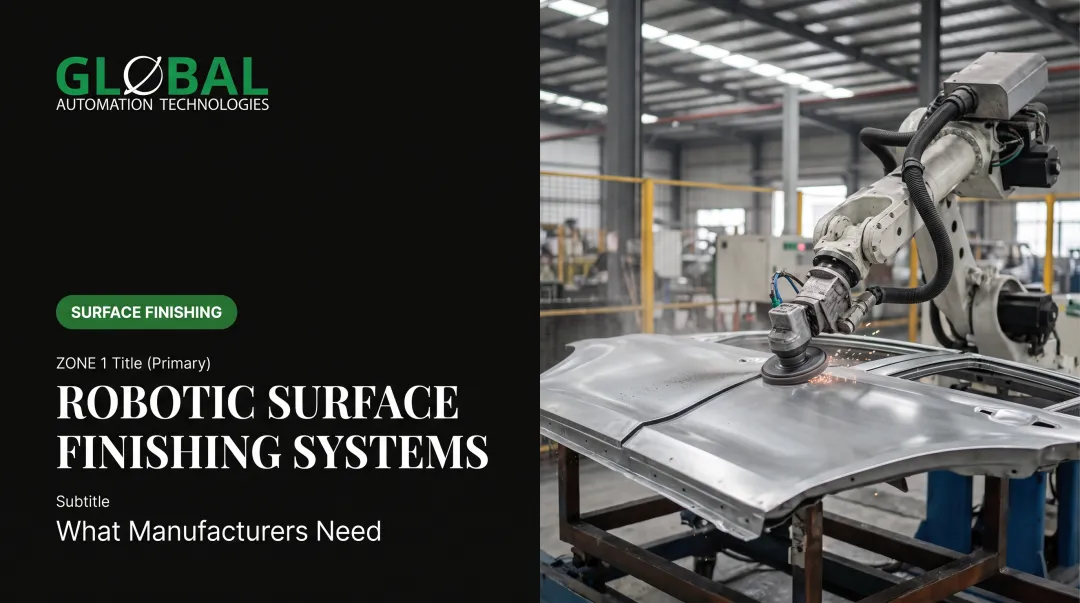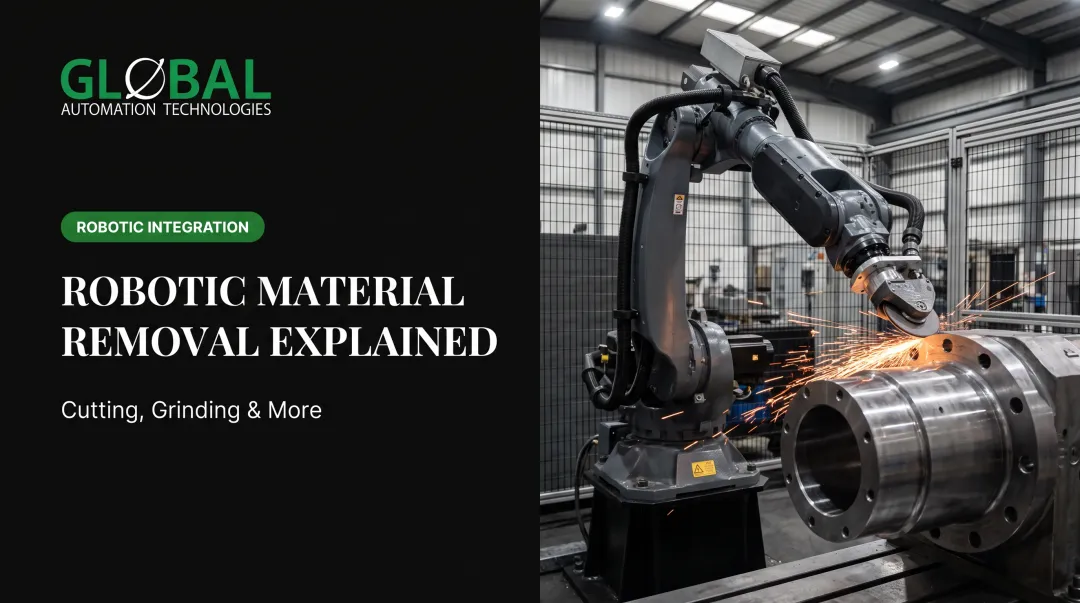

Robotic deburring solves this by putting the repetitive, physically demanding work on a robotic arm equipped with rotary tools, brushes, or force-controlled end effectors. The result is consistent edge quality delivered at production speed, shift after shift.
This guide covers how robotic deburring systems work, the benefits they deliver, the tooling options available, what a deburring cell actually costs, and how to choose an integration partner who can make it work on your parts.
Key Takeaways
- Robotic deburring replaces manual labor and fixed CNC paths with programmable tooling for consistent edge finish.
- Force-controlled end effectors adapt to part variation and prevent gouging on inconsistent surfaces.
- Automation improves quality consistency while offsetting the manufacturing labor shortage.
- Cell cost depends on robot size, tooling, and vision; get a quote matched to your parts.
- AI-assisted simulation can cut robot programming time from weeks to days.
What Is Robotic Deburring?
Robotic deburring is the use of an articulated robotic arm, fitted with tooling like spindles, brushes, abrasive belts, or force-controlled end effectors, to remove burrs, flash, and sharp edges left behind by machining, casting, stamping, or welding.
Unlike manual deburring, which relies on hand tools and operator skill, a robotic system executes the same programmed path every time. That removes the operator-to-operator variation that still shows up among skilled workers with hand-held grinding wheels.
Gear manufacturing is a clear case: one shop moved deburring into a probed robotic cell to eliminate inconsistency and clear a production bottleneck, according to Modern Machine Shop's coverage of the transition.
How it differs from other methods:
- CNC-integrated deburring — tied to the machine's own spindle and program. Works well for a single, mass-produced part but lacks flexibility across part families.
- Bulk finishing (tumbling/vibratory) — processes whole batches against media. Fine for high volumes of small, non-delicate parts, but it cannot selectively break one edge and leave another, and it struggles with large or heavy components.
- Robotic deburring — a programmable arm that follows complex 3D contours and reaches into bores, internal edges, and weld seams that fixed automation or hand tools can't consistently access.
That reach and flexibility is why robotic deburring shows up most heavily in automotive, heavy equipment, aerospace, and general metal fabrication. Those industries run tight tolerances, mixed part geometries, and high cost when a burr is missed.
It fits the same automotive OEM, Tier 1, and heavy industry environments where GLOBAL Automation Technologies already runs machine tending and secondary operations cells.
How Automated Robotic Deburring Systems Work: Step-by-Step
A deburring cell isn't just a robot with a grinder bolted on. It's a coordinated sequence of loading, tooling, force control, and inspection working together.
1. Part loading and orientation Parts arrive via conveyor, fixture, or a bin-picking vision system. The robot needs a consistent, repeatable way to locate the edges and features that require deburring before it ever touches a tool.
2. Tool selection and engagement Based on part geometry and burr type, the robot selects or changes end-of-arm tooling : a brush for light edge-breaking, an abrasive belt for heavier stock removal, or a rotary burr for precision work.
3. Force-controlled, path-based burr removal Compliance technology keeps the tool in contact without damaging the part. Force-controlled devices follow surface irregularities and part-to-part variation without gouging or undercutting, which is critical for castings and forgings where no two parts are identical.
4. Programming and simulation Before anything runs on the floor, offline programming and simulation validate the toolpath virtually. AI-assisted simulation makes that step faster and safer. GLOBAL's engineers use it to model, test, and optimize robot programs before deployment — cutting programming time from weeks to days and catching path errors before they become scrap.
5. In-process or post-process inspection Vision systems or sensors check edge quality before parts move downstream, catching missed burrs or excessive material removal before they reach the next station.
6. Part unload and line integration Finished parts move into downstream operations. Deburring cells are frequently integrated directly with machine tending or CNC operations, creating one continuous workflow that runs beyond a single shift rather than a separate manual step.

Key Benefits of Robotic Deburring for Manufacturers
Consistency, Throughput, and Quality Traceability
Every part gets identical treatment regardless of shift, operator, or fatigue. In one 2025 aerospace aluminum application, a robotic deburring process ran roughly twice as fast as manual work while reducing scrap and rework, according to Concept Systems and ATI's documented case study.
Beyond speed, robots enable:
- Extended unattended capacity: lights-out running between scheduled maintenance windows without adding headcount
- Faster changeover: reprogramming a robot for a new part family beats retraining operators or retooling fixed automation
- Data logging: force-controlled and vision-inspected systems document quality for traceability in automotive and aerospace
Improved Worker Safety
Is deburring a hard job? Ask anyone who's done it. Manual deburring involves constant vibration, high contact force, and awkward, contorted postures for hours at a time.
That work drives repetitive-motion injuries, exposure to metal shards and dust, and real physical strain. Most people do not want to do it long-term.
Automation removes people from that environment entirely, eliminating the shard exposure and repetitive-motion risk that make deburring stations a retention headache in the first place.
Addressing the Labor Shortage
The math on manufacturing labor isn't encouraging. The National Association of Manufacturers reported 529,000 open manufacturing jobs in a recent month and projects 3.8 million jobs will need to be filled over the next decade. As many as 1.9 million could go unfilled, according to NAM's manufacturing facts data.
Automating a tedious, hard-to-staff task like deburring frees existing employees for higher-value roles instead of competing for workers nobody wants to hire for grinding stations.
Robotic Deburring Methods & End-of-Arm Tooling
Tool choice depends entirely on the burr, the material, and the finish required.
Common Deburring End Effectors
| Tool Type | Best Fit | Typical Use |
|---|---|---|
| Rotary brushes/abrasive tools | Light burr removal, edge breaking | Machined metal parts |
| Force-controlled/compliant tooling | Surfaces with dimensional variation | Castings, forgings with inconsistent contours |
| Belt sanding/grinding heads | Heavier stock removal | Weld seams, casting flash, forged parts |
Compliant tooling stands out for a practical reason: it holds constant contact pressure despite small surface deviations. That prevents the two most common deburring failures—gouging a soft spot or leaving a burr untouched when the tool loses contact.
Selecting the Right Method
Method selection depends on:
- Material (metal vs. plastic or composite)
- Burr size and location
- Part volume and cycle time requirements
- Tolerance and finish specifications
Getting this wrong means reworked tooling, missed cycle-time targets, or damaged parts. It's a decision best made with an experienced integrator who's validated similar applications, not one made from a spec sheet alone.
Robotic Deburring Machine Cost & ROI: What to Expect
There's no single number for "what does a deburring machine cost." Pricing depends on:
- Robot payload and reach
- Tooling complexity (single tool vs. automatic tool-change systems)
- Fixturing requirements for your specific parts
- Vision or force-control add-ons
- Cell scope (standalone vs. integrated into an existing line)
Cost tiers
- Basic single-station cells: one robot, fixed tooling, minimal sensing. Lowest cost, best for simple, high-volume parts.
- Force-controlled cells: added compliance devices for handling part variation. Mid-range investment, broader part coverage.
- Multi-axis, vision-guided, multi-tool cells: bin picking, automatic tool changing, in-process inspection. Highest investment, but handles the widest range of part families and geometries.

What drives ROI
- Labor savings from redeployed deburring operators
- Scrap and rework reduction from consistent edge treatment
- Throughput gains from unattended operation
- Reduced injury-related costs
Similar robotic automation cells, including GLOBAL's machine tending deployments, typically pay for themselves in 12 to 18 months. That payback comes from more parts per shift with fewer direct labor hours.
Deburring cells follow the same logic. Your exact timeline depends on scrap rates, labor costs, and how severe the current bottleneck is. Get a quote scoped to your actual parts before locking in a number.
Choosing the Right Robotic Deburring Integration Partner
Deburring automation lives or dies on force control tuning, tooling selection, and part-specific programming, not just robot hardware. A robot arm from any manufacturer can technically hold a brush. Making it remove the right amount of material, on every part, without gouging, takes integration experience.
Look for a partner offering full turnkey capability:
- Layout and design
- Build and programming
- Validation and installation
- Commissioning and training
- Ongoing support after startup
GLOBAL Automation Technologies has spent 17+ years as a robotics integrator with a proven global base of robotic deployments. Work centers on FANUC platforms as a Level 5 FANUC Authorized System Integrator, built for precision manufacturing. That FANUC-focused approach matters for deburring, since force-controlled applications demand tight coordination between robot controller and compliance tooling.
GLOBAL goes further than the cell itself. Beyond designing and building the deburring cell through its automation solutions and engineering services work, GLOBAL's technical staffing recruits and places controls and mechanical engineers to run and maintain it long-term. The same organization that programmed the system also supplies the people who keep it running. One call gets you the system and the engineers behind it.
Frequently Asked Questions
What is the cost of a deburring machine?
Cost depends on robot size, tooling type, vision or force-control features, and integration complexity. Get a quote based on your specific part geometry and volume.
What is robotic deburring?
Robotic deburring uses a robotic arm with specialized tooling (brushes, abrasive belts, or force-controlled end effectors) to remove burrs and sharp edges. Unlike manual deburring, it delivers consistent results; unlike CNC deburring, it isn't tied to one machine's program.
Is deburring a hard job?
Yes. Manual deburring involves repetitive motion, high contact force, and exposure to metal shards, making it physically demanding work. Robotic automation removes workers from that exposure while handling the repetitive burden.
What materials can be robotically deburred?
Robotic deburring works on metals, plastics, and composites. Tooling (brush type, abrasive grit, or compliance force) is adjusted based on the specific material and burr type.
Is robotic deburring better than CNC deburring?
Robotic deburring offers more flexibility for complex geometries and multiple part families. CNC-integrated deburring can be more cost-effective for a single, high-volume, dedicated part.
How long does it take to implement a robotic deburring cell?
Timelines vary based on complexity, tooling needs, and vision integration. AI-assisted simulation and offline programming can shorten deployment by validating toolpaths before floor installation begins.