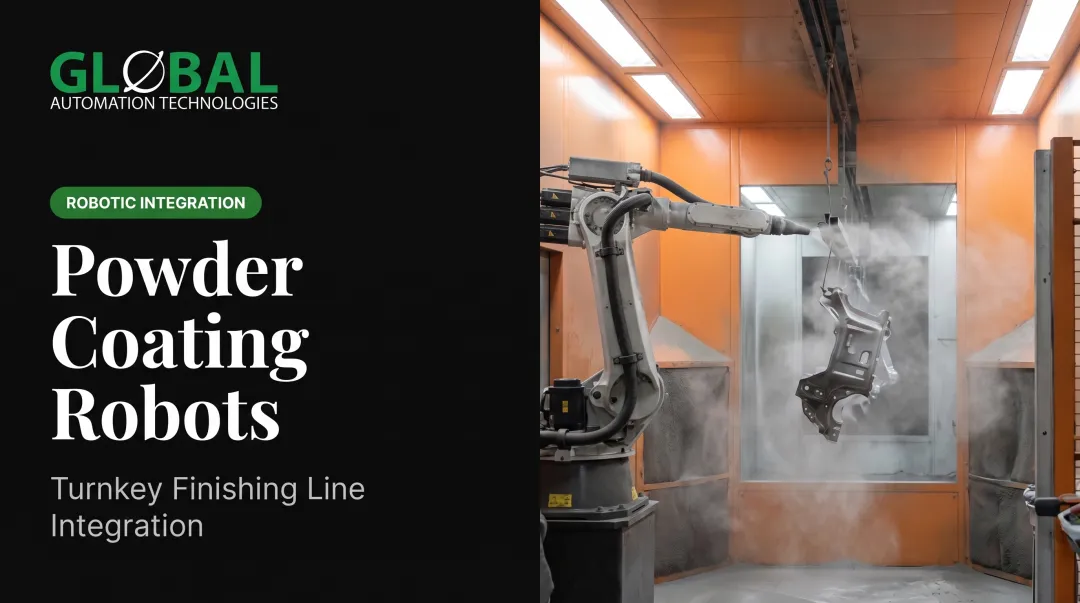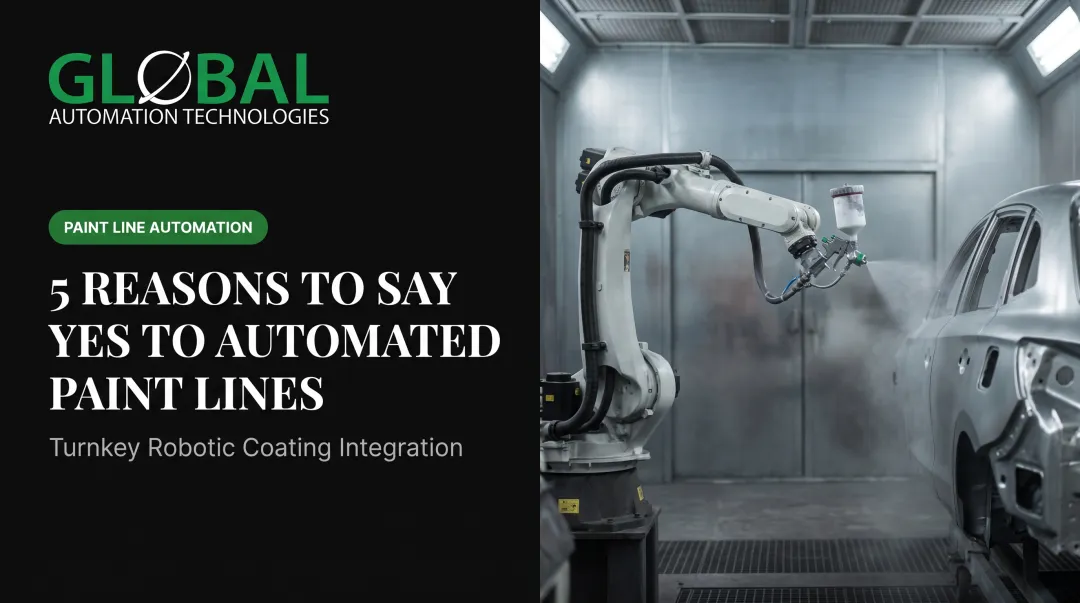

Robotic painting cells solve a different set of problems than most automation investments. This guide covers how they work, what they cost, which industries rely on them, and how to pick an integration partner. Adoption is climbing fastest in automotive, heavy equipment, and general industrial manufacturing, where consistent finish quality and worker safety carry real financial weight.
Key Takeaways
- Robotic arms apply coatings with tight, repeatable precision, cutting overspray and rework
- Removing operators from booths eliminates isocyanate, VOC, and particulate exposure
- AI-assisted simulation now compresses programming from weeks to days
- Integrator selection affects long-term ROI as much as the robot itself
What Is Automated Robotic Arm Painting?
Automated robotic arm painting uses a programmable robotic arm fitted with an electrostatic gun, conventional spray gun, or bell atomizer to apply coatings with repeatable precision. Instead of a human moving a spray gun by feel, the robot follows a pre-programmed path every single time.
Most industrial paint robots run on six-axis architecture. Six independently controlled joints let the arm reach around corners, angle into recessed panels, and maintain consistent gun distance across complex geometry, something a fixed-position sprayer simply can't do.
This isn't experimental technology. Trallfa began developing a robot to spray wheelbarrows in 1964, completed its first prototype in 1967, and commercialized the TR 400 in 1969 (Norwegian Museum of Science and Technology). ABB later acquired the technology outright by 1988. Six decades of refinement is why today's systems hold up on production lines.
Types of Robotic Painting Arms
Not every paint robot is built the same way. Common configurations include:
- Six-axis spray arms – the standard for articulated, multi-angle coverage
- Hollow-wrist arms – route paint hoses and cabling internally, reducing snag points and contamination risk
- Overhead-mounted or rail-mounted arms – free up floor space and extend reach across large parts
- Explosion-proof, hazard-rated arms – built for Class I, Division 1 environments where flammable vapors are present

Hollow-wrist and explosion-proof designs aren't nice-to-haves in hazardous paint environments. They're often the difference between a compliant booth and a shutdown waiting to happen. GLOBAL Automation Technologies, a Level 5 FANUC Authorized System Integrator, primarily deploys FANUC paint robots built for these conditions. The arms use intrinsically safe construction and hollow-wrist routing for automotive basecoat, topcoat, clearcoat, powder coating, and gelcoat work.
How Robotic Arm Painting Works
Programming and Simulation
Before a robot ever picks up a gun, engineers build the spray path offline. This defines trajectory, speed, and gun angle against a digital model of the part. Trial runs happen in software, so production stays online.
This stage used to eat weeks. ABB claims its paint-specific offline software can cut setup time by up to 80% (ABB Painting Software Solutions).
GLOBAL's engineers use AI-assisted simulation to model, test, and optimize robot programs before a single line of code touches the floor. That compresses programming from weeks to days and cuts commissioning surprises.
Paint Delivery and Real-Time Feedback
Once the path is set, the paint delivery system takes over:
- Proportioning units mix and meter coating materials
- Atomizers (electrostatic or bell-style) break paint into fine, even particles
- Flow and pressure regulators keep application consistent from the first part to the ten-thousandth
Modern cells add vision and sensor feedback on top of this, adjusting spray parameters mid-cycle to hold film thickness within tight tolerance. GLOBAL's robotic painting systems target consistent film build within specification on precision-critical finishes.
Validation and Line Integration
After spray control comes verification. Before a part moves downstream, in-line inspection flags coating defects—missed spots, thin coverage, or contamination. Machine vision in the cell catches these issues in real time, not at final QC after a bad part has already burned labor and material.
Robots then tie directly into conveyor systems for continuous, high-volume production without manual handoffs.

Key Benefits of Automated Robotic Painting
Consistency and precision. A robot doesn't get tired, distracted, or inconsistent between shifts. Uniform film build reduces rework and warranty claims tied to thin spots or runs.
Material savings. Reduced overspray means less wasted paint and lower hazardous waste disposal costs. ABB's RB 1000i-S atomizer improves transfer efficiency by up to 10% and cuts paint waste by at least 30% versus its predecessor (ABB, 2024).
Worker safety. Isocyanate exposure isn't a minor concern. OSHA links it to skin and respiratory irritation, with some isocyanates classified as potential human carcinogens (OSHA). Robotic cells remove operators from the booth entirely.
Throughput and uptime. Robots don't need shift breaks. They support round-the-clock operation with faster, more consistent cycle times than any human sprayer.
Faster changeovers. Reprogramming for a new part, color, or coating type takes minutes with modern software, not hours of manual retooling.
ROI timeline. Painting-specific payback data is limited industry-wide, but comparable automated cells like machine tending typically pay back in 12 to 18 months through labor and waste reduction. Painting cells follow the same logic: less waste, higher throughput, fewer rework cycles.

Industries Using Robotic Arm Painting
Robotic arm painting is common wherever finish quality, throughput, and operator safety are non-negotiable:
- Automotive OEMs and Tier 1 suppliers — exterior body panels, interior trim, and Class A finishes on high-volume lines. Lindner lifted monthly output from 6,000 to 7,000 units and cut shifts from three to two (FANUC Case Study).
- Heavy equipment, agricultural, and construction machinery — multi-layer protective coatings built for harsh field conditions, using the same path-programming discipline as automotive primer and topcoat work.
- Aerospace, defense, and data center infrastructure — precise, corrosion-resistant finishes on complex geometry, including multi-variant aircraft radome work at Robins Air Force Base (Aerobotix).

Cost of Robotic Painting Systems
There's no universal published price for a "typical" robotic paint cell, and any quote given without reviewing your application should be treated with caution. Costs depend heavily on scope. The main drivers include:
- Robot hardware – payload, reach, hollow-wrist design, and mounting configuration
- Booth infrastructure – airflow management, hazardous-area electrical classification, fire protection
- Atomization equipment – proportioners, applicators, color-change systems, fluid controls
- Integration labor – programming, calibration, commissioning, and operator training
- Safety certifications – explosion-proof ratings and code compliance review
Ongoing costs such as maintenance, paint materials, and energy use should be weighed against long-term waste and labor savings. Predictive maintenance tools that flag equipment issues before they cause downtime can cut unplanned stoppages once a cell is running.
Choosing the Right Robotic Painting Partner
The robot is only part of the equation. The partner who designs, programs, and supports the cell around it determines whether the system delivers consistent finish quality.
Look for a partner offering turnkey capability:
- Booth layout and process engineering
- Robot selection and path programming
- Vision inspection and process validation
- Installation, commissioning, and training
- Ongoing maintenance support
Cross-industry experience matters too. Problem-solving developed on an automotive Class A finish line often transfers directly to heavy equipment or aerospace coating challenges, since the underlying physics of spray-pattern control doesn't change much between industries.
GLOBAL Automation Technologies combines automation solutions, services and technical staffing. Manufacturers get the painting cell and the trained engineers to run and maintain it, without juggling two separate vendors. That approach is how the company is structured from the start.
Frequently Asked Questions
How much does a robot painter cost?
Costs vary by robot type, booth setup, and integration scope. An integrator can quote based on your part geometry, finish requirements, and production volume.
What are those robot arms called?
They're called industrial robots or paint robots. Most are six-axis articulated arms fitted with applicators such as electrostatic guns or bell atomizers.
Is there a robot that can paint?
Yes. Industrial paint robots have been in commercial use since 1969, starting with Trallfa's TR 400, and are now standard equipment across automotive and industrial manufacturing.
How long does it take to program a robotic painting cell?
Traditional programming often took weeks. AI-assisted simulation tools now let engineers model and optimize paths offline, often cutting programming to days.
What safety certifications matter for robotic painting in hazardous environments?
Explosion-proof ratings like Class I, Division 1 (or ATEX Zone 1 in Europe) matter most for booth environments with flammable vapors. NFPA 33 and OSHA 1910.107 govern spray-finishing safety requirements in the US.