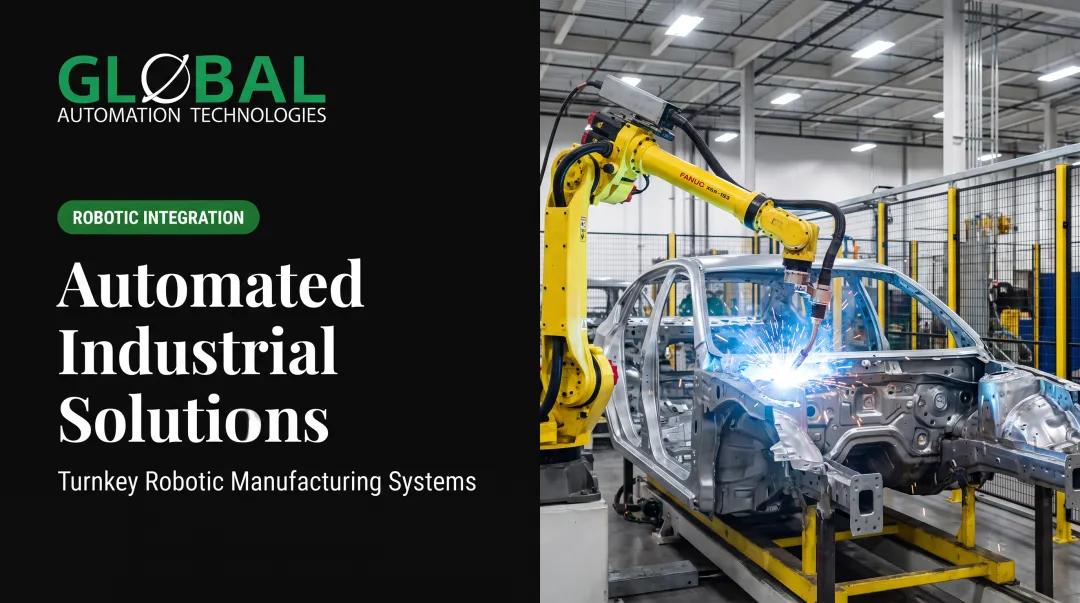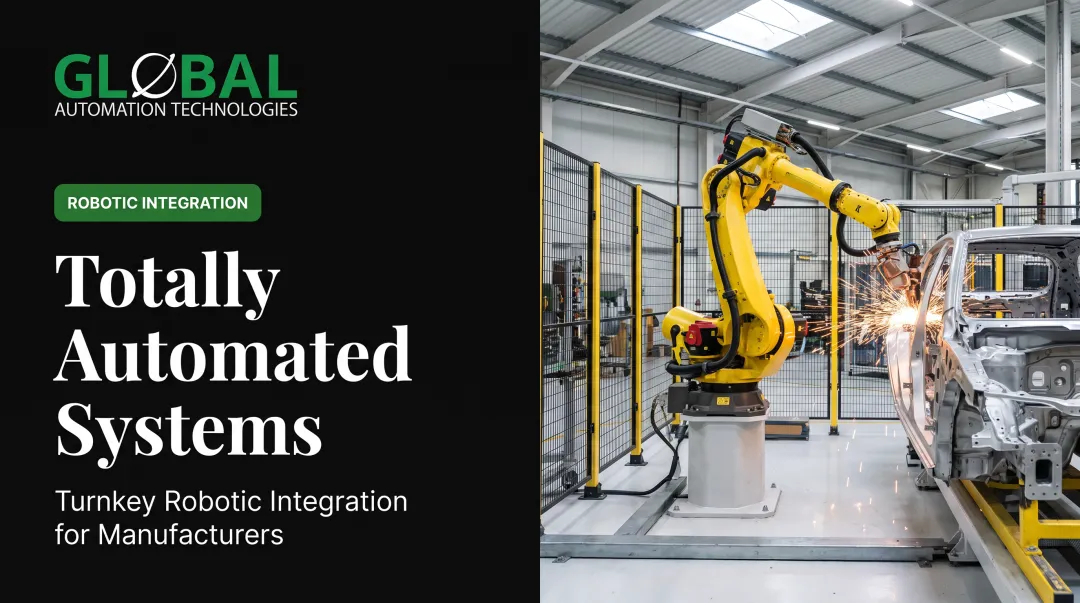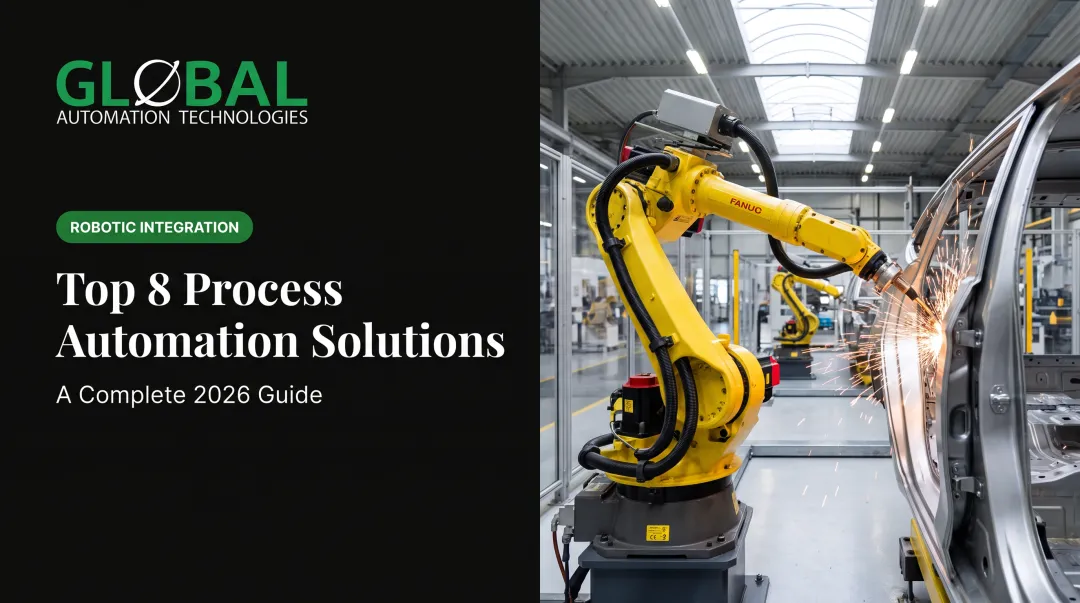

This guide breaks down what manufacturing automation actually is, the types and levels you'll encounter, real examples from the shop floor, and how to build a realistic roadmap for 2026. GLOBAL Automation Technologies, a top-tier Level 5 FANUC Authorized System Integrator, has spent 17+ years integrating robotic systems and staffing the engineers who run them, so this perspective comes from hands-on experience, not theory.
Key Takeaways
- Automation pairs robotics, controls, and software so production runs with far less manual intervention
- Fixed, programmable, and flexible automation each fit different volumes and product mixes
- AI-assisted simulation now cuts robot programming from weeks to days
- Robotic machine tending cells often pay for themselves in 12-18 months
- Successful adoption starts small: evaluate, pilot, then scale
What Is Manufacturing Automation?
Manufacturing automation uses technology, robotics, and control systems to perform production tasks with little or no human input. A full setup stacks connected components—robots, controllers, and software—that work together across the line.
A typical automated manufacturing system includes:
- Robots — programmable, multi-axis manipulators handling welding, painting, assembly, or material handling
- PLCs (Programmable Logic Controllers) — industrial computers that run machinery and monitor sensor data continuously
- HMIs (Human-Machine Interfaces) — the screens operators use to see real-time process data
- MES/ERP software — systems that connect shop-floor activity to business planning and quality tracking
Where Integrators Fit In
An automation integrator designs, builds, programs, installs, and supports these systems. According to A3 (the Association for Advancing Automation), integrators help manufacturers research, select, build, and maintain robotic systems from start to finish.
GLOBAL's turnkey model covers this entire lifecycle: process study, engineering and design, simulation, controls, machine vision, build, installation, commissioning, training, and ongoing support. GLOBAL pairs that integration work with technical staffing, so clients get the system and the engineers to run it from one source.
From the Assembly Line to Smart Factories
Automation isn't new. Ford's moving assembly line at Highland Park in 1913 cut Model T build time to just 90 minutes, according to Ford's own corporate history. A century later, the goal is similar: reduce wasted motion and time. The tools, however, have evolved into connected, self-optimizing smart factories driven by AI and IIoT.
Types and Levels of Automation in Manufacturing
Not every plant needs the same kind of automation. It depends on volume, product variety, and how often you change over production.
Three Core Types
| Type | How It Works | Best Fit |
|---|---|---|
| Fixed (Hard) Automation | Sequence is built into the equipment itself; high investment, high output rate | Stable, high-volume products (engine blocks, standardized parts) |
| Programmable Automation | Reprogrammed between batches; slower changeover than flexible systems | Batch runs of dozens to thousands of units |
| Flexible Automation | Extension of programmable automation with rapid, automatic changeover | Mixed product lines with frequent variation |

This taxonomy comes from Britannica's overview of automation applications, and it remains the clearest way to frame the decision.
Maturity: From Manual to Connected
Most plants progress gradually rather than jumping straight to full autonomy. A typical path looks like:
- Manual operations — humans handle every task
- Mechanized processes — machines assist, but people still control the sequence
- Automated islands — isolated cells run automatically but don't talk to each other
- Integrated automation — cells and lines share data across the plant
- Fully autonomous, intelligent systems — connected, self-optimizing, self-adapting production

Deloitte describes this end state as connectivity, optimization, transparency, proactivity, and agility working together. Their smart-factory framework maps how those traits show up on the plant floor.
CIM and IIoT
Reaching the upper maturity levels usually means connecting information systems, not just machines. Computer-Integrated Manufacturing (CIM) links production information and control across processes, lines, and plants using a shared database.
IIoT adds networked sensors and analytics on top. Deloitte's 2025 survey found 46% of manufacturers already use IIoT at the facility or network level, with 57% using cloud and data analytics tools.
GLOBAL's FANUC-based robotic systems support both fixed and flexible configurations: fixed cells for high-volume automotive body shop work, and vision-guided setups for heavy industry clients running mixed part families through the same line.
Real-World Examples of Automation in Manufacturing
Theory is one thing. Here's what automation looks like on an actual production floor.
Robotic Machine Tending. Northern Kentucky Machine deployed FANUC robots to route long CNC runs to unattended "lights-out" stations, freeing workers for higher-skill tasks. The result: faster cycles and more consistent part quality, per FANUC America's case study.
Robotic Painting and Dispensing. GLOBAL's painting systems hold film build within specification shift after shift, while cutting overspray and reducing operator exposure to isocyanates and VOCs. Dispensing applications add sub-millimeter path accuracy for adhesives, foams, and sealants.
Robotic Welding. Great Lakes Stainless used a FANUC cobot welder to cut curved-part fabrication time from roughly 3 hours to 15 minutes (a 95% reduction), with a smoother finish and welders freed for higher-value work, per FANUC's case study.

AI-Assisted Simulation. GLOBAL's engineers model and test robot programs before any code touches the factory floor, cutting programming time from weeks to days and reducing commissioning surprises.
Predictive Maintenance. AI-driven health assessments flag equipment issues before they cause unplanned downtime, so plants can protect maintenance budgets and avoid costly line stops.
These plant-floor results sit against a larger wave of adoption. Globally, industrial robot installations hit 542,000 in 2024, with operational stock reaching 4.66 million units, up 9% year-over-year, according to the International Federation of Robotics.
Key Benefits of Automation for Manufacturers in 2026
Manufacturers adopting automation in 2026 typically gain ground in four areas: throughput, cost, safety, and quality.
- Automated cells run through breaks, shift changes, and overnight hours between scheduled maintenance windows. Deloitte's 2025 survey found plants using smart manufacturing tools reported 10-20% output gains and 10-15% additional unlocked capacity.
- Robotic machine tending cells typically pay for themselves in 12-18 months, from more parts per shift and fewer direct labor hours on repetitive loading.
- Removing operators from spray booths cuts exposure to isocyanates and VOCs, both linked by OSHA to respiratory issues and skin irritation. Material handling robots also take people out of repetitive heavy lifting.
- Real-time bead validation and vision inspection catch thin beads, missed paths, and off-spec material before parts move downstream, cutting rework and scrap.

On ROI timing, A3's modeled $250,000 turnkey cell shows a roughly two-year payback under specific assumptions. Treat that as a starting point, not a guarantee, and recalculate against your labor costs and uptime.
Challenges to Consider Before Automating
Automation isn't plug-and-play. Three obstacles come up repeatedly:
- High upfront investment. Robot hardware is often just a third of total project cost; tooling, guarding, controls, and programming make up the rest. Base payback on your labor and uptime numbers, not industry averages.
- The skills gap. Automated systems need controls engineers, PLC programmers, and robotics technicians—roles NAM's survey ranks among the hardest to fill. GLOBAL's staffing division places these professionals on contract, contract-to-hire, or direct-hire terms while internal teams ramp up.
- Integration complexity. Retrofitting legacy equipment means coordinating new robots with existing PLCs, conveyors, and safety systems, often while keeping the line running.
How to Plan Your 2026 Automation Roadmap
A solid 2026 roadmap starts with your current floor reality and ends with a partner who can execute. Work through these four steps before you lock in capital.
- Run a current-state evaluation. Map your workflow, cycle times, and equipment to find bottlenecks, safety risks, and the highest-impact automation opportunities.
- Set measurable goals. Tie targets to throughput, quality, or safety, not vague "efficiency" language.
- Pilot before you scale. Test one line or process, gather real performance data, then expand plant-wide once the kinks are worked out.
- Partner with an integrator that also staffs. Pairing automation solutions with embedded engineering talent under one roof—GLOBAL—means you're not stuck waiting on your own team to catch up.
Frequently Asked Questions
What does an automation integrator do?
An integrator designs, builds, programs, installs, and supports robotic systems for manufacturers. Some integrators, like GLOBAL, also supply the engineers to operate and maintain those systems long-term.
What is an automated manufacturing system?
An automated manufacturing system combines robotics, control systems (PLCs, HMIs), and software (MES/ERP) to run production tasks with minimal human input.
What is manufacturing automation?
Manufacturing automation uses technology, robotics, and control systems to perform production tasks with little to no manual intervention, improving speed, consistency, and safety.
What are the three types of automation in manufacturing?
Fixed automation uses a hardware-defined sequence for high-volume, stable production. Programmable automation can be reprogrammed between batches. Flexible automation adds fast, automatic changeover for mixed product runs.
What are the five levels of automation in manufacturing?
Manual, mechanized, automated islands, integrated automation, and fully autonomous/intelligent systems. Most plants progress through these stages as their capabilities mature.
What is an example of automation in manufacturing?
Robotic machine tending, where a robot loads and unloads CNC machines continuously, extending unattended run time and improving spindle utilization.