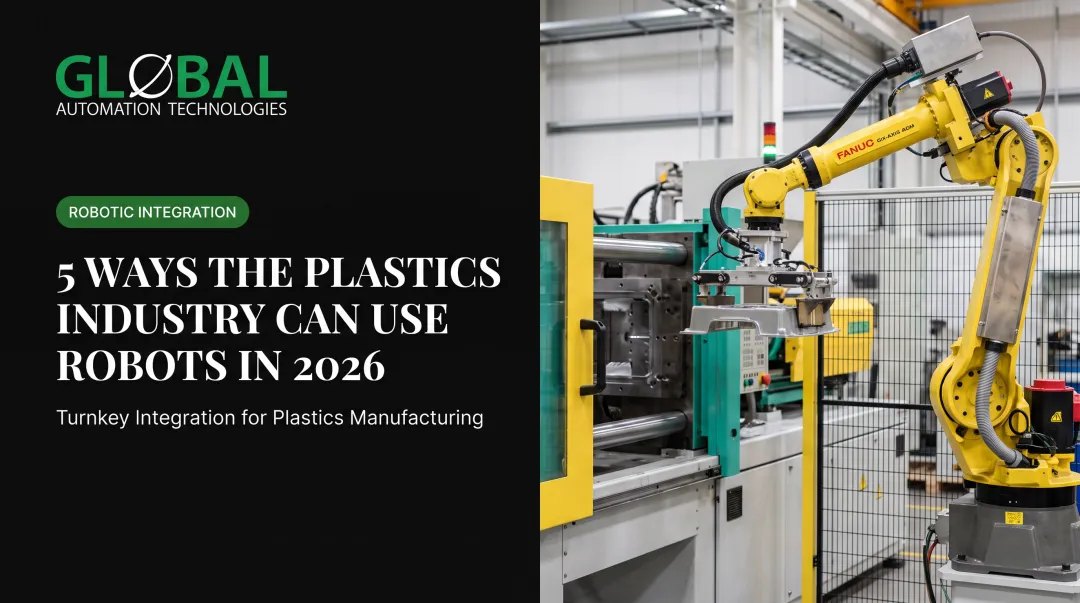

Staffing that job has gotten harder too. More than 40% of plastics companies now cite labor shortages as their single biggest operational challenge, according to a 2025 workforce report from the Society of Plastics Engineers.
Robotic machine tending has become the standard answer. It's one of the most widely adopted automation applications in plastics manufacturing, and newer AI-driven tools are pushing adoption even further. This article covers how machine tending robots work, the tasks they take over, the robot types manufacturers choose between, the ROI case, and the technology reshaping the space right now.
Key Takeaways
- Machine tending removes operators from hot, repetitive, hazardous handling at the press.
- Six-axis, SCARA, and Cartesian robots match different layouts, cycle times, and budgets.
- Well-designed cells typically pay for themselves within 12 to 18 months.
- AI-assisted simulation and predictive maintenance are cutting startup time and unplanned downtime.
- Turnkey capability and cross-industry depth matter as much as the robot hardware.
What Is Robotic Machine Tending in Injection Molding?
Machine tending is the automated loading and unloading of parts and materials at an injection molding machine. It's usually the first automation project a plastics manufacturer tackles, and for good reason: it's a contained, well-understood task with a clear payoff before a company scales into more complex applications like overmolding or assembly.
What manual tending gets wrong:
- Operators handle hot, freshly ejected parts, risking burns near the clamp and nozzle
- Inconsistent grip pressure and placement warp or mar parts, especially thin-walled ones
- Skilled workers spend hours on a task that doesn't use any of their training
Core Cell Components
A typical machine tending cell includes:
- Injection molding machine (IMM): runs its normal clamp-injection-cooling-ejection cycle
- Robot: often six-axis; Cartesian and SCARA units are common too
- End-of-arm tooling (EOAT): a gripper or vacuum cup array shaped to the part
- Safety guarding and interlocks: tied directly into the machine's cycle logic
The robot doesn't just show up and grab parts whenever it feels like it. It synchronizes with the molding machine's control system in real time, so extraction and placement line up with each stage of the cycle.
Standards like EUROMAP 67 define the electrical handshake between machine and robot, while EUROMAP 79 / OPC 40079 adds bidirectional data exchange that helps prevent collisions and share part-quality data. That handshake lets the robot pull a part the moment it's safe to enter, without slowing the press below its rated cycle time.

Common Robotic Applications Around the Injection Molding Process
Machine tending covers far more ground than simple pick-and-place. Once a robot is synchronized with the press, manufacturers tend to layer on additional tasks.
Common applications include:
- Core loading and unloading: Remove finished parts to conveyors, pallets, or trim stations; depalletize raw material and repalletize finished goods in automated cells
- Insert molding: Place metal inserts (pins, threads, flanges) into the mold before injection to eliminate hand-placement errors across every shot
- Overmolding: Transfer a molded part from one press straight into a second machine so materials or components combine without manual handoff
- In-mold labeling and decorating: Load pre-printed labels or films into the open mold so they fuse into the part with consistent positioning every cycle
- Sprue and runner handling: Pull sprues and runners for granulation to improve material efficiency and cut scrap
- Post-processing: Handle trimming, inspection, hot stamping, packaging, and palletizing once parts leave the press
Types of Robots Used for Injection Molding Machine Tending
Not every tending job calls for the same robot. Reach, speed, and complexity should drive the choice, not brand loyalty or what's sitting in a catalog.
| Robot Type | Best For | Trade-Off |
|---|---|---|
| Six-Axis | Complex handling, insert placement, multi-machine cells | Slower mold entry/exit; higher relative cost |
| SCARA | Fast, simpler horizontal transfers | Limited reach around fixtures |
| Cartesian | Straightforward pick-and-place at one press | Less angular dexterity |
Six-Axis Robots
Six-axis robots offer the widest range of motion and the most dexterity of the three. They can approach a mold from nearly any angle, which makes them the go-to choice for insert placement, multi-machine cells, and jobs that need more than a straight pull-and-place.
They generally cost more and move a bit slower entering and exiting the mold than a Cartesian unit, but the flexibility often justifies it.
SCARA Robots
SCARA robots handle fast, horizontal-motion tasks well. With a smaller reach and lighter build, they're a cost-effective fit for simpler tending jobs—especially downstream stacking and packaging where speed matters more than reach.
Their fixed swing-arm design limits how well they can maneuver around fixtures inside a crowded cell.
Cartesian Robots
Cartesian, or linear, robots are the most common choice for straightforward injection molding tending. They typically enter and exit the mold faster than a six-axis arm, scale well across similar presses, and deliver strong value for high-volume pick-and-place—though they offer less angular dexterity when parts or inserts need angled approaches.

The Business Case: Benefits and ROI of Machine Tending Automation
The case for machine tending automation rests on three pillars: safety, throughput, and quality. All three show up on the balance sheet eventually.
Safety gains:
- Operators are removed from repeated exposure to hot molds, molten plastic, and moving clamp mechanisms
- Modern robots include collision detection and emergency-stop safeguards as standard
- Fewer near-misses and injuries mean lower workers' compensation exposure and less downtime from incidents
Throughput gains:
- Robots don't take breaks, so machines can run well beyond a single shift, with lights-out running between scheduled maintenance windows
- Higher machine utilization directly translates to more parts per shift
- Consistent cycle times eliminate the slowdowns that creep in during long manual shifts
Quality gains:
- Precise, repeatable handling cuts down on warping and part defects
- Consistency holds up across a full shift, unlike a tired operator at hour seven
- Lower scrap and rework rates protect margin on every lot that leaves the press
A documented case makes the numbers concrete. Plastic Designs Inc. installed a SCARA cell for stacking and packaging injection-molded shims and reported a 20% increase in production capacity, plus a labor drop from one full-time operator to roughly 25-50% of one operator's time.
Plastics Machinery Manufacturing covered the project.
Across the industry, the pattern holds: injection molding machine tending cells typically pay for themselves in 12 to 18 months. The math isn't complicated — more parts per shift with fewer direct labor hours, plus fewer defects eating into margin.
New Technology Shaping Injection Molding Automation
So what's actually new here, beyond faster robots?
AI-assisted simulation is the biggest shift. Engineers program and validate robot paths in a virtual cell before anything reaches the molding floor. That cuts startup time and skips the trial-and-error that used to drag out commissioning. GLOBAL's engineering team uses this approach to compress robot programming from weeks down to days.
AI-driven predictive maintenance matters just as much on a running press. Sensors and health-assessment algorithms watch robot and end-of-arm tooling performance, flagging wear before it stops a cycle. Maintenance teams act on early warnings instead of reacting to mid-shift breakdowns.
Vision-guided robotics add another layer on the cell. Robots with vision can verify part orientation out of the mold, catch defects mid-cycle, and adjust handling on the fly.
Tighter real-time data exchange between the robot and molding machine controller improves traceability across the full production run, not only at the end of it.

How to Choose the Right Machine Tending Automation Partner
Picking a vendor for a machine tending cell isn't just about robot specs. The partner matters as much as the hardware.
Evaluate partners on three fronts:
- Full turnkey capability from layout through ongoing support
- Engineering talent available after installation
- Cross-industry depth that transfers to plastics
Prioritize full turnkey capability. The provider should handle layout, design, build, programming, installation, and ongoing support—not just equipment drop-off. Cells engineered end-to-end tend to run smoother from day one.
Ask who runs the system after installation. A robotic cell is only as good as the engineering talent maintaining it.
GLOBAL Automation Technologies, a Level 5 FANUC Authorized System Integrator, pairs automation solutions, services and technical staffing, so manufacturers get both the cell and the engineers to keep it tuned.
Check for cross-industry depth. Integrators who've solved similar handling problems in automotive, heavy industry, or data center work often bring proven solutions to plastics faster than specialists starting from scratch. GLOBAL has deployed robots across a proven global base, experience that transfers well between industries.
Frequently Asked Questions
What is the new technology for injection molding?
AI-assisted simulation now lets engineers program and validate robot paths virtually, speeding up startup. AI-driven predictive maintenance flags wear on robots and tooling before it causes unplanned downtime.
What is a machine tending robot in injection molding?
A machine tending robot loads and unloads parts and materials from the molding machine. It automates a repetitive task that would otherwise keep an operator at the press all shift.
How much does an injection molding machine tending robot cost?
Cost varies by robot type, payload, and cell complexity. Most cells pay for themselves within 12 to 18 months through labor savings and higher throughput.
Can one robot tend multiple injection molding machines?
Yes, a single robot can often service two or more machines in a linear or cell layout, depending on cycle times and available reach.
Which robot type is best for injection molding machine tending?
Six-axis robots suit complex handling like insert placement and multi-machine cells. Cartesian and SCARA robots work well for simpler, cost-sensitive tending tasks.
Is machine tending automation only worthwhile for high-volume production?
High-volume runs see the fastest ROI. Smaller manufacturers still gain safer, more consistent production—especially with scalable SCARA or Cartesian options.