
Introduction
Manufacturing floors look different than they did a decade ago. Fixed conveyors and hydraulic presses still handle the basics. But programmable robots now run welding, tending, painting, and handling work that once kept a skilled operator at the machine all shift.
That change is happening at scale. Manufacturers installed 542,000 industrial robots worldwide in 2024 — more than double a decade earlier — and the global operational stock climbed past 4.6 million units, according to a 2025 report from the International Federation of Robotics.
For plant leaders, this is no longer optional context. It shapes capital budgets, staffing plans, and whether a line can hold cost and quality against automated competitors. Here's what's driving the shift, where it's showing up on the floor, and what to evaluate next.
Key Takeaways
- AI-assisted simulation lets engineers model and prove out robot programs before code runs on the floor, compressing programming timelines
- Robotic machine tending raises spindle utilization and extends production well beyond a single shift
- Consistent automated processes raise quality and keep workers out of hazardous exposure
- Predictive maintenance catches equipment issues before they cause downtime
- Manufacturers outside automotive—EV, heavy equipment, and data centers—are adopting automation at speed
Key Trends Transforming Industries
AI-Assisted Simulation and Faster Robot Programming
Before a robot ever touches a part on the floor, engineers can now build and test the entire cell in software. Virtual commissioning lets teams model robot paths, cycle times, and collision risks digitally, catching problems before equipment is installed.
This practice is spreading fast. In a McKinsey survey of senior industrial leaders, 86% said digital twins were applicable to their operations, and 44% had already implemented one.
GLOBAL, a top-tier Level 5 FANUC Authorized System Integrator, uses AI-assisted simulation to model, test, and optimize robot programs before the first line of code runs on the production floor. Collision risks, reach limits, and cycle-time bottlenecks surface in the virtual cell rather than during commissioning, which shortens programming timelines and takes surprises out of startup on automotive and heavy industry projects.
The payoff shows up in the numbers. One McKinsey case study found a digital twin used for production scheduling delivered 5%-7% in monthly cost savings, while a bottleneck-sequencing optimizer cut processing time by roughly 4%.
Robotic Machine Tending for Higher Spindle Utilization
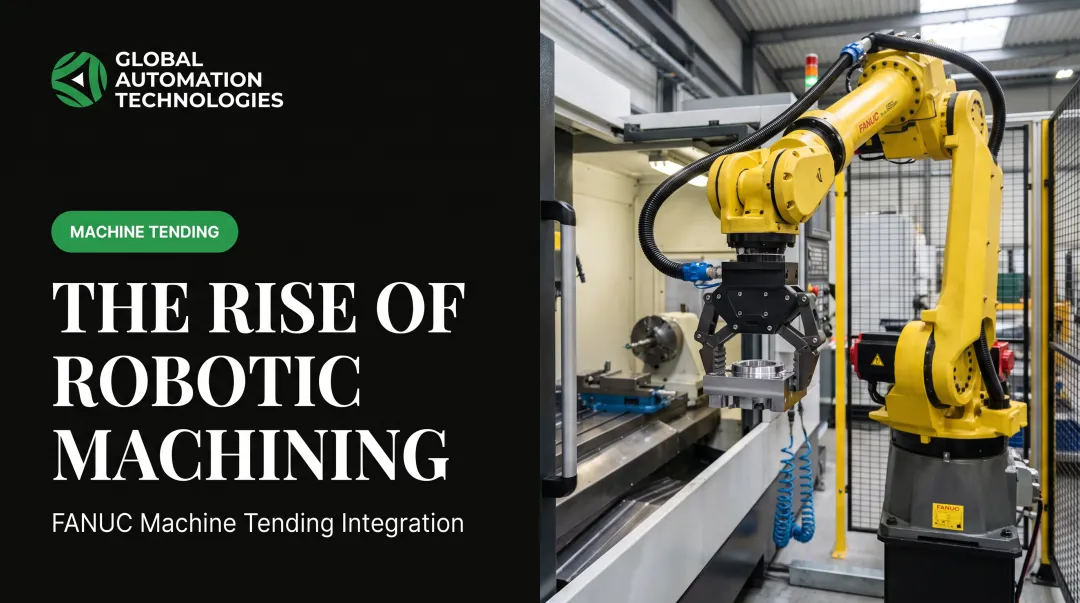
CNC machines sit idle more often than plant managers would like, waiting for an operator to load the next part. Robotic machine tending closes that gap. A robot loads and unloads continuously, letting machines keep cutting through breaks and shift changes and into lights-out running between scheduled maintenance windows.
That extended runtime adds up. Machine tending cells typically pay for themselves in 12 to 18 months, driven by a simple equation: more parts per shift with fewer direct labor hours.
The labor market is pushing this trend too:
- The U.S. employed 354,800 machinists and tool-and-die makers in 2024
- The Bureau of Labor Statistics projects roughly 34,200 openings annually through 2034, almost entirely from retirements rather than growth
- BLS specifically credits autoloaders and CNC efficiency gains for keeping employment in the trade flat
GLOBAL's machine tending systems support both single-machine and multi-machine setups, including cells where one robot serves two, three, or more machines with buffer stations and part tracking to keep every spindle cutting near full utilization.
Precision Process Automation: Painting, Dispensing & Quality Validation
Painting and dispensing are hard to keep consistent with human hands. Fatigue, angle variation, and timing differences show up as visible defects. Vision-guided robotic systems remove that variability by executing the same spray pattern or bead path on every part, every time.
GLOBAL's robotic painting systems hold film build within specification shift after shift across automotive topcoat, powder coating, and gelcoat applications, repeating the same programmed path instead of drifting with operator technique and fatigue. On the dispensing side, real-time bead quality validation combines vision inspection with flow monitoring to check three things on every pass:
- Bead width — confirming material spread matches spec
- Placement — verifying the path follows joint geometries and cavity profiles
- Continuity — catching gaps before the part moves downstream

Safety improves as well. OSHA lists isocyanate exposure among manual painting hazards, with effects ranging from respiratory irritation to carcinogenic risk. Robotic cells remove operators from that exposure entirely, along with VOCs and overspray particulates.
Material use drops too. Automated painting has historically shown savings as high as 35% compared to manual application.
AI-Driven Predictive Maintenance
Unplanned downtime is one of the most expensive problems in manufacturing, and it's getting worse. Siemens' 2024 downtime benchmark puts automotive downtime at $2.3 million per unproductive hour, double the 2019 figure, with costs reaching $150,000 per hour even for small and midsize manufacturers.
AI-driven predictive maintenance reverses that pattern. Sensor data feeds AI health-assessment models that flag early signs of wear or failure while there's still time to schedule a fix instead of scrambling for one.
GLOBAL has built AI-driven health assessments into its own engineering workflow, applying 17+ years of hands-on robotics experience toward one practical goal: catching problems early enough that they're a line item on a maintenance schedule, not a production emergency.
Automation Expanding Beyond Automotive into New Verticals
Automotive built the robotics industry, but it's no longer the ceiling. Globally, electronics manufacturing now accounts for 24% of robot installations versus automotive's 23%, with metal and machinery, plastics and chemicals, and food and beverage all adding share. U.S. food and beverage installations alone jumped 21% to 2,200 units in 2024.
GLOBAL's own client base reflects that same shift. Beyond automotive OEMs and Tier 1 suppliers, the company now works across a growing range of industries, including data center infrastructure manufacturers building server racks, enclosures, and power distribution systems that keep the digital economy running. Heavy equipment, agriculture, and EV manufacturing round out the expansion.
The common thread is cross-industry problem-solving: a robotic welding cell built for a tractor frame and one built for a car body solve the same fundamental problem, even though the parts look nothing alike.
What's Driving These Automation Trends
Several forces are converging to push adoption higher and faster.
- Technology is catching up to the promise. Among 600 large manufacturing executives surveyed by Deloitte, 29% had already deployed AI/ML at facility scale, with production output gains averaging 10–20% after implementation.
- Market demand keeps climbing. Manufacturers need extended, multi-shift production and faster cycle times, and automated cells add capacity without adding a full extra shift of hires.
- Labor shortages leave little choice. U.S. manufacturers may need 3.8 million new workers by 2033, with roughly 1.9 million positions potentially going unfilled.
- Regulation is pushing hazardous work toward robots. Exposure limits for VOCs and isocyanates make manual painting riskier from a compliance standpoint every year.
- Competitors are already moving. 78% of manufacturers now put more than 20% of their improvement budgets toward smart manufacturing, and 88% expect that spending to hold or grow.

Standing still is a competitive disadvantage.
How These Trends Are Impacting the Manufacturing Industry
These shifts are already reshaping plant floors, budgets, and hiring plans across the industry.
Operational Impact
Plant layouts are shifting away from long manual lines toward discrete automated cells with fewer manual touchpoints between stations. Fewer hand-offs mean fewer chances for variation, damage, or delay.
Deloitte's 2025 survey found manufacturers reporting average gains after implementing smart manufacturing technology:
- 10%-20% in production output
- 7%-20% in employee productivity
- 10%-15% in unlocked capacity, without a new building or line
Business Impact
Capital budgets are moving the same direction, with spend shifting away from traditional capital projects and toward smart-manufacturing technology. Order data tells the story: North American robot orders reached $2.25 billion in 2025, up 10.1% in revenue and 6.6% in units year-over-year. General industries, not just automotive, drove the increase.
Workforce Impact
Demand for workers is shifting, not shrinking. Deloitte found 69%-72% of manufacturers report moderate-to-significant difficulty hiring for IT, operational technology, and engineering roles: the skills needed to program, run, and maintain robotic systems.
That hiring gap is where GLOBAL's combined offering helps. GLOBAL builds and integrates the robotic cell through its automation systems and engineering services work, and its technical staffing recruits controls, mechanical, and project management engineers into customer roles on a contract, contract-to-hire, or direct-hire basis to run it—so a new system doesn't sit underused because nobody on staff can program it.
Future Signals for Automation and Robotics
Automation isn't standing still. Here's what to watch over the next one to three years.
Early indicators:
- Generative AI tools increasingly assist with robot programming, much like Microsoft Copilot already does in industrial engineering workflows
- Autonomous mobile robots (AMRs) are moving from pilot projects into mission-critical, just-in-time material delivery on plant floors
Technologies gaining traction:
- Robot-as-a-Service (RaaS) models lower the barrier for manufacturers avoiding large upfront capital outlays
- No-code and low-code programming opens up cell configuration to plant staff who aren't traditional robot programmers
- Edge AI enables real-time decisions on the line, such as Ford and IBM using local computer vision for millisecond-scale defect detection on vehicle bodies
Over the next few years, expect broader adoption outside automotive and shorter deployment cycles through simulation-first engineering. Predictive analytics will move from specialty add-on to standard capability.
Conclusion
AI-assisted simulation, robotic machine tending, precision process automation, predictive maintenance, and cross-industry expansion point to one shift: manufacturing that runs faster, safer, and with fewer surprises.
Manufacturers who adopt these technologies early already see the payoff in lower downtime costs, tighter quality control, and production capacity they didn't need a new plant to get.
Strategic foresight matters, but so does execution. Building the right robotic cell and finding engineers who can program, run, and maintain it are usually two separate problems — unless your automation partner handles both. Manufacturers exploring their options can connect with GLOBAL's engineering team to talk through what a specific application might need.
Frequently Asked Questions
What is the difference between machinery automation and robotics?
Automation is the broad use of technology to perform tasks with minimal human input — from fixed conveyors to sensor-triggered shutoffs. Robotics is a specialized subset: reprogrammable machines built to handle multiple tasks.
What industries benefit most from robotics and automation?
Automotive, EV manufacturing, heavy equipment, and aerospace remain the biggest adopters. Data center infrastructure production (server racks, enclosures, and power distribution systems) is one of the fastest-growing new verticals.
How much does industrial automation cost to implement?
Costs depend on application complexity, robot count, tooling, and integration scope. Simpler cells such as cobot machine tending sit at the lower end; multi-robot welding or paint lines require substantially more capital.
How long does it take to see ROI from robotic automation?
Most manufacturers see payback within 12 to 18 months for machine tending applications. AI-assisted simulation shortens the road there by cutting programming and startup time from weeks to days.
What skills are needed to work in robotics and automation?
Controls programming, mechanical and electrical maintenance, and PLC/robot programming knowledge are the core skills employers look for. Demand for both contract and direct-hire automation talent is climbing.
Is automation replacing human jobs in manufacturing?
Automation shifts labor toward higher-skill roles like programming, maintenance, and process improvement rather than eliminating jobs outright. Manufacturers that adopt robots typically raise productivity while overall labor demand holds steady or moves into new technical roles.