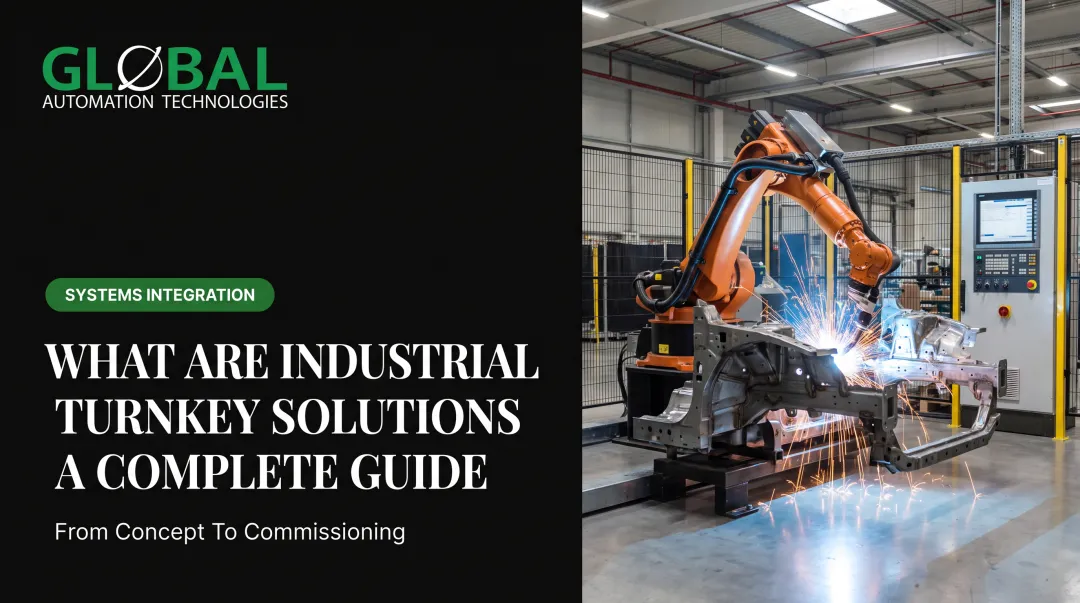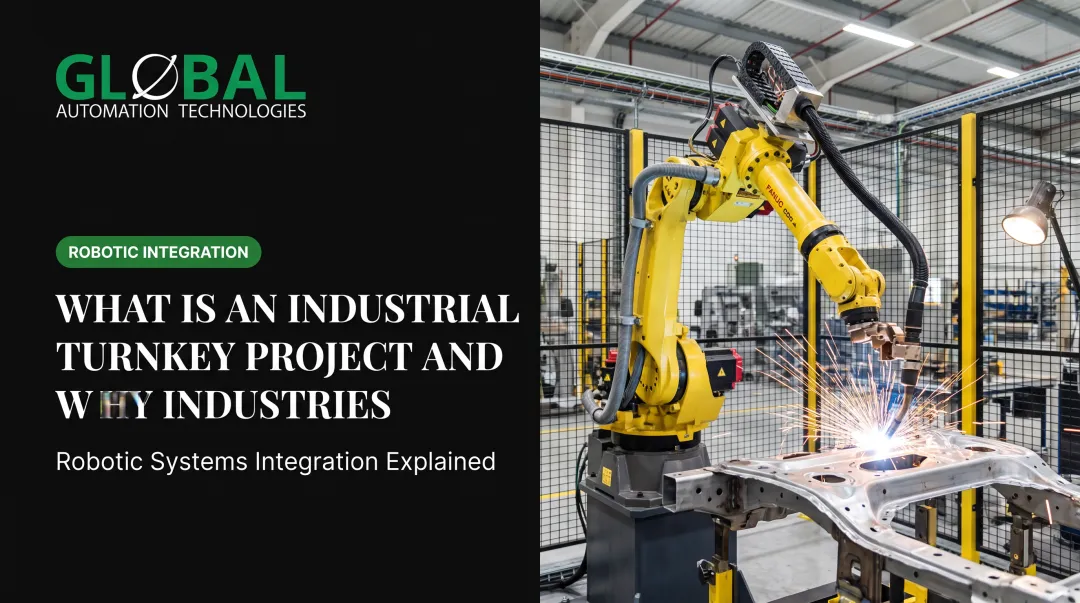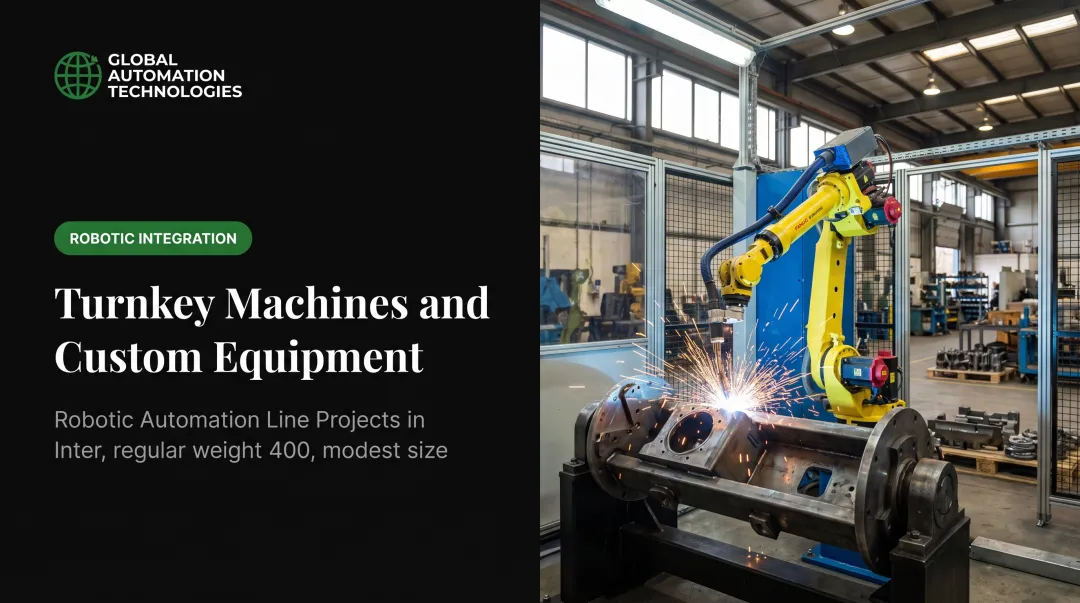

Turnkey manufacturing gets talked about a lot in the abstract, but its real value shows up in far more concrete places: uptime, throughput, and how fast a line pays for itself. This article breaks down why turnkey solutions matter using operational outcomes, not theory.
TL;DR
- One provider handles design, build, integration, and support, cutting vendor complexity
- Faster deployment, consistent quality, lower risk, and better total cost of ownership
- Machine tending cells typically pay for themselves within 12–18 months
- The right partner brings both systems and skilled engineers, not just equipment
What Is Turnkey Manufacturing?
Turnkey manufacturing means one provider owns the entire project scope: design, engineering, installation, commissioning, and ongoing support. You work with one team instead of separate vendors for mechanical design, controls programming, and installation.
It typically applies to:
- Robotic system integration
- Production line automation
- Machine tending
- Robotic welding
- Painting and coating systems
- Material handling
The real value is lower operational risk and faster time-to-production—two outcomes that matter far more once a line runs at full volume.
Key Advantages of Turnkey Manufacturing Solutions
These advantages tie directly to metrics plant managers already track: cycle time, scrap rate, labor cost, and equipment utilization. None of this is theoretical. It shows up in the numbers manufacturers report to leadership every month.
Single Point of Accountability
With turnkey automation, one provider owns design, build, integration, and support. That's different from coordinating separate mechanical, electrical, and controls vendors and hoping they communicate.
Why it matters: Multi-vendor projects create natural friction. When something breaks, who's responsible: the mechanical integrator, the controls vendor, or the panel builder?
Automation World notes that a provider with full-system knowledge reduces handoff delays between vendors and closes the communication and responsibility gaps fragmented projects create.
- Fewer handoff errors between disciplines
- Faster issue resolution with no finger-pointing between suppliers
- Less time spent by your own team managing multiple contracts
KPIs impacted: project timeline, change-order costs, communication overhead.
This advantage matters most on complex, multi-discipline projects — full production line automation or robotic cell integration where mechanical, electrical, and software all have to work in sync from day one.

Faster Deployment and Time-to-Production
Turnkey providers increasingly use AI-assisted simulation to compress programming and commissioning schedules. At GLOBAL Automation Technologies, this approach cuts robot programming time from weeks to days by modeling, testing, and optimizing the program before it ever touches the production floor.
That matters because ramp-up delays are lost revenue. FANUC's ROBOGUIDE platform, for example, lets engineers build and test a full 3D workcell simulation before installation, reducing planning risk without needing a physical prototype.
- Simulation catches collision and cycle-time issues before steel hits the floor
- Fewer surprises during commissioning means fewer schedule slips
- Faster startups translate directly into earlier production revenue
KPIs impacted: time-to-production, commissioning hours, ROI timeline.
This matters most under deadline pressure — EV production ramp-ups, new product launches, or line conversions where every week of delay has a dollar figure attached.
Lower Total Cost of Ownership and Reduced Risk
Turnkey solutions remove the overhead of building in-house automation infrastructure, hiring specialized staff, and managing a stack of suppliers. Consolidated design also reduces the mismatched tolerances and incompatible components that plague multi-vendor builds.
The payback math is real. Machine-tending cells typically pay for themselves within 12 to 18 months through labor savings and higher spindle utilization. One documented FANUC machine-tending deployment for a CNC client achieved a 33-week ROI with a 33% increase in production efficiency. Parts per shift jumped from 100 to more than 150.
That's a single project result, not a guaranteed average. It still shows the mechanism clearly: robots keep machines running through breaks, shift changes, and overnight hours that manual tending can't cover.
- Predictable capital budgeting instead of scope-creep surprises
- Fewer defects from mismatched components across vendors
- Higher utilization on existing capital equipment
KPIs impacted: total project cost, payback period, unplanned downtime, defect rate.

Capital-intensive work, hazardous processes like painting and welding, and operations under strict compliance rules feel this advantage first.
The Role of Talent: Why Systems Alone Aren't Enough
Even the best robotic cell underperforms without engineers who know how to program, maintain, and optimize it. This is a gap a lot of manufacturers hit after a system-only vendor walks away: the equipment works, but nobody in-house can push it past 70% of its capability.
GLOBAL addresses this with an approach: automation solutions, services and technical staffing. One call gets you the system and the people to run it:
- Controls engineers
- PLC programmers
- Commissioning specialists
The system builder knows what the staffing client needs, and the staffing team knows what the system requires. That feedback loop is hard to replicate when solutions and talent come from two separate companies.
What Happens When Turnkey Solutions Are Skipped
Fragmented vendor management has predictable consequences:
- Inconsistent quality from disconnected handoffs between design, build, and integration teams
- Higher error rates from mismatched components and unclear ownership
- Reactive firefighting when equipment fails and there's no single support contact
- Rising costs over time from delays, rework, and duplicated vendor management effort
- Scaling difficulty when trying to replicate automation across multiple plants
This isn't theoretical. Plant managers describe it as day-to-day reality when a project involves four vendors and zero shared accountability.
How to Choose the Right Turnkey Manufacturing Partner
The right partner is defined by scope, talent, and proven delivery—not slide decks.
- Confirm full-scope capability. Layout, design, build, programming, validation, installation, commissioning, and ongoing support should live under one roof, not across three contracts.
- Ask about talent access. A provider that only sells equipment leaves you exposed the moment something needs reprogramming. Look for partners who also supply engineering talent.
- Check cross-industry experience and tools. Providers with proven work across automotive, heavy equipment, and general industrial lines, plus modern tools like AI-assisted simulation and predictive maintenance, tend to catch problems before they hit the floor.

GLOBAL, for instance, is a Level 5 FANUC Authorized System Integrator and #1 purchaser of FANUC robots among North American integrators in 2025. That scale brings deep bench strength on both the engineering and staffing sides.
Conclusion
The real value of turnkey manufacturing is accountability, speed, and a lower total cost that compounds the longer a system runs—not just day-one convenience. Fewer disruptions this year mean fewer disruptions next year too.
Turnkey automation should be treated as an ongoing operational strategy, not a one-time purchase. Partners like GLOBAL Automation Technologies, who deliver both the system and the engineers to sustain it, are set up for that kind of long-term operating partnership.
Frequently Asked Questions
What are turnkey manufacturing solutions?
An end-to-end model where a single provider handles design, build, integration, and support for an automation project. Manufacturers get one point of contact instead of coordinating separate vendors.
What is an example of a turnkey manufacturing solution?
A robotic machine tending cell or automated painting line delivered by one provider—from layout and programming through installation, commissioning, and ongoing support—is a common example.
How long does it take to implement a turnkey automation system?
Timelines depend on scope, cell complexity, and facility readiness—from a few months for a single cell to longer for full line integrations. AI-assisted simulation can cut robot programming from weeks to days and help keep projects on schedule.
Is turnkey automation more expensive than a multi-vendor approach?
Upfront costs can be higher, but turnkey projects often lower total cost of ownership by cutting rework, schedule delays, and the overhead of managing multiple vendors.
What industries benefit most from turnkey manufacturing?
Automotive OEMs and Tier 1 suppliers are the most established adopters, followed by heavy equipment, aerospace, and general industrial manufacturers.
How do I know if my company needs a turnkey automation partner?
Signs include lacking in-house automation expertise, needing to scale production quickly, or struggling to coordinate multiple automation vendors on a single project.