
When these systems fail or fall behind, the results show up fast: unplanned downtime, inconsistent part quality, and safety incidents that trace back to outdated or fragmented controls. The stakes are real. Siemens forecast that unplanned downtime would cost Fortune Global 500 industrial companies nearly $1.5 trillion in 2023, equal to 11% of their turnover.
This guide breaks down what a factory control system actually is, its core components, the main types (PLC, DCS, SCADA), the benefits of getting it right, and how to choose a partner who can build and support one.
Key Takeaways
- Factory control systems combine hardware and software to monitor and direct machinery in real time
- PLCs, DCS, SCADA, and PAC/IPC fit different scales—from single machines to plant-wide operations
- They sit below ERP and MES in the automation pyramid, feeding real-time data upward
- Modern systems boost uptime, quality, and worker safety while enabling AI-driven predictive maintenance
- The right integration partner decides whether your system delivers long-term ROI or becomes a costly maintenance burden
What Is a Factory Control System in Manufacturing?
A factory control system, also called an industrial control system (ICS), is the combination of hardware and software engineered to monitor, regulate, and direct machinery, processes, and production lines. It's the operational nervous system of a plant—the layer that keeps throughput, quality, and safety on target shift after shift.
This article breaks down how that system works, the components every plant relies on, and why robotic cells demand tighter integration than general controls alone.
Here's the core loop, as defined by the National Institute of Standards and Technology. Sensors measure a process variable, a controller compares that reading to a target setpoint, and actuators adjust the process to close the gap. Valves, motors, and robots carry out those corrections in real time.
The cycle repeats continuously, often thousands of times per second. Production stays within spec without a human touching a dial.

Core Components of a Factory Control System
Every factory control system, regardless of size, relies on the same building blocks:
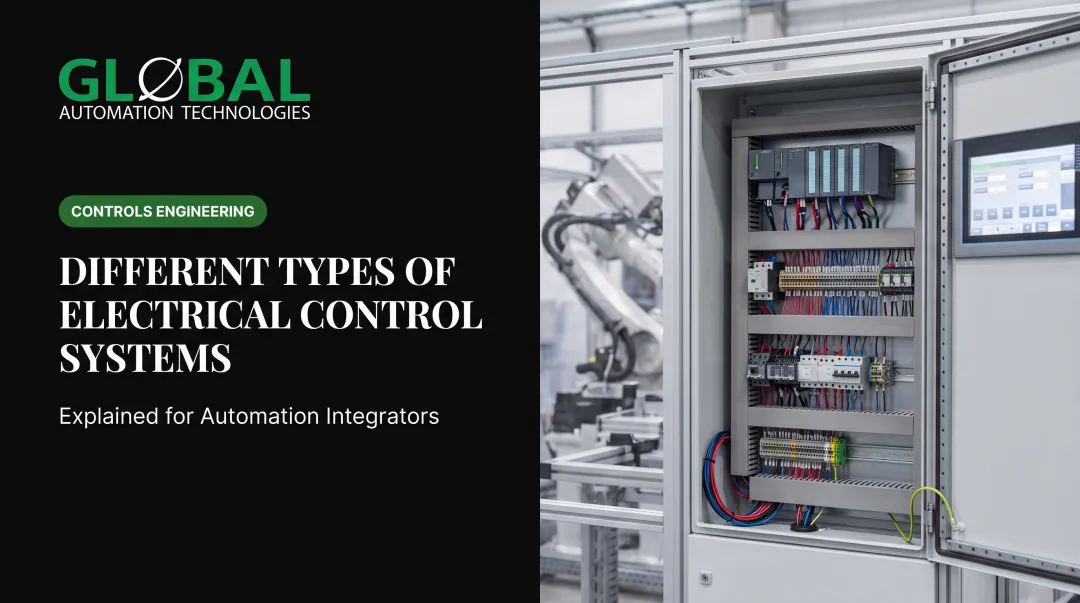
- Control hardware: PLCs, sensors, actuators, drives, and robots that physically interact with equipment on the floor
- Control software: the logic and algorithms that interpret sensor data and issue commands
- Human-Machine Interface (HMI): the dashboard operators use to monitor status, adjust setpoints, and intervene manually
- Communication networks: protocols such as EtherNet/IP, PROFIBUS, and Modbus that connect field devices to controllers and higher-level IT systems
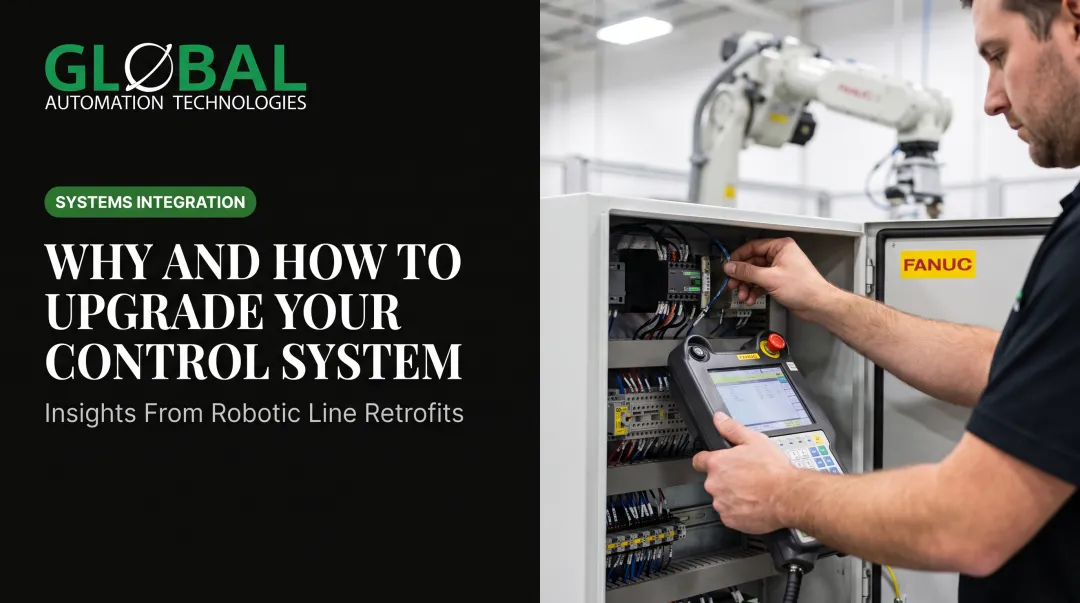
Those same building blocks get more demanding inside a robotic cell. There, the control system also governs motion paths, programming logic, and safety interlocks.
General controls knowledge isn't enough at that layer. You need integrated robotics expertise so motion, process, and safety systems work together without conflict.
Types of Factory Control Systems
Not every plant needs the same control architecture. The right choice depends on process scale, geography, and how fast decisions need to happen.
| Type | Best For | Key Trait |
|---|---|---|
| PLC | Discrete machine or cell-level control | Ruggedized, millisecond-scale logic, often ladder-programmed |
| DCS | Large, continuous processes | Decentralized architecture integrating control, safety, and asset management |
| SCADA | Operations spread across large distances | Centralized monitoring with customizable HMI dashboards |
| PAC/IPC | Hybrid applications needing PC-level power | Combines PLC reliability with modern programming languages |
Programmable Logic Controllers (PLCs) handle the granular, real-time work: opening a valve, indexing a conveyor, triggering a weld. They're the workhorse of discrete manufacturing.
Distributed Control Systems (DCS) take over when a process spans an entire facility, such as continuous chemical or batch processing, where localized loops need to coordinate under one supervisory umbrella.
SCADA systems fit operations where assets sit far apart, such as pipelines or multi-site utilities, and centralized data acquisition matters as much as control itself.
PAC and IPC systems serve hybrid needs with PLC-grade reliability with the computing horsepower to run vision processing, data logging, or advanced algorithms on the same platform.
These categories rarely operate in isolation anymore. They layer together as the automation pyramid, with data moving from field devices up through supervisory and business systems.
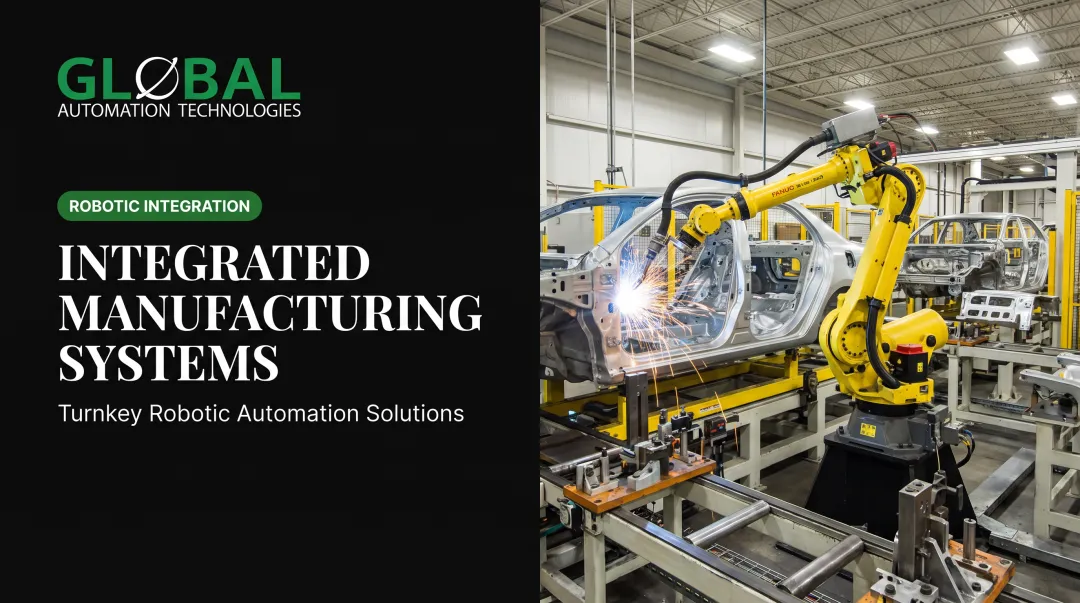
Robot controllers sit in a specialized niche inside that pyramid. They govern motion, path planning, and safety zones for robots doing welding, painting, dispensing, or machine tending.
GLOBAL Automation Technologies, a Level 5 FANUC Authorized System Integrator, programs this layer directly—tying robot motion to process outcomes such as weld quality or paint film consistency.
Factory Control Systems vs. Business Systems: Where ERP and MES Fit In
Control systems don't operate in a vacuum. They feed data upward through what ISA-95 describes as the automation pyramid:
| Level | Function |
|---|---|
| Levels 0–1 | Field devices and sensors that touch the physical process |
| Level 2 | Control systems (PLC, DCS) that supervise machinery in real time |
| Level 3 | MES, coordinating manufacturing operations and scheduling |
| Level 4 | ERP, managing business-wide planning and resources |
An ERP system integrates business-wide functions—sales, inventory, finance, procurement, and HR—and consumes production data delivered upward from the control layer. It doesn't run machinery. It runs the business around the machinery.
An MES sits between control and ERP. It turns real-time plant data into operational decisions: work orders, production schedules, quality tracking, and material flow—without taking on full enterprise planning.
The timescale gap is the real divide. Control systems act in milliseconds to keep a robot arm on path or a valve at the right pressure. MES and ERP work on business timescales—shift plans, inventory levels, purchase orders, staffing.
Confuse the layers, and you'll either under-invest in real-time control or over-engineer business software to do a job it was never built for.

Key Benefits of Modern Factory Control Systems
A well-designed factory control system pays for itself many times over. Returns show up in output, quality, safety, uptime, and day-to-day decision-making.
Operational efficiency. Real-time coordination reduces downtime and shortens cycle times. Deloitte's 2025 survey of manufacturing executives found that smart-manufacturing implementations delivered average gains of 10% to 20% in production output, alongside 7% to 20% improvements in employee productivity.
Product quality. Continuous monitoring of variables like temperature, pressure, and position cuts defects before they reach the next station. GLOBAL's robotic dispensing cells, for example, pair vision inspection with flow monitoring to validate bead width and volume in real time, stopping non-conforming parts before they move downstream.
Workplace safety. Control systems supervise robots that take over hazardous tasks, keeping people out of harm’s way. Robotic painting systems eliminate operator exposure to isocyanates, VOCs, and overspray particulates by keeping people out of the booth entirely during coating operations.
Predictive maintenance. Control systems paired with AI-driven analytics catch equipment problems before they become failures. The U.S. Department of Energy reports that industrial predictive maintenance programs deliver 25% to 30% lower maintenance costs, 70% to 75% fewer breakdowns, and 35% to 45% less downtime compared to reactive approaches.
Faster changeovers. Modular, networked architectures let manufacturers adapt lines to new products or demand shifts without a full rebuild. Coordinated recipe downloads and PLC updates can move a line from one SKU to another in minutes instead of hours.
Data visibility. Control system data feeds the dashboards behind lean and continuous improvement work. Teams see OEE, scrap, and station-level cycle times in one place, so root-cause fixes happen faster.
Choosing the Right Partner to Design, Integrate, and Support Your Control System
Specifying and installing a factory control system takes expertise across robotics, PLC programming, network architecture, and safety compliance. Piecing that together from multiple vendors introduces gaps, and gaps are where downtime hides.
Look for a partner offering full turnkey capability:
- Layout and design — process study, ROI assessment, and offline programming before anything is built
- Build and integration — cell fabrication, machine vision, SCADA and IoT connectivity
- Programming — controls code and robot motion written in-house, not outsourced
- Validation — proving out the process before production launch
- Installation and commissioning — on-site startup with dedicated engineers
- Training and ongoing support — so your team isn't left guessing after go-live

GLOBAL Automation Technologies structures its work around this model. It combines automation solutions, services and technical staffing, so one engagement delivers both the control system and the engineers to run it.
That combined approach is backed by practical delivery advantages:
- AI-assisted simulation that compresses robot programming timelines—modeling and optimizing before code hits the floor
- AI-driven health assessments that flag equipment issues early and protect uptime and maintenance budgets
- A proven global base of robotic deployments across demanding production environments
Most manufacturers get stuck sourcing engineers after the integrator moves on. This model closes that gap.
Frequently Asked Questions
What are the four types of control systems?
The four main types are PLCs, DCS, SCADA, and PAC/IPC systems. They scale from single-machine or cell control (PLC/PAC) to plant-wide continuous processes (DCS) to geographically dispersed supervisory operations (SCADA).
What is the ERP system in a factory?
ERP integrates business functions like finance, inventory, and procurement across the whole company. It draws real-time production data up from the plant's control systems to inform planning decisions.
What is the difference between a PLC and a DCS?
A PLC handles discrete, machine-level or cell-level control, often with ladder logic. A DCS manages large, continuous, plant-wide processes through a decentralized architecture integrating control and safety.
Are factory control systems the same as SCADA?
No. SCADA is one type of industrial control system, focused on supervisory monitoring and remote control across dispersed assets. It's a subset of the broader control system category, not the entire category.
How does AI improve factory control systems?
AI-assisted simulation speeds up commissioning by modeling and testing robot programs before deployment, compressing programming timelines. AI-driven predictive maintenance flags equipment issues before they cause failures.
Can factory control systems be hacked?
Yes. Internet-connected ICS and SCADA systems are vulnerable to cyberattacks, especially when industrial protocols lack built-in authentication or encryption. Network segmentation, access controls, and continuous monitoring are essential safeguards.