
Introduction
Robotic welding has turned manufacturing from a labor-intensive craft into a high-precision automated process. Work that once needed skilled hands in hazardous conditions now runs on programmable arms that repeat the same motion thousands of times without variation.
Those systems deliver consistent arc-on time and weld quality at volumes manual welding cannot match. And for many shops, automation is no longer a nice-to-have.
The American Welding Society reports that 771,000 welding professionals currently work in the U.S., but over 157,000 are nearing retirement, and the industry needs 320,500 new professionals by 2029. When the workforce cannot keep pace with demand, manufacturers either automate or accept capacity constraints.
Workforce pressure is only part of the story. Robotic welding also addresses everyday production problems:
- Inconsistent quality from human fatigue
- Arc-on times below 30% for manual welders
- High rework costs from variable bead quality
- Safety risks from fume exposure and burns
This guide breaks down the main robotic welding types, where each one fits, and how manufacturers apply them across automotive, heavy equipment, and general industrial production.
Key Takeaways
- Robotic welding joins metal with programmable robots for consistent quality and 3-4x higher throughput
- Six primary types—MIG, TIG, Spot, Arc, Laser, and Plasma—fit different materials, joints, and volumes
- Choose by material thickness, production volume, precision needs, and speed vs. finish quality
- GLOBAL pairs turnkey robotic welding systems with engineering talent, backed by 700+ robots deployed worldwide
What Is Robotic Welding?
Robotic welding uses programmable robotic arms equipped with welding torches to join metal components through automated, repeatable motion paths. These systems integrate multiple elements into a coordinated production unit:
- 6-axis robot arm with controller and programming
- Welding power source and torch or gun
- Wire feeder (for wire-fed processes)
- Fixturing and servo positioning for part presentation
- Safety systems, guarding, and fume extraction
- Control software and optional vision systems
Robotic welding operates as a full production system. It delivers consistent arc-on time, weld quality, and throughput that manual welding cannot match at scale.
A manual welder might maintain 20-30% arc-on time due to setup, positioning, and fatigue. A robotic cell sustains 85-95% arc-on time, which means far higher output on the same parts.

Why Robotic Welding Is Important in Manufacturing
The skilled welder shortage makes robotic welding essential for maintaining production capacity. The U.S. Bureau of Labor Statistics projects 45,600 annual job openings through 2034, but retirements are accelerating faster than training programs can fill the pipeline. Manufacturing can no longer rely on hiring its way out of capacity constraints.
What goes wrong without robotic welding:
- Inconsistent weld quality from operator fatigue, skill variation, and manual positioning errors
- Low arc-on time—often under 30% for manual welders versus up to 95% for robots
- High rework costs from defects that escape to downstream assembly or final inspection
- Safety risks from prolonged fume exposure, radiant energy, burns, and repetitive motion injuries
Those gaps are exactly where robotic welding pays off: less scrap, higher arc-on time, fewer escaped defects, and safer cells that can run lights-out. Shops routinely see throughput gains around 30%, rework cuts up to 80%, and welding time reductions as high as 85% once cells are online.
Types of Robotic Welding
Robotic welding is not one-size-fits-all. Different processes suit different materials, joint types, production volumes, and quality requirements. The right choice is what separates an automation investment that pays back from one that bottlenecks the line.
MIG Welding (GMAW – Gas Metal Arc Welding)
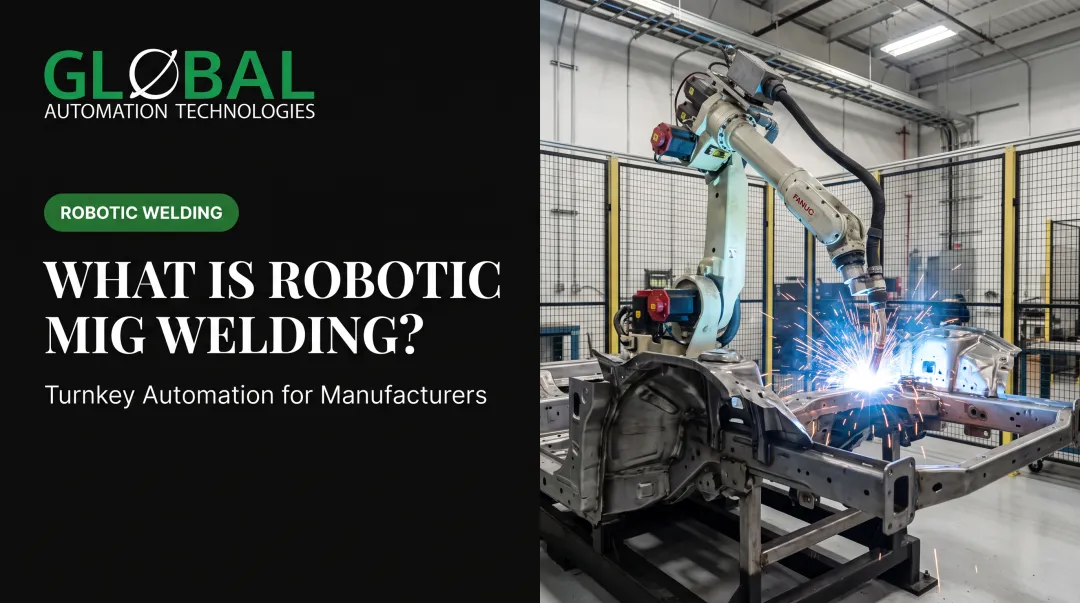
MIG is a wire-feed process: a consumable electrode melts into the weld pool under shielding gas. Continuous wire feed drives higher deposition rates than TIG and simpler setup than most other arc processes, which is why shops lean on it for high-volume steel, stainless, and aluminum work.
Best for:
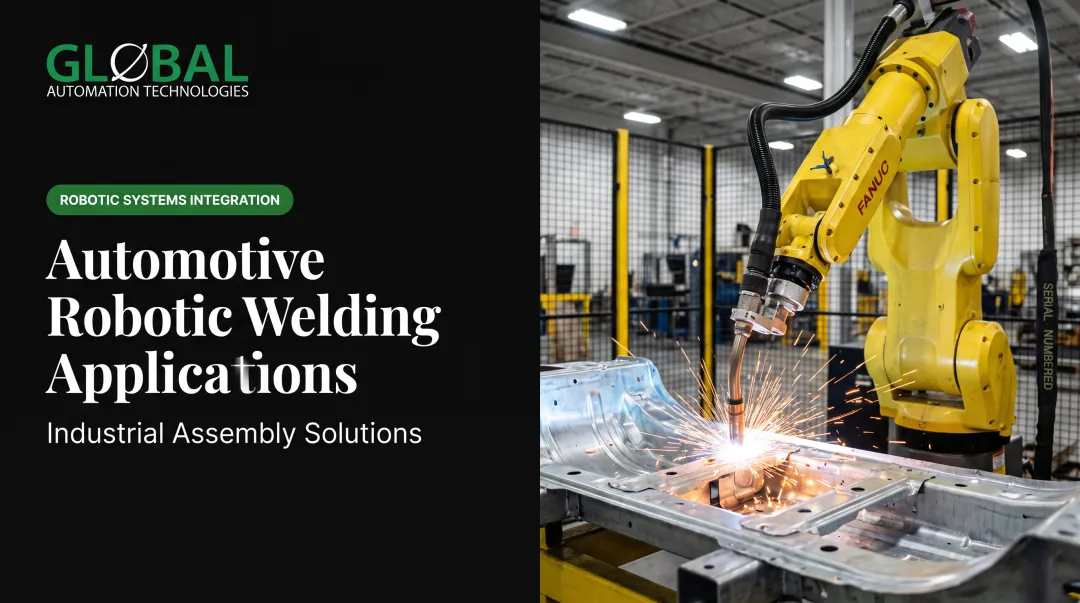
- Automotive body assembly and frame welding
- Heavy equipment frames and structural components
- Fabricated brackets, tubes, tanks, and beams
- Jobs that need speed and deep penetration more than a showroom finish
Trade-offs: Highest throughput and strong penetration on thick stock; lower consumable cost than TIG. More spatter, less cosmetic bead appearance, and ongoing shielding-gas and torch maintenance.
TIG Welding (GTAW – Gas Tungsten Arc Welding)
TIG uses a non-consumable tungsten electrode (optional filler) under inert gas. Precise heat input yields clean, low-spatter beads on thin-wall stainless, exotic alloys, and other joints that must pass visual or x-ray scrutiny—at the cost of slower travel than MIG.
Best for:
- Aerospace parts that need structural certification
- Medical devices and pharmaceutical equipment
- Critical pressure vessels and piping
- Work where bead appearance and material integrity come first
Trade-offs: Top-tier precision and finish with little cleanup. Slower cycles than MIG or spot welding, and more demanding torch-angle and filler-feed programming.
Spot Welding (Resistance Spot Welding)
Spot welding clamps overlapping sheets between electrodes and drives high current through the stack to form a fusion nugget. No filler or shielding gas is needed. Each weld takes seconds, so robots routinely place hundreds of spots on a single body-in-white.
Best for:
- Automotive body-in-white (doors, closures, underbodies)
- Appliance panels and enclosures
- Any unit that needs hundreds of identical sheet joints
Trade-offs: Fastest cycles and lowest consumable cost per weld, with simple programming. Limited to thin overlap joints; leaves electrode marks; tips need regular dressing and replacement.
Arc Welding (SMAW – Shielded Metal Arc Welding / Stick Welding)
Stick (SMAW) uses a flux-coated consumable electrode that forms both the weld metal and a protective slag layer. It stays stable in wind, contamination, and outdoor conditions that would break other arc processes—so it shows up more in field and heavy structural work than on high-speed robot cells.
Best for:
- Pipeline welding and field repairs
- Shipbuilding and offshore structures
- Heavy structural steel fabrication
- Repairs where portability and contaminant tolerance matter
Trade-offs: Handles harsh environments and thicker sections. Slag must be chipped off; harder to automate on complex paths; slower than MIG and less refined than TIG. Rarely the first pick for high-volume robotic lines.
Laser Welding
Laser welding focuses a beam into a small, intense heat source for deep, narrow welds and a small heat-affected zone. On thin stock it leads on travel speed and low distortion—if joint fit-up and process control are tight enough to support it.
Best for:
- EV battery packs (multilayer foil and busbar welds)
- Medical implants and surgical instruments
- Electronics enclosures and hermetic seals
- Thin-wall tube joints where distortion has to stay minimal
Trade-offs: Narrow beads, high speed, little cleanup. High capital cost (source, optics, safety enclosures), gap tolerance often under 0.05 mm, and a narrower range of thicknesses and joint designs.
Plasma Welding
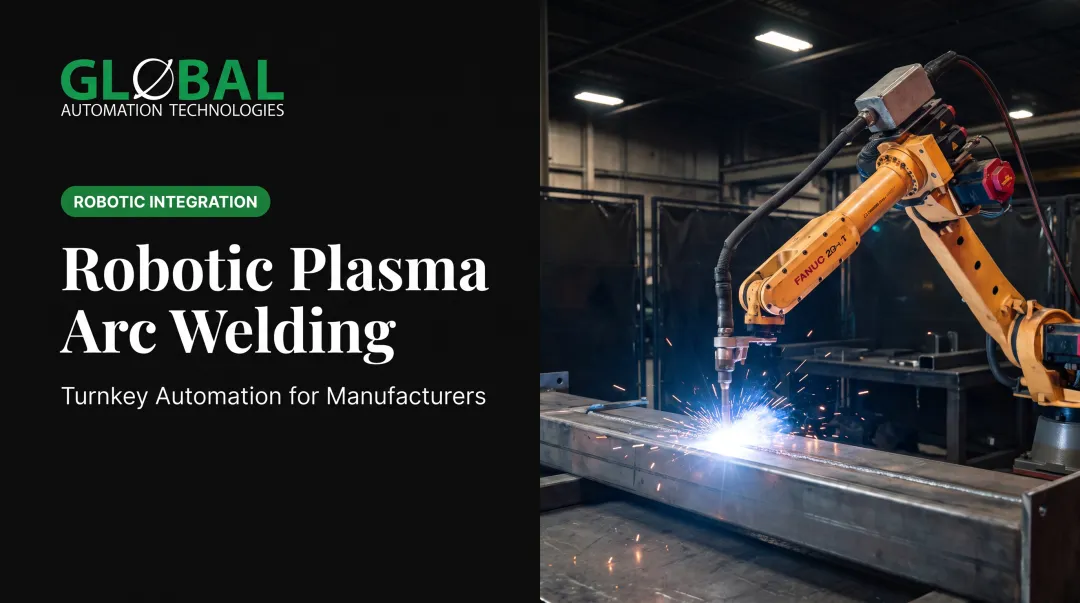
Plasma welding constricts an ionized gas arc through a nozzle for higher energy density than TIG. That yields deeper single-pass penetration and steadier arcs at lower current, with clean finishes—at higher equipment cost and a more involved setup.
Best for:
- Aerospace engine and turbine components
- Pressure vessels and chemical process piping
- Nuclear pipe welding
- Thick sections that need full penetration in one pass
Trade-offs: Strong single-pass depth, stable low-current arcs, and minimal spatter. More complex setup and higher equipment cost than TIG.
Quick comparison
| Process | Best for | Relative speed | Main limitation |
|---|---|---|---|
| MIG (GMAW) | High-volume steel/aluminum fabrication | Fast | Spatter, less cosmetic finish |
| TIG (GTAW) | Thin wall, x-ray / cosmetic critical | Slow | Cycle time, programming effort |
| Spot (RSW) | Thin sheet, many identical joints | Fastest | Overlap joints only; tip marks |
| Stick (SMAW) | Field, outdoor, heavy structural | Slow | Slag cleanup; harder to automate |
| Laser | EV batteries, precision thin stock | Very fast | Capital cost; tight fit-up |
| Plasma | Thick single-pass, high-spec pipe | Moderate–fast | Setup complexity; equipment cost |
Match process to material thickness, joint design, volume, and finish requirements before you lock cell design and tooling.

How to Choose the Right Type of Robotic Welding
The "right" welding type is determined by your material, joint design, production volume, quality requirements, and long-term automation strategy—not by what's most popular or familiar.
Material and Thickness
- MIG: Steel, stainless steel, and aluminum 3mm and thicker; best for general fabrication
- TIG: Thin-wall stainless, exotic alloys, aluminum under 3mm; best for precision and appearance
- Spot: Overlapping sheet metal (0.5-3mm typical); automotive body panels and appliances
- Laser: Thin materials (under 4mm) where distortion and finish matter; battery packs and medical devices
- Plasma: Thick sections requiring single-pass penetration; pressure vessels and aerospace
Production Volume and Cycle Time
- High-volume (hundreds to thousands per day): Spot and MIG for fastest throughput
- Low-volume precision work: TIG and Plasma for quality over speed
- Speed + precision both matter: Laser when capital investment is justified
Quality and Appearance Requirements
- X-ray quality and cosmetic finish: TIG and Laser for clean, defect-free welds
- Structural strength where appearance is secondary: MIG for deep penetration and speed
- Hidden joints: Spot welding for internal assemblies
Integration Complexity and Future Flexibility
Consider how the welding type affects fixturing cost, programming time, and ability to scale or adapt. Laser and TIG demand tight tolerances. If your upstream processes can't deliver consistent gaps, you'll fight quality issues daily. MIG and Spot are more forgiving but may require more post-weld cleanup.
Those tradeoffs are easier to judge with an integrator that models the cell around your part geometry before you lock in a process. GLOBAL Automation Technologies, a Level 5 FANUC Authorized System Integrator, delivers turnkey welding systems and the engineering talent to run them. With 17+ years and 700+ robots deployed across automotive, heavy equipment, aerospace, and general industrial manufacturing, GLOBAL sizes cells to your weld requirements, production rate, and quality standards.
Budget and Total Cost of Ownership
Evaluate not just equipment cost but:
- Consumables: Wire, gas, electrodes, contact tips, nozzles (MIG); tungsten and filler (TIG); electrode dressing (Spot); laser optics and chiller maintenance (Laser)
- Maintenance: Torch cleaning, spatter removal, electrode replacement, optic alignment
- Programming labor: Complex torch angles and filler control (TIG, Plasma) versus simpler paths (MIG, Spot)
- Rework rates: Processes with tighter tolerances reduce downstream defects
Common Mistakes When Selecting a Welding Type
Three selection mistakes show up repeatedly when manufacturers move from manual welding to robotic cells. Each one costs more in rework, downtime, or failed runoff than the process choice itself.
Choosing Based on Familiarity Instead of Application Fit
Selecting MIG because "that's what we know" when TIG would eliminate costly rework on precision parts. Many manufacturers default to the process their team already runs, even when another process would cut rework, raise quality, or shorten cycle times for that job.
Ignoring Fixturing and Fit-Up Requirements
Laser and TIG demand tight tolerances. In one documented case, a multilayer battery joint required gaps below 0.05 mm for 100% weld success. If upstream processes can't deliver consistent part presentation and joint fit-up, you'll fight quality issues daily, even with a capable robot and welding process.
Underestimating Programming and Integration Complexity
Some welding types need advanced motion control, seam tracking, or adaptive power control that under-scoped integrations can't deliver. Poor integration turns a capable robot into an expensive liability.
Each application still needs:
- Process-parameter development
- Path validation
- Fixture design
- Formal runoff
Integrators report 5-9 months for mid-complexity cells with custom fixtures.
Conclusion
Robotic welding is essential for manufacturers facing welder shortages, quality demands, and throughput pressures. The choice between MIG, TIG, Spot, Arc, Laser, or Plasma determines whether your automation investment delivers ROI or becomes a production bottleneck.
Successful robotic welding requires both the right technology and the right integration partner. GLOBAL Automation Technologies has deployed 700+ robots worldwide and provides both the system and the engineers to make it work: from feasibility studies and simulation through installation, commissioning, training, and ongoing support.
With experience across automotive OEMs, heavy equipment, aerospace, and general industrial manufacturing, GLOBAL engineers welding cells around your specific part geometry, weld requirements, production rate, and quality standards.
Frequently Asked Questions
What are the applications of robotic welding?
Robotic welding is used in automotive body assembly, heavy equipment frames, aerospace components, medical devices, and shipbuilding. Applications range from high-speed spot welding of body panels to precision TIG welding of aerospace parts.
How much faster is robotic welding than manual welding?
Robots achieve 85-95% arc-on time versus 20-30% for manual welders, translating to 3-4x throughput on the same parts. Robots maintain consistent speed without fatigue, and shops have seen 30% throughput gains and 85% reductions in welding time.
Will robotic welding replace human welders?
Robots handle repetitive, high-volume tasks while skilled welders focus on complex one-offs, programming, and oversight. They fill capacity gaps from the welder shortage rather than eliminate jobs. The BLS still projects 45,600 annual openings through 2034.
What is the difference between MIG and TIG robotic welding?
MIG uses consumable wire for speed and penetration on thicker materials, with higher deposition rates and simpler programming. TIG uses a tungsten electrode for precision and cosmetic finish on thin or critical welds, with tighter control but slower speeds.
How do I choose the right type of robotic welding for my application?
Evaluate material type and thickness, production volume, quality requirements, and budget. Work with experienced integrators to match the welding process to your production reality, including fixturing, fit-up, programming, and long-term support.
What industries use robotic welding the most?
Automotive manufacturing leads in spot and arc welding for bodies and frames, followed by heavy equipment (MIG for structural components), aerospace (TIG for precision), and increasingly EV battery manufacturing (laser welding for thin, low-distortion joints).