
That's not a labor problem. It's a process design problem.
This guide breaks down what automated fastening systems actually are, the main types of fastening automation, why manufacturers are investing in them, and how to tell if your facility is a good candidate. We'll also cover what separates a working cell from an expensive robot arm bolted to the floor.
Key Takeaways
- Programmed cells present, position, and install fasteners with repeatable process control
- Removing manual fastener handling — not just adding a robot — delivers the biggest documented gains
- Manual, semi-automated, and fully automated approaches each fit different volume and complexity profiles
- Feeding and part variation, not tightening speed, are usually the real bottleneck
- An experienced integrator that also supplies engineers to run the cell reduces startup risk
What Is an Automated Fastening System?
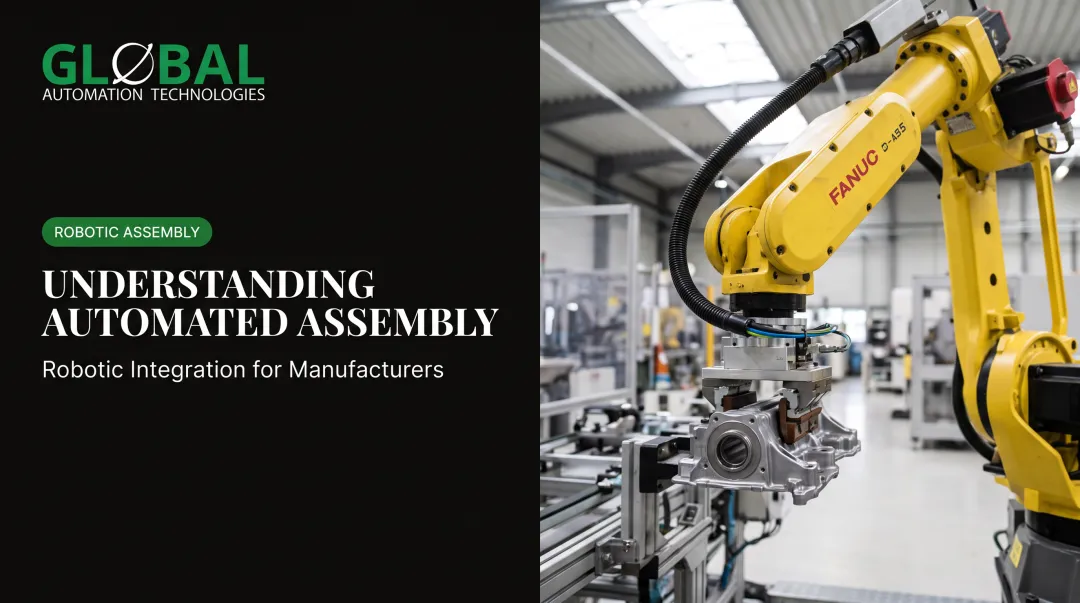
An automated fastening system is an integrated station (robotic or fixed-mechanism) that presents, aligns, drives, and verifies a fastener with minimal human involvement. It's built to run the same install correctly, thousands of times, without an operator repeating the motion by hand.
Core components include:
- Feeder/dispenser — a hopper, vibratory bowl, or step feeder that separates and orients fasteners for pickup
- Installation head — a screw spindle, rivet-nut setter, or press that performs the actual drive or set operation
- Robotic arm or fixed station — provides motion and positioning relative to the workpiece
- Process controller — tracks torque, angle, depth, and cycle count, and flags anything out of spec

How This Differs From a Hand Tool
A pneumatic screwdriver in an operator's hand is a tool, not a system. Automation adds three capabilities a hand tool can't match:
- Repeatability — the same force and placement every cycle
- Data logging — torque and position records tied to each part
- Unattended operation — once the station is fed and running
That combination lets a fastening station run without someone watching every cycle.
Types of Fastening: Manual, Mechanical, and Automated Methods
Fastening is both the hardware you choose and how you install it. Mechanical fastening defines the joint; manual, automated, and in-die methods define how that hardware goes in on the line.
Mechanical Fastening Explained
Mechanical fastening joins parts using discrete hardware (screws, bolts, rivets, clips) rather than welding or adhesives. The defining trait: it's reversible and serviceable. You can remove a bolted panel for repair; you can't easily undo a weld.
Common Fastening Families
For discrete, mechanically installed fasteners, the main categories manufacturers automate include:
- Threaded fasteners — screws and bolts, driven with torque/angle control
- Rivets and rivet nuts — mechanically set into pre-formed holes
- Clinch nuts and press-fit fasteners — installed with a controlled press stroke
- Studs — mechanically inserted or threaded (not welded)
Adhesive bonding and stud welding often get grouped with fastening in conversation, but they're separate joining processes with their own automation requirements.
Manual vs. Automated vs. In-Die Insertion
| Method | Speed | Flexibility | Best fit |
|---|---|---|---|
| Manual insertion | Slowest, station-dependent | Highest; adapts to part variation | Low volume, high mix |
| Automated insertion | ~3 seconds per screw when tuned | Lower; needs consistent part presentation | High volume, stable geometry |
| In-die fastening | Fast; forming and fastening in one press stroke | Low; tied to press tooling | High-volume stamped parts |

That ~3-second automated rate reflects industry benchmarks once feed and motion are tuned (ASSEMBLY, 2020). It isn't fixed: long pneumatic travel or awkward pick-and-drive sequences can add a couple of seconds, while short servo travel can cut close to a second. Time your specific application before you budget a cycle rate.
Why Manufacturers Are Automating Fastening Operations
The Throughput Case
Seconds shaved off a fastening cycle compound fast across a full shift. GM's Rivnut retrofit (a bowl feeder plus integrated screwdriver) let one operator install five fasteners in about two-thirds of the time it previously took to install four (ASSEMBLY, 2018). That is a documented plant-level result, not a universal multiplier. The real gain came from removing manual handling, not only speeding up the drive.
McKinsey's research on Industry 4.0 adoption found 10-30% throughput gains and 15-30% labor-productivity improvements across manufacturing use cases. Treat those ranges as directional context, not fastening-specific guarantees.
Built for Unattended Operation
Once a station is loaded with parts and fasteners, it can keep running without an operator standing over it. That is the design intent, not guaranteed uptime: misaligned parts or damaged fasteners can still stall a cell.
The payoff is largest in automotive and EV production, where lines run around the clock and every recovered minute compounds across the shift.
Precision and Error Detection
Automated fastening stations record torque, angle, depth, and position on every cycle. That data targets the failure modes most common in screwdriving (ASSEMBLY, 2021):
- Missing fasteners
- Cross-threading and cam-out
- Stripped threads
- Torque errors
If a fastener seats improperly, the system flags it before the part moves downstream, instead of catching the defect in final inspection or in the field.
Tool-level repeatability supports the same case. Typical published ranges put air tools near ±5%, electric tools near ±2%, and DC-controlled tools as tight as ±0.1%.

Labor Economics
Manufacturing turnover averaged 36.6% in 2023. Deloitte projects roughly 3.8 million net new manufacturing roles needed through 2033, with close to half at risk of going unfilled.
Automating repetitive fastening frees operators for work that still needs judgment:
- Changeover and line setup
- Quality response
- Exception handling
Those same building blocks (feeding, insertion, torque recording, and traceability) are what integrators embed in full assembly cells. GLOBAL's robotic assembly automation applies them alongside dispensing and material transfer, drawing on 700+ FANUC-based systems. The integration patterns used for fastening often transfer to welding, painting, or handling lines in the same facility.
When Fastening Automation Makes Sense (and When It Doesn't)
Not every fastening station is a strong automation candidate. Match your line against these signals before you commit capital.
Good fit:
- Stable, recurring fastener types across high production volume
- Constrained takt time where manual installation is the bottleneck
- Costly rework or warranty exposure tied to fastening defects
- Difficulty staffing repetitive stations consistently
Poor fit:
- Frequent uncontrolled design changes
- Mixed or inconsistent fastener supply
- Low annual volume that can't justify integration cost
- Weak part-location repeatability without fixturing investment
ROI Reality
Payback depends on your labor savings, scrap reduction, and full installed cost — not just the robot price tag. That hardware is often only about a third of total project cost once feeders, fixturing, and controls are included.

As a reference point, GLOBAL's robotic machine-tending cells typically pay back in 12 to 18 months based on parts-per-shift gains and reduced direct labor. Fastening cells follow the same cash-flow logic, but the exact timeline should come from a feasibility study on your actual part and volume.
Choosing the Right Automated Fastening Partner
Hardware is the easy part. Integration determines whether the cell actually hits production targets. Layout, programming, validation, and operator training are what turn a robot arm into a working station.
Look for a partner that offers:
- Full-scope integration: process analysis, layout design, custom fixturing, controls engineering, and validation—with torque and traceability built in, not bolted on later
- Post-installation support: engineers who can run, troubleshoot, and maintain the cell once it's live, not just hand you the keys
- Cross-industry experience: problems solved in automotive fastening cells often transfer directly to heavy equipment or general industrial assembly lines
GLOBAL Automation Technologies' dual model puts automation solutions, services and technical staffing under one roof. Instead of choosing between buying a cell or hiring an engineer to run it, manufacturers get both from a single partner.
Feasibility studies cover cycle time, capital requirements, and expected returns before a line is ever built.
Frequently Asked Questions
What is automated fastener installation?
It's a robotic or mechanized system that picks, aligns, and drives fasteners (screws, rivet nuts, clinch nuts, or studs) into a workpiece with minimal operator involvement, while recording torque and position data for each cycle.
What are the main types of fastening?
The core mechanically-installed categories are threaded fasteners (screws/bolts), rivets and rivet nuts, clinch nuts/press-fit fasteners, and studs. Adhesives and welding are related joining methods but fall outside discrete fastening.
What is mechanical fastening?
Mechanical fastening joins components using hardware such as screws, bolts, rivets, and clips rather than welds or adhesives. Its key advantage is reversibility: fastened joints can be disassembled for repair or service.
How much faster is automated fastening compared to manual insertion?
Speed gains depend on the application. One documented automotive case saw five fastener installations completed in about two-thirds the time previously needed for four, once feeding was automated.
Is automated fastening only for high-volume production?
High volume maximizes ROI, but it's not the only path. In-die fastening and semi-automated feed-assist tools can work well for mid-volume runs where full robotic automation isn't yet justified.
How long does it take for an automated fastening system to pay for itself?
Payback is application-specific, driven by labor savings, scrap reduction, and full installed cost. Comparable automated cells, like robotic machine tending, typically pay back in 12 to 18 months.