
For OEMs and Tier 1 suppliers, the 2D-versus-3D decision isn't academic. It affects hardware costs, cycle times, inspection accuracy, and whether your robots can handle randomly oriented parts at all. Many teams default to whatever vision system their last integrator recommended, without weighing the actual application.
The right answer depends on application complexity, not brand preference. Here's how to think through it.
Key Takeaways
- 2D vision is fast and affordable for barcode reading, label checks, and presence/absence inspection
- 3D vision adds depth for bin picking, robotic guidance, and complex geometric checks
- Cost, lighting sensitivity, and part complexity drive the 2D vs 3D choice
- Many plants run both on one line to cover simple checks and depth-critical tasks
2D vs 3D Vision Systems: Quick Comparison
Here's the side-by-side breakdown manufacturing engineers actually need.
| Factor | 2D Vision | 3D Vision |
|---|---|---|
| Cost | Lower upfront investment, simpler setup | Higher initial cost, offset by ROI on precision tasks |
| Depth perception | None — flat, planar images only | Full spatial data: width, height, depth |
| Lighting sensitivity | Highly dependent on controlled, consistent lighting | More robust to shadows and lighting variation |
| Best-fit tasks | Barcode reading, surface defects, presence/absence checks | Bin picking, robotic guidance, dimensional inspection |
| Processing speed | Faster, simpler data sets | Slightly slower, though AI tools are closing the gap |
Speed caveat: there's no universal, controlled benchmark proving 2D always outpaces 3D in raw speed. KEYENCE puts a simple machine-vision inspection at roughly 20-100 milliseconds, but that's not a head-to-head dimensionality test. Judge speed at the cell level, not the camera spec sheet.

What Is 2D Machine Vision?
2D vision captures images along the X-Y plane using CCD or CMOS sensors, then analyzes contrast, color, and edges to make decisions. There's no depth channel. The camera sees a flat picture, similar to a photograph, and software hunts for patterns within it.
This simplicity is the appeal. Fewer variables mean:
- Faster cycle times on high-speed lines
- Lower cost of entry for smaller operations
- Simpler integration, especially for teams new to vision systems
Common formats include:
- Smart cameras with onboard processing
- Single or multi-camera arrays for wider coverage
- Line-scan cameras for parts moving continuously past a fixed sensor
The catch: 2D systems need a fixed viewpoint and tightly controlled, high-contrast lighting. Shadows or glare can throw off results fast.
Use Cases of 2D Vision
2D shows up wherever the decision depends on what's printed, colored, or shaped in a flat plane rather than in physical depth.
- Quality control checkpoints that catch surface scratches, print defects, or missing components
- Label verification confirming the right label, position, and product
- Barcode and OCR reading for tracking parts and packaging through the line
Industries where this dominates: electronics assembly, food and beverage packaging, and pharmaceutical labeling. Cognex reports pharmaceutical inspection systems running at 30 vials per minute, 24/7. One beverage inspection deployment has been reported at 80,000 bottles per hour with a near-zero failure rate.

Neither figure is confirmed as a pure 2D setup, but both show the throughput high-speed vision can reach when lighting and part presentation stay controlled.
What Is 3D Machine Vision?
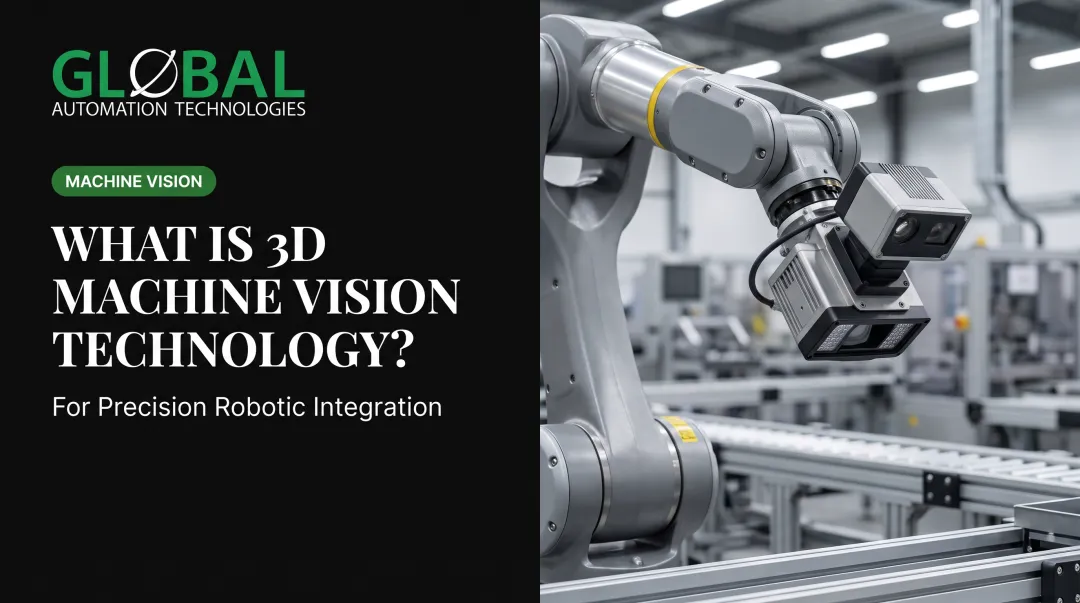
3D vision adds the missing piece: depth. Using structured light, laser triangulation, or stereo vision, these systems capture width, height, and depth simultaneously, building a spatial map of the object rather than a flat picture.
That third dimension changes what's possible:
- Robotic guidance becomes viable, since the robot now knows exactly where a part sits in 3D space
- Manual handling errors drop, because parts no longer need precise upstream fixturing
- Unstructured environments — bins full of randomly oriented parts, for instance — become workable
Not all 3D systems work the same way:
- Structured light — projects a known pattern onto the object; distortion in that pattern reveals depth
- Laser triangulation — a laser line hits the object, and a camera reads the reflection angle to calculate height
- Time-of-flight cameras — measure how long light takes to bounce back, ideal for longer working distances
- Stereo vision — two cameras compare slightly different angles to build a depth map
- LiDAR and photogrammetry — used for larger work envelopes and high-speed geometric data collection

3D earns its higher price tag in applications where flat imaging simply can't provide enough information.
- Robotic bin-picking — locating and grasping parts that arrive in random orientations
- Machine tending cells — verifying part position and orientation before loading
- Weld and assembly verification — checking bead width, height, volume, and continuity on complex geometries
Industries leaning hardest on 3D: automotive body assembly, aerospace tolerance checking, and heavy equipment manufacturing.
Sonaca Group's aerospace inspection cell cut full-part inspection time from 15 minutes down to 4 minutes 30 seconds, a roughly 70% reduction, while improving precision tenfold.
2D vs 3D Vision: Which Should You Choose?
Strip away the marketing, and the decision comes down to four questions:
- How complex is the part? Flat, uniform parts favor 2D. Irregular geometry favors 3D.
- Can you control the environment? Consistent lighting and fixed part position support 2D. Variable lighting or shadows push you toward 3D.
- What's the budget? 2D wins on upfront cost every time. 3D needs to justify itself through precision gains or automation capability.
- Do you need robotic guidance? If a robot must locate and grasp a part without precise fixturing, 3D isn't optional.
Choose 2D when:
- Parts sit flat and stationary
- Lighting is controllable
- The task is identification, not manipulation
- Throughput matters more than depth data
Choose 3D when:
- Parts arrive randomly oriented
- Depth measurement matters
- A robot needs to locate and pick the part
- Inspection needs surface profile or volume data
Here's the part most vendors skip mentioning: plenty of manufacturers run both. 2D handles identification and label verification at one station; 3D handles spatial tasks like bin picking or weld inspection at another. Same line, complementary jobs.
Real-World Application: Vision-Guided Machine Tending
At GLOBAL Automation Technologies, a Level 5 FANUC Authorized System Integrator, we deploy 3D vision-guided FANUC robotic systems for machine tending and material handling across automotive, heavy equipment, and general industrial manufacturing. Here, the 2D-vs-3D choice shows up on the plant floor.
The common challenge: manual tending caps spindle utilization. An operator has to:
- Open the machine door, load the part, close the door, and start the cycle
- Cover limited shifts and take breaks
- Risk occasional part misfeeds
Those constraints limit unattended run time.
3D vision removes those limits. Using FANUC iRVision paired with 3D area sensors, our systems locate parts regardless of orientation — no precise upstream fixturing required. The robot sees the part, calculates its position, and picks it correctly the first time.
We also pair this with AI-assisted simulation. Instead of programming a robot cell live on the floor, engineers model, test, and refine the program virtually first. This approach typically shortens deployment timelines from weeks to days, with fewer surprises at commissioning.
The payoff most clients care about: machine tending cells typically pay for themselves in 12 to 18 months through higher spindle utilization and extended unattended operation.
For complex, variable part handling, 3D vision-guided robotics determines whether a robot only works with perfectly fixtured parts or handles real production variability.
If you're evaluating a vision-guided automation cell for your facility, contact GLOBAL Automation Technologies for a system and engineering assessment.
Conclusion
Neither 2D nor 3D vision is universally better. The right system depends entirely on whether your application needs flat surface analysis or full spatial understanding. A barcode scanner doesn't need depth data. A robot picking parts from a bin absolutely does.
In practice, this comes down to cost control with 2D, and precision plus robotic flexibility with 3D. Many production lines use both together for complete quality assurance, from identification through final inspection.
Match the tool to the task, not the other way around.
Frequently Asked Questions
What are the key differences between 2D and 3D vision systems?
2D captures flat width/height images for surface-level analysis. 3D adds depth data for spatial and volumetric understanding, which is what enables robotic guidance and complex part handling.
How accurate is machine vision?
Modern vision systems can achieve micron-level accuracy under the right conditions. 3D systems are particularly well-suited to tight-tolerance and dimensional inspection tasks where depth matters.
What does 2D vision look like?
2D vision output is a flat, pixel-based image analyzed for contrast, color, and edges. There is no depth or volume data, only what is visible in a single plane.
When should you choose a 3D vision system over 2D?
Choose 3D when parts are randomly oriented, require robotic guidance, or need precise depth and dimensional measurement that a flat image can't capture.
Can 2D and 3D vision systems work together?
Yes. Many manufacturers combine both — 2D for barcode and label reading, 3D for depth-dependent inspection or robotic guidance — on the same production line.
How much does a machine vision system cost?
2D systems generally cost less upfront and are simpler to integrate. 3D systems require greater investment but often deliver strong ROI through reduced defects and expanded automation capability.