
North American companies ordered 36,766 robots worth $2.25 billion in 2025 — a 6.6% jump in units and 10.1% jump in revenue over 2024, with food, consumer goods, and general industry driving much of that growth, according to A3's 2025 robot order data.
Case palletizing robots sit at the center of that shift. They pull repetitive lifting off human backs, cut per-case handling costs, and keep automotive, CPG, and heavy industry lines running at a pace manual crews simply can't sustain. This guide breaks down the three robots manufacturers are actually deploying in 2026, plus what actually determines whether one of these systems delivers ROI or becomes an expensive paperweight.
TL;DR
- Cut labor costs and injury risk by automating how cases stack onto pallets
- Choose based on payload, cycle speed, footprint, and integration ease, not brand loyalty alone
- Our 2026 shortlist: FANUC M-410iC, ABB IRB 460, and KUKA KR 700 PA
- The integration partner you choose matters as much as the robot nameplate
Overview of Case Palletizing Robots in Modern Manufacturing & Logistics
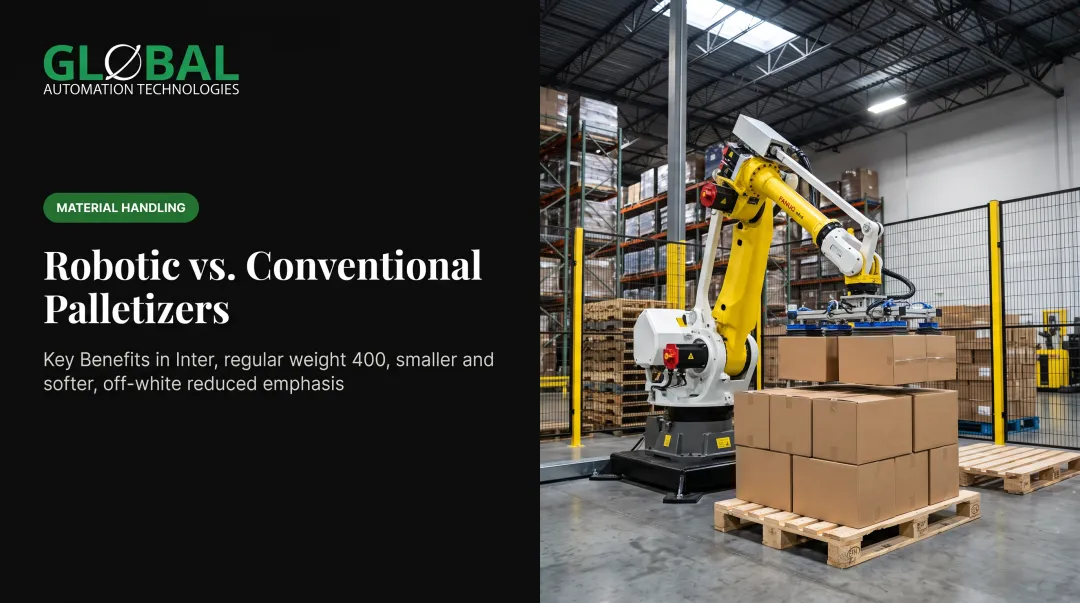
A case palletizing robot is a robotic arm that picks cases or boxes off a conveyor and stacks them onto pallets according to a programmed pattern. Most run on four axes rather than six, trading flexibility for speed and mechanical simplicity — a fair trade when the job is stacking the same box shape thousands of times a shift.
The category is growing fast. The global robotic palletizer market hit $1.4 billion in 2024 and is projected to reach $1.9 billion by 2029, according to MarketsandMarkets' 2024-2029 report.
Zoom out to industrial robots broadly, and the Americas installed 50,100 units in 2024, with the U.S. accounting for 68% of that regional total, per IFR's World Robotics 2025 report.
That growth isn't abstract. It's showing up on plant floors as companies replace end-of-line manual stacking crews with dedicated palletizing cells. Below, we break down the three robots dominating that space in 2026.

Top 3 Case Palletizing Robots in 2026
We evaluated each robot against five practical criteria: payload capacity, cycle speed, footprint, reliability, and how easily it integrates into an existing line without a full retrofit.
FANUC M-410iC Series
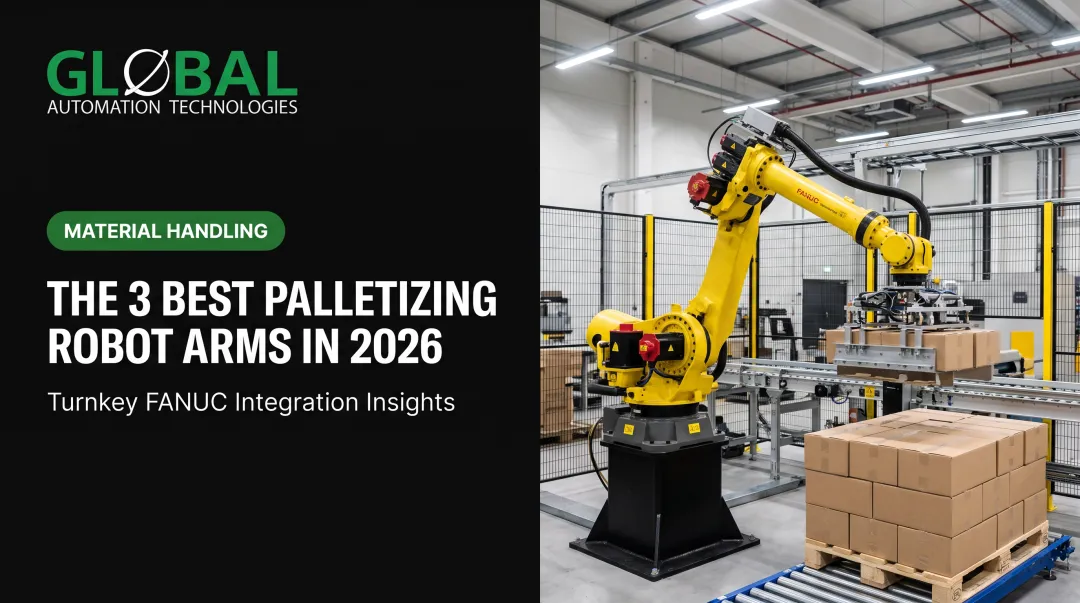
FANUC has long been one of the largest names in industrial robotics, and the M-410iC series is its purpose-built answer to case and bag palletizing. It's a 4-axis platform designed specifically for stacking, not adapted from a general-purpose arm.
What makes it stand out:
- Compact footprint relative to its payload class, making it easier to drop into tight end-of-line spaces
- High-payload variants (up to 500 kg) suited for hazardous environments or heavier case loads
- Mature integrator ecosystem, with broad tooling, vision, and end-of-line packaging support for production deployments
| Model | Payload Capacity | Reach | Cycle Speed |
|---|---|---|---|
| M-410iC/110 | 110 kg | 2,403 mm | Up to 2,200 cycles/hour |
| M-410iC/185 | 185 kg | 3,143 mm | Not publicly specified |
| M-410iC/315 | 315 kg | ~3,143 mm (X/Y range) | Not publicly specified |
| M-410iC/500 | 500 kg | 3,143 mm | Not publicly specified |
Source: FANUC America and FANUC Japan product pages.
GLOBAL Automation Technologies, a Level 5 FANUC Authorized System Integrator, often specifies the M-410iC series for palletizing cells when payload, speed, and reach need to hold up on a live production line.
ABB IRB 460
ABB built the IRB 460 as a high-speed palletizer, and it shows in the numbers. This is the go-to arm for FMCG, food and beverage, and consumer goods lines running high-volume, single-SKU cases through a single station.
Differentiators worth noting:
- Fast cycle speed: up to 2,190 cycles/hour at a 60 kg load, among the quickest in its class
- Small footprint that suits crowded end-of-line packaging areas
- Fast changeovers between SKUs without a full reprogram
| Specification | Value |
|---|---|
| Payload Capacity | 110 kg |
| Reach | 2.4 m (2,400 mm) |
| Cycle Speed | Up to 2,190 cycles/hour (60 kg load) |
Source: ABB IRB 460 datasheet.
Choose the IRB 460 when speed on lightweight, repetitive loads is the priority—not for heavy or oversized cases.
KUKA KR 700 PA
KUKA takes the opposite approach with the KR 700 PA: built for weight, not raw speed. This is a heavy-duty palletizer designed for large, high-weight cases that would strain smaller platforms.
Why it earns a spot on this list:
- 700 kg payload class, among the highest available in dedicated palletizing robots
- Large working envelope (3,320 mm reach) for building tall, wide pallet patterns
- Rated for continuous high-duty-cycle operation, with the ability to palletize whole layers at once rather than case by case
| Specification | Value |
|---|---|
| Payload Capacity | 700 kg |
| Maximum Reach | 3,320 mm |
| Axes/Design | 4-axis, palletizing-specific |
| Cycle Benchmark | 17 work cycles/minute at 700 kg payload |
Source: KUKA KR 700 PA.
If your line handles bagged feed, heavy chemical drums, or oversized industrial cases, this is the class of robot you're shopping in.

How We Chose the Best Case Palletizing Robots
The most common mistake buyers make is picking a robot based on price or brand recognition alone. A robot arm is one line item in a much bigger system. Treating it as the whole purchase leads to budget overruns once integration reality sets in.
We weighed four factors instead:
- Payload and throughput fit: Rated capacity must cover case weight plus end-of-arm tooling, with headroom left over
- Proven reliability and uptime: Track record in continuous industrial operation, not lab conditions
- Software and programming ease: How fast pallet patterns can be built, tested, and changed for new SKUs
- Integration and staffing support: Who shows up after install when something needs adjusting at 2 a.m.
That last point gets overlooked often. A palletizing cell is more than a robot: conveyor infeed, end-of-arm tooling, PLC integration, pallet discharge, and stretch wrap coordination, engineered as one system.
GLOBAL pairs automation solutions, services and technical staffing, so the engineers who know the FANUC controls architecture are the same ones available to keep the cell running after commissioning.
Conclusion
Picking the right case palletizing robot is only half the job. FANUC, ABB, and KUKA all build excellent hardware, but a robot arm alone doesn't deliver results.
Real-world ROI depends on how well that arm integrates with conveyors, controls, and end-of-arm tooling, and whether qualified people are available to keep it running once it's live.
Before you finalize a purchase:
- Weigh scalability against your growth plans
- Confirm long-term support is actually available, not just promised
- Price out the full system, not just the arm
GLOBAL Automation Technologies delivers both pieces of that equation: the robotic palletizing system and the engineers to run and maintain it, backed by 17+ years in operation and a proven global base of robotic deployments. If you're evaluating a palletizing project for 2026, reach out to GLOBAL's team for a process study before you commit to a robot brand.
Frequently Asked Questions
What is a palletizing robot?
A palletizing robot is an automated robotic arm that stacks cases, bags, or boxes onto pallets according to programmed patterns. It optimizes space, load stability, and stacking speed compared to manual labor.
How much does a palletizing robot cost?
Costs vary widely by payload, brand, and integration scope. Budget for the robot arm, end-of-arm tooling, conveyors, controls, and safety guarding, not just the arm's sticker price.
What is the difference between case palletizing and mixed-case palletizing?
Case palletizing handles uniform, single-SKU cases moving through one station. Mixed-case palletizing requires AI and vision-guided systems to stack varying box sizes and weights onto the same pallet.
How many axes does a case palletizing robot need?
Most dedicated palletizers, including all three robots in this guide, use 4-axis designs for speed and mechanical simplicity. Six-axis arms offer more flexibility but are typically reserved for complex or mixed loads.
What payload capacity is required for a case palletizing robot?
Payload needs depend on case weight plus end-of-arm tooling weight. Most standard case palletizers range from 110 kg to 700 kg+ capacity, depending on the product line.
How long does it take to install a robotic palletizing system?
Timelines vary based on cell complexity, conveyor integration, and site readiness. AI-assisted simulation and offline programming can cut programming from weeks to days, but full commissioning still depends on project scope.