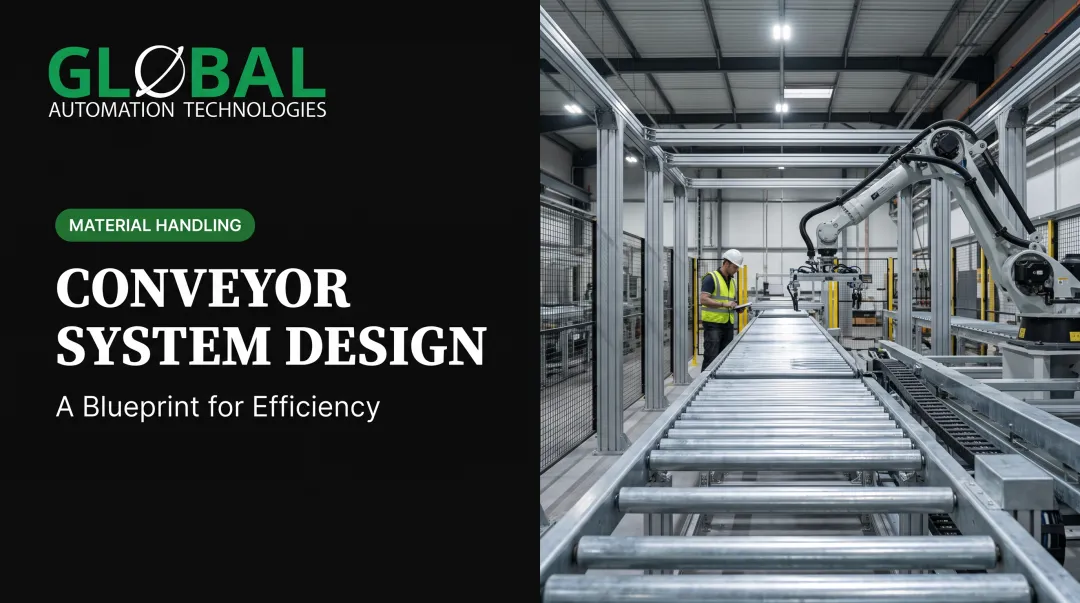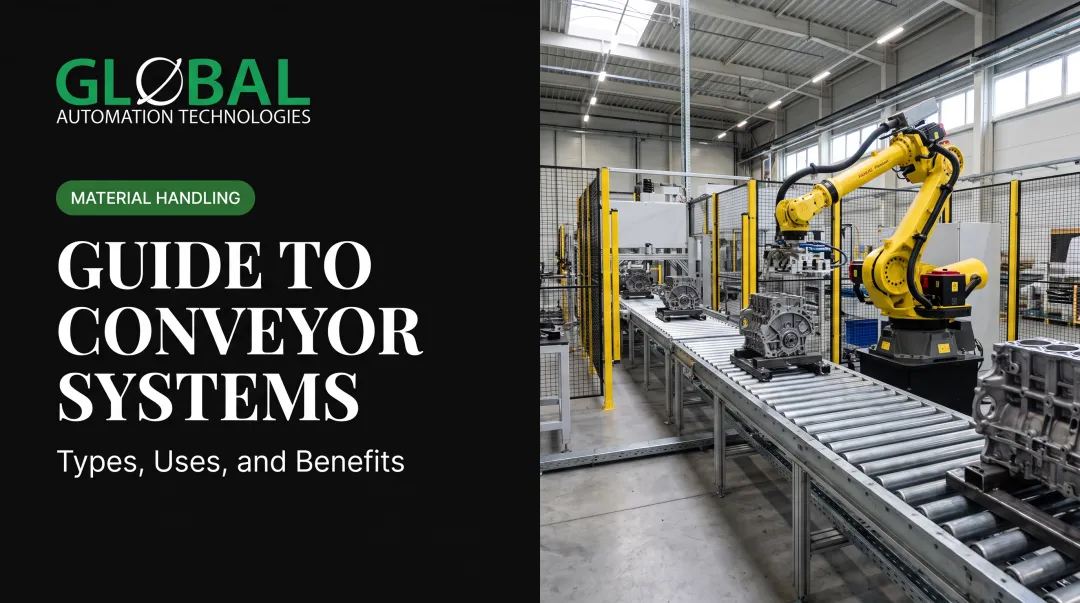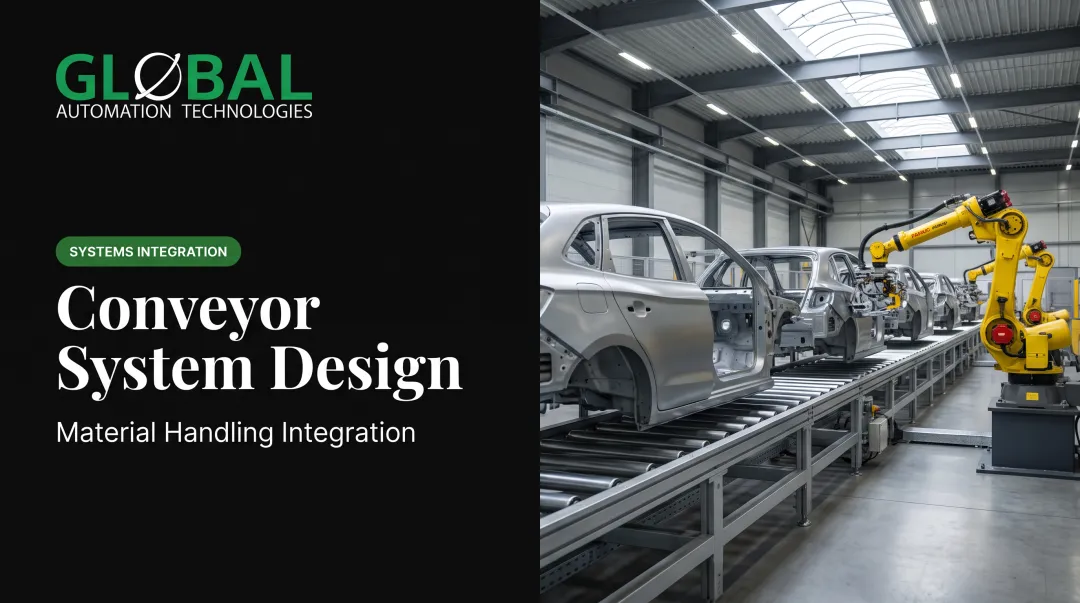

Bottlenecks pile up. Manual handling injuries spike. Throughput becomes unpredictable, and unplanned downtime disrupts schedules that were already tight. Siemens' 2024 downtime analysis puts a real number on the stakes: automotive manufacturers lose an estimated $2.3 million for every unproductive hour on the line (Siemens, 2024).
This guide breaks down what material flow actually means, the four core conveyor types driving it, and how pairing conveyors with robotic automation creates a connected, high-performing production line.
Key Takeaways
- Stronger material flow (raw materials, WIP, and finished goods) shortens cycle times and lowers costs
- Four core conveyor types (belt, roller, chain, overhead/vertical) serve different loads, layouts, and throughput needs
- Conveyors matched to product and process cut manual handling injuries and labor overhead
- Pairing conveyors with robotic machine tending and material handling cells delivers the biggest efficiency gains
- Routine maintenance and OSHA/ANSI-aligned safety protocols keep conveyor-driven lines running without surprise downtime
What Is Material Flow in Manufacturing?
Material flow is the planned, continuous movement of raw materials, components, work-in-process (WIP), and finished goods through a facility—from receiving to shipping.
The Lean Enterprise Institute defines it as the movement of physical items through the entire value stream. That framing matters: flow isn't just transportation.
It also covers:
- Storage and staging between process steps
- Handoffs from one workstation, cell, or department to another
- Timing and sequencing of when materials arrive relative to when they're needed
A slowdown at any single point ripples downstream. One jammed handoff can stall an entire line.
Push vs. Pull: Two Different Flow Philosophies
Facility layout and production strategy shape how material actually moves:
- Push production runs large batches at maximum rate from forecasted demand, then sends them downstream whether the next process is ready or not.
- Pull production reverses that model. Downstream stations signal exactly what part, quantity, and timing they need—and nothing moves until that signal arrives.
Layout has a measurable effect on which model works and how well. A NIST Manufacturing Extension Partnership case study on plant-layout redesign reported 30% direct-labor cost savings, 50% higher efficiency, and roughly 40% shorter cycle times after reworking flow paths and travel distances (NIST MEP, 2024).
A well-designed layout, backed by the right conveyor infrastructure, is what turns those gains from theory into plant-floor results.
Poor material flow shows up in predictable ways: growing bottlenecks, excess WIP sitting in staging areas, and machines idling while they wait on parts. These are exactly the problems conveyor systems are engineered to solve.
What Is a Conveyor System? Exploring the Core Types
A conveyor system transports materials, products, or loads from one point to another with minimal manual handling. Dozens of variations exist across industries, but for most manufacturing operations, they fall into four practical categories based on load type and drive mechanism.
Belt Conveyors
Belt conveyors use a continuous belt that runs over drive and idler pulleys. Friction from the drive pulley pulls the belt—and whatever sits on it—forward.
Best-fit applications:
- Lightweight-to-medium loads and small parts
- Inclines and declines between elevations
- Delicate or surface-sensitive parts that need gentler handling than rollers provide
Roller Conveyors (Gravity & Powered)
Roller conveyors move loads across a series of rollers. Gravity versions rely on a slight decline to keep boxes moving; powered versions use motors. Many modern systems add zero-pressure accumulation, where motorized zones stop automatically when the next zone downstream is occupied.
Best-fit applications:
- Cartons, totes, and boxes in distribution and packaging
- Assembly-line accumulation and inspection staging
- Pallet handling in heavier-duty configurations
Chain Conveyors
Chain conveyors use double or multiple chain lines to move rigid products or pallet carriers in cycles, tolerating higher loads and moderate speeds better than belts can.
Best-fit applications:
- Heavy pallets, drums, and industrial parts
- Buffering between operations like punching and welding
- Supplying components to automotive assembly stations
Overhead/Vertical Conveyors
These systems move material through the air or between floor levels using trolleys, spiral tracks, or reciprocating platforms rather than floor-level paths.
Best-fit applications:
- Multi-level facilities that need vertical transport
- Space-constrained plants where floor-level conveying isn't practical
- Overhead routing that keeps aisles and floor space clear for other equipment
Facility layout, product weight and dimensions, and required throughput rate determine which type — or, more often, which combination of types — fits a given operation. Most real-world facilities run more than one conveyor type simultaneously, matched to different stages of the process.

Benefits of Conveyor Systems for Driving Material Flow Success
The core value of a conveyor system comes down to predictability. Continuous, mechanized movement reduces manual handling time and shortens the overall cycle from raw material to finished part.
Efficiency and throughput gains:
- Consistent conveyance eliminates the variability that comes with manual cart or forklift transport
- Accumulation zones on powered conveyors keep parts moving without operators babysitting queues
- Predictable transit times make scheduling and capacity planning far more accurate
Cost and safety benefits:
Fewer manual lifts mean fewer overexertion injuries—a real exposure in manufacturing. The Bureau of Labor Statistics recorded 9,760 manufacturing cases involving overexertion in lifting or lowering in 2020 alone (BLS, 2022).
- Reduced injury exposure lowers workers' compensation claims and lost-time labor
- Automating repetitive transport work cuts direct labor overhead per unit produced
The ROI shows up fastest when conveyors are matched precisely to the product they're moving. A belt conveyor forced to handle heavy pallet loads underperforms; a chain conveyor overbuilt for lightweight cartons wastes capital. Getting the match right is where the real savings live.
Conveyor Systems and Robotic Automation: Building a Connected Material Flow
Conveyors move material. Robots act on it. The biggest material flow breakthroughs happen at the intersection of the two: when conveyor infrastructure and robotic cells are engineered to operate as one synchronized system rather than two separate pieces of equipment bolted together.
How Robotic Machine Tending Cells Use Conveyor Lines
A robotic machine tending cell pulls parts directly from a conveyor, loads a CNC machine or press, and returns the finished part to the line, all without an operator standing at the machine. This keeps spindles running and material flowing continuously instead of idling between manual load cycles.
GLOBAL Automation Technologies, a Level 5 FANUC Authorized System Integrator, is built for exactly this intersection. As a systems integrator with its own engineering services and technical staffing, GLOBAL designs the automation and can supply the engineers who run it. That combined model matters on conveyor-integrated projects, because the controls work is genuinely complex:
- Speed matching so the robot tracks the conveyor without stopping the line
- Trigger signals that tell the robot exactly when and where a part is present
- Fault handling and E-stop coordination between the robot controller and the existing conveyor PLC
- Accumulation point elimination so parts don't back up at the robot's work zone
GLOBAL's engineers handle this integration whether they're retrofitting a robotic cell onto an existing conveyor line or designing both systems concurrently from a blank sheet.
Retrofits mean adapting to the existing PLC architecture and layout. Ground-up projects let teams co-engineer conveyor speed, part spacing, and robot reach envelopes from day one—usually with tighter synchronization as a result.
Why This Speeds Up Deployment
That level of synchronization is easier to get right when it is proven before hardware hits the floor. GLOBAL uses AI-assisted simulation to model and test robot programs before a single line of code runs on the production line. The result: robot programming drops from weeks to days, commissioning shortens, and fewer startup surprises delay full production.
This connected approach—conveyor plus robot, synchronized from the controls layer up—is where automotive OEMs, Tier 1 suppliers, and heavy industry manufacturers see the most value. Continuous, high-volume flow across welding, painting, dispensing, and assembly depends on that integration, not conveyors running in isolation.

Best Practices for Maintaining Conveyor Performance and Safety
Conveyor performance degrades quietly until it doesn't. A short list of routine checks prevents most avoidable downtime:
- Check belt tracking and tension to prevent drift, slippage, or premature wear
- Inspect pulley bearings for heat buildup or unusual noise
- Monitor motor performance against baseline load and temperature readings
- Clear debris and blockages on a fixed schedule rather than reactively
Safety Requirements You Can't Skip
Conveyor safety isn't optional, and it's governed by more than one standard:
- OSHA 29 CFR 1910.147 covers lockout/tagout procedures for controlling hazardous energy during servicing
- OSHA 29 CFR 1910.212 requires guarding at points of operation and rotating parts
- ASME B20.1-2024 (ANSI-approved) covers design, installation, and inspection, including equipment tied to remote e-stops
These layered requirements mean a compliant conveyor line needs both proper physical guarding and documented energy-control procedures, not just a warning sign near the pinch point.
Where Predictive Maintenance Fits
AI-driven health assessments flag wear and performance issues before they cause failures. GLOBAL builds that monitoring into integrated conveyor-robot lines through SCADA and IoT connectivity.
Early signals on drifting motor performance or bearing wear let teams schedule a fix instead of reacting to a shutdown.
Frequently Asked Questions
What is a conveyor system for material handling?
A conveyor system is a mechanical setup that automates the transport of materials or products between points in a facility. It reduces manual handling and increases throughput compared to manual transport methods.
What does material flow mean?
Material flow is the continuous, planned movement of raw materials, work-in-process, and finished goods through a facility, from receiving through to shipping. It includes storage and staging, not just transportation.
What are the four types of conveyors?
Belt, roller, chain, and overhead/vertical conveyors are the four foundational categories most manufacturing facilities rely on. Most operations combine two or more types to match different stages of their process.
How do you choose the right conveyor system for your facility?
Selection comes down to product weight and size, required throughput rate, facility layout, and how the conveyor needs to integrate with existing equipment or robotics. Getting this match wrong is the most common source of underperformance.
Can conveyor systems be integrated with robotics and automation?
Yes. Pairing conveyors with robotic machine tending or material handling cells is one of the fastest ways manufacturers improve line efficiency, provided the controls integration between the robot and conveyor PLC is done correctly.
How do conveyor systems improve workplace safety?
They reduce manual lifting and the overexertion injuries that come with it. Well-designed systems also include built-in safety features like emergency stops and lockout/tagout points required under OSHA and ASME B20.1.