
Introduction
Manufacturers today face a simple math problem: more output, fewer defects, less labor risk. Manual assembly lines struggle to solve for all three at once.
Fatigue leads to inconsistent quality. Repetitive tasks like welding, fastening, and material handling create real safety hazards.
Global robot installations reached 541,302 in 2023, and operational stock hit 4,281,585 units worldwide, according to the International Federation of Robotics. Manufacturers everywhere are betting on automation to close the gap.
This guide breaks down what assembly line robots are, the main types in use today, how they work on a production floor, and how to choose the right robot and integration partner for your line.
Key Takeaways
- Assembly line robots weld, dispense, and handle parts faster and more consistently than manual labor
- Choose among five main types—articulated, SCARA, Delta, Cartesian, and cobots—based on reach, speed, and payload
- Robots only perform when paired with sensors, conveyors, and control software as one system
- Picking the right integration partner matters more than picking the "best" robot on paper
What Is an Assembly Line Robot?
An assembly line robot is a programmable, multi-axis machine that joins, places, or processes components as products move along a production line. Unlike a manual assembly station, where a person performs the same motion hundreds of times per shift, a robot repeats that motion with the same precision on the first part and the ten-thousandth.
Manufacturers turn to robots for mechanical precision and payload handling that outpaces human capability. The roots go back more than a century: Henry Ford's moving assembly line, introduced in October 1913 at Highland Park, Michigan, cut Model T assembly time from 12.5 hours to just 93 minutes, according to the Library of Congress.
Nearly five decades later, in 1961, GM installed Unimate at its Ternstedt plant in Trenton, New Jersey. Widely credited as the first industrial robot, it sequenced and stacked hot die-cast metal parts.
Anatomy of a Robotic Arm: What Are the Parts Called?
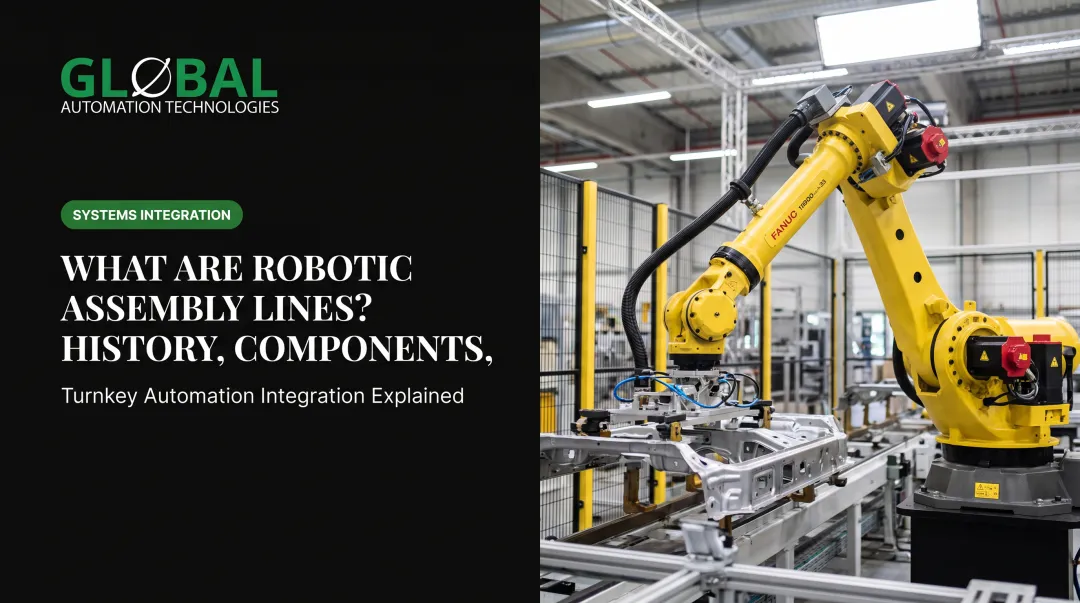
Every industrial robot arm shares a common structure, even though the terminology varies slightly across manufacturers:
- Base – anchors the robot to the floor or a fixed platform
- Shoulder and elbow joints – provide the rotational movement that gives the arm its reach
- Wrist – the final joint, allowing fine orientation adjustments before contact
- End-of-arm tooling (end effector) – the tool doing the actual work
Each joint, or axis, adds a degree of freedom. More axes mean more flexibility to reach around obstacles and orient parts at odd angles.
The controller acts as the robot's brain. It executes the programmed motion path, processes sensor input, and makes real-time adjustments. Without it, the arm is just hardware.
End effectors vary by task:
- Grippers for picking and placing rigid parts
- Suction cups for flat or delicate surfaces like glass or sheet metal
- Welding torches for joining metal components
- Dispensing nozzles for sealants and adhesives
- Screwdrivers or nutrunners for fastening operations

How a Single Robot Fits Into a Larger Assembly System
A robot rarely works alone on the floor. It's one node in a larger system that includes conveyors, part feeders, vision systems, and a central controller synchronizing multiple stations. Take one robot out of sequence, and the whole line stalls—so system design and integration matter as much as the arm you choose.
Types of Assembly Line Robots Used on Production Lines
Robot selection comes down to four variables: degrees of freedom, payload capacity, speed, and work envelope. Get any one of these wrong for the application, and you'll either overpay for capability you don't need or bottleneck your line.
Articulated (Six-Axis) Robots
These are the workhorses of automotive and heavy-part assembly. Multiple revolute joints let them move in complex, multi-directional paths, reaching over obstacles, rotating parts mid-cycle, and working across non-parallel planes. Six-axis is the most common configuration because it balances reach, dexterity, and payload for general-purpose assembly.
SCARA Robots
SCARA robots have a rigid Z-axis and flexible XY movement, making them fast and precise for work between parallel planes. That geometry is ideal for high-speed pick-and-place and small-parts assembly, particularly in electronics manufacturing where insertion accuracy matters more than reach.
Delta (Parallel-Arm) Robots
Mounted overhead with a triangular arm design, Delta robots excel at very fast, lightweight tasks. Think small consumer electronics assembly, where speed outpaces almost every other robot type. Their tradeoff is limited payload, but for light parts moving at high cycle rates, nothing beats them.
Cartesian/Gantry Robots
Cartesian robots move linearly along X, Y, and Z axes rather than rotating through joints. This makes them straightforward to program and well-suited for large work envelopes and heavier, simpler pick-and-place tasks. They're often mounted overhead to save floor space.
Collaborative Robots (Cobots)
Cobots use force-limiting sensors to detect contact and stop or slow down, allowing them to work near human operators without full safety cages in many configurations. They're a strong fit for low-volume lines or mixed-task cells where a full guarded workcell doesn't make economic sense.

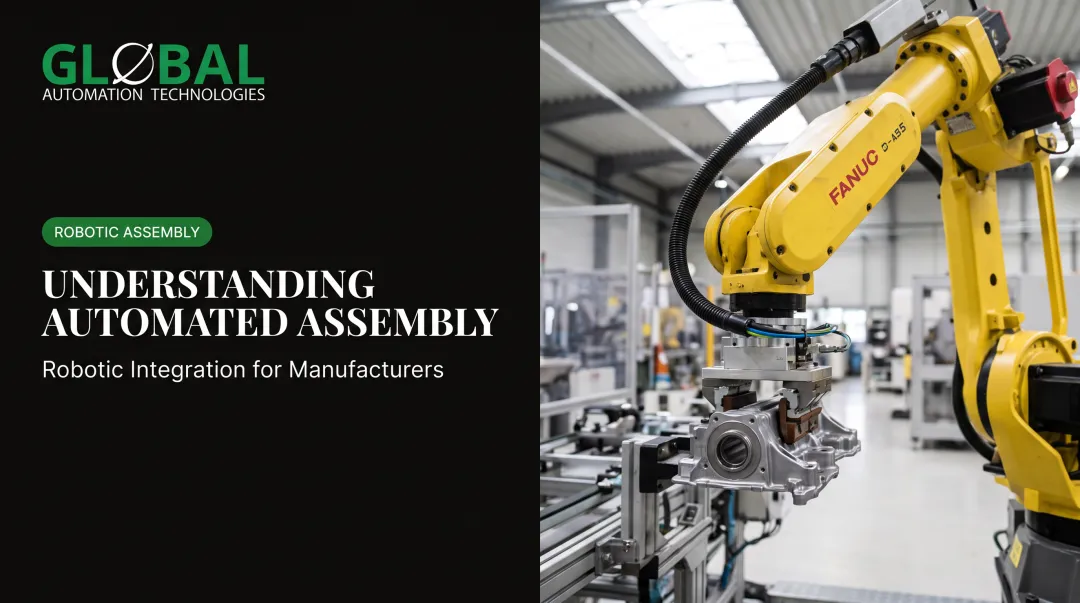
A note on robot selection: GLOBAL Automation Technologies deploys FANUC robots across all five categories, chosen for reliability in hazardous, high-precision automotive and heavy-industry environments. As a Level 5 FANUC Authorized System Integrator, GLOBAL matches robot type to part geometry, cycle time, and floor space constraints on a project-by-project basis.
How Assembly Line Robots Work
A robotic assembly line follows a repeatable, sequenced workflow:
- Parts loading – raw components or subassemblies enter the line via conveyor, tray, or bin
- Sequential robot stations – each robot performs its assigned task (pick-and-place, weld, fasten, dispense)
- Movement to the next station – a conveyor or indexing system advances the product downstream
Sensors and Vision Guide Every Move
Vision systems, such as FANUC's iRVision, locate parts, verify orientation, and catch defects before they move further down the line. These systems can also read barcodes, take measurements, and log traceability data, all without slowing the cycle.
The Closed-Loop Feedback Process
When a robot senses a misalignment—through force feedback or a vision check—the control system adjusts position in real time or flags the part for correction.
ABB calls this integrated force control: the robot adjusts its path based on sensor input instead of blindly following a fixed trajectory. That closed-loop response is what makes a modern assembly cell aware of conditions at the tool tip.
Central Coordination Through MES
A Manufacturing Execution System (MES) bridges ERP data and shop-floor equipment, tracking production in real time, enforcing quality checks, and logging traceability data across every station. Multiple robots on a line don't operate independently — they're synchronized through this layer.
AI-Assisted Simulation Speeds Commissioning
Programming robots used to take weeks. Offline simulation software now lets engineers model, test, and validate robot paths virtually before code runs on the plant floor.
GLOBAL uses AI-assisted simulation so engineers can test cell layouts and cycle times in a virtual environment first. That cuts startup time and reduces commissioning surprises once the system hits the floor.
Applications and Benefits of Assembly Line Robots
Where Robots Do the Heavy Lifting
Automotive OEMs and EV manufacturers lean on robots more than any other sector. Automotive alone accounts for roughly one-third of all operational industrial robots worldwide. Tier 1 suppliers, electronics manufacturers, heavy equipment producers, and increasingly data center infrastructure builders round out the top adopters.
Common assembly tasks robots handle include:
- Welding and joining
- Screwing and fastening
- Dispensing and gluing
- Painting and coating
- Machine tending
- Quality inspection
A single body-in-white welding cell, for example, can involve robots handling over 30 parts and making more than 300 welds in a single cycle, according to KUKA's documented Tier 1 automotive line. That scale of repetition is something no manual line could sustain at the same quality level.
The ROI Case
Robotic automation delivers four core benefits:
- Higher throughput and faster cycle times
- Tighter precision and consistency across every part
- Improved workplace safety by removing operators from hazardous tasks
- Better process data for quality tracking and continuous improvement
Automation payback periods have compressed significantly, from a historical 5-to-8-year range down to 1-to-3 years today, according to McKinsey.
Machine tending and dispensing cells often land at the aggressive end of that curve. These cells typically pay for themselves within 12 to 18 months, driven by higher spindle utilization, reduced direct labor hours, and fewer scrap parts from inconsistent manual cycles.

Challenges and Choosing the Right Automation Partner
Robots aren't the hard part. The real friction shows up in three places:
- High upfront investment — 71% of industrial executives name capital cost their biggest automation hurdle, per McKinsey
- Integration complexity with legacy equipment, floor layouts, and existing control systems
- A shortage of skilled engineers to program, commission, and maintain robotic cells long after installation day
That last point deserves more attention than it usually gets. 61% of executives in the same McKinsey survey cited a lack of automation experience as a barrier — not the hardware, the people. A perfectly specified robot cell is worthless without someone who knows how to program, troubleshoot, and keep it running.
What to Actually Evaluate in a Partner
Skip the robot spec sheet comparison for a minute. Instead, evaluate partners on turnkey capability:
- Layout and process design
- Build and mechanical integration
- Programming and commissioning
- Installation and validation
- Ongoing support and training
This is where GLOBAL closes a gap most integrators can't. GLOBAL pairs turnkey automation solutions, services and technical staffing that places controls engineers, robot programmers, and project managers into client environments on contract, contract-to-hire, or direct-hire terms.
With 17+ years of experience and a proven global base of robotic deployments, GLOBAL delivers both the system and the engineers to run it from a single point of contact.
Frequently Asked Questions
How does a robotic arm work in an assembly line?
A robotic arm follows a programmed path from its controller. Sensors and end effectors pick, place, weld, or fasten parts as products move down the line, adjusting in real time when vision or force feedback flags an issue.
Which robotic arms are most commonly used in assembly line applications?
Six-axis articulated robots are the most widely used for general assembly thanks to their flexibility and reach. SCARA and Delta robots dominate high-speed, small-parts assembly like electronics.
What are the parts of a robotic arm called?
The main components are the base, shoulder, elbow, wrist, end effector, and controller. Each joint adds a degree of freedom, while the controller processes sensor data and executes the motion program.
How much does it cost to implement assembly line robots?
A single robotic cell can start in the tens of thousands of dollars. Complete welding cells often run $120,000 to $500,000 or more, and full multi-robot lines can reach into the millions depending on complexity.
What industries use assembly line robots the most?
Automotive leads by a wide margin, accounting for roughly one-third of all operational robots globally. Electronics, metal and machinery manufacturing, heavy equipment, and data center infrastructure production are close behind.
Can assembly line robots work alongside human workers safely?
Collaborative robots with force-limiting sensors can work near humans without full cages, provided the application meets ISO/TS 15066. Traditional industrial robots still need fencing, light curtains, and e-stops per OSHA guidelines.