
The numbers back this up. BLS reported 946,290 private-industry DART cases in 2023-2024 tied to overexertion and repetitive motion, though this figure spans all industries, not bin sorting specifically. Manufacturers are also staring down a workforce gap — the Manufacturing Institute projects the sector could need 3.8 million new employees by 2033, with 1.9 million roles potentially unfilled.
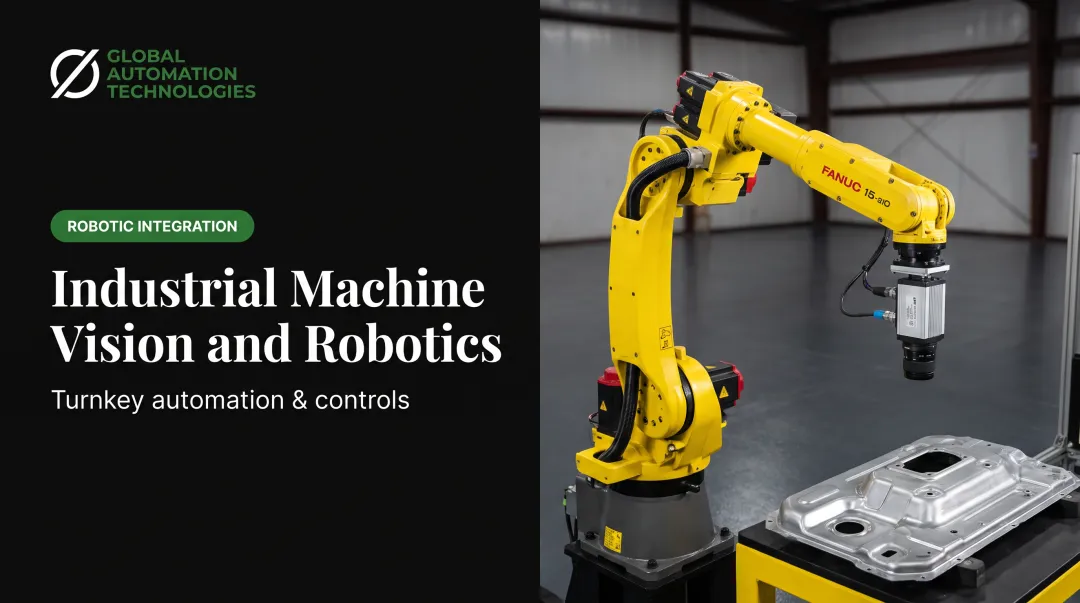
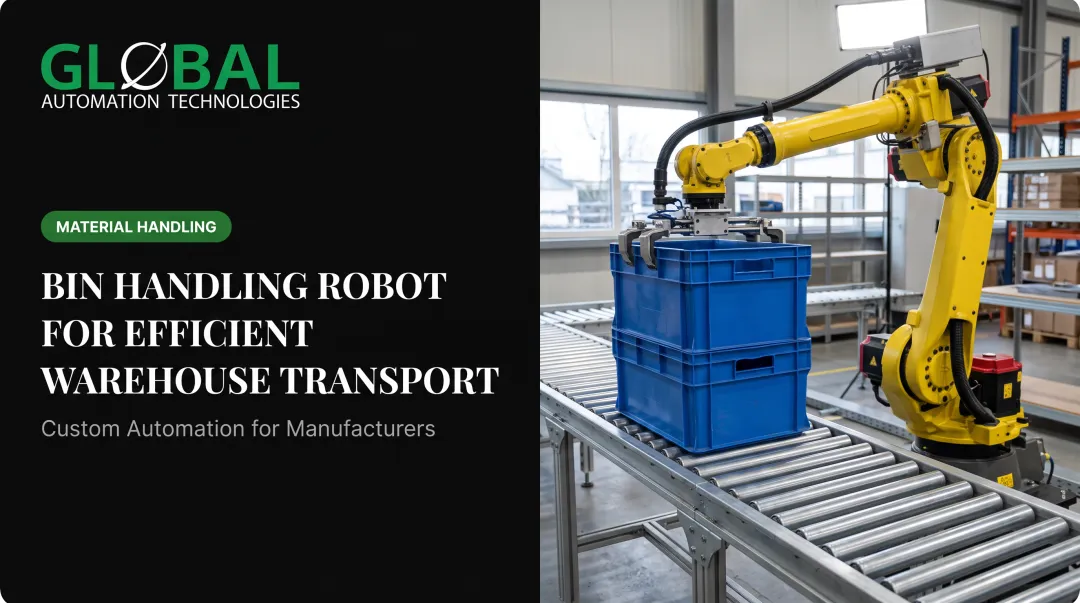
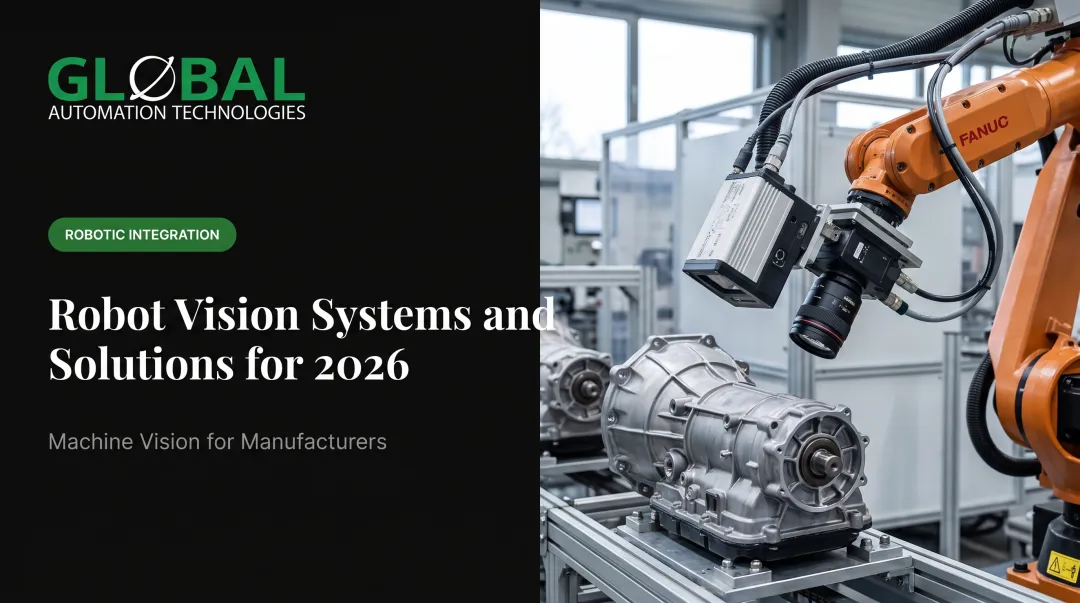
3D bin picking — a robot paired with a 3D vision system that locates, grasps, and places randomly oriented parts — is how manufacturers are closing that gap. This article covers how it works, what it costs, where it struggles, and where it's already delivering results.
Key Takeaways
- 3D bin picking finds and grasps randomly oriented parts with a 3D camera and AI—unlike fixed pick-and-place
- Harder than 2D vision-guided picking: it must solve depth, occlusion, and unpredictable part poses
- Lighting, reflective materials, and calibration drift are the most common failure points — all fixable with the right setup
- A single bin-picking cell can be retrained for new parts without hard tooling changes
- Working with an integrator that handles both hardware and engineering talent reduces deployment risk
What Is 3D Bin Picking?
3D bin picking is a robot equipped with a 3D camera that identifies and retrieves parts randomly placed in a bin or container: no fixturing, no pre-arranged orientation required.
Industry references break bin organization into three tiers:
- Structured — parts sit in fixed, known positions (like a tray with molded slots)
- Semi-structured — parts have some freedom but a predictable pose range, often from a collapsed structured load
- Unstructured/random — parts land in a bin however gravity and chance decide
Unstructured bins are the hard case. Pose distribution is unpredictable, which means the robot's grasp configuration has to be calculated fresh, every single time.
This differs from 2D vision-guided pick and place, which matches flat images against a template. 2D vision doesn't capture depth. It can tell you what a part looks like from above, but not how it's rotated or stacked. 3D systems capture a point cloud, giving the robot the height and orientation data it needs to plan a grasp.
The technology isn't new or experimental. Its roots trace back to research competitions like the Amazon Picking Challenge, first run in 2015, which pushed grasp planning and object recognition forward under real-world conditions.
By 2017, the renamed Amazon Robotics Challenge had teams tackling combined pick, stow, and recognition tasks. That track record marks a mature, field-tested capability.
Random vs. Ordered Bin Picking
Random bin picking handles chaotic piles where parts have no predictable pose. Ordered or structured picking deals with parts already arranged — think a tray of pre-placed components.
Most real factories need the former. Incoming castings, stampings, and molded parts rarely arrive neatly arranged. If your process depends on manual sorting before a robot can take over, you haven't actually automated the hard part.
How 3D Bin Picking Systems Work
A working bin-picking cell has four core components:
- 3D camera/scanner — captures a depth map or point cloud of the bin
- Robot arm — executes the physical pick and place motion
- End-effector (gripper) — suction, parallel-jaw, or multi-finger, chosen for the part
- Software/AI — identifies pickable objects and calculates a grasp

Calibration Comes First
Before any picking happens, two calibrations have to be locked in:
- Tool Center Point (TCP) calibration — tells the robot controller exactly where its gripper's working point is in space
- Vision-to-robot calibration — maps what the camera sees to the robot's coordinate frame
Get either wrong, and the robot will reach for the wrong spot. Photoneo's documented workflow, for example, uses a known reference ball attached to the robot endpoint to build this calibration matrix, and warns that moving the camera afterward invalidates it entirely.
The Scan-Detect-Plan-Execute Cycle
Once calibrated, the cell runs a continuous loop:
- Scan — the 3D camera captures a fresh point cloud of the bin
- Detect — AI or CAD-matching software identifies pickable parts and generates grasp points
- Plan — motion-planning software calculates a collision-free path around the bin walls, neighboring parts, and the gripper itself
- Execute — the robot performs the pick and places the part
This cycle repeats, rescanning after every pick, until the bin runs empty. That continuous loop is what makes unattended operation possible.

Reported cycle times vary widely by application. One medical-kitting deployment averaged 4-second pick cycles, while a heavy brake-disc application ran closer to 30 seconds per piece. Don't treat these as interchangeable benchmarks; cycle time depends heavily on part size, weight, and gripper travel distance.
Choosing the Right Gripper
End-effector selection comes down to the part itself:
- Suction — works well for flat, non-porous surfaces
- Parallel-jaw — suited to rigid parts with defined edges
- Multi-finger — needed for irregular shapes or delicate handling
Gripper choice also shapes how hard grasp planning will be on the floor. GLOBAL's engineers use AI-assisted simulation to model and test robot programs before deployment, which shortens programming time from weeks to days and helps catch grasp-planning issues before they become on-floor surprises.
Benefits of 3D Bin Picking for Manufacturers
3D bin picking pulls people off repetitive sorting and delivers gains manual handling can't match: lower injury risk, steadier throughput, fewer handling defects, and faster changeovers.
- Labor and safety: Removes workers from repetitive, ergonomically taxing sorting tied to overexertion injury claims
- Throughput: Enables lights-out or unattended running between scheduled maintenance windows, with consistent cycle times manual sorting can't hold across shifts
- Quality: Cuts misplacement and handling damage versus manual transfers
- Flexibility: Retrains one cell for new part geometries without hard tooling changes, unlike bowl feeders or fixed conveyors
On ROI: Independent, bin-picking-specific payback data is scarce in published research. Adjacent robotic material handling is the better reference point.
GLOBAL's benchmark for robotic machine tending cells is a 12–18 month payback, driven by higher spindle utilization and reduced direct labor. Bin picking follows the same logic: more parts moved per shift with fewer hands. Actual payback still depends on part mix, bin fill rates, and labor costs, so treat generic industry claims with skepticism and ask any integrator for a project-specific model.

Common Challenges and How They're Solved
No vision system is perfect out of the box. Here's where bin-picking cells typically run into trouble:
Lighting variation. Ambient light changes cause inconsistent depth readings from scan to scan. The fix is stable, controlled lighting or sensors designed to be less light-dependent.
Reflective, transparent, and dark parts. Specular metal surfaces can reflect projector light thousands of times stronger than the rest of the scene, saturating camera pixels and corrupting the point cloud. Common mitigations include:
- Specular-preset camera modes
- HDR or multi-acquisition capture
- Dark, non-reflective backgrounds behind shiny parts
Transparent parts remain genuinely difficult , and no universal fix exists. Production testing on your actual parts is non-negotiable before you commit to a system.
Occlusion and stacking. A good scan doesn't guarantee a reachable grasp if a part is buried under others. Collision-aware path planning has to account for the bin wall, neighboring parts, the gripper geometry, and the withdrawal path, not just the target part.
Calibration drift. Vibration and mechanical shifts over time can throw off a calibration that worked perfectly at commissioning. Stable mounting and periodic re-verification keep this in check.
Industries and Real-World Applications
| Sector | Application | Notes |
|---|---|---|
| Automotive & Tier 1 | High-precision part sorting, stacking into jigs | Volkswagen Slovakia used 3D scanning to locate loose parts from floor containers |
| Logistics & e-commerce | High-speed random package picking for fulfillment | Deployments reported at multiple European e-commerce operators |
| Food, beverage & pharma | Hygienic, high-cycle picking with barcode visibility | A CapSen medical deployment reported sub-0.5-second detection and 4-second average cycles with error-free 24/7 operation |
| Heavy industry | Metal component handling, shiny-surface challenges | Brake-disc bin picking reported complete cycles under 30 seconds per piece |
Automotive and Tier 1 plants are where GLOBAL's plant-floor engineering experience applies most directly. Body shop, powertrain, and final assembly lines all handle loose, randomly presented metal parts. Those conditions are exactly what make 3D bin picking worthwhile.
Frequently Asked Questions
How do robots pick things up?
A robot uses an end-effector such as a gripper, suction cup, or claw, guided by vision or sensor data that tells the arm where and how to grasp an object. The vision system does the "seeing," while the gripper does the physical work.
Are there robots to pick strawberries?
Yes, soft-fruit picking robots exist using specialized 3D vision and gentle grippers. They're a distinct agricultural application, though, built around fragile produce rather than industrial parts.
What's the difference between bin picking and depalletizing?
Depalletizing removes uniformly stacked boxes from a pallet in predictable positions. Bin picking handles randomly oriented parts inside a container, which requires far more complex pose estimation.
How much does a 3D bin picking system cost?
Cost depends on camera type, robot platform, gripper complexity, and integration scope, including tooling, controls, guarding, and commissioning. Get a project-specific quote from an integrator rather than relying on generic figures.
Can 3D bin picking handle mixed part types in the same bin?
Modern AI-based systems can be trained to recognize and pick multiple part geometries in the same bin. Performance still depends on how much the parts vary and how flexible the gripper is.
How long does it take to deploy a 3D bin picking cell?
AI-assisted simulation has shortened programming timelines. GLOBAL's engineers report cutting robot programming from weeks to days by modeling and testing programs before floor deployment. Full cell commissioning still varies by project scope.