
The numbers back this up. The IFR's World Robotics 2025 report counted 4,664,000 operational industrial robots worldwide in 2024, a 9% jump year over year, with 542,000 new units installed that year alone.
Manufacturers aren't adopting robots just to keep up with trends. Many face real labor shortages, rising quality demands, and safety concerns that traditional staffing can't solve. This article breaks down what industrial robots actually are, the main types you'll encounter, where they're used, what they cost, and how to pick a partner that won't leave you stranded mid-project.
Key Takeaways
- Industrial robots automate welding, painting, assembly, and material handling as reprogrammable, multipurpose systems
- Match the job to the type: articulated, SCARA, cartesian/gantry, cylindrical, delta, or cobot
- Machine tending cells often pay for themselves in 12-18 months, depending on robot type and integration scope
- Choose your integration and staffing partner as carefully as the robot itself
What Is Industrial Robotics?
According to ISO 8373:2021, an industrial robot is an "automatically controlled, reprogrammable multipurpose manipulator, programmable in three or more axes, which can be either fixed in place or fixed to a mobile platform for use in automation applications in an industrial environment."
Two words matter most here:
- Reprogrammable: you can change its motions without physically altering the machine
- Multipurpose: it can be adapted to a new task with some physical modification
How This Differs From Other Automation
Not everything on a factory floor qualifies as an industrial robot:
- Fixed automation performs one task and can't be reprogrammed, so it isn't a robot by this definition
- Cobots (collaborative robots) are a safety classification, not a separate mechanical structure. They're still industrial robots designed to work near humans
- AGVs (automated guided vehicles) fall outside this definition unless they carry a manipulator arm that independently meets the ISO standard
Why It Matters for Manufacturers Today
Robotic welding used to mean automotive body shops. That's no longer the whole story.
FANUC's collaborative robots now handle aerospace inspection tasks, cutting a complex 50-plus-callout inspection from up to 12 hours down to under 10 minutes, according to a FANUC America case study.
Heavy equipment manufacturers are welding excavator attachments weighing up to two tons with extended-reach robotic arms.
AI is changing the engineering side too. At GLOBAL Automation Technologies, engineers use AI-assisted simulation to model and test robot programs before a single line of code touches the production floor, cutting programming timelines from weeks to days. AI-driven health assessments also flag equipment issues early, before they turn into unplanned downtime.
The 5 Main Types of Industrial Robots
Choosing the right robot structure depends entirely on your application. Here's how the main types break down.
Articulated Robots
With a rotating base and typically 4-6 rotary joints, articulated robots are the most versatile type on the market. They handle:
- Welding
- Palletizing
- Material handling
- Machine tending
- Assembly
Their wide range of motion makes them the default choice across most manufacturing sectors.

SCARA Robots
Four-axis SCARA robots trade some flexibility for speed and precision. Two parallel rotary joints give them excellent compliance in a selected plane, which is why they dominate electronics assembly and fast pick-and-place work.
Cartesian/Gantry Robots
These move along three linear axes, often mounted on overhead tracks. They excel at transferring loads over long distances with precise positioning, making them ideal for part transfer across large work cells.
Cylindrical Robots
Built with a rotating base and a prismatic (sliding) joint, cylindrical robots are common in machine tending and die-casting applications where a compact reach pattern works well.
Delta (Parallel) Robots
Picture an inverted triangle of arms and links working in a closed loop. Delta robots are built for speed: high-speed picking, packing, and packaging, especially in food and pharma environments.
Collaborative Robots (Cobots)
Cobots are a safety designation, not a separate mechanical structure. Rounded edges, force sensors, and speed limiters let them work alongside people without traditional guarding. Global cobot installation share climbed from 9.9% in 2022 to 10.5% in 2023, according to IFR data, making this the fastest-growing segment in the industry.

Common Applications and Real-World Examples
Robots earn their keep in a handful of core applications. Here's where they deliver the most value.
Welding
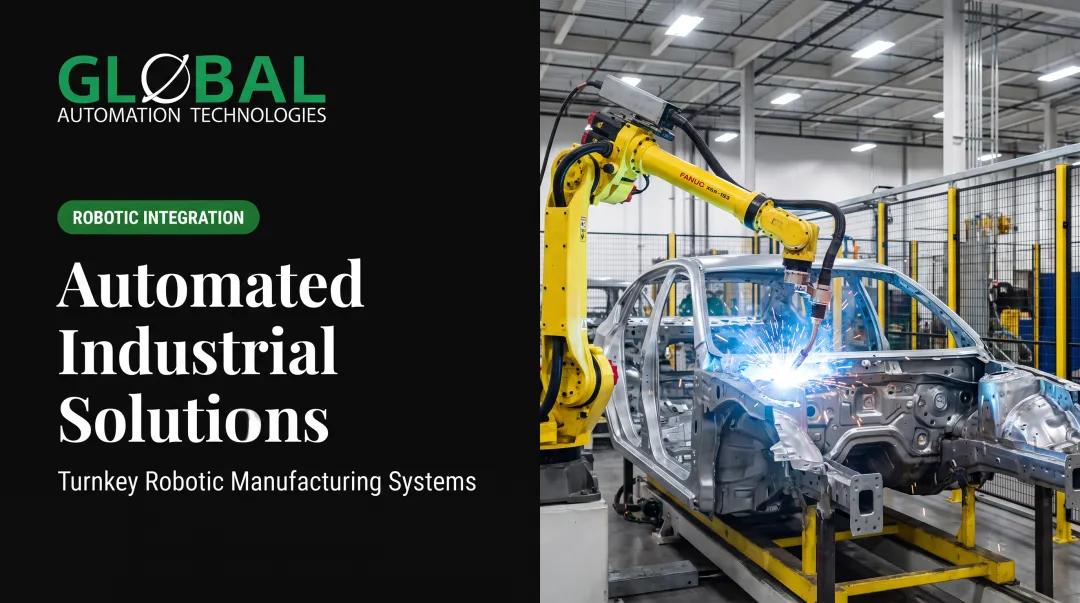
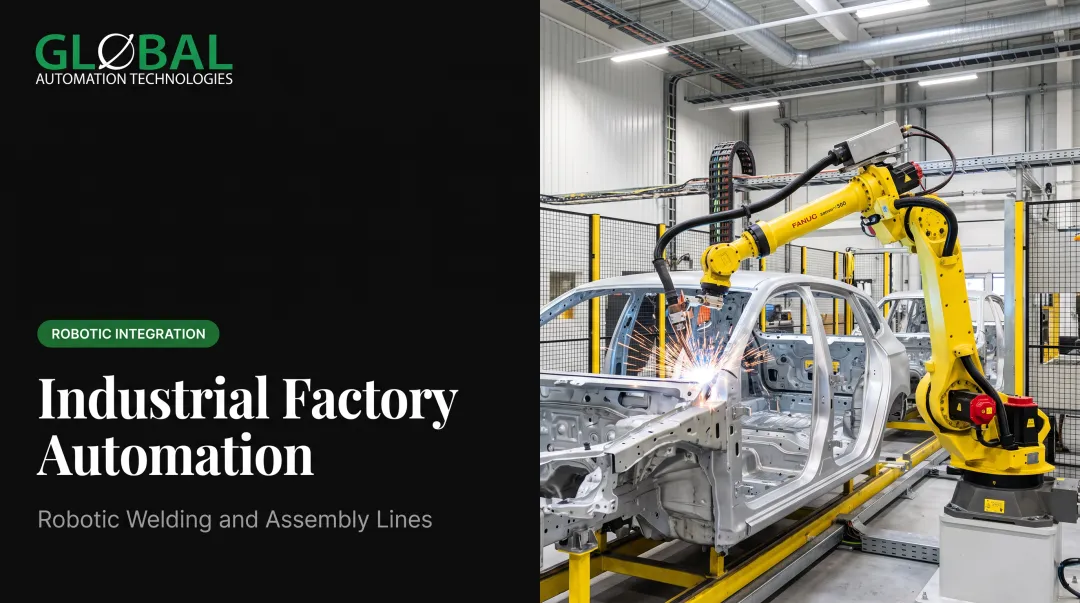
Automotive represented 25% of global robot installations in 2023, per the IFR's 2024 Executive Summary. Articulated robots dominate here because they handle high-volume, high-precision welds with laser seam inspection and real-time arc-data monitoring. Systems check weld size, porosity, and undercut as they go.
Machine Tending
Robots load and unload CNC machines, letting production run through breaks, shift changes, and overnight hours. GLOBAL's machine tending cells typically pay for themselves in 12-18 months. Configurations range from a single robot serving one machine to multi-machine cells with buffer stations and vision-guided part recognition.
Painting and Dispensing
Robotic painting holds film build within specification by combining FANUC paint robots with process-specific engineering: optimized spray patterns, controlled material flow, and booth airflow management. Benefits include:
- Reduced overspray and material waste
- Consistent film build without operator variability
- Operators removed from hazardous VOC and isocyanate exposure
Robotic dispensing applies seam sealer, structural adhesives, cavity wax, and underbody coating with the same process control—metered flow, path accuracy, and repeatable bead geometry on every cycle.
Material Handling and Palletizing
High-mix production and logistics operations use robots for pick-and-place, palletizing, and conveyor integration. The work is repetitive, physically demanding, and easy to get wrong by hand. Vision-guided cells keep pace with mixed SKUs while cutting handling errors and strain injuries.
Inspection and Quality Validation
Machine-vision systems paired with flow monitoring check bead width, placement, and continuity in real time. This catches off-spec sealant or adhesive application on body-in-white joints and cavity fills before parts move downstream, rather than discovering defects after the fact.

Benefits and Costs of Industrial Robot Automation
The core case for robotics comes down to four things: productivity, consistency, safety, and uptime.
- Higher output from longer cycles and less idle time, without matching headcount growth
- Repeatable motion paths that cut scrap and rework across shifts
- Operators removed from heavy lifts, hot work, and hazardous spray environments
- Continuous operation through breaks, second shifts, and lights-out windows
Deloitte's 2025 Smart Manufacturing and Operations Survey found companies adopting smart manufacturing technologies saw up to a 20% improvement in production output, a 20% gain in employee productivity, and a 15% increase in unlocked capacity.
That same survey found 48% of manufacturers struggle to fill production and operations-management roles — a labor gap robots are increasingly filling.
What Does an Industrial Robot Cost?
Base robot pricing shifts based on payload, reach, and brand. The sticker price on the arm itself is only part of the picture. Total system cost typically includes:
- Application-specific tooling and end-of-arm fixtures
- Controls engineering, vision integration, and programming
- Installation, commissioning, and operator training
ROI timelines vary by application. McKinsey reports that manufacturing payback periods have shrunk from a historical 5-8 years down to 1-3 years today, as robot costs have fallen more than 50% over the past three decades. Machine tending cells often land at the faster end, paying back in 12-18 months.

Choosing the Right Automation Partner
Picking a robot is the easy part. Picking the right partner to design, build, and support your system is where projects succeed or fail.
Look for a partner offering genuine turnkey capability:
- Process study and feasibility — workflow evaluation, ROI assessment, scope definition
- Engineering and design — layout, robot selection, tooling, controls
- Simulation and programming — offline testing before anything touches the floor
- Build and commissioning — installation and production launch
- Ongoing support — training, documentation, and maintenance

Why GLOBAL Offers Solutions and Engineers Matters
Most automation firms do integration or staffing, not both. GLOBAL Automation Technologies runs both under one roof: an automation solutions division that designs and builds the robotic cell, and technical staffing that places controls engineers, PLC programmers, and project managers to run it.
One call gets you the machine and the people who keep it running.
When you evaluate an integrator, demand proof on points like these:
- Cross-industry experience — GLOBAL has integrated 700+ robots across 22 countries and 5 industries in 17+ years
- Manufacturer certification — Level 5 FANUC Authorized System Integrator, and #1 purchaser of FANUC robots among North American integrators in 2025
- Full lifecycle support — training, documentation, and maintenance that continue after installation
Frequently Asked Questions
What is industrial robotics?
Industrial robotics refers to automated, reprogrammable manipulators that perform manufacturing tasks—welding, painting, assembly, and more—with speed, precision, and repeatability. Per ISO 8373, they must be programmable in three or more axes.
What are the five main types of industrial robots?
The five main types are articulated, SCARA, cartesian/gantry, cylindrical, and delta robots. Collaborative robots (cobots) are a fast-growing sixth category, though they're a safety classification rather than a distinct mechanical structure.
Which robot type is most commonly used in manufacturing industries?
Articulated robots are the most common because of their versatility and wide range of motion. They handle welding, material handling, machine tending, and assembly across nearly every manufacturing sector.
What are some examples of industrial robots?
Common platforms include FANUC for machine tending and inspection, Yaskawa/Motoman for arc welding in automotive and heavy equipment, and ABB for handling, welding, and packaging cells.
How much does an industrial robot cost?
Industrial robot arms often run about $25,000–$100,000+, while full cells with tooling, programming, safety, and training commonly total $100,000–$500,000+. Type, payload, and integration scope drive the final number more than the arm sticker price alone.