
Picking the wrong application for your line wastes capital and delays ROI. This guide breaks down the top industrial robot applications, what makes each one valuable, and how to match the right one to your production bottleneck.
TL;DR
- Robots handle welding, machine tending, material handling, painting, dispensing, assembly, and inspection across manufacturing
- Welding and machine tending remain the highest-volume applications in North America
- The right application depends on payload, precision, cycle time, and hazard exposure — not trends
- Pairing automation solutions, services and technical staffing shortens deployment and reduces downtime risk
Overview of Industrial Robot Applications in US Manufacturing
Industrial robots are programmable, multi-axis manipulators built to perform repetitive, precise, or hazardous manufacturing tasks without fatigue or variation. They range from six-axis arms handling heavy welding torches to compact SCARA units placing microchips.
Adoption keeps climbing. The International Federation of Robotics reports 4.664 million industrial robots operating worldwide in 2024, a 9% jump from the prior year and the largest annual stock increase on record.
That growth isn't evenly spread across U.S. manufacturing floors. Some applications dominate adoption because they solve the most expensive, most dangerous, or most repetitive problems on the plant floor. Below, we break down which applications deliver the biggest gains today.
Top Industrial Robot Applications
These are ranked by adoption breadth, ROI potential, and relevance to today's biggest manufacturing pressures: labor shortages, safety compliance, and throughput demands.
Welding
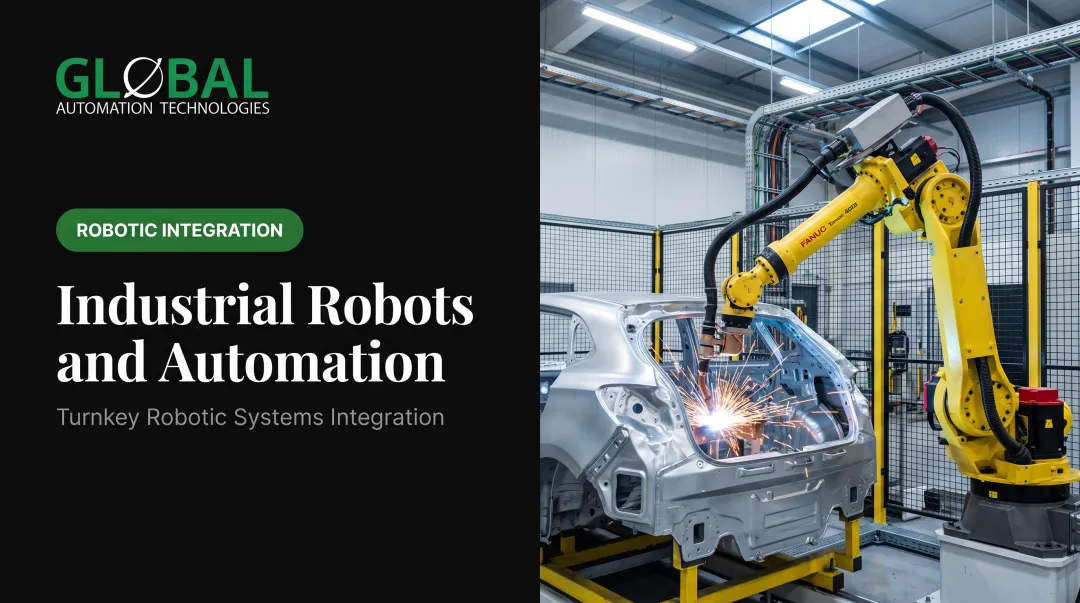
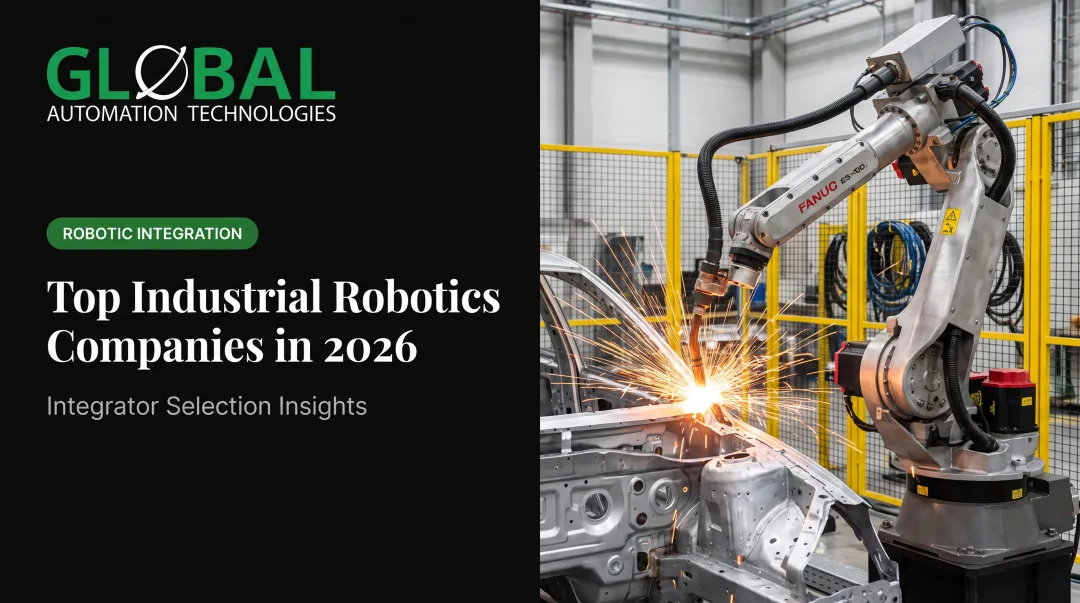
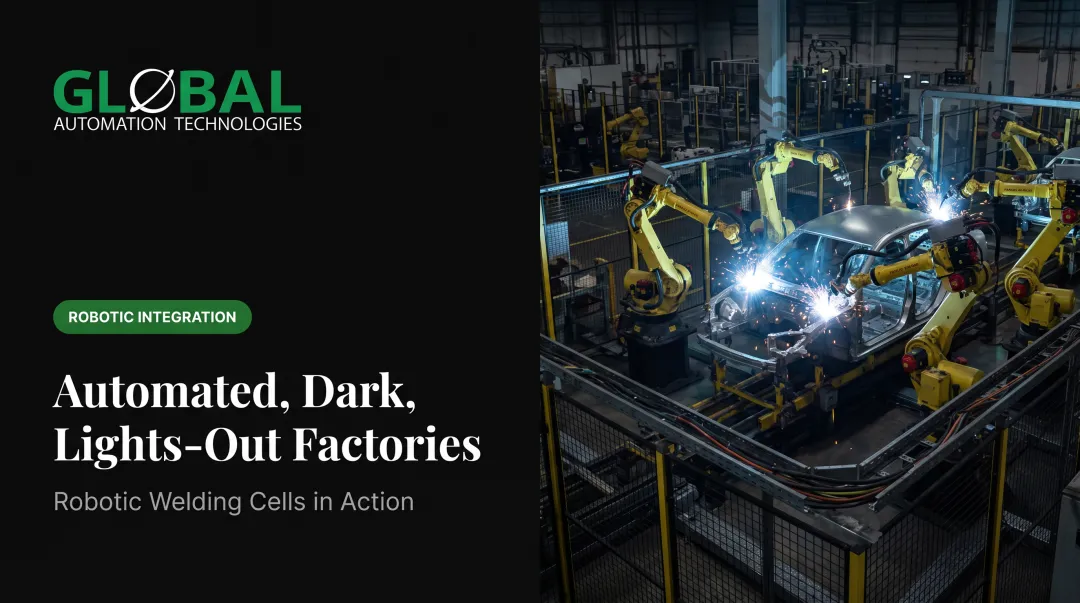
Robotic MIG, TIG, spot, and arc welding deliver seam quality and consistency that manual welders can't match shift after shift. That matters most in automotive body shops and heavy equipment plants, where a single bad weld can trigger costly rework or a failed part.
- Removes workers from high-heat, fume-heavy, hazardous welding bays
- Delivers repeatable weld penetration and bead geometry across thousands of cycles
- Supports single-robot, multi-robot, or coordinated welding cells for complex geometries
Welding remains one of the largest robot application categories globally. IFR data shows welding accounted for roughly 17.4% of the 541,000 new industrial robot installations tracked in 2023 (IFR World Robotics 2024).
GLOBAL Automation Technologies, a Level 5 FANUC Authorized System Integrator, has deployed robotic welding systems across automotive, heavy equipment, agricultural, aerospace, and general industrial manufacturing. Each cell is custom-engineered around part geometry, weld requirements, and production rate, with optional vision for seam location and quality verification.
Machine Tending
Machine tending robots load and unload CNC machines, presses, and injection molders, turning single-shift equipment into extended-shift production assets that run between scheduled maintenance windows. The robot opens the door, loads the part, closes the door, and starts the cycle, over and over, without a break.
- Extends unattended operation through nights and weekend shifts
- Frees operators from monotonous, repetitive tending cycles to focus on inspection and process improvement
- Scales to single-machine or multi-machine cells with optional vision for part recognition
GLOBAL's robotic machine tending cells typically pay for themselves in 12 to 18 months through higher spindle utilization and reduced idle time between manual load cycles.
Material Handling & Palletizing
Pick-and-place, palletizing, and pallet-to-conveyor transfer are the backbone of warehouse and end-of-line packaging automation. Robots handle repetitive lifting that would otherwise wear down human operators over a full shift.
Key advantages:
- Continuous, fatigue-free operation compared to manual labor shifts
- Reduced injury risk from repetitive heavy lifting
- Flexible integration with existing conveyor systems and vision-guided part recognition
This is often one of the easiest entry points into automation because the ROI math is straightforward: fewer injuries, fewer labor hours, more throughput per shift.

Assembly
Six-axis and SCARA robots place small components with vision-guided precision on electronics lines and automotive powertrain assembly. Precision here isn't optional: a misplaced fastener or missed torque spec can fail a part downstream.
- Adapts to fluctuating production volumes without added ergonomic strain on workers
- Supports fastening, bolt tightening, nut running, and torque recording with full traceability
- Machine vision verifies part orientation and location in real time
GLOBAL designs robotic final-assembly systems with pick-and-place, fixturing, testing, and production documentation built in — giving manufacturers a traceable record of every fastened joint.
Painting & Coating
Robotic spray systems apply base coats and clear coats with consistent gun distance, angle, and speed. Manual spray rarely holds that same path and film build across a full shift.
GLOBAL's robotic painting systems deliver consistent film build within specification, using programmed, repeatable spray patterns that eliminate part-to-part variability. The engineering process covers spray-pattern optimization, color-change design, and booth-airflow management.
- Reduces overspray and paint waste, lowering material cost per part
- Removes operators from exposure to isocyanates, VOCs, and overspray particulates
- Supports automotive topcoat, powder coating, gelcoat, and general industrial finishing
Dispensing
Robots apply adhesives, sealants, and structural bead in automotive body shops and electronics potting with a precision manual application simply can't hit consistently.
GLOBAL's dispensing systems combine programmed 3D bead paths with real-time vision inspection that checks bead width, placement, and continuity as the part moves. Flow monitoring runs in parallel, confirming material delivery rather than just gun movement.
- Catches off-spec beads or missed paths before parts move downstream
- Coordinates material flow rate, gun parameters, and robot speed for consistent volume
- Works on moving production lines with AI-guided dispense verification
Inspection & Quality Control
Vision-equipped robots detect defects, measure dimensions, and support full traceability. That is critical in regulated industries like automotive and aerospace, where a missed defect can mean a recall.
Human visual inspection carries real error rates. One casting-inspection study found 17.8% Type I and 29.8% Type II error rates among human inspectors (Stallard et al., 2018).
A separate AI-based inspection model achieved 99.86% accuracy on casting defect detection (Sundaram et al., 2023). The studies used different methods and are not a direct head-to-head comparison, but together they show why manufacturers invest in vision-guided inspection.
- Detects surface defects and dimensional variance at line speed
- Builds traceability records required in automotive and aerospace
- Lowers escape risk versus manual visual checks alone

Cutting, Deburring & Material Removal
Robotic laser, plasma, and waterjet cutting, along with deburring and polishing, deliver surface finishes that stay consistent when manual grinding starts to drift.
- Reduces material waste compared to manual cutting methods
- Delivers repeatable finish quality regardless of operator fatigue
- Handles hazardous cutting environments without exposing workers to fumes or debris
How Manufacturers Choose the Right Application for Their Line
The most common mistake? Picking an application because it's trending, not because it matches an actual bottleneck. A plant with an assembly backlog doesn't need a painting robot. It needs a fix for its actual constraint.
Before committing, evaluate:
- Payload and reach requirements — match the robot to your heaviest part and farthest reach point
- Cycle time targets — know what throughput you actually need, not what sounds impressive
- Safety and hazard reduction goals — prioritize applications removing workers from the most dangerous tasks
- Integration complexity — factor in existing PLCs, conveyors, fixtures, and safety guarding

Once the application matches a real constraint, execution matters as much as selection. Pairing automation solutions, services and technical staffing shortens commissioning and cuts the risk of costly reprogramming errors later.
That urgency is showing up in the market. A3 recorded 9,064 robot orders worth $580.7M in Q1 2025 alone, citing labor shortages and reshoring as key drivers (Automate.org, 2025).
Conclusion
The right industrial robot application is the one matched to your facility's bottleneck, hazard profile, and production goals. Before you commit, weigh scalability, realistic ROI timelines, and the ongoing support you'll need once the system is running.
GLOBAL Automation Technologies delivers both turnkey robotic systems and the engineering talent to run them. Manufacturers move from concept to production faster when equipment and staffing come from one partner.
Frequently Asked Questions
What are some industrial applications of robots?
The main categories include welding, machine tending, material handling, painting, dispensing, assembly, and inspection. Each addresses a different combination of precision, safety, and throughput needs on the manufacturing floor.
What industries use industrial robots the most?
Automotive, electronics, food and beverage, and heavy equipment manufacturing lead adoption. Aerospace and agricultural equipment manufacturers are also expanding robotic use rapidly.
How much does an industrial robot system cost?
Cost varies based on payload, tooling, and integration complexity — the robot itself often represents a fraction of the total turnkey installation cost. Most manufacturers recoup their investment through labor savings and higher uptime over time.
How long does it take to deploy an industrial robot cell?
Timelines depend on application complexity, tooling readiness, and safety validation requirements. AI-assisted simulation can shrink the programming phase specifically from weeks to days, though total project duration varies by scope.
Are industrial robots safe to work alongside humans?
Traditional robots typically require safety guarding under standards like ANSI/A3 R15.06-2025 and ISO 10218-2:2025. Collaborative applications still require a full risk assessment covering tooling, motion, and contact hazards before deployment.
What is the difference between a cobot and an industrial robot?
Cobots run at lower speeds and payloads, designed to share workspace with humans without full safety fencing. Traditional industrial robots handle heavier payloads at higher speeds but require guarding as determined by application-level risk assessment.