
The problem is that most manufacturers hear the term constantly, in trade publications, at conferences, from consultants, without ever translating it into concrete plant-floor investments. What does it actually mean for your welding cells, your CNC lines, your paint booths?
This article breaks down the definition, history, core technologies, benefits, challenges, and real-world applications of Industry 4.0, so you can move from buzzword to budget line item.
Key Takeaways
- Industry 4.0 connects IoT, AI, robotics, and analytics into one manufacturing ecosystem
- Fourth industrial wave after mechanization, mass production, and computerization
- Core stack: smart sensors, robotics, digital twins, predictive maintenance, cybersecurity
- Deloitte: 92% of manufacturing executives expect smart manufacturing to drive competitiveness
- Skills gaps and legacy systems slow adoption, but payback often starts on one production line
What Is Industry 4.0? Definition and Origins
Industry 4.0 is the digital transformation of manufacturing through connected technologies that enable automation, real-time decision-making, and self-optimizing processes. NIST describes it as the automation of traditional manufacturing using robotics, IoT, big-data analytics, AI, and autonomous systems.
The term originated in Germany. According to the European Commission's monitoring report, the "Industrie 4.0" initiative launched in 2011, growing out of the German government's High-Tech Strategy 2020. By April 2013, the Industrie 4.0 Working Group had delivered formal recommendations to Chancellor Angela Merkel at Hannover Messe.
The concept went global in 2016. World Economic Forum founder Klaus Schwab framed the "Fourth Industrial Revolution" as a fusion of physical, digital, and biological technologies.
Adoption Is Accelerating, Not Theoretical
This isn't a future concept anymore. Deloitte's 2025 Smart Manufacturing Survey of 600 executives at large US manufacturers found:
- 46% already use IIoT at the facility or network level
- 57% use cloud computing and data analytics
- 92% expect smart manufacturing to be the main driver of competitiveness within three years

Industry 4.0 differs from general digitization. Buying a tablet for shop-floor checklists isn't Industry 4.0. It requires integrated, autonomous systems where machines, data, and processes talk to each other—not isolated digital tools bolted onto old processes.
The Four Industrial Revolutions: A Quick History
Manufacturing has evolved through distinct leaps, each defined by a new power source or information technology.
- First Revolution (late 1700s): Water and steam power replaced human and animal labor, enabling the first mechanized production.
- Second Revolution (late 1800s): Electricity and assembly lines made mass production possible for the first time.
- Third Revolution (mid-1900s): Computers, PLCs, and early automation put programmable control and digital data on the factory floor.
- Fourth Revolution (today): IoT, AI, cloud, and robotics converge into smart factories that monitor and optimize production in real time.

A fifth wave is already emerging. Industry 5.0 keeps Industry 4.0's automation gains and puts human-machine collaboration and sustainability at the center, with people working alongside the machines.
Core Technologies Powering Industry 4.0
Industry 4.0 runs on a connected technology stack. Six building blocks show up most often on the plant floor.
Industrial IoT and Smart Sensors
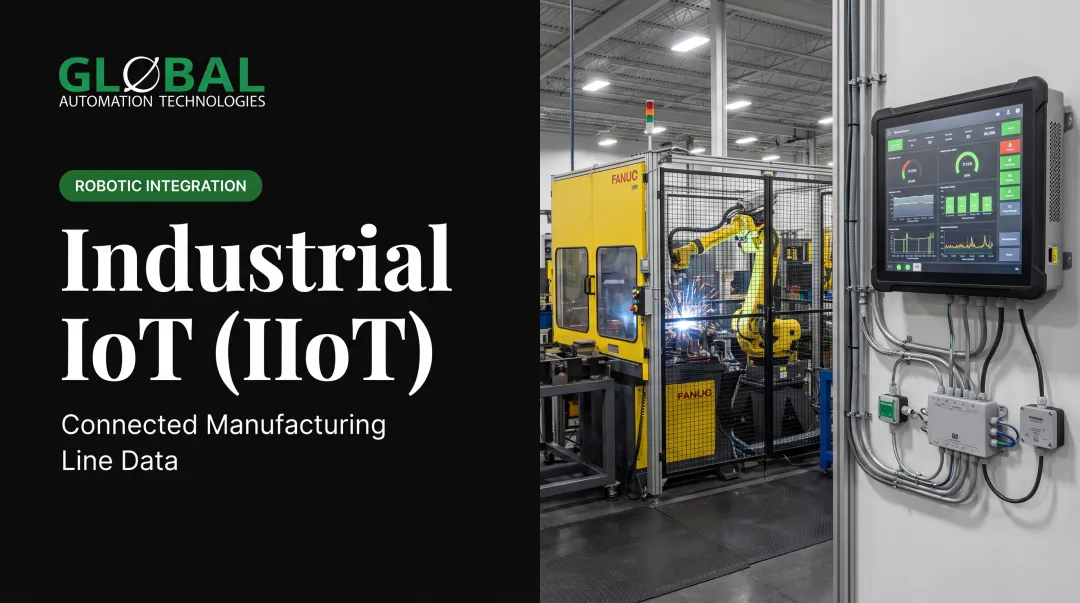
Sensors embedded in machines, robots, and even products themselves generate real-time data across the plant floor. That data is the raw material every other Industry 4.0 technology depends on.
Robotics and Automation
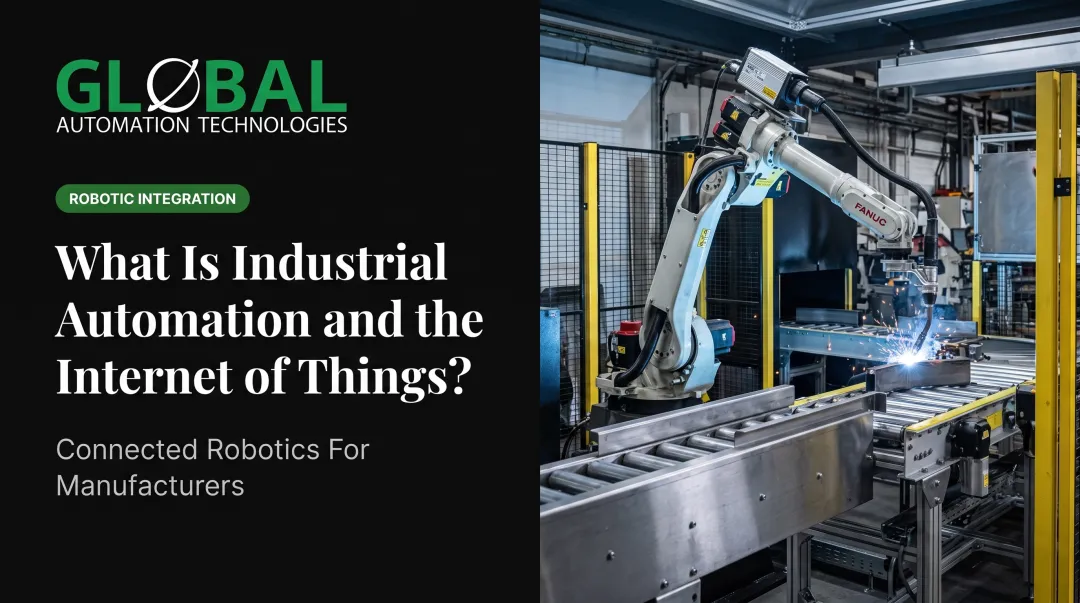
Autonomous and collaborative robots now handle welding, material handling, machine tending, painting, and inspection with minimal human intervention. This is where GLOBAL Automation Technologies operates directly, deploying FANUC-based robotic systems for these exact applications.
- Machine tending cells that load CNC machines, presses, and injection molding equipment
- Robotic painting cells with intrinsically safe FANUC paint robots for hazardous spray environments
- Material handling cells with vision-guided pick-and-place and palletizing
AI, Machine Learning, and Digital Twins
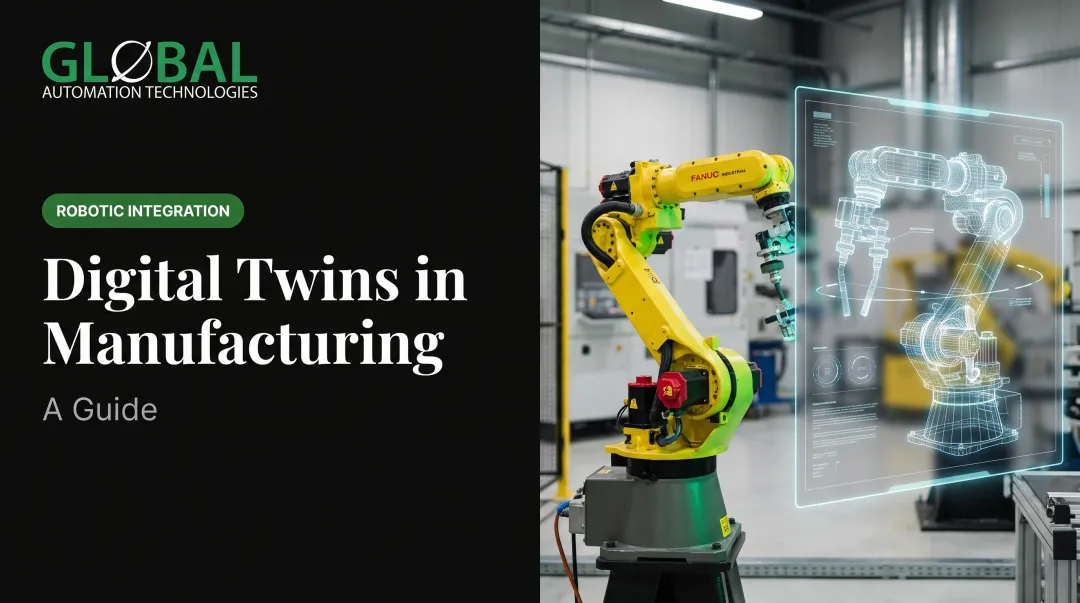
AI-assisted simulation lets engineers model and test robot programs before a single line of code touches the production floor. GLOBAL, which holds Level 5 status in FANUC’s Authorized System Integrator program, reports this compresses robot programming timelines from weeks to days, reducing commissioning surprises.
Siemens customer cases echo the pattern: one reported 50% faster commissioning using digital twins; another reported 30% lower commissioning time.
Predictive Maintenance
AI-driven health assessments flag equipment issues before they cause failure. McKinsey's research on manufacturing analytics puts typical gains at 30-50% less downtime and 20-40% longer machine life. One anonymized McKinsey case cut compressor-related downtime from 14 days to six.
Cloud and Edge Computing
Edge devices process sensor data on the plant floor when milliseconds matter. Cloud platforms aggregate that data so manufacturers can coordinate operations across sites instead of plant by plant.
Cybersecurity
As IT and OT systems merge, the attack surface expands. NIST flags this directly: greater interconnectivity raises the risk of theft, damage, or disruption. Secure network design has to ship with the automation project—not as a retrofit after connect day.
Benefits of Industry 4.0 for Manufacturers
Connected technology only matters if it moves the needle on real plant metrics. Here's where the returns show up:
- Productivity and uptime: Deloitte's survey found average gains of 10-20% in output, 7-20% in employee productivity, and 10-15% unlocked capacity among manufacturers using smart manufacturing tools
- Faster ROI: Robotic machine tending cells typically pay for themselves within 12-18 months through higher spindle utilization and extended unattended operation
- Quality and consistency: Real-time vision inspection catches defects before they move downstream; robotic painting systems hold film build within specification shift after shift
- Workforce safety: Operators leave hazardous environments (isocyanates, VOCs, overspray) and move into higher-value oversight, programming, and inspection roles

For context on scale, the WEF's 2025 Global Lighthouse Network report cited a 31.1% defect reduction at one automotive casting plant and a 35% efficiency gain at a Continental Automotive facility, both from multi-technology Industry 4.0 programs rather than any single tool.
Common Challenges in Industry 4.0 Adoption
Nobody flips a switch and becomes a smart factory overnight. Three obstacles come up repeatedly:
Legacy system integration. Retrofitting older machinery with IoT sensors and connecting it to modern networks takes engineering time and careful planning around production schedules.
Skills gaps. The Manufacturing Institute projects US manufacturers may need up to 3.8 million additional employees between 2024 and 2033, with as many as 1.9 million positions potentially unfilled. Deloitte found 69-72% of manufacturers report moderate-to-significant difficulty hiring for IT, OT, data science, and cybersecurity roles.
Cybersecurity and data volume. Connected factories generate large data volumes and a wider attack surface. Nearly half of manufacturers surveyed on smart-factory priorities named operational risk, cybersecurity included, as their top concern.
These barriers often stack: a plant upgrading legacy equipment still needs people who can deploy and run the new systems. GLOBAL Automation Technologies pairs automation solutions and services with contract, contract-to-hire, and direct-hire technical staffing so manufacturers can tackle the equipment problem and the talent problem through one partner.
Real-World Examples and Applications
Industry 4.0 looks different depending on the vertical, but the underlying pattern is the same: connect equipment, automate repetitive tasks, and use data to catch problems early.
- Automotive and EV manufacturing: Robotic welding, assembly, and painting lines that scale with high-volume production while holding tight tolerances
- Heavy equipment and industrial manufacturers: Machine tending and material handling cells that extend unattended operation through shift changes and overnight runs
- Data center infrastructure manufacturers: Automation of server rack and enclosure assembly as demand for compute infrastructure grows
Published results back this up. WEF's Lighthouse Network found that automotive facilities layering AI vision inspection, digital twins, and process control saw measurable gains at one plant: OEE up 17%, labor productivity up 27%, and defects down over 31%.
A separate Continental Automotive facility combined digital-twin commissioning with intelligent warehousing and reported 35% efficiency gains and 15% better space utilization. Those results come from multiple Industry 4.0 technologies working together across a facility.
Frequently Asked Questions
What is the difference between Industry 4.0 and Industry 5.0?
Industry 4.0 technologies (IoT, AI, robotics, cloud) focus on automation and connectivity. Industry 5.0 builds on this foundation, emphasizing human-machine collaboration, personalization, and sustainability alongside automation.
What are Industry 4.0 examples?
Common examples include predictive maintenance sensors that flag equipment issues early, robotic machine tending cells that run CNC equipment unattended overnight, and digital twins that simulate production lines before rollout.
What are Industry 4.0 standards?
No single global standard exists yet. ISO/IEC 30141 covers IoT reference architecture, ISA/IEC 62443 addresses industrial cybersecurity, and Germany's Plattform Industrie 4.0 provides strategic coordination.
Is Industry 4.0 the same as smart manufacturing?
The terms overlap in everyday use, but NIST distinguishes them: Industry 4.0 is the broader connected ecosystem, while smart manufacturing describes its practical, real-time application on the factory floor.
How much does it cost to implement Industry 4.0 technology?
Costs vary widely by scope. Many manufacturers start with a single robotic cell, such as machine tending, to prove ROI before a full line retrofit. Those cells often pay for themselves in 12 to 18 months.
What industries benefit most from Industry 4.0?
Automotive, heavy equipment, industrial manufacturing, and data center infrastructure sectors see the fastest returns because high-volume, repetitive processes suit automation well.