
For decades, this meant forklifts, pallet jacks, and workers lifting parts by hand. That's changing fast. North American companies ordered 36,766 robots worth $2.25 billion in 2025, up 6.6% in units and 10.1% in value from the year before, and non-automotive buyers accounted for most of that growth. Manufacturers outside the auto industry are investing in automation at a pace that used to be reserved for car plants.
This guide breaks down the types of material handling systems available, where each one fits, the real benefits of upgrading, and how to choose the right mix for your operation.
Key Takeaways
- Material handling options run from manual equipment to mechanical transport and fully robotic cells
- Robotic machine tending raises spindle utilization and supports unattended overnight production
- Match the system to production volume, part characteristics, and facility layout
- Integrators that supply both systems and engineering talent cut implementation risk
What Does Material Handling Include?
MHI defines material handling as "the movement, protection, storage and control of materials and products throughout the process of their manufacture and distribution, consumption and disposal." In practice, that breaks into a few core functions:
- Loading and unloading — getting materials on and off machines, vehicles, or storage
- Transportation — moving materials between stations, cells, or facilities
- Storage — holding raw materials, WIP, or finished goods until needed
- Inventory control — tracking what's where and how much is on hand
- Protection — preventing damage, contamination, or loss during handling
Every material handling decision touches four dimensions: movement (how it gets from A to B), time (how fast it needs to happen), quantity (batch size or unit load), and space (the footprint available). Get any one of these wrong and the whole line slows down.

Manufacturing vs. Warehousing Context
In a manufacturing plant, material handling usually means moving parts between workstations or tending a machine—loading raw stock into a CNC, pulling a finished part off a press.
In warehousing and distribution, the focus shifts to order picking, sorting, and staging for shipment. The equipment overlaps, but the priorities differ: plants optimize for cycle time and machine uptime; warehouses optimize for order accuracy and throughput per labor hour.
The 10 Principles That Guide Decisions
MHI's College-Industry Council on Material Handling Education (CICMHE) outlines 10 principles that still guide equipment selection: planning, standardization, work, ergonomics, unit load, space utilization, system, automation, environment, and life cycle cost.
On a manufacturing floor, these map directly to choices about robotic cells, conveyor layout, and workstation design. Automation and system design are line-level decisions engineers make every week.
Types of Material Handling Systems
Manual and Mechanical Handling
Forklifts, pallet jacks, hand trucks, and carts still have a place. They make sense for low-volume operations, highly variable tasks, or areas where flexibility matters more than speed. A hand pallet jack, for example, is genuinely manual — no motor, just leverage. A forklift, by contrast, is classified by OSHA as a powered industrial truck, not manual equipment, even though a human drives it.
Storage and Positioning Equipment
Racking, shelving, and mezzanines buffer material until it's needed. Lift tables and hoists position that material at the workstation, getting it to the right height and orientation for the next operation. This is the staging layer that sits between storage and active processing.
Automated Systems and Robotic Material Handling
This is where most of the growth is happening. Key technologies include:
- Conveyors — fixed, repeatable transport between stations
- AS/RS (Automated Storage and Retrieval Systems) — precision storage and retrieval with minimal human intervention
- AGVs — guided vehicles following fixed or predefined routes, best for stable, repetitive flows
- AMRs — autonomous mobile robots that navigate dynamically, better suited to layouts that change
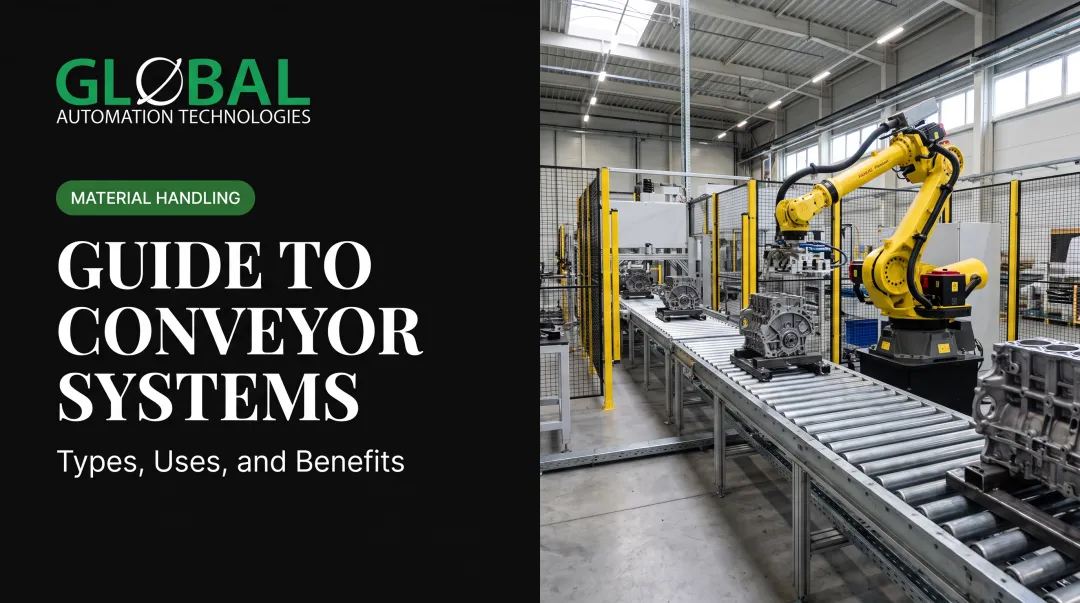
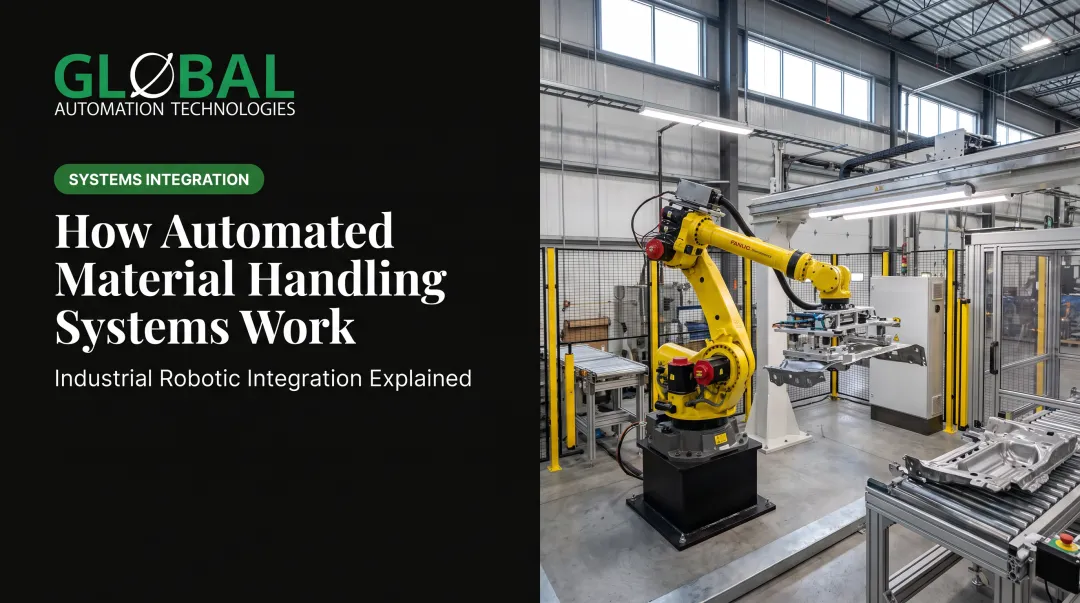
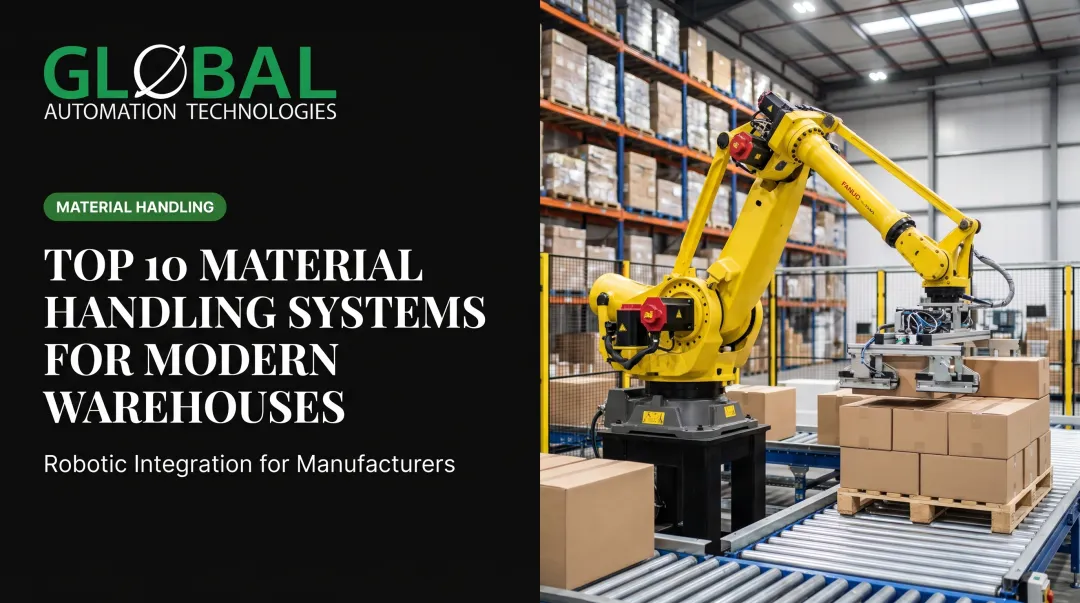
Robotic machine tending is a major subset of this category. A robot loads and unloads a CNC machine, press, or molding cell instead of an operator handling each cycle.
Integrators such as GLOBAL, which holds Level 5 status in FANUC’s Authorized System Integrator program, build these cells on FANUC robots as single-machine setups or multi-machine cells, where one robot serves two or more machines with buffer stations and part tracking. The main gains are:
- Higher spindle utilization (the machine keeps cutting instead of waiting on load/unload)
- Unattended running through breaks, shift changes, and overnight shifts
- Typical payback in 12 to 18 months, based on more parts per shift and lower direct labor
ROI still depends on cycle time, part geometry, and staffing, so treat that range as application-specific rather than universal.

Engineered/Turnkey Systems
Pick modules and fully integrated systems combine multiple handling types into one coordinated line. A turnkey integrator covers the full scope: design, build, controls programming, vision integration, and commissioning. That keeps equipment, software, and line logic under one accountable partner instead of multiple disconnected vendors.
Benefits of Optimized Material Handling
Fewer Injuries, Less Hazardous Exposure
Manufacturing carried a total-recordable incidence rate of 2.7 and a DART rate of 1.7 cases per 100 full-time workers in 2024, according to BLS data. Overexertion and repetitive motion remain leading causes of workplace injury.
Removing operators from repetitive lifting and hazardous tasks addresses this directly. GLOBAL's robotic painting systems, for instance, pull operators out of spray booths entirely, eliminating exposure to isocyanates, VOCs, and overspray particulates. The same logic extends to material handling in bin-picking or heavy-part transfer.

Productivity and Uptime Gains
Robotic machine tending keeps production running through breaks, shift changes, and overnight hours without a human present. A3 reports that tending cells also improve accuracy and repeatability, cutting machining errors and scrap.
Cost Savings
Reduced material damage, less waste, and lower direct labor costs compound over a system's service life. A3's ROI framework models robot ownership against manual labor costs across a 20-year system life, factoring in purchase price, maintenance, and electricity, not just a quick payback snapshot.
Quality Consistency
Vision-guided systems with real-time inspection catch defects before parts move downstream. Defects get caught at the point of handling instead of at final QC, where rework is expensive.
Better Retention
Pulling repetitive, strenuous tasks off workers' plates and reassigning them to inspection, programming, or process improvement improves job satisfaction. Those roles are also easier to fill than repetitive lifting positions.
Industries That Rely on Material Handling Systems
Material handling automation spans a wide range of sectors:
- Automotive and EV manufacturing: high-volume, high-precision requirements
- Heavy equipment: large, heavy components for agricultural, construction, and mining lines
- Aerospace: tight tolerances and smaller batch sizes
- Electronics and data center infrastructure: server racks, enclosures, and power systems
- Food and beverage: sanitary handling requirements
- Warehousing and distribution: order fulfillment at scale
Automotive OEMs and Tier 1 suppliers push the hardest on precision and volume, which is why they're among the most demanding customers for integrators. GLOBAL's core customer base sits squarely here, alongside heavy equipment and general industrial manufacturers.
Semiconductor manufacturing is a distinct case worth calling out on its own. Its automated material handling requirements are so specialized they are covered separately in the FAQ below.
How to Choose the Right Material Handling System
Start with three questions:
- What's your production volume? Low-volume, high-mix work often still favors manual or mechanical handling. High-volume, repetitive work justifies automation.
- What are your part characteristics? Weight, fragility, and geometry all affect whether a robot, conveyor, or AGV makes sense.
- What does your facility layout allow? Fixed conveyors need stable routes; AMRs handle layouts that shift.

From there, run the numbers. Estimate payback by comparing automation costs against current labor and downtime costs. A3's ROI calculator, for example, weighs purchase price, maintenance, and electricity against manual labor rates over a system's full life.
Before committing capital, work with an integrator that can run a facility assessment and build a simulation-based design. GLOBAL's process starts by evaluating existing equipment, cycle times, floor space, and part geometry, then models the cell in simulation before code runs on the plant floor.
AI-assisted simulation compresses that programming timeline from weeks to days, catching problems early instead of during commissioning.
Frequently Asked Questions
What does material handling include?
It covers loading, unloading, transportation, storage, inventory control, and protection of materials throughout manufacturing and distribution. That includes every step a material takes between arriving as raw stock and leaving as a finished product.
What are the 10 principles of material handling?
MHI's principles are planning, standardization, work, ergonomics, unit load, space utilization, system, automation, environment, and life cycle cost. They guide decisions on everything from workstation layout to robotic cell design.
What industries use material handling?
Automotive, EV, heavy equipment, aerospace, electronics, food and beverage, and warehousing all rely heavily on material handling systems. Automotive OEMs and Tier 1 suppliers tend to have the most demanding requirements due to volume and precision needs.
What is AMHS in the semiconductor industry?
AMHS stands for Automated Material Handling System, the network of overhead hoists, AGVs, conveyors, and stockers that transport wafers in FOUPs between fab tools. It maintains cleanroom precision and supports continuous fab operation between scheduled maintenance windows.
How much does a robotic material handling system cost?
Cost varies widely by application, part complexity, and cell scope. GLOBAL's machine tending cells typically pay for themselves within 12 to 18 months through added throughput and reduced labor hours.
What is the difference between material handling and material flow?
Material handling refers to the equipment and actions used to move, store, and protect materials. Material flow describes the overall pattern and efficiency of that movement across the whole production process.