
Introduction
In manufacturing facilities across North America, robots equipped with advanced vision systems now achieve placement accuracy within 100 micrometers—roughly the width of a human hair—while inspecting millions of data points per second. That level of precision lets factories automate quality control, part recognition, and assembly work that once depended on human judgment.
At the same time, manufacturers must raise quality and output while contending with a projected shortage of 1.9 million unfilled manufacturing positions through 2033. Machine vision robotics is already closing that gap: a CNC machine-tending deployment increased production from 100 to over 150 parts per shift with the same labor and paid back in 33 weeks.
This article covers how vision-guided robots work, where they deliver ROI on the plant floor, and what it takes to deploy them successfully.
Key Takeaways
- Vision systems let robots identify, locate, and inspect parts in real time—without relying on human sight
- Plants see clear ROI in weld checks, 20–24 hour untended machine tending, and in-line dispense bead validation
- Cameras, processors, and ML models must integrate cleanly with robot controllers, PLCs, and production systems
- AI-assisted simulation cuts vision-guided robot programming from weeks to days before install
What Is Industrial Machine Vision in Robotics?
Industrial machine vision enables robots to acquire, process, and interpret visual information so they can make automated decisions on the plant floor. Cameras and sensors become perception systems that guide robots through tasks traditional automation cannot handle:
- Recognizing parts regardless of orientation
- Inspecting products at production line speeds
- Tracking moving assemblies in real time
- Adapting to part-to-part variation that would stop a fixed program
Machine Vision vs. Computer Vision
Though often used interchangeably in robotics, "machine vision" typically means industrial applications with specialized cameras and controlled environments. "Computer vision" is the broader AI field of analyzing images and video in any setting.
Modern industrial systems blend both. They use rule-based image processing for speed and reliability, and deep learning models when object recognition gets complex.
How Vision-Guided Robots Work
The workflow follows three core steps:
- Visual data capture - Industrial cameras and sensors record 2D images or 3D point clouds of parts, assemblies, or work areas
- Image processing and analysis - Edge computers or integrated controllers analyze predefined features, detect objects, measure dimensions, or run deep learning inference—often in 20-100 milliseconds for simple inspections
- Decision-making and robot action - Vision results trigger robot movements, quality decisions, or process adjustments in real time

That closed loop is what lets vision-guided robots keep running when parts shift, lighting changes, or mix changes—conditions that stop rigid, pre-programmed cells.
Core Applications of Machine Vision in Industrial Robotics
Autonomous Navigation and Path Planning
Vision-guided mobile robots navigate factory floors by building real-time maps with SLAM (Simultaneous Localization and Mapping) algorithms.
ABB's visual SLAM technology combines AI with 3D vision to guide autonomous mobile robots (AMRs) accurately in dynamic plants—where layouts shift, obstacles appear, and lighting changes through the day.
Typical applications include:
- Automated material transport - AMRs deliver parts between workstations, eliminating manual tugger routes
- Inspection tasks - Mobile robots equipped with cameras patrol large facilities to monitor equipment status and detect anomalies
- Just-in-time delivery - Vision-guided vehicles supply components to assembly lines based on production demand
These systems reduce labor requirements for repetitive material movement while improving delivery consistency and freeing human workers for higher-value tasks.
Object Detection, Recognition, and Localization
Deep learning models trained on thousands of part images enable robots to identify specific components regardless of orientation, lighting conditions, or positioning variations. Supervised object detection and image segmentation techniques allow robots to handle parts arriving randomly on conveyors, stacked in bins, or presented on pallets without precise upstream fixturing.
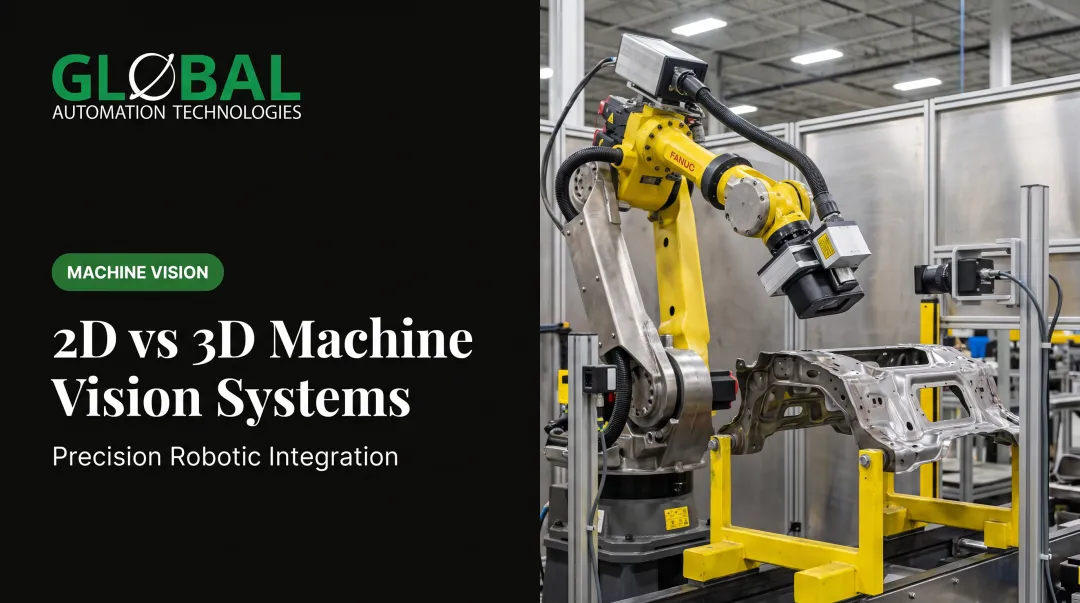
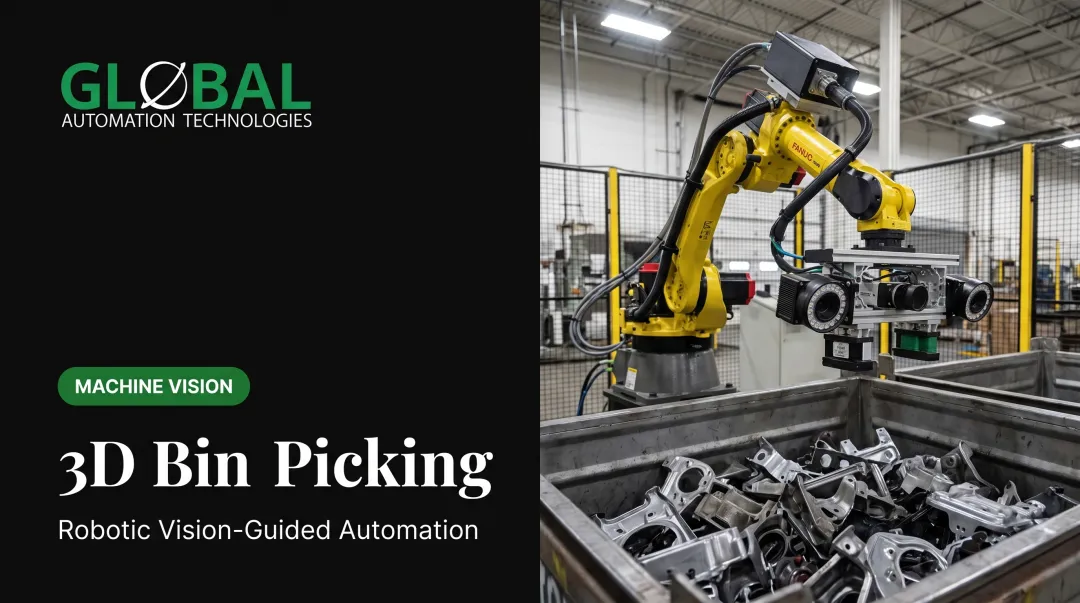
3D vision adds the depth perception 2D cameras lack. While 2D systems recognize what an object is, 3D cameras determine precise location and orientation for robotic grasping. That depth data is essential for bin picking, assembly insertion, and machine loading, where millimeter-level accuracy decides success.
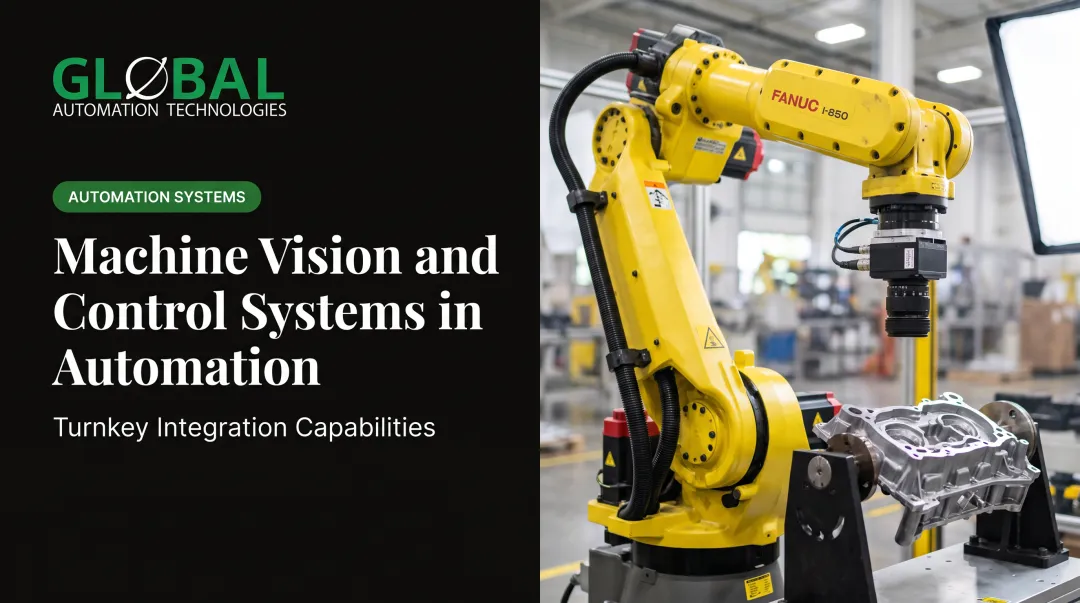
GLOBAL, a top-tier Level 5 FANUC Authorized System Integrator, integrates FANUC iRVision and 3D area sensors into material handling cells, enabling robots to identify parts regardless of orientation, support random bin picking, and verify component position during machine tending and assembly operations.
Quality Inspection and Defect Detection
Vision systems inspect products for defects, dimensional accuracy, surface finish, completeness, and correct assembly at speeds human inspectors cannot match.
ABB's 3D inspection robot cell scans millions of data points per shot and performs quality control testing 10 times faster than traditional coordinate measuring machines (CMMs), with accuracy below 100 micrometers.
Industrial applications include:
- Dimensional verification - Measuring critical features to ensure parts meet specification
- Surface defect detection - Identifying scratches, dents, contamination, or finish inconsistencies
- Assembly completeness - Confirming all components are present and correctly installed
- Weld quality verification - Inspecting bead size, penetration, and joint integrity
Robot-mounted inspection cells bring metrology directly to the production line, eliminating the bottleneck of moving parts to separate quality labs and enabling 100% inspection rather than statistical sampling.

Robotic Guidance for Precision Tasks
Machine vision guides robots through operations demanding real-time adaptation:
- Robotic welding - Seam tracking detects joint gaps as small as 0.1 mm and corrects the path in real time for part variation and thermal distortion
- Dispensing and sealing - Vision validates bead width, placement, and continuity as robots apply adhesives and sealers on complex 3D paths
- Painting - Vision flags finish defects in-process; GLOBAL's robotic painting systems pair that feedback with film build held within specification
- Assembly - Vision verifies component presence and orientation before insertion, even when parts arrive in varying positions
General Motors deployed FANUC robots with 3M AI technology for moving-line topcoat inspection and repair, improving consistency and reducing costs by automating a task previously performed manually on stationary vehicles.
Machine Tending and Material Handling
Vision enables robots to load and unload CNC machines, presses, and molding equipment while adapting to variations in part presentation. The technology excels at bin picking—identifying correct parts from mixed bins and retrieving them regardless of orientation—a task that stymied traditional automation for decades.
Measurable outcomes: A 2023 machine-tending deployment using FANUC robots achieved:
- 150+ parts per 8-hour shift, up from 100 parts with the same labor
- 20-24 hours per day machining through breaks, shift changes, and overnight periods
- 33% higher production efficiency
- 33-week return on investment
Vision-guided machine tending delivers ROI by maximizing spindle utilization—keeping expensive CNC equipment cutting parts instead of waiting for manual loading—while eliminating the ergonomic burden of repetitive part handling.

Key Technologies Enabling Vision-Guided Robotics
Cameras and Sensors
Different vision tasks demand different sensor technologies:
2D cameras capture flat images for basic recognition, barcode reading, and pattern matching. They excel at high-speed inspection where depth information isn't required.
3D cameras deliver depth perception for assembly, measurement, and robotic guidance. Time-of-flight sensors measure how long light takes to bounce back from a surface. That depth data lets robots grasp randomly oriented parts and work around complex geometries.
LiDAR (Light Detection and Ranging) creates detailed 3D maps of large areas, essential for autonomous mobile robot navigation in manufacturing facilities where AMRs must avoid forklifts, people, and changing obstacles.
Industrial-hardened systems protect sensitive optics in harsh environments. Basler's IP67-rated cameras capture precise images despite exposure to dust, water, and coolant spray common in metalworking and fabrication.
Edge Computing and Processing Hardware
Real-time capability demands low-latency processing at the robot location. Edge computers analyze visual data on the factory floor rather than sending it to remote servers. That local processing supports immediate decisions when robots must react to moving parts or changing conditions in milliseconds.
Processing hardware runs:
- Feature extraction algorithms that identify edges, shapes, and patterns
- Object detection models that locate specific parts within complex scenes
- Quality inspection routines that compare captured images against known-good references
- Coordinate transformations that convert camera coordinates into robot motion commands
Vision systems integrate with robots, PLCs, conveyors, and other automation, coordinating actions across the entire production cell rather than operating in isolation.

AI and Machine Learning Models
Modern vision systems increasingly rely on deep learning, particularly convolutional neural networks (CNNs) trained on manufacturing data. Industrial deep learning workflows follow a structured cycle:
- Training: Engineers label hundreds or thousands of images showing parts, defects, or assembly states
- Validation: The model is tested against new images to verify accuracy before deployment
- Inference: The trained model analyzes production images in real time, classifying parts or detecting anomalies
Unlike traditional rule-based vision that requires engineers to manually define inspection criteria, machine learning models improve as they see more examples. They still need human oversight for retraining with newly labeled data, not autonomous self-improvement.
Before those models hit the floor, simulation closes the gap between training and live cells. GLOBAL uses AI-assisted simulation to optimize robot programs before physical deployment, cutting programming time from weeks to days by testing vision-guided sequences virtually.
Industry Applications and Real-World Results
Automotive Manufacturing and EV Production
Vision robotics is embedded across automotive production:
- Body-in-white welding - Vision identifies seams, guides welding torches along joints, and verifies weld quality on complex assemblies
- Paint quality verification - Inspection systems detect runs, sags, dirt contamination, and coverage issues before vehicles reach final assembly
- Component traceability - Vision systems support AIAG CQI-28 traceability requirements, documenting part serial numbers and assembly data throughout production
GLOBAL integrates vision into automotive painting, dispensing, and assembly cells. Systems validate bead width and placement for seam sealers, adhesives, and protective coatings while holding sub-millimeter path accuracy across complex 3D body-panel contours.
Heavy Equipment and Fabrication
Large components in construction, agricultural, and mining equipment manufacturing create distinct conditions for vision systems:
- Parts arrive with greater size variability than typical automotive stampings
- Cameras face welding flash, metal debris, and harsh cell environments
- Work cells must fit oversized assemblies that are costly to move
Robot-mounted 3D inspection addresses these conditions by bringing metrology to the part instead of hauling massive components to a separate quality lab. In documented deployments, that approach has cut quality-control testing time by as much as ten times. Industrial-grade cameras in protective housings hold up in fabrication environments while delivering inspection accuracy below 100 micrometers.
GLOBAL engineers vision-guided welding cells for heavy industry, using seam tracking to compensate for joint variations and thermal distortion while verifying weld penetration and bead geometry on structural assemblies.
Tier 1 Supplier Operations
Tier 1 automotive suppliers manufacture diverse components in high-mix environments where production runs change frequently. Vision robotics enables rapid changeovers by eliminating the fixed tooling and precise part presentation traditional automation demands.
Adaptive part recognition lets the same robotic cell handle multiple component variants without extensive reprogramming. Vision systems identify which part entered the cell, retrieve the matching robot program, and adjust handling to that geometry. The result is flexible work cells that still meet automotive OEM requirements for quality documentation and traceability.
GLOBAL's vision-enabled material handling integrates FANUC iRVision for random bin picking and structured placement, reducing fixturing requirements while supporting the product variety Tier 1 operations require.
Emerging Applications Beyond Automotive
Vision robotics expands into growth sectors demanding precision automation.
Battery assembly is a clear example. An A3 case study documents a battery line upgrade that combines Siemens PLCs, ABB robots, RFID, and vision systems on one platform. In that environment, vision supports precise component handling, cell-placement inspection, and full assembly traceability.
Manufacturers in data center infrastructure, energy storage, and related sectors face the same quality and flexibility pressure. The inspection, path guidance, and traceability methods proven in automotive and heavy industry transfer directly to those lines.
Implementing Machine Vision Robotics: What Manufacturers Need to Know
Assess Current Operations for High-Value Applications
Vision robotics delivers the clearest ROI where manufacturers face specific challenges:
- Repetitive tasks with variation - Parts arrive in different orientations, requiring human judgment to locate and orient
- Quality bottlenecks - Inspection capacity limits throughput or high defect escape rates drive warranty costs
- Ergonomic challenges - Workers perform physically demanding handling, loading, or inspection tasks
- High scrap and rework rates - Manual processes produce inconsistent results or miss defects until downstream operations
The 2023 FANUC machine-tending case combined several factors (labor shortage, repetitive loading/unloading, long machine-running hours, and 1,500 parts per week) to produce a 33-week payback. Successful implementations start by identifying where automation will solve concrete operational problems before any equipment is specified.
Integration Requirements
Production layout - Vision cells require adequate space for robot reach, camera field of view, part staging, and safety guarding. Engineers evaluate existing floor plans to determine whether automation fits within current constraints or requires layout modifications.
Lighting design - Consistent illumination ensures reliable image capture; LED lighting systems eliminate the flicker and color shift that can degrade vision performance.
Plant control systems - Vision integrates with PLCs, SCADA, and MES platforms to coordinate robot actions with conveyors, quality data collection, and production tracking—including trigger signals, fault handling, emergency-stop coordination, and bidirectional data exchange.
Robot positioning and reach - Camera placement, part presentation, and robot mounting all affect what the vision system can see and where the robot can work. Engineers use 3D simulation to verify the robot can access all required positions without collisions or singularities.
Simulation and Offline Programming
AI-assisted simulation models robot programs, tests scenarios, and optimizes motion before physical deployment. Offline programming can reduce robot programming time significantly. Engineers validate vision-guided pick sequences, verify clearances, optimize cycle times, and surface integration issues in the model instead of during production downtime.
GLOBAL uses AI-assisted engineering tools to cut programming time from weeks to days, enabling faster startups with fewer commissioning surprises while freeing engineers to focus on complex integration challenges.
Deployment Phases
Successful implementations follow a structured path:
- Process study and feasibility - Evaluate workflows, cycle times, ROI, and implementation timeline before committing capital
- Engineering and simulation - Design the system, select components, and test robot programs offline
- Build and integration - Assemble the cell, install cameras and sensors, integrate controls, and configure software
- Commissioning and validation - Install on the production floor, verify performance against quality standards, and document results
- Training and production ramp - Train operators for monitoring and exception handling, then ramp to full production volume

Throughout deployment, manufacturers need both the robotic system and the engineering talent to deploy and maintain it. GLOBAL's dual model delivers both: its engineering services designs and integrates vision-guided automation while its technical staffing supplies controls engineers, robot programmers, and commissioning specialists for ongoing support (contract, contract-to-hire, or direct placement).
Frequently Asked Questions
How is machine vision used in robotics?
Machine vision lets robots capture and interpret images through cameras and sensors. That supports navigation, object recognition, quality inspection, and precision guidance without relying on human eyesight for every decision.
Is machine vision considered AI?
Modern systems often use AI and machine learning, including deep learning for object recognition. Traditional machine vision can still run on rule-based image processing alone. Most industrial setups combine both for speed and flexibility.
What's the difference between machine vision and computer vision in robotics?
"Machine vision" usually means industrial cameras and controlled lighting built for manufacturing tasks. "Computer vision" is the broader field of computers interpreting visual data. In robotics, people often use the terms interchangeably.
What ROI can manufacturers expect from machine vision robotics?
ROI depends on the application. One documented machine-tending case hit a 33-week payback via higher spindle use, more parts per shift, and 20–24 hour unattended runs. Inspection systems pay back through less scrap, rework, and warranty cost.
What are the key components of a machine vision system for industrial robotics?
Core pieces are industrial cameras and sensors, consistent lighting, processing hardware for real-time analysis, models or rules that interpret the image, and a link to the robot controller so the cell can act on what it sees.
How long does it take to implement a machine vision robotics system?
Timelines usually run from a few weeks to several months, based on cell complexity. AI-assisted simulation and offline programming let teams test paths virtually first, which can cut robot programming from weeks to days.
Vision-guided robotics turns common plant constraints into clearer results: higher throughput, steadier quality, safer cells, and people moved onto higher-value work. Fixed automation cannot match that mix of speed and changeover flexibility when SKUs or fixtures shift.
GLOBAL Automation Technologies brings 17+ years of robotics integration, AI-assisted engineering tools, and technical staffing into one turnkey path—from feasibility through commissioning, training, and support. Contact GLOBAL at +1 (810) 877-0329 or info@globalat.com to talk through machine vision robotics for your line.