
Introduction: Understanding the Final Stage of Manufacturing
Most manufacturers devote enormous energy to refining their production processes—optimizing assembly lines, accelerating machine cycles, and cutting every second from mid-line operations. Yet many overlook the final 20-30% of the manufacturing journey: the packaging, labeling, palletizing, and shipping preparation stage where finished products meet outbound logistics.
That oversight is costly. Manual end-of-line (EOL) processes create persistent bottlenecks, quality inconsistencies, and safety hazards. As order volumes climb and skilled labor becomes harder to find, these inefficiencies compound.
A single mislabeled shipment can trigger chargebacks. A poorly stacked pallet can result in damaged inventory. Workers performing repetitive lifting tasks face mounting injury risk. Meanwhile, production lines upstream sit idle, waiting for the final station to catch up.
This article explains what end-of-line automation is, how it works, what it delivers, and how manufacturers can implement it strategically to eliminate these final-stage constraints.
Key Takeaways
- End-of-line automation covers packaging, labeling, inspection, palletizing, and shipping prep after production
- Robotics, conveyors, vision systems, and integrated controls remove bottlenecks and raise throughput
- Most manufacturers see ROI in 12–24 months via lower labor costs, fewer errors, and higher capacity
- Start with one high-impact station (such as robotic palletizing) to prove value before full-line rollout
What Is End-of-Line Automation?
End-of-line (EOL) automation refers to integrated systems of machinery, robotics, and software that handle the final stages of production. These systems package finished products, apply labels and batch codes, inspect quality, palletize loads, and prepare goods for outbound shipment.
They sit downstream of primary and secondary manufacturing, typically covering the last 20-30% of the production line before goods leave the facility.
Where EOL Fits in the Manufacturing Workflow
EOL automation begins where manufacturing ends. Once a product completes assembly, curing, or final inspection, it enters the EOL zone for post-production material handling. Here, the system:
- Forms and seals shipping cartons
- Applies barcodes, shipping labels, and regulatory markings
- Verifies packaging completeness and label accuracy
- Stacks cases onto pallets in optimized patterns
- Routes loads to staging areas or loading docks
This final stage connects production output to outbound logistics, ensuring products ship on time, intact, and correctly labeled.

Unlike mid-line automation, which focuses on in-process tasks like welding, assembly, or coating, EOL automation centers on post-production material handling, packaging integrity, shipping preparation, and outbound logistics. The goal shifts from making the product to protecting it, documenting it, and moving it efficiently into the supply chain.
The Evolution from Manual to Automated EOL
Historically, teams of workers manually packed boxes, applied labels by hand, and built pallets one case at a time. That approach worked at low volumes but struggled to scale.
Manual processes introduce real costs:
- Inconsistent pallet patterns and misplaced labels
- Packaging errors and slower throughput
- Repetitive lifting, bending, and twisting that drive fatigue and injury
Today, integrated robotic systems perform these tasks faster, more consistently, and with greater precision. Articulated robots stack pallets without breaks. Vision systems verify every label. Automated sealers form perfect cartons every cycle. The result: higher output, fewer errors, and safer working conditions.
Market Growth and Adoption
The global end-of-line packaging market was valued at $6.15 billion in 2024 and is forecast to reach $9.67 billion by 2035, a 4.21% compound annual growth rate (Market Research Future, 2026).
In a PMMI survey of 119 CPG representatives, 55% identified packaging and processing as the most useful area for automation, while 35% reported that secondary packaging remained highly manual (PMMI via Packaging World, 2022).
With U.S. manufacturers potentially facing 1.9 million unfilled positions through 2033 (Deloitte and The Manufacturing Institute, 2024), automation offers a path to maintain output without expanding headcount.
Core Components of End-of-Line Automation Systems
Modern EOL systems integrate multiple technologies into a coordinated workflow. Each component plays a specific role in moving products from production to pallet.
Robotic Material Handling and Palletizing Systems
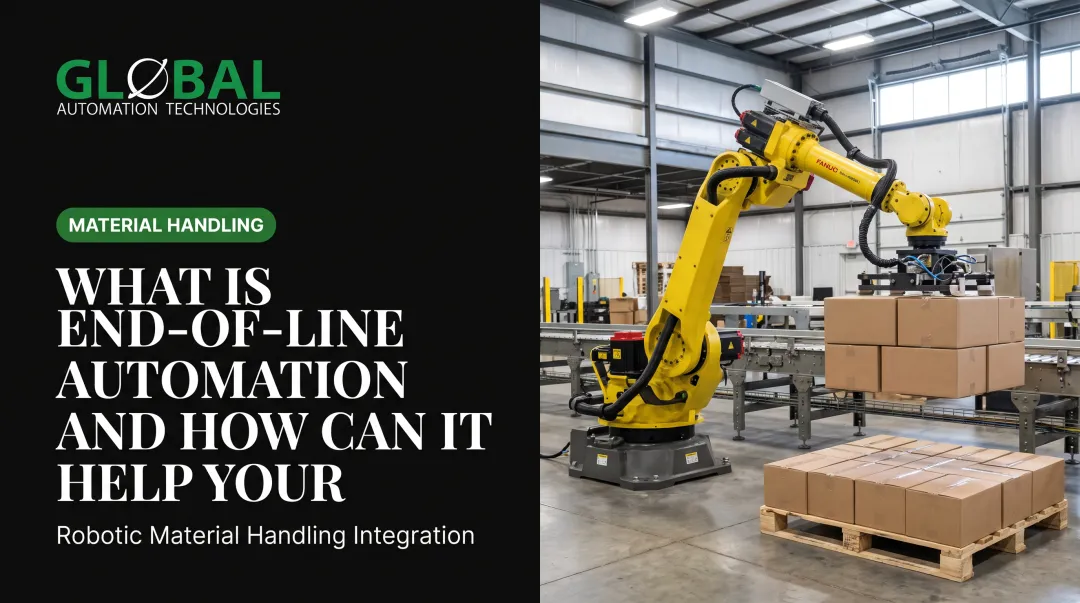
Industrial robots, typically articulated 6-axis arms, pick, orient, and stack products onto pallets with precision. These robots handle varied product sizes, weights, and stacking patterns, optimizing load stability for transport.
Key capabilities:
- Payload ranges from 20 kg to 800 kg, depending on model (Yaskawa Motoman)
- Speeds up to 25 cases per minute for articulated systems (Columbia/Okura)
- Programmable pallet patterns for different SKUs and shipping configurations
- Ability to serve up to four production lines simultaneously

Case Erecting and Sealing Equipment
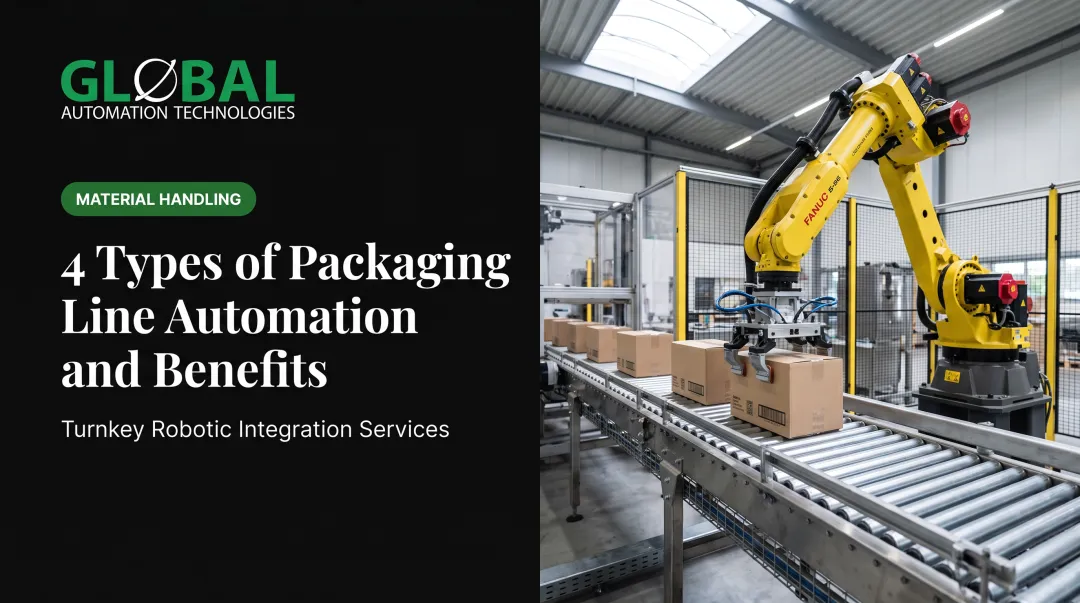
Automated machinery forms flat cardboard into boxes, loads products, and seals cartons with tape or hot-melt adhesive. This eliminates manual box assembly and ensures consistent package integrity.
Typical specifications:
- Entry-level case erectors: up to 15 cases per minute (Pearson Packaging, 2024)
- High-speed case sealers: 25-42 cases per minute, depending on case length (Pearson Packaging)
- Automatic size adjustments for different carton dimensions
Labeling and Marking Systems
Automatic label applicators print and place shipping labels, barcodes, batch codes, and regulatory marks onto packages at high speed.
Performance benchmarks:
- High-speed systems: up to 200 m/min or 2,000 labels per minute (HERMA)
- Sub-millimeter placement tolerances for consistent label positioning
- Integration with barcode verification and print-quality inspection
Vision Inspection and Quality Control
Camera-based systems using machine vision and AI verify packaging completeness, detect defects, confirm label accuracy, validate barcodes, and ensure products meet quality standards before shipping.
Proven results:
- At Federal Package, Cognex vision systems inspected deodorant packs at 80 units per minute for filling drips and verified labels at 60 units per minute, achieving greater than 99% defect-catching accuracy (Cognex)
- Inspect every unit on the line, a coverage level manual checks cannot match
- Divert non-conforming packages before they reach palletizing
Conveyor and Material Transport Networks
Integrated conveyor systems move products between EOL stations, synchronize equipment timing, and route items to appropriate packing, labeling, or palletizing zones.
Conveyor types include:
- Belt conveyors for gentle product handling
- Roller conveyors for heavier loads
- Chain conveyors for rugged environments
- Accumulation zones to buffer flow between stations
Warehouse Control Systems (WCS) and Software Integration
Control software coordinates all EOL equipment, manages work orders, tracks production in real-time, collects performance data, and integrates with upstream WMS/ERP systems for complete visibility.
Core functions:
- Synchronize robot, conveyor, and packaging equipment
- Route products based on SKU, destination, or priority
- Capture throughput, downtime, and quality metrics
- Provide dashboards for operational monitoring
Benefits of End-of-Line Automation for Manufacturers
EOL automation improves throughput, cost, quality, safety, and flexibility in ways that show up on the plant floor and the P&L.
Higher Throughput and Productivity
Automated systems operate continuously at consistent speeds—often 2-4x faster than manual processes. They eliminate shift breaks, fatigue, and variability, so manufacturers can fulfill more orders without expanding floor space or headcount.
Real-world impact:
- Napco reported a 15% throughput increase after deploying collaborative robots with palletizing solutions (Robotiq)
- A certified FANUC integrator documented that one operator could supervise 3-5 automated palletizing cells (Motion Controls Robotics)
Lower Operating Costs
Automation lowers labor expense and trims the hidden costs that pile up at the end of the line:
- Reduces the need for 3-10+ workers per line
- Decreases material waste through precise packaging application
- Cuts damaged products in transit
- Lowers workers' compensation claims from repetitive-stress injuries
ROI example:
Cascade Coffee achieved a 9-month payback on its palletizing investment, beating an expected payback of under two years through higher-than-expected uptime and consistent throughput (Robotiq, 2025).
A separate integrator case study reported 40% lower labor requirements after automation (Motion Controls Robotics). Most manufacturers see ROI within 12-24 months, though results vary by application and facility.

Consistent Quality and Fewer Errors
Machines perform identical operations every cycle, eliminating human variability in package weights, label placement, and pallet patterns. That consistency reduces shipping chargebacks, customer complaints, and returned products.
Federal Package's automated vision inspection caught more than 99% of defects across every unit, a level of scrutiny manual inspection cannot sustain (Cognex).
Safer Workplaces
Automation removes workers from repetitive lifting, awkward postures, and physically demanding tasks that cause musculoskeletal injuries.
Transportation and material-moving occupations had the highest number of days-away, job-restriction, or job-transfer cases in BLS data, with a median 20 days of job transfer or restriction (U.S. Bureau of Labor Statistics, 2023).
OSHA confirms that heavy lifting, bending, reaching, and repetition raise MSD risk, and that ergonomics can reduce the number and severity of these injuries (OSHA).
Scalability and Operational Flexibility
Modern EOL systems can be quickly reprogrammed for different product sizes, packaging formats, and pallet patterns. Manufacturers can respond to seasonal demand spikes, new product launches, or customer-specific requirements without major reconfiguration.
Real-Time Data and Performance Visibility
Automated systems capture detailed metrics on throughput rates, downtime causes, quality defects, and equipment efficiency. Those metrics support continuous improvement and predictive maintenance planning.
Industries That Benefit Most from End-of-Line Automation
While EOL automation applies broadly, three industries see particularly strong returns.
Automotive and Heavy Equipment Manufacturing
OEMs and Tier 1 suppliers packaging components, assemblies, and aftermarket parts benefit from robotic palletizing. These systems handle varied part geometries, weights up to hundreds of pounds, and complex packing requirements for just-in-time delivery schedules.
GLOBAL Automation Technologies, a Level 5 FANUC Authorized System Integrator, supports automotive OEMs and Tier 1 suppliers across body shop, paint, powertrain, and final assembly with FANUC-based material handling—pick-and-place, part transfer, conveyor integration, palletizing, and depalletizing.
Food and Beverage Production
High-volume operations require hygienic handling, rapid changeovers between product SKUs, precise weight verification, and regulatory-compliant labeling. EOL automation maintains food safety standards while meeting peak seasonal demands.
One example: Cascade Coffee deployed six cobot palletizers across its lines, with output ranging from about 2,500 to 6,500 cases per day (Packaging World, 2026).
Consumer Packaged Goods (CPG)
Manufacturers of household products, personal care items, and retail goods face multiple SKUs, frequent promotional packaging changes, and high daily volumes. Speed, flexibility, and consistent retail-ready presentation are critical competitive advantages.
PMMI's 2024 secondary-packaging report frames SKU proliferation, rapid changeover, and machinery flexibility as linked requirements (PMMI, 2024).
Implementation Considerations and Challenges
EOL automation delivers strong returns, but successful implementation requires careful planning.
Upfront Capital Investment and ROI Planning
EOL automation requires significant initial expenditure for equipment, integration, and installation. Manufacturers should run a cost-benefit analysis that compares current labor and error costs with the automation investment.
Budgetary cost ranges (for approximately 20 cases per minute):
- Robotic case packing: $150,000-$300,000+
- Robotic palletizing: $200,000-$400,000+
- Manual-setup case erector: $35,000-$65,000+
- Random case erector: $150,000+
- Combined robotic EOL solution: $750,000 or more, depending on project parameters (Motion Controls Robotics)
Integration Complexity with Existing Systems
Connecting new automated equipment to legacy production lines, ERP systems, and existing facility layouts takes careful planning and expert systems integration. Installation can disrupt production, so schedule downtime windows early.
Conveyor-layout requirements add cost. Stainless or washdown construction can raise the price significantly.
Ongoing Maintenance and Technical Support Requirements
Automated systems need ongoing operational support:
- Preventive maintenance schedules and spare parts inventory
- Technicians skilled in robotics, pneumatics, controls, and mechanical systems
- Internal expertise—or a partner that provides ongoing technical support
Plan for these needs before go-live so uptime does not depend on ad-hoc fixes.

Workforce Transition and Skills Development
Implementation also needs change management. Address employee concerns early, retrain operators for equipment operation and maintenance, and redeploy workers from manual tasks into higher-value roles such as quality oversight and continuous improvement.
How to Get Started with End-of-Line Automation
A structured approach minimizes risk and gets results faster.
Conduct a Thorough Assessment of Current EOL Processes
Map your existing workflow from finished product to loaded truck, then:
- Flag bottlenecks: slowest stations, highest error rates, and safety incidents
- Quantify labor costs and throughput limits
- Rank processes by ROI potential for automation
Start with Targeted, High-Impact Automation
Rather than attempting full-line automation immediately, begin with the single biggest pain point: often robotic palletizing for heavy or repetitive lifting, or automated labeling where errors cause costly shipping mistakes. Proving value with one station builds confidence and funds for expansion.
Timeline example:
One integrator reported delivery in approximately 2-3 months from order, followed by one week for installation, startup, and commissioning for a modular palletizing cell (Motion Controls Robotics).
Partner with Experienced Automation Integrators
Work with systems integrators who know your industry and can design around existing equipment. Favor partners who deliver turnkey implementation (engineering, installation, programming, commissioning) and ongoing technical support.
If you need both the robotic system and the people to run it, GLOBAL Automation Technologies pairs automation solutions, services and technical staffing under one roof. That model covers FANUC-based palletizing, pick-and-place, conveyor integration, and vision-guided handling, plus controls engineers, robot programmers, and commissioning support on contract, contract-to-hire, or direct-hire terms—from feasibility through ongoing maintenance.
Frequently Asked Questions
What does "end-of-line" mean in the context of manufacturing?
End-of-line refers to the final stage of production where finished products are packaged, labeled, quality-checked, palletized, and prepared for shipment: everything that happens after the product is manufactured but before it leaves the facility.
How much does end-of-line automation typically cost?
Costs vary widely based on system complexity and scale, ranging from $50,000-$150,000 for single automated stations like a robotic palletizer to $500,000-$2+ million for complete integrated EOL systems. Most manufacturers see ROI within 12-24 months.
What's the difference between end-of-line and mid-line automation?
Mid-line automation handles production processes like assembly, welding, dispensing, or painting during manufacturing, while end-of-line automation specifically addresses post-production tasks like packaging, labeling, and shipping preparation.
Can end-of-line automation integrate with our existing production equipment?
Modern EOL systems are designed for integration with existing production lines through standard conveyor interfaces, communication protocols, and control systems. Integration complexity depends on the age and type of current equipment.
How long does it take to implement end-of-line automation?
Timeline varies from 3-6 months for single-station automation (equipment procurement, installation, programming, and testing) to 12-18+ months for complex full-line systems. Careful planning and phased implementation help minimize production disruptions.
Do we need specialized staff to operate EOL automation systems?
Basic operation can be learned quickly with proper training. Getting full performance from the system takes expertise in robotics, controls, and preventive maintenance. That usually comes from internal training or a technical staffing partner who can supply automation engineers.