
The answer is the articulated robot arm, the most common industrial robot design on the market. Built on a series of rotary joints, it's engineered specifically to mimic the reach and dexterity of a human arm. This article covers what defines an articulated robot, how its anatomy works, where it's used, what it costs, and how to pick the right partner to build one.
Key Takeaways
- Articulated robots use rotary joints (axes) to mimic human arm motion, typically on 4 to 6+ axes
- Widest motion range of any industrial robot type for welding, handling, assembly, and machine tending
- Full turnkey projects often run $100,000+ once integration, tooling, and safety are included
- Integrator expertise matters as much as robot brand for uptime, cycle time, and ROI
What Is an Articulated Robot Arm?
An articulated robot is a manipulator built with three or more rotary joints, each called an axis. Every axis adds a degree of freedom, giving the arm more ways to bend, twist, and position itself in space. The International Federation of Robotics defines it as a robot that is automatically controlled, reprogrammable, and capable of movement across three or more axes.
Most industrial articulated robots run 4 to 6 axes, with six-axis models being the standard. A six-axis configuration provides complete freedom of movement in three-dimensional space, according to the Association for Advancing Automation (A3). That full range of motion is why six-axis arms became the default for complex tasks.
Each joint is driven by a servo motor, giving engineers precise control over speed and position at every point in the motion path. The overall structure (base, shoulder, arm, and wrist) is designed to echo human anatomy, which gives these robots their reach and dexterity.
Major manufacturers building articulated robots include:
- FANUC
- Yaskawa Motoman
- ABB
- KUKA
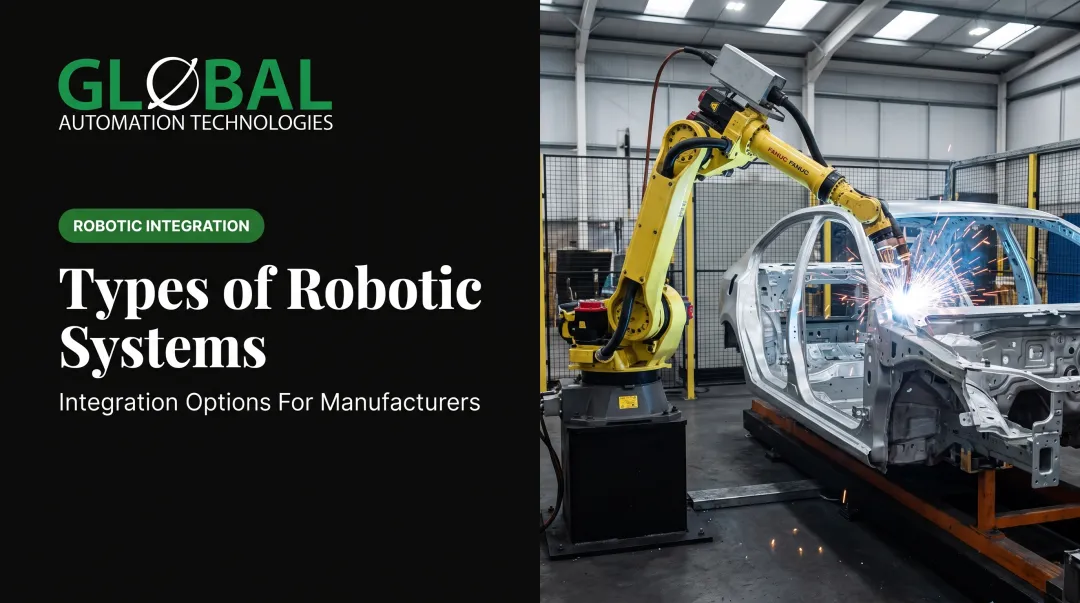
As a Level 5 FANUC Authorized System Integrator, GLOBAL Automation Technologies deploys FANUC articulated robots in hazardous and high-precision environments, from paint booths to welding cells.
How Does an Articulated Robot Arm Work? Anatomy of the 6-Axis Robot
An articulated arm moves through a chain of rotary joints. Six axes handle reach and orientation; a few core components keep that motion precise under load.
Breaking Down the 6 Axes
Each axis controls a specific part of the motion chain:
- Axis 1 — rotates the entire robot at its base
- Axis 2 — swings the lower arm forward and backward
- Axis 3 — raises and lowers the upper arm
- Axis 4 — rolls the forearm (wrist rotation)
- Axis 5 — pitches the wrist up and down
- Axis 6 — twists the end effector for final tool orientation
Together, these axes let the robot reach a workpiece from nearly any angle and hold tool orientation through the path.

Core Mechanical Components
A handful of components make this coordinated motion possible:
- Servo motors (actuators) convert electrical energy into precise joint movement
- Reduction gears amplify motor torque so the arm can carry heavier payloads without oversized motors (ABB on motor and gear units)
- Encoders report joint position and speed to the controller in real time for closed-loop control (Yaskawa on servo feedback)
- Transmission systems (belts and gears) transfer power from motor to joint
- End effectors (EOAT) mount at the wrist — gripper, welder, dispenser, or other tooling matched to the job
No two manufacturers build this chain identically — reducer types, encoder styles, and transmission layouts vary by brand and model. But the functional logic stays consistent across the industry.

Advantages and Limitations of Articulated Robots
Where articulated robots win:
- Largest work envelope of any robot type, handling everything from small components to oversized parts
- High payload capacity: FANUC's M-2000iA/2300 handles up to 2,300 kg, and KUKA's KR TITAN ultra manages up to 1,500 kg with a 4,200 mm reach
- Versatility: one platform covers welding, painting, palletizing, and more
Where they fall short:
- Generally slower than delta robots for high-speed pick-and-place work
- Less suited to micron-level precision than dedicated Cartesian systems
- Larger footprint and more complex kinematics than simpler robot architectures
- Higher cost when a basic Cartesian or SCARA arm would get the job done
Robot selection always comes down to tradeoffs between speed, payload, reach, and accuracy. No single architecture wins across the board.

Industrial robot suppliers saw shipment declines in 2024, with recovery expected in 2025, yet six-axis arms remain the workhorse whenever the job needs complex motion.
Common Applications and Industries Using Articulated Robots
Articulated robots show up wherever a task demands reach, orientation flexibility, and repeatability:
- Arc welding
- Material handling and palletizing
- Assembly
- Machine tending
- Dispensing and painting
They show up most often in these industries:
- Automotive OEMs and Tier 1 suppliers
- Heavy equipment manufacturers
- Data center infrastructure producers
- General industrial manufacturing
Automotive remains the single largest adopter of industrial robots in the US.
GLOBAL's own deployments illustrate the range:
- Machine tending cells that push spindle utilization toward 100%, keeping CNC and press equipment running through shift changes and overnight
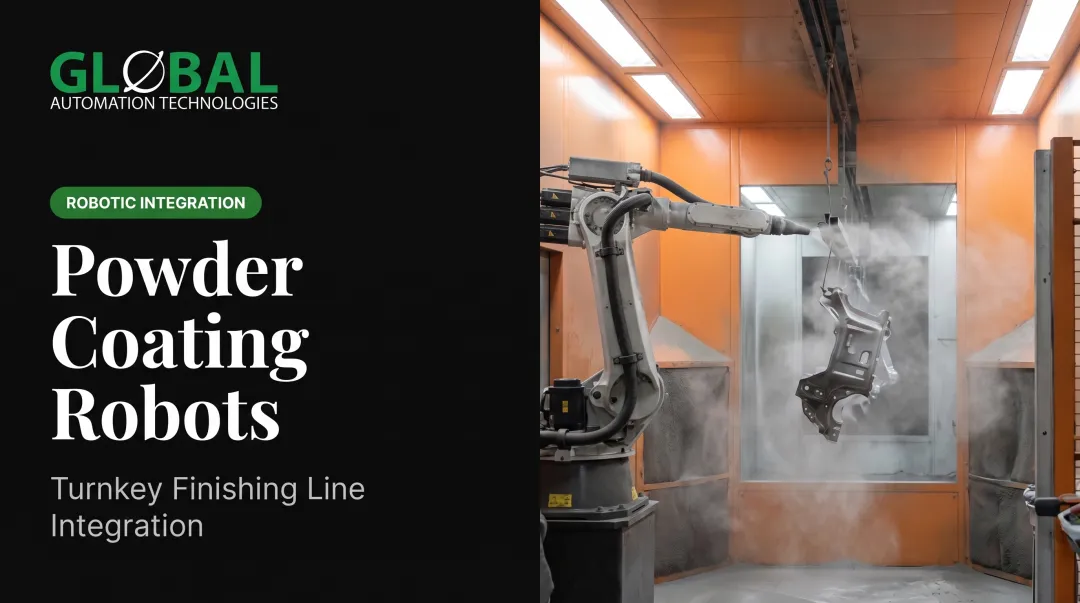
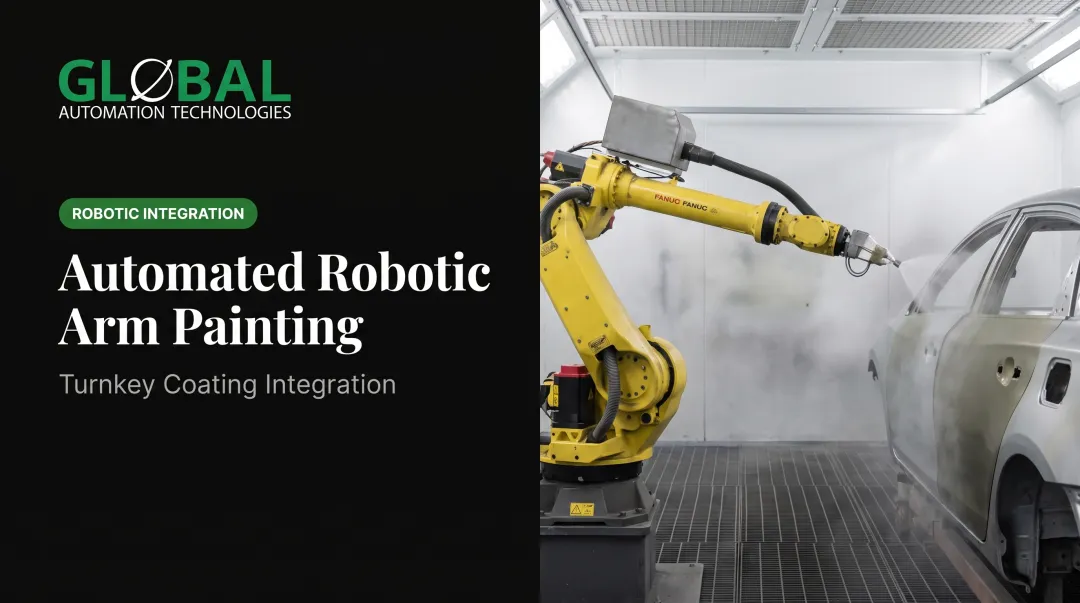
- Robotic painting systems engineered to hold film build within specification, with spray paths tuned to substrate and finish
- Dispensing systems with real-time bead quality validation—checking width, placement, and continuity before parts move downstream
How Much Do Articulated Robots Cost?
A full articulated robot project typically runs upwards of $100,000 once you factor in everything beyond the robot itself.
A long-standing industry rule of thumb from A3 pegs the robot hardware at roughly one-third of a full turnkey installation cost. The other two-thirds cover integration, tooling, safety, and training.

Common cost drivers:
- System integration and controls engineering
- End-of-arm tooling and fixtures
- Safety guarding and equipment
- Operator and maintenance training
- Ongoing maintenance and wear items
ROI comes from weighing those upfront costs against throughput gains, quality consistency, and labor savings. Machine tending cells typically pay for themselves in 12 to 18 months, driven by more parts per shift with fewer direct labor hours.
Choosing the Right Articulated Robot Partner
Robot brand matters less than application fit. Payload, reach, speed, and precision requirements should drive the selection, not the other way around.
Just as important is picking a partner with full turnkey capability, not just equipment supply:
- Design and engineering — process evaluation, simulation, and system design before anything gets built
- Programming and integration — robot programming, controls, vision systems, and SCADA/IoT connectivity where needed
- Build, installation, and commissioning — cell construction, on-site installation, and production validation
- Training and ongoing support — operator training, documentation, and long-term technical backup
A3's Certified Robot Integrator program requires an on-site audit, personnel assessment, and safety training. Use that standard as a benchmark when you evaluate any integrator's credibility.

GLOBAL pairs automation solutions, services and technical staffing under one roof. A manufacturer can get both the robot cell and the embedded controls or mechanical engineers to run it, without juggling two separate vendors.
Frequently Asked Questions
What is an articulated arm robot?
An articulated robot is a manipulator built with rotary joints, called axes, designed to replicate human arm movement. It's the most common industrial robot type, typically running 4 to 6 axes.
How much do articulated robots cost?
Full turnkey projects often exceed $100,000 once integration, tooling, and safety equipment are factored in. Final cost depends on payload, reach, end-of-arm tooling, and cell complexity.
What industries use articulated robots the most?
Automotive OEMs and Tier 1 suppliers are the largest adopters, followed closely by heavy equipment manufacturers and general industrial manufacturing. Data center infrastructure producers are a growing segment too.
How many axes does an articulated robot have?
Most articulated robots run 4 to 6 axes, with six-axis being the industry standard. Six axes provide complete freedom of movement in three-dimensional space.
What is the difference between an articulated robot and a SCARA or delta robot?
Articulated robots offer the widest reach and flexibility, ideal for complex, varied tasks like welding. SCARA and delta robots trade that flexibility for speed, excelling at fast, lightweight pick-and-place work.
How long does it take to see ROI from an articulated robot system?
Machine tending cells typically pay for themselves in 12 to 18 months through higher throughput and fewer labor hours. Payback varies by application, cycle-time gains, and local labor rates.