
Introduction
Walk any modern production floor and you'll see it: robots welding beside human technicians, sensors feeding predictive maintenance dashboards, and engineers troubleshooting code on a tablet mid-shift.
That mix of machines, software, and skilled people is what industrial and manufacturing solutions means in practice.
The common pain point is treating automation and workforce staffing as separate problems. Plants buy a robot cell from one vendor, then scramble to find controls engineers from another.
The result? Slower ramp-ups, unfilled engineering roles, and automation investments that sit underutilized.
This guide covers what these solutions include, real-world examples across welding, painting, and inspection, and the industries that depend on them most. You'll also see the benefits they deliver and how to choose a partner who solves both the equipment and staffing sides of the equation.
Key Takeaways
- Industrial and manufacturing solutions unite robotics, automation software, and technical talent in one system
- Machine tending, welding, painting, dispensing, and inspection automation lead adoption
- Automotive, heavy equipment, aerospace, and data center manufacturers drive automation uptake
- Machine tending cells typically pay for themselves within 12 to 18 months
- Partners that combine systems integration and staffing close the install-to-operate gap
What Are Industrial and Manufacturing Solutions?
Industrial and manufacturing solutions refer to the combined set of equipment, robotics, automation software, and engineering labor used to design, build, and maintain products at scale. Hardware on the plant floor is only one piece. The full ecosystem keeps production running.
Manufacturing has shifted from manual, labor-intensive assembly lines toward robotics-driven, sensor-enabled environments.
The National Institute of Standards and Technology (NIST) defines Industry 4.0 as the automation of traditional manufacturing processes using robotics, the Internet of Things, big-data analytics, and autonomous systems, according to NIST's 2025 advanced manufacturing framework. Manufacturers now build interconnected systems that communicate with each other, rather than adding standalone machines.
The Three Pillars of a True Solution
A complete industrial manufacturing solution rests on three pillars:
- Physical automation — robots, machine tools, conveyors, and material handling equipment
- Digital tools — simulation software, predictive maintenance platforms, and vision systems
- Human capital — controls engineers, systems integrators, and maintenance technicians who design, program, and sustain the equipment
Miss any one pillar and the system underperforms. A robot without a trained programmer is dead weight. Predictive maintenance software without a technician to act on its alerts doesn't prevent downtime. It just documents it.

Why Combining Systems and People Matters
GLOBAL Automation Technologies shows how this works in practice. Across three distinct offerings—automation solutions (turnkey robotic integration), engineering services (GLOBAL's own engineers placed on customer contracts), and technical staffing (controls engineers and robot programmers recruited into customer roles)—a manufacturer can source both the automated cell and the people to run it from one partner.
The internal logic is simple: the team building the system knows exactly what skill set the staffing side needs to place. That same systems-and-people mindset shapes how cells get programmed and kept online. AI-assisted simulation compresses robot programming timelines from weeks to days, because engineers model, test, and optimize programs virtually before anything runs on the floor. Predictive maintenance tools layer on top, flagging equipment issues before they cause unplanned downtime.
Types and Examples of Industrial and Manufacturing Solutions
Industrial manufacturing spans multiple functions on the plant floor, and each has developed its own automation approach shaped by decades of process refinement.
Robotic Material Handling and Machine Tending
Robots load and unload CNC machines, transfer parts between processes, and keep spindles running well past what a human shift schedule allows. In a FANUC America case study at Swivellink, robots tended two ROBODRILL machines 20–24 hours a day. The cell delivered a 33% production efficiency increase and raised output from 100 to more than 150 parts per eight-hour shift.
Machine tending cells tend to show fast payback and a clearer split of human vs. automated work:
- Machine tending cells typically pay for themselves in 12 to 18 months through higher spindle utilization and less idle time between load cycles
- Industry benchmark from the Association for Advancing Automation: 6 to 15 months on average, varying by system type
- Labor is redeployed, not removed — operators move into inspection and process improvement
Welding, Painting and Dispensing Automation
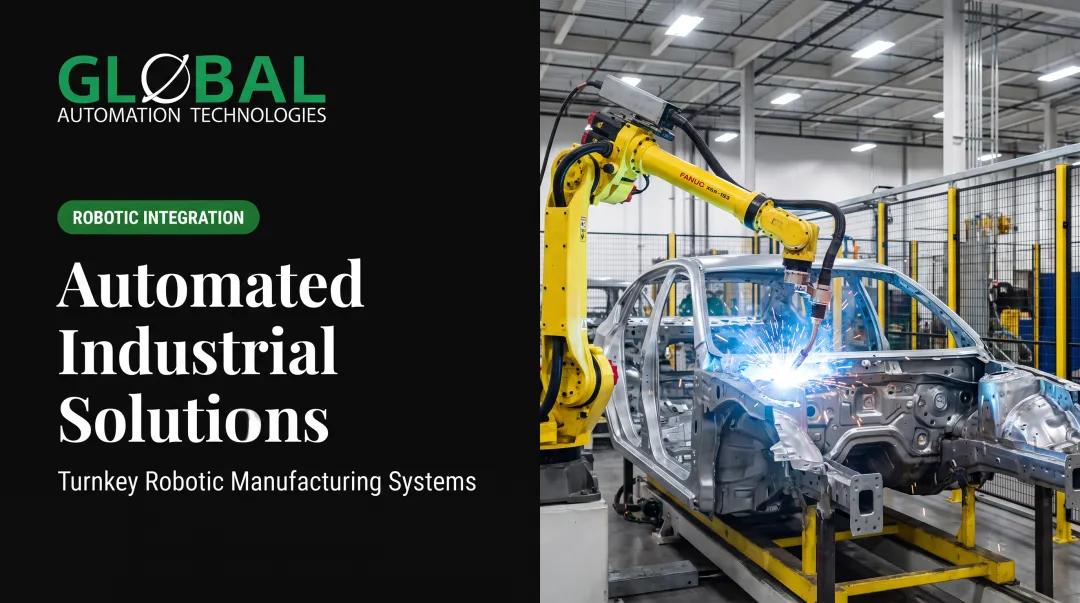
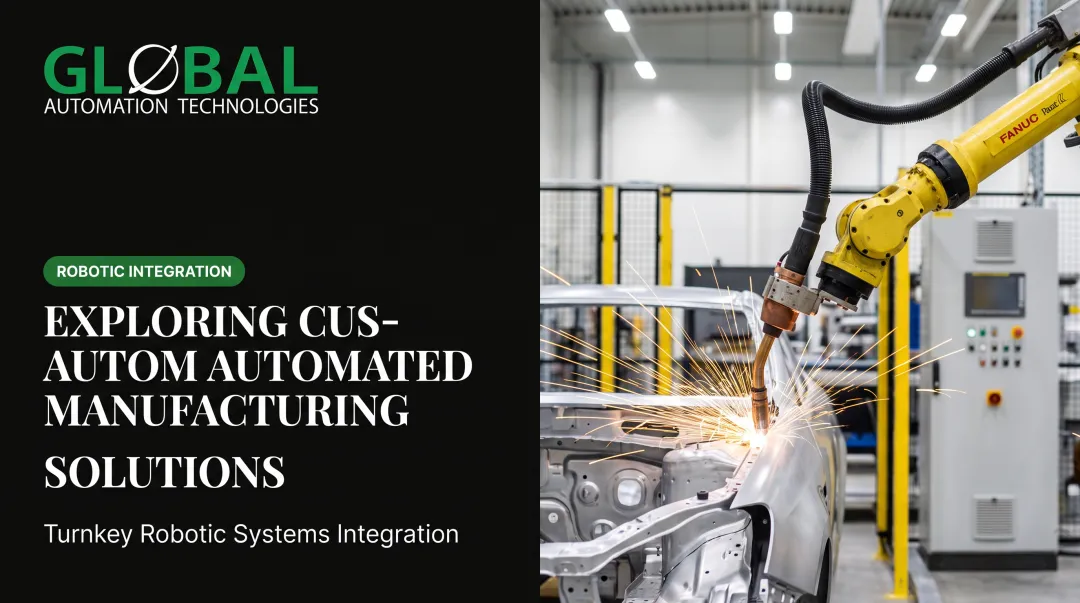
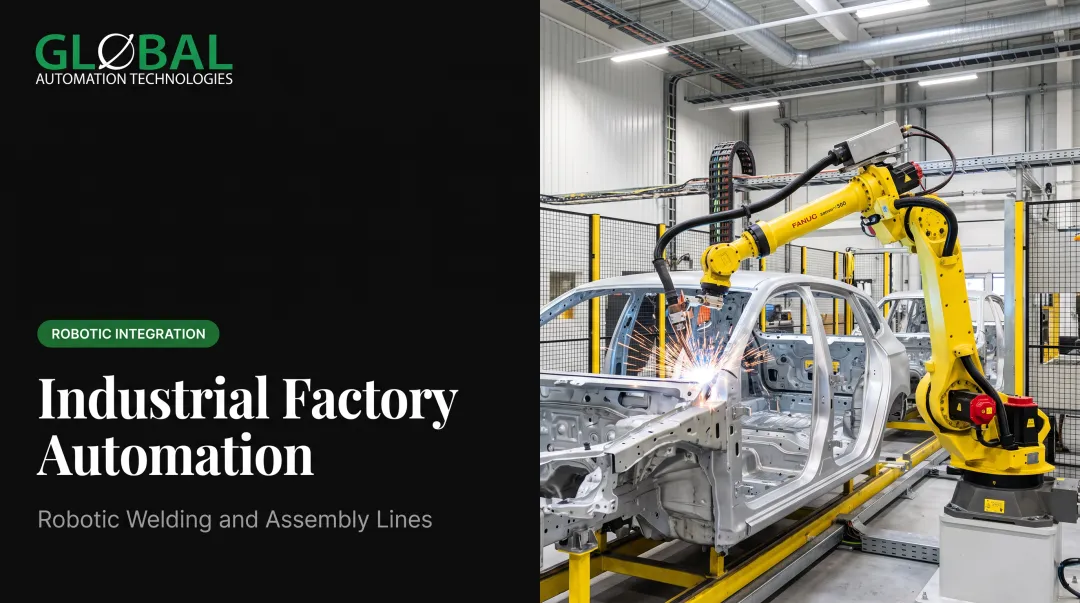
Robotic welding delivers consistent weld quality at volumes manual welders can't sustain shift after shift. Robotic painting brings the same consistency to finish work. GLOBAL paint systems hold film build within specification shift after shift on FANUC paint robots built for Class A automotive finishes, following the same programmed path every cycle instead of varying with operator technique and fatigue.
Dispensing and adhesive cells validate bead quality in real time:
- Vision inspection checks bead width, placement, and continuity during the dispense cycle
- Flow monitoring tracks delivery rate and flags clogs or pressure drops immediately
Together, they catch off-spec beads before the part moves downstream.
Inspection and Quality Control Systems
Machine vision systems catch defects earlier than manual inspection ever could. A 2024 peer-reviewed study on surface-defect detection reported 97.2% detection accuracy in an experimental machine-vision setup, according to research published in Machines.
Results vary by application, but the pattern holds: automated inspection cuts scrap and rework by catching issues in real time instead of after the fact.
Technical Staffing and Engineering Support
Hardware alone doesn't run a plant. Manufacturers need controls engineers, robotics programmers, PLC specialists, and maintenance technicians to keep systems operational. These roles come through three engagement models:
- Contract — short-term support for project surges or specialized needs
- Contract-to-hire — trial period before permanent commitment
- Direct placement — full-time hires for long-term embedded roles
Industries That Rely on Industrial and Manufacturing Solutions
Automation adoption isn't evenly distributed. Some sectors lead by a wide margin, and a handful of industries account for most of the demand.
Automotive OEMs and EV manufacturers use turnkey robotic automation for high-volume vehicle production and line modernization. The International Federation of Robotics reported roughly 1 million operational robots in automotive factories worldwide, about one-third of all industrial robots across every sector.
Other major adopters include:
- Tier 1 automotive suppliers run robotic welding, dispensing, painting, and assembly to hit high-volume component targets
- Heavy equipment, agricultural, and construction manufacturers automate large-scale lines to raise productivity and keep operators out of hazardous work
- Data center infrastructure manufacturers add robotic automation as demand for racks, enclosures, and modular components accelerates
These industries share the same core automation building blocks: welding, dispensing, material handling, and machine vision. Each tunes those tools to its own part geometries, volumes, and quality standards.
Key Benefits of Modern Industrial and Manufacturing Solutions
Automation delivers five advantages you can measure on the plant floor.
Throughput and continuous production. Robotic cells run through breaks, shift changes, and overnight hours that would otherwise sit idle. This extends production capacity without proportional labor cost increases.
Quality and precision. Consistent film build accuracy and repeatable weld or dispensing quality reduce rework. A robot doesn't get tired on the third shift or vary its technique between parts.
Operator safety. Spray booth environments carry real hazards. According to OSHA, isocyanates in polyurethane coatings are a leading cause of work-related asthma. NIOSH points to closed systems and ventilation as the main engineering controls for that risk.
Robotic painting removes operators from the booth entirely, so they avoid contact with:
- Isocyanates from two-component coatings
- Volatile organic compounds (VOCs) from solvent-based paints
- Airborne overspray particulates
Cost savings. Higher transfer efficiency in robotic painting means less overspray and lower material cost per part. Stack that against the 6–15 month average ROI window reported by the Association for Advancing Automation, and most manufacturers recoup the investment inside the first year and a half.
Workforce flexibility. On-demand automation talent (contract, contract-to-hire, or direct placement) fills skill gaps without the months-long hiring cycles that stall automation projects.

Choosing the Right Automation and Manufacturing Solutions Partner
Not every automation vendor offers the same depth of service, and the gaps show up later, usually during commissioning, when there's nobody trained to run what just got installed.
Look for a partner with genuine turnkey capability across the full project lifecycle:
- Layout and conceptual design: process study, ROI assessment, and cell configuration
- Engineering and programming: controls architecture, offline simulation, and robot programming
- Validation and installation: process testing before the system leaves the shop, then on-site commissioning
- Ongoing support: training, documentation, health assessments, and access to embedded technical staff
The decisive criterion is whether the partner combines automation solutions, services and technical staffing. When one company builds the system and supplies the engineers to run it, a single phone call resolves both sides of the problem instead of two separate vendor negotiations.
GLOBAL Automation Technologies is built around that combined model, pairing automation solutions with engineering services and technical staffing. The firm brings 17+ years in operation, a proven global base of robotic deployments, and Level 5 FANUC Authorized System Integrator credentials (the highest tier in FANUC's program), the #1 purchaser of FANUC robots among North American integrators in 2025.
AI-assisted simulation and predictive maintenance tools shorten programming timelines and flag equipment issues before they cause downtime.
Frequently Asked Questions
What is industrial manufacturing?
Industrial manufacturing is the large-scale production of goods using machinery, automation, and skilled labor. It spans sectors like automotive, aerospace, heavy equipment, and general industrial production.
Which industries use industrial and manufacturing solutions?
Automotive and EV manufacturers, Tier 1 suppliers, heavy equipment and agricultural producers, aerospace manufacturers, and data center infrastructure makers. Automotive remains the single largest adopter by robot volume.
What are examples of industrial manufacturing solutions?
Common examples include robotic welding, machine tending for CNC and injection molding, robotic painting and dispensing automation, and machine vision inspection systems. Each targets a specific bottleneck on the production line.
What is the difference between industrial automation and industrial manufacturing?
Manufacturing is the broader production process : transforming raw materials into finished goods. Automation refers specifically to the machines, robotics, and software used within that process to reduce manual labor.
How long does it take to implement an industrial automation solution?
Most projects take 3 to 12 months depending on scope, moving through design, simulation, build, installation, and commissioning. Machine tending cells often reach payback within 12 to 18 months post-launch.
What is Industry 4.0 and how does it relate to manufacturing solutions?
Industry 4.0 refers to integrating AI, IoT, and data-driven tools like predictive maintenance and digital simulation into manufacturing. It's the technology layer that makes modern industrial and manufacturing solutions smarter and more connected than traditional automation.